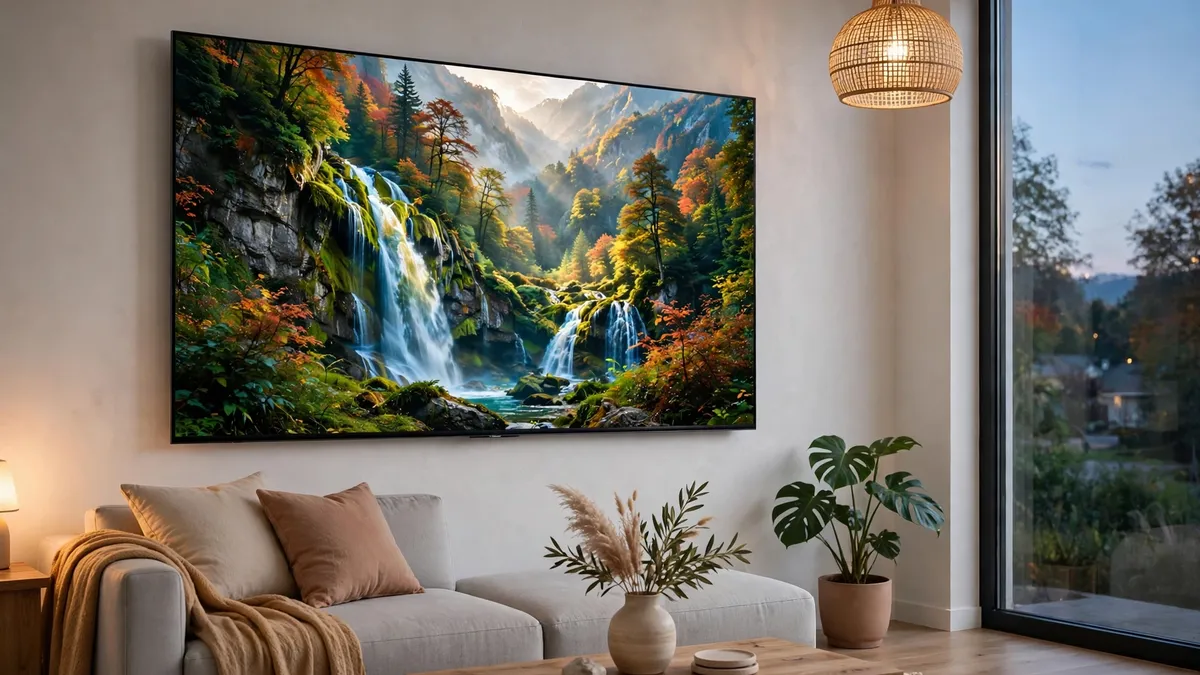
The best QLED TVs in 2027 combine the bright, saturated colour that made quantum-dot sets popular with far better contrast, faster gaming features, and smarter software than the first QLED models. Samsung, TCL, Hisense, LG, and Sony now sell QLED panels at almost every price, from affordable 55-inch sets under $800 to premium 85-inch flagships above $2,500, and the differences between them are no longer just about brightness.
What matters most in 2027 is how a QLED handles your room. A bright living room needs high peak brightness and a good anti-reflection coating, while a dark home theatre rewards local dimming and deep blacks. For gaming, 4K at 120Hz, variable refresh rate, and low input lag are now standard on mid-range models, but only some sets deliver all of them on every HDMI port.
We compared the current 2026 and 2027 QLED lineups on brightness, colour volume, contrast, viewing angle, gaming support, sound, and smart features, and weighed each set against its price. Prices below are approximate starting prices for the smallest common size, usually 55 inches, and they change often, so check current pricing before you buy. The seven sets below are the strongest QLED picks for most homes this year.
Key takeaways
- Samsung QN90F is the best overall QLED in 2027, with the brightest picture and the most complete gaming support.
- TCL QM7K offers the best value, delivering Mini-LED backlighting and strong brightness for around $799.
- Hisense U8QG is the brightness leader for sunny rooms, with excellent HDR highlights and solid sound.
- LG QNED90 is the best QLED for wide seating, keeping colour accurate from the side seats.
- Do not pay extra for 8K in 2027; a good 4K QLED with strong local dimming looks better for the money.
At a glance: the shortlist
| TV | Best for | Starting price | Standout feature |
|---|---|---|---|
| Samsung QN90F | Best overall | From $1,499 | Highest brightness, 4K 120Hz on all ports |
| Samsung QN85F | Best value Samsung | From $999 | Strong brightness, full gaming suite |
| TCL QM7K | Best value overall | From $799 | Mini-LED backlight, 144Hz panel |
| Hisense U8QG | Bright rooms | From $1,099 | Very high peak brightness, good speakers |
| LG QNED90 | Wide viewing angles | From $1,199 | Wide-angle colour, good for large families |
| TCL QM6K | Big screen on a budget | From $599 | Low price for 65 inches and up |
| Samsung The Frame | Design and art mode | From $1,299 | Matte screen that looks like framed art |
Samsung QN90F — Best overall
The Samsung QN90F is the QLED to buy if you want one set that does everything well. It pairs a quantum-dot panel with a Mini-LED backlight, so it reaches very high brightness for HDR highlights while keeping dark scenes controlled.

Gamers get 4K at 120Hz, variable refresh rate, auto low-latency mode, and four HDMI 2. 1 ports.
Pros: Excellent brightness and colour; strong local dimming; full gaming features on all ports; effective anti-reflection coating.
Cons: No Dolby Vision support; premium price; sound is good but a soundbar still helps.
Samsung QN85F — Best value Samsung
The QN85F gives up some of the QN90F peak brightness and dimming zones but keeps most of what makes a Samsung QLED appealing. Colours are rich and accurate after a quick picture-mode change, motion is smooth for sport, and the same Tizen interface and gaming features carry over.
It suits a mixed-use living room where the TV runs all day, with bright daytime viewing, detailed evening films, and responsive games. Viewing angles are wider than on budget sets.
Pros: Strong all-round picture for the price; full gaming support; bright and clean in daylight; wide viewing angles.
Cons: Less contrast than the QN90F; no Dolby Vision; built-in sound is average.
TCL QM7K — Best value overall
The TCL QM7K is the value pick of this list. It combines a quantum-dot panel with a Mini-LED backlight and a 144Hz panel, a combination that was flagship-only a few years ago.
Its Google TV interface is straightforward, and it supports Dolby Vision, HDR10+, and both major variable refresh rate formats, with 4K at 120Hz gaming. Local dimming can show a little blooming around bright objects on black backgrounds, and the design is plain. For pure picture per dollar, though, it is hard to beat, and it is a strong pick if you want a TV for gaming without paying flagship prices.
Pros: Outstanding value; Mini-LED brightness; Dolby Vision and 144Hz support; Google TV.
Cons: Some blooming in dark scenes; plain design; remote and menus feel basic.
Hisense U8QG — Best for bright rooms
The Hisense U8QG is built for rooms where sunlight is the enemy. Its peak brightness is among the highest in this list, so HDR highlights stay vivid even with curtains open.
It also has better built-in sound than most rivals at this price, with a fuller mid-range that makes dialogue easier to follow. Gaming support includes 4K 120Hz and variable refresh rate, and it supports Dolby Vision and HDR10+.
Pros: Very high brightness; good built-in sound; Dolby Vision support; strong gaming features.
Cons: Narrower viewing angles; some blooming in dark scenes; interface can feel busy.
LG QNED90 — Best for wide viewing angles
The LG QNED90 is the QLED pick for a wide living room. Where most QLED panels lose colour and contrast quickly off-axis, this set keeps its picture consistent from the side seats, which matters when the whole family watches together.
Its webOS platform is clean and fast, with a good app selection. Gamers get 4K 120Hz, variable refresh rate, and low input lag. Black levels and contrast are a step behind the Samsung QN90F and Hisense U8QG, so it is not the first choice for a dark-room cinema, but for a shared family room it is a smart pick. If you are weighing panel types, our guide to the best OLED TVs explains where OLED still wins on contrast.
Pros: Excellent viewing angles; clean webOS interface; reliable gaming features; natural colour.
Cons: Lower contrast than rivals; not the brightest flagship; sound is modest.
TCL QM6K — Best big screen on a budget
The TCL QM6K is the cheapest way into a genuinely good QLED picture, and it is especially strong value at 65 and 75 inches, where the price gap to premium sets grows large. It offers a quantum-dot panel with Mini-LED backlighting, good brightness for its price, and Google TV with Dolby Vision support, which is rare this cheap.
Picture quality is a clear step up from entry-level LED TVs: colours are richer, HDR has more depth, and motion is smooth enough for sport. Local dimming is less precise than on the QM7K, so dark scenes can look a little grey, and the speakers are basic.
Pros: Very low price for the size; Mini-LED and Dolby Vision; good brightness; Google TV.
Cons: Weaker contrast in dark scenes; basic sound; fewer dimming zones.
Samsung The Frame — Best for design
Samsung The Frame is a QLED first and a design object second, and in 2027 it is good enough at both to earn a place here. Its matte screen cuts reflections far better than a glossy panel, and in art mode it displays artwork with a paper-like finish that genuinely looks like a framed print on the wall.
It is not the brightest or highest-contrast set on this list, and you pay a premium for the design and matte finish. It also needs a wall mount and ideally an art subscription to get the most from art mode. But for a living room where the TV is part of the decor, no other QLED does the job this well. It also works as a good smart TV, with the same interface and apps as Samsung flagship sets.
Pros: Matte screen with very low reflections; convincing art mode; slim, frame-like design; full gaming and smart features.
Cons: Premium price for the picture quality; art content costs extra; not the best for dark-room contrast.
How to choose
Start with the room, not the brand. Measure your viewing distance and pick a size first: 55 inches suits most bedrooms and small living rooms, 65 inches is the sweet spot for a typical living room, and 75 inches or larger works if you sit more than three metres away.
Next, match the features to how you watch. Gamers should insist on 4K 120Hz, variable refresh rate, and auto low-latency mode on at least two HDMI ports.
Finally, compare the price for the size you actually want, not the smallest size in the advert. A mid-range 65-inch set often beats a flagship 55-inch set for the same money.
Checklist: before you buy
- Measure the wall or stand and the viewing distance, then choose the size before the model.
- Check peak brightness and the anti-reflection coating if the room gets direct sunlight.
- Confirm 4K 120Hz, variable refresh rate, and low input lag if you game on a console or PC.
- Check Dolby Vision support if your streaming services use it.
- Test the smart platform and remote, or confirm your preferred apps are available.
- Budget for a soundbar if the TV will be your main speaker, and check the return policy.
Frequently asked questions
What is a QLED TV?
A QLED TV is an LCD TV that uses a layer of quantum dots to produce colour. The dots convert blue backlight into pure red and green, giving brighter, more saturated colour than a standard LED TV, while keeping the high brightness LCD is known for.
Is QLED better than OLED?
Neither is better for everyone. QLED is brighter, usually cheaper at large sizes, and has no burn-in risk, so it suits bright rooms and all-day viewing. OLED has perfect blacks and better contrast in dark rooms, but costs more and is less bright. Choose QLED for brightness and value, OLED for dark-room cinema.
Do QLED TVs support Dolby Vision?
Some do and some do not. TCL, Hisense, and LG QLED sets generally support Dolby Vision, while Samsung sets support HDR10+ instead. If you stream a lot of Dolby Vision content, check the spec sheet before buying.
What size QLED TV should I buy?
For most living rooms, 65 inches is the best balance of immersion and price. Choose 55 inches for a bedroom or small room, and 75 inches or larger if you sit more than three metres from the screen. Measure the space first.
Are QLED TVs good for gaming?
Yes. Look for 4K at 120Hz, variable refresh rate, auto low-latency mode, and HDMI 2.1 ports. The Samsung QN90F, TCL QM7K, and Hisense U8QG all cover those features, with input lag low enough for competitive play.
How long will a QLED TV last?
A good QLED TV should last seven to ten years with normal use. The panel is durable and has no burn-in risk, so the main limits are the smart platform slowing down and newer features arriving. Buying a set with strong brightness and full gaming support helps it stay relevant longer.
The bottom line
For most buyers, the Samsung QN90F is the best QLED TV in 2027: it is the brightest, most complete all-rounder, with the best gaming support and the strongest anti-reflection coating. If the budget is tighter, the TCL QM7K delivers most of that experience for roughly half the price, and it is the pick we would buy with our own money.
Bright-room buyers should choose the Hisense U8QG, wide-room buyers the LG QNED90, and design-led buyers the Samsung The Frame. Whichever you pick, buy the size that fits your room, check the gaming and HDR features that matter to you, and confirm the current price before ordering.