The best running watches with GPS in 2027 do more than record a route. They measure pace, distance, heart rate and recovery accurately enough to shape training, and they keep working when phone signal runs out. Which watch gives you reliable GPS, a battery that survives a long run, and training data you will actually use, without paying for features you will never open?
The short answer is the Garmin Forerunner 570 for most serious runners, the COROS Pace 4 for the best value and battery life, and the Apple Watch Ultra 3 for iPhone owners who want one watch for running and everything else.
Key takeaways
- Best overall: Garmin Forerunner 570 — the best balance of GPS accuracy, training tools, display and weight.
- Best value and battery: COROS Pace 4 — 41 hours of GPS in all-systems mode at $249, with offline maps added by a September 2026 firmware update.
- Best premium Garmin: Garmin Forerunner 970 — full maps, longer battery and a tougher build for trail running.
- Best for iPhone: Apple Watch Ultra 3 — dual-frequency GPS, 42-hour battery and the deepest app experience.
- Best budget Garmin: Garmin Forerunner 165 — an AMOLED screen and Garmin training tools for $249, with single-band GPS as the main compromise.
- Check the price before you buy: launch prices are quoted below, and several of these watches are now regularly discounted.
How to choose a GPS running watch
GPS accuracy matters most. Dual-frequency, or multi-band, GPS listens on two satellite frequencies, which helps the watch hold a clean track between tall buildings, under tree cover and on twisting trails. Single-band GPS is fine on open roads.
Battery life is the second test. Manufacturers quote maximum figures, and music, maps, always-on screens and dual-frequency GPS all shorten them. Choose a watch rated for at least twice your longest planned run.
Maps are the third decision. Breadcrumb navigation shows a line to follow, which is enough for a familiar loop. Full offline maps show roads, trails and points of interest, and can reroute you. They matter most for trail running and new routes.
Weight and the training platform complete the picture. A lighter watch is easier to forget on a long run, and clear recovery, load and race-prediction data beats metrics you never check. Garmin and COROS work with iPhone and Android, while Apple Watch needs an iPhone. If heart rate accuracy is a priority, read our guide to the best fitness trackers for heart rate.
Best running watches with GPS in 2027 at a glance
| Watch | Launch price | GPS battery | Dual-frequency GPS | Offline maps | Weight |
|---|---|---|---|---|---|
| Garmin Forerunner 570 | $549.99 | Up to 18 hours | Yes | No | 42–50 g |
| COROS Pace 4 | $249 | Up to 41 hours (all-systems) | Yes | Yes, via firmware update | 32–40 g |
| Garmin Forerunner 970 | $749.99 | Up to 26 hours | Yes | Yes | 56 g |
| Apple Watch Ultra 3 | $799 | Up to 42 hours (normal use) | Yes | Yes | About 62 g (case only) |
| COROS Pace Pro | $349 | Up to 38 hours | Yes | Yes | 37–49 g |
| Garmin Forerunner 165 | $249 | Up to 19 hours | No | No | 39 g |
Table: The six watches compared on the specifications that matter most for running. Prices are launch prices in US dollars; battery figures are manufacturer maximums.
1. Garmin Forerunner 570
Best for: most serious runners who want the best all-round GPS running watch.
The Forerunner 570, launched in May 2025 at $549.99, is the sweet spot in Garmin’s running range. It comes in 42 mm and 47 mm sizes, weighs 42 g and 50 g, and pairs a bright AMOLED display with Garmin’s Elevate Gen 5 heart-rate sensor and multi-band GPS. The 47 mm model is rated for up to 11 days in smartwatch mode and up to 18 hours of GPS.
Its strength is the training platform: Training Readiness, training load, recovery time, VO2 max estimates, race predictions and daily suggested workouts, plus running power, music storage and Garmin Pay. The main omission is maps: you can follow a course as a breadcrumb line, but there is no map underneath and no rerouting if you go wrong.
2. COROS Pace 4
Best for: runners who want the longest battery life and the best value.
The COROS Pace 4, launched in November 2025 at $249, is hard to argue against on value. It weighs 32 g with a nylon band or 40 g with a silicone band, has a 1.2-inch AMOLED touchscreen, and is rated for up to 19 days of daily use and up to 41 hours of GPS in all-systems mode, or 31 hours in dual-frequency mode.
It also has dual-frequency GPS, a redesigned heart-rate sensor, barometric altimeter and compass. COROS does not charge a subscription for its EvoLab training platform, so VO2 max, training load and recovery data are included. The Pace 4 launched with breadcrumb navigation only, but a September 2026 firmware update added offline maps.
3. Garmin Forerunner 970
Best for: marathon, trail and ultra runners who want maps, battery and the full Garmin training suite.
The Forerunner 970 is the flagship of the 2025 Forerunner line, launched alongside the 570 in May 2025 at $749.99. It is a 47 mm watch with a titanium bezel, sapphire lens and 56 g case, sharing the 570’s AMOLED display, Elevate Gen 5 sensor and multi-band GPS. Garmin rates it for up to 15 days in smartwatch mode and up to 26 hours of GPS.
The extra $200 over the 570 buys preloaded maps with turn-by-turn navigation and rerouting, ClimbPro for hills, an ECG, an LED flashlight and 32 GB of storage, plus Running Tolerance, Running Economy and Step Speed Loss. If you run mainly on roads, the 570 gives you the same core training experience for less.
4. Apple Watch Ultra 3
Best for: iPhone owners who want a smartwatch first and a serious running watch second.
The Apple Watch Ultra 3, released in September 2025 at $799, is a 49 mm titanium smartwatch with a sapphire crystal display reaching up to 3,000 nits, precision dual-frequency GPS, cellular connectivity and satellite emergency features where supported. Apple rates battery life at up to 42 hours in normal use, or 72 hours in Low Power Mode.
For running, it offers Pacer, Heart Rate Zones, custom workouts, running power, training load and Workout Buddy, along with offline maps and a customisable Action button that can mark laps. Its app library is the real advantage: Strava, TrainingPeaks and Nike Run Club run natively. If you are weighing Garmin against Apple, see our Garmin Forerunner 265 vs Apple Watch Ultra 3 comparison.
The trade-offs are weight and platform. At about 62 g for the case alone, it is heavier than every dedicated running watch here, and it needs an iPhone. Its built-in training platform is less deep than Garmin’s, although third-party apps close much of that gap.
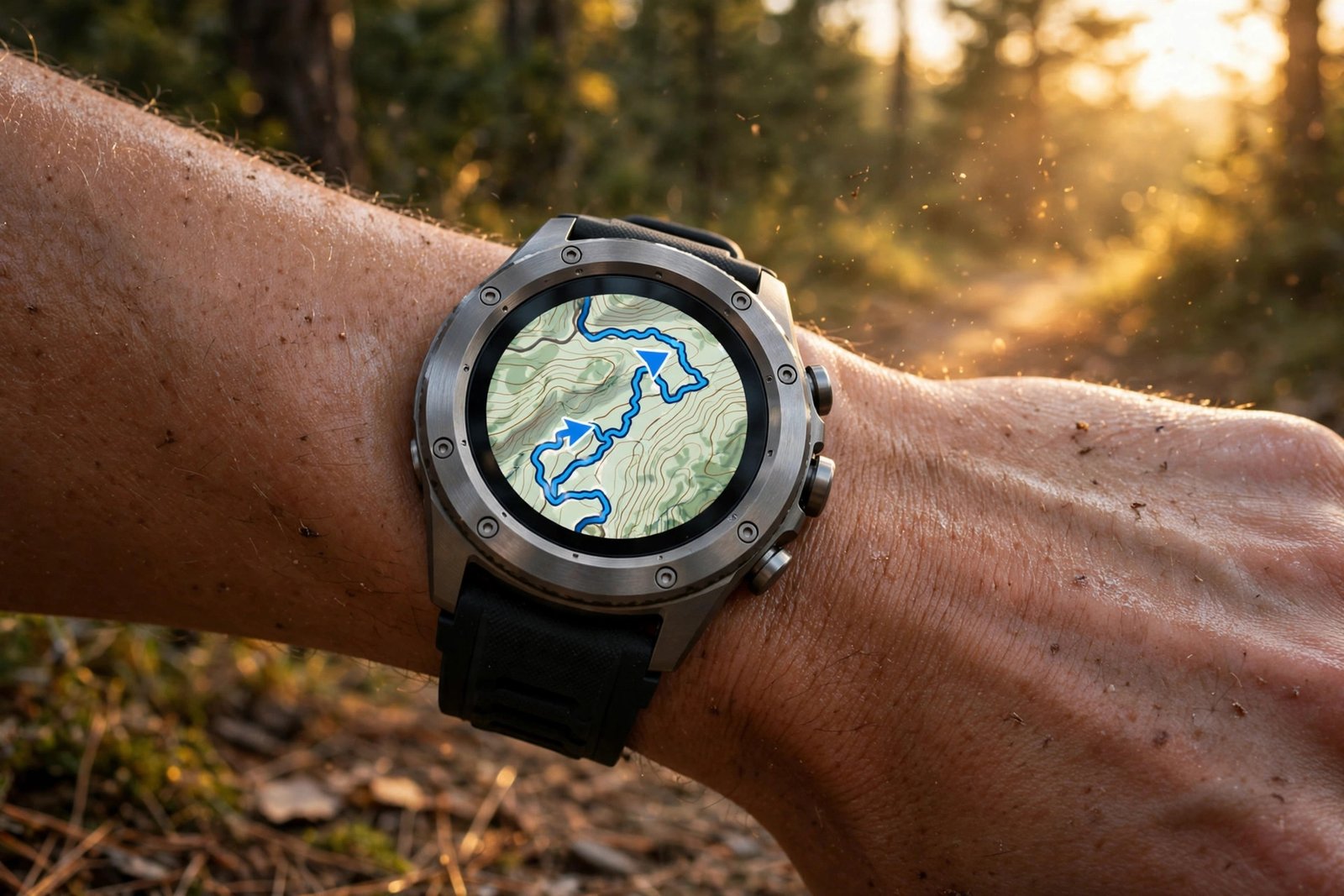
5. COROS Pace Pro
Best for: runners who want an AMOLED screen, offline maps and long battery life without paying flagship prices.
The COROS Pace Pro, launched in October 2024 at $349, was COROS’s first AMOLED running watch and the first in the Pace line with global offline maps. It has a 1.3-inch AMOLED touchscreen at 1,500 nits, dual-frequency GPS, 32 GB of storage and an ECG sensor. COROS rates it for up to 20 days of daily use and up to 38 hours of GPS, or 31 hours in dual-frequency mode.
It weighs 49 g with a silicone band or 37 g with a nylon band, and its 46 mm case is larger than the Pace 4’s, which suits runners who want a bigger screen for maps. The Pace 4 has since narrowed the gap: it is cheaper, lighter and now has maps too.
6. Garmin Forerunner 165
Best for: beginners and budget-conscious runners who want a Garmin, not a fitness band.
The Garmin Forerunner 165, launched in February 2024 at $249, or $299.99 for the Music edition, is the entry point to Garmin’s AMOLED running watches. It has a 43 mm case, a 1.2-inch AMOLED touchscreen, weighs 39 g and is rated for up to 11 days in smartwatch mode and up to 19 hours of GPS. Garmin Pay, daily suggested workouts, recovery guidance and race predictions are included.
The compromise is GPS. The 165 uses single-band multi-GNSS — GPS, GLONASS and Galileo — rather than dual-frequency GPS, so accuracy can suffer between tall buildings and under dense tree cover. There are no maps, no Training Readiness score and no microphone or speaker. Garmin has since launched the Forerunner 170 as its successor, so check current prices: the 165 is often discounted. If your budget is tighter still, our guide to the best smartwatches under $100 covers cheaper options.
How to decide in five minutes
- Where do you run? Open roads: any watch here works. City streets or wooded trails: choose dual-frequency GPS — the 570, 970, Pace 4, Pace Pro or Ultra 3.
- How long is your longest run? Under three hours: battery is not a deciding factor. Over five hours, or an ultra: choose the Pace 4, Pace Pro or 970.
- Do you need maps? New trails or races in unfamiliar places: 970, Pace 4, Pace Pro or Ultra 3. Familiar loops: the 570 or 165 will do.
- Which phone do you use? iPhone only for Apple Watch. Garmin and COROS work with iPhone and Android.
- What is your budget? Under $300: Pace 4 or 165. Around $350–$550: Pace Pro or 570. Over $700: 970 or Ultra 3.
Frequently asked questions
What is the best running watch with GPS for most people in 2027?
The Garmin Forerunner 570, for its multi-band GPS, AMOLED display, training platform and weight at a mid-range price. The COROS Pace 4 is the better buy if battery life and value matter more.
Is dual-frequency GPS worth paying extra for?
Yes, if you run in cities, under tree cover or on winding trails, where single-band GPS is more likely to cut corners and misread pace. On open roads, the difference is smaller.
How much GPS battery life do I need for a marathon?
At least 10 hours of GPS gives comfortable headroom for most marathon finishes, even with music and navigation running. For an ultra, look for 20 hours or more in the GPS mode you will actually use.
Do I need offline maps on a running watch?
Not for familiar road routes, where breadcrumb navigation is enough. Offline maps are worth it for trail running, new routes and races in unfamiliar places.
Can an Apple Watch replace a Garmin for running?
For most runners, yes, especially iPhone owners who value apps, calls and music. The Ultra 3 has dual-frequency GPS, offline maps and training load. Garmin still leads on GPS battery life and built-in training depth.
Are these watches good for beginners?
Yes. The Forerunner 165 and COROS Pace 4 both suit beginners, with guided workouts, recovery advice and race predictions. Start with the cheaper watch, and upgrade only when you know which features you are missing.
The bottom line
The best running watch with GPS in 2027 is the one that matches your routes, your longest runs and your phone, not the one with the longest specification sheet. For most runners, that is the Garmin Forerunner 570. For the best value and battery life, it is the COROS Pace 4. For iPhone owners who want a smartwatch as well, it is the Apple Watch Ultra 3.