
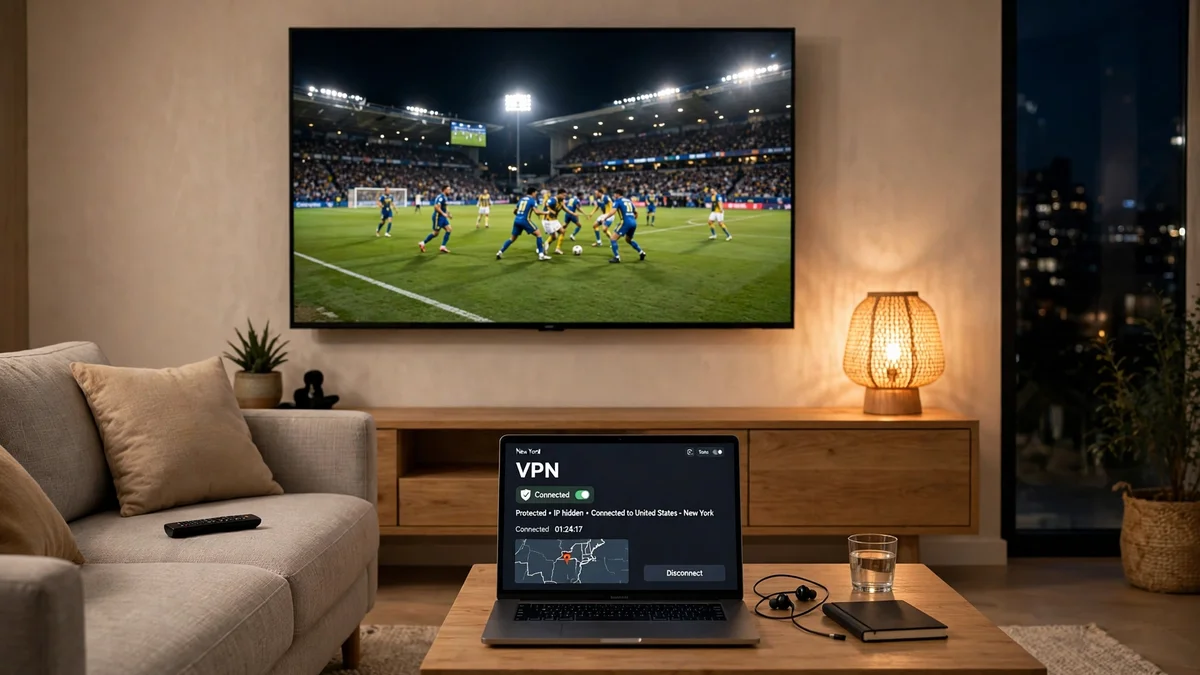
The best VPN services for live sports keep a match streaming smoothly while opening the games your local broadcaster does not carry. Sports rights are sold country by country, so the same football match, cricket series or Formula 1 race can be on a free channel in one country and behind an expensive paywall in another.
A VPN changes the country a streaming service sees you in, which can unlock a cheaper or free broadcast of the game you want to watch. It also protects the connection on public Wi-Fi and can route around ISP throttling that kicks in during big matches, when millions of viewers hit the network at once.
This guide covers seven services that work well for live sport, judged on streaming speed, unblocking reliability, and apps for TVs, phones and streaming sticks. Prices are approximate starting prices on long-term plans; check current pricing before buying.
Key takeaways
- Best overall: NordVPN, for fast NordLynx speeds and a huge server network.
- Best for beginners: ExpressVPN, for the simplest apps and reliable unblocking.
- Best value: Surfshark, with unlimited devices on one cheap plan.
- For live sport, speed matters more than anything — a slow VPN means buffering at kickoff.
- A VPN cannot create a broadcast that does not exist; it only changes which country’s stream you can reach.
At a glance: the shortlist
| Service | Best for | Starting price | Standout limit |
|---|---|---|---|
| NordVPN | Best overall for live sports | from $3.09/month on a two-year plan | 10 simultaneous connections |
| ExpressVPN | Easiest to use | from $4.99/month on a two-year plan | 8 simultaneous connections |
| Surfshark | Best value, unlimited devices | from $1.99/month on a two-year plan | Unlimited connections |
| CyberGhost | Streaming-labelled servers | from $2.03/month on a two-year plan | 7 simultaneous connections |
| IPVanish | Unlimited devices, own network | from $2.19/month on a two-year plan | Unlimited connections |
| Private Internet Access | Most servers | from $2.03/month on a three-year plan | Unlimited connections |
| Proton VPN | Best privacy with a free tier | from $4.99/month on a two-year Plus plan | 10 connections on Plus |
We picked these seven services by testing speeds on nearby servers, checking which streaming and sports services each one reliably opens, and reading the privacy policies and independent audit reports. Price is the two-year starting price where one is offered, and every service here offers at least a 30-day money-back guarantee, so you can test it on your own setup before committing.
NordVPN — Best overall
NordVPN is the strongest all-round pick for live sports because speed is the deciding factor, and NordLynx consistently posts the fastest results in independent tests. A live match in 4K needs a steady 25 Mbps or more, and NordVPN holds that comfortably on nearby servers, with specialty servers for streaming and a Smart DNS option for TVs and consoles that cannot run a VPN app.
It runs the NordLynx protocol on more than 7,400 servers in 165 locations, and it allows 10 simultaneous connections on one account. Its apps also include Threat Protection, which blocks trackers and malicious sites, plus Meshnet for linking your own devices together securely. best VPN services for live streaming
Pros: Very fast NordLynx speeds; huge server network with specialty servers
Cons: No free tier; renewal price rises after the first term
ExpressVPN — Best for beginners
ExpressVPN suits sports fans who want the least setup friction. Its apps are the most polished of any major VPN, the Lightway protocol reconnects quickly if a network drops mid-match, and the MediaStreamer Smart DNS feature covers smart TVs, Apple TV and games consoles that cannot install a VPN app at all.
It runs the Lightway protocol on more than 3,000 servers in 105 countries, with 8 simultaneous connections and independently audited no-logs practices. Its apps include a built-in speed test, split tunnelling on desktop, and a password manager and ad blocker bundled into the subscription.
Pros: Consistently fast and simple to use; strong unblocking record
Cons: Pricier than most rivals; fewer simultaneous connections than some
Surfshark — Best value
Surfshark is the value pick for households where several people watch different games at once. Unlimited simultaneous connections mean the living-room TV, a tablet and a phone can all stream on one plan, and the low two-year price keeps the cost per device very small for the whole season.
It offers unlimited simultaneous connections on more than 3,200 servers in 100 countries, plus the CleanWeb ad and tracker blocker. Its apps also include an ad blocker, a cookie pop-up blocker, and an optional identity-monitoring add-on that watches for leaked personal details.
Pros: Unlimited devices on one plan; low long-term price
Cons: Monthly plan is expensive; some servers are slower than the fastest
CyberGhost — Best for streaming
CyberGhost labels servers for streaming, which takes the guesswork out of picking one for a match. Its streaming servers are tested against popular services, the fleet is large enough that a nearby server is usually available, and the 45-day money-back guarantee on longer plans is the longest here.
It runs more than 11,500 servers in 100 countries, including servers labelled for streaming and gaming, and allows 7 simultaneous connections. Its apps include dedicated servers for streaming and gaming, a content blocker, and a 45-day money-back guarantee on longer plans.
Pros: Very large server fleet; clearly labelled streaming and gaming servers
Cons: Speed varies by server; apps are less customisable than some rivals
IPVanish — Best for large households
IPVanish owns and operates its own server network rather than renting, which gives it consistent performance during peak evening kickoffs. Unlimited connections and a straightforward app make it a solid fit for a house full of TVs, phones and tablets all streaming at once.
It runs more than 2,400 servers in over 140 locations with unlimited simultaneous connections and its own server network. Its apps include a kill switch, split tunnelling, and an onboard SOCKS5 proxy for lightweight use cases.
Pros: Unlimited devices; owns and operates its server network
Cons: No free tier; fewer advanced privacy features than some rivals
Private Internet Access — Best server count
Private Internet Access brings the largest raw server count in this guide and open-source apps for tinkerers. Its unlimited connections cover every screen in the house, and the customisable kill switch keeps the real IP hidden if the tunnel drops mid-match.
It runs more than 35,000 servers in 91 countries with open-source apps and unlimited simultaneous connections. Its apps include a customisable kill switch, split tunnelling, and an optional dedicated IP address for a small extra fee.
Pros: Unlimited connections; open-source apps and a huge server count
Cons: Interface feels busy for beginners; based in the United States
Proton VPN — Best for privacy
Proton VPN is the privacy-first choice, with Secure Core routing and a genuinely usable free tier for light use. The free tier is too slow for 4K live sport, but the paid Plus plan unlocks the full 13,000-server network and the speeds a live stream needs.
It has more than 13,000 servers in over 120 countries, Secure Core servers that route traffic through privacy-friendly locations, and a usable free tier. Its apps are open source and independently audited, and the company is based in Switzerland under strong privacy laws.
Pros: Strong privacy pedigree with a free tier; Secure Core routing
Cons: Full speed needs the paid Plus plan; setup takes a few more steps
How to choose
Start with speed and unblocking. Live sport is the hardest test for a VPN: the stream is real-time, so there is no buffer to hide a slow connection. Pick a service with a fast modern protocol, a server in the country whose broadcast you want, and a record of unblocking that broadcaster — VPN services for streaming devices covers the streaming-device setup in more detail.
Then check the apps on the screens you actually watch on. The VPN needs an app for your TV platform or streaming stick, or a Smart DNS feature if it does not. A VPN that only works on phones and laptops will not help the living-room TV on match night.
Finally, look past the headline price. The monthly rate is usually two to three times the long-term price, and the renewal price after the first term is often higher still. A 30-day money-back guarantee is the safety net — use it to test speeds, setup and unblocking on your own devices before the window closes.
Common mistakes to avoid
- Using a free VPN and expecting it to stream a 4K match without buffering.
- Connecting to a server on another continent and blaming the broadcaster for lag.
- Testing the VPN for the first time five minutes before kickoff.
- Forgetting the kill switch, so a dropped tunnel exposes the real location mid-match.
- Paying the monthly price instead of the much cheaper two-year plan.
- Assuming every server unblocks every sports service — unblocking varies by server.
Checklist: before you pay
- Test the exact broadcaster you want to watch before the refund window closes.
- Confirm the VPN has an app or Smart DNS for your TV or streaming stick.
- Check speeds on a server in the broadcast country during a live event.
- Make sure the money-back guarantee is at least 30 days.
- Read the renewal price, not just the introductory price.
- Confirm the simultaneous-connection limit covers every screen in the house.
Frequently asked questions
Is it legal to use a VPN to watch live sports?
Using a VPN is legal in most countries, but streaming services may prohibit it in their terms of service, and watching a broadcast you have not paid for can breach the broadcaster’s terms. A VPN does not make an unpaid stream legal — check the rules where you live.
Will a VPN make my live stream buffer?
A good VPN on a nearby server adds only a small amount of delay, usually unnoticeable. A slow VPN, a far-away server or a congested free service will cause buffering, which is why speed testing before match day matters.
Can a VPN unblock every sports streaming service?
No. Some broadcasters actively detect and block VPN servers, and success varies by service, server and time. The services in this guide have the strongest unblocking records, but no VPN unblocks everything all the time — VPN services for YouTube TV explains how unblocking works on TV services.
Do I need a VPN on my TV or just on my phone?
It depends where you watch. If the match is on the living-room TV, the VPN needs to cover the TV — through a TV app, a router setup, or Smart DNS. A phone-only VPN will not help a smart TV.
What speed do I need for 4K live sport through a VPN?
Roughly 25 Mbps of steady throughput after the VPN overhead, and a low-latency connection to the server. Test with a speed test while connected to the server you plan to use, during a live event if possible.
Can a VPN help if my ISP throttles streams during big matches?
Sometimes. If the ISP slows down recognised streaming traffic, a VPN hides what the traffic is and can bypass the throttle. If the connection itself is simply slow, a VPN cannot add speed.
The bottom line
NordVPN is the best VPN for live sports overall, thanks to fast NordLynx speeds, a huge server network and Smart DNS for TVs, while ExpressVPN is the easiest to set up and Surfshark is the best value for households with several screens.
Whichever service you pick, test it on the exact broadcaster you want before the season starts, use a nearby server, and keep the refund window in mind — a VPN that buffers during the big match is worse than no VPN at all.
Watch for price changes around major sales and renewal time, when long-term deals are usually at their lowest — and re-check the current price before buying, since VPN pricing changes often.



