
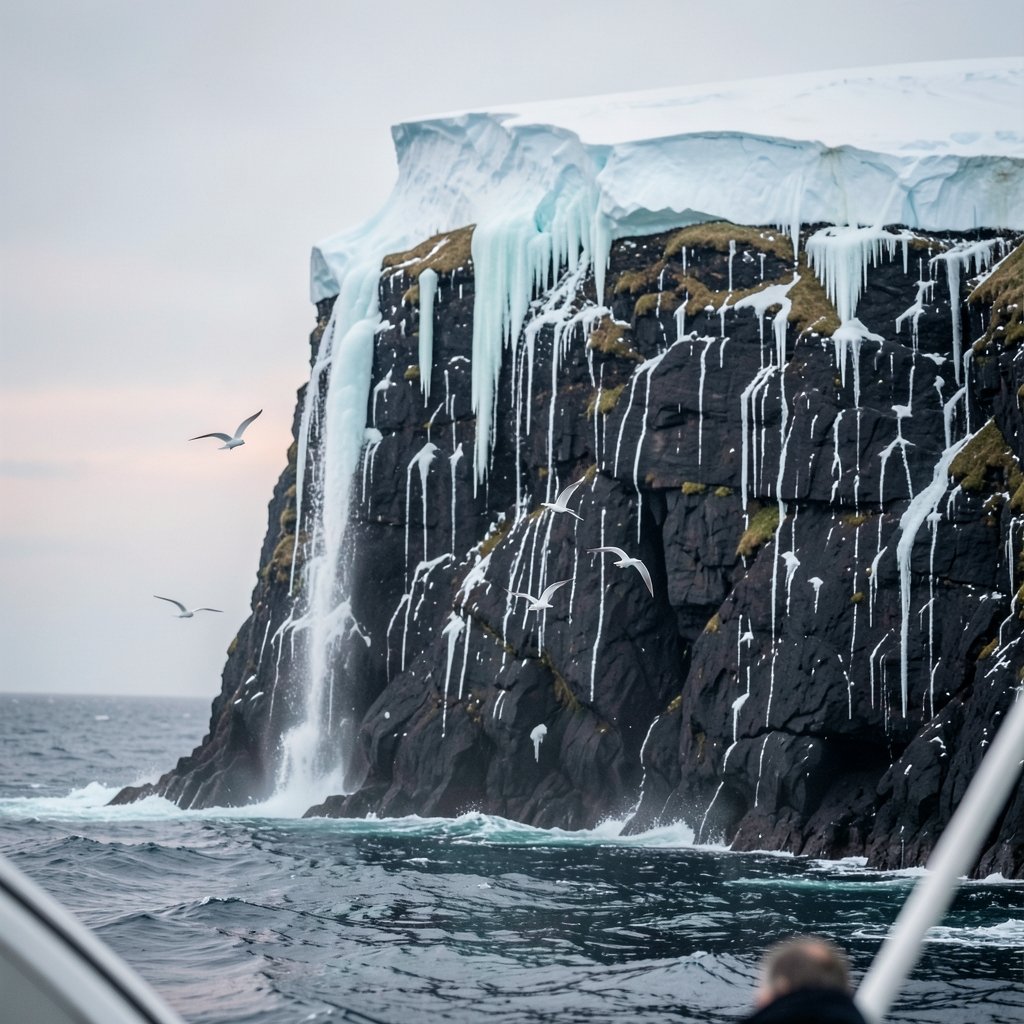
What does it take to be called the most remote island on Earth? For Bouvet Island, the answer is roughly 1,700 kilometers of open ocean in every direction, cliffs that rise straight out of the South Atlantic, and a permanent ice cap that has never hosted a single resident. This tiny Norwegian dependency is the kind of place that captures the imagination precisely because almost nothing about it is convenient, welcoming, or easy to reach.
People who search late at night for strange places often find Bouvet Island, or “bouvet isola” as it appears in Italian-language searches. The questions are easy to understand: an island with no population, a mysterious abandoned boat, and a name that keeps appearing in lists of the world’s most isolated places will raise questions. This article answers those questions with facts, geography, and the honest uncertainties around Bouvet.
Where Is Bouvet Island, Exactly?
Bouvet Island sits in the South Atlantic Ocean at roughly 54°26′S and 3°24′E. To put that in perspective, it lies about 1,700 kilometers north of the Antarctic coast and roughly 2,600 kilometers southwest of South Africa. There is no landmass anywhere near it. The nearest inhabited place is thousands of kilometers away, which is why the island has earned its reputation as one of the most isolated spots on the planet.
The island is a dependency of Norway, a status that dates back to the early twentieth century. It is not part of the Antarctic Treaty area in the way that, say, Antarctica itself is, but it is administered under Norwegian sovereignty. For travelers and researchers alike, reaching it requires a ship capable of handling the notoriously rough Southern Ocean, plus a willingness to accept that landing may be impossible due to weather and swell.
A Short History of a Very Lonely Island

Bouvet Island was first sighted on 1 January 1739 by the French explorer Jean-Baptiste Charles Bouvet de Lozier, who named it “Cap de la Circoncision.” For decades, no one was quite sure whether it was an island or part of a larger southern landmass. That question was not settled until 1808, when the British whalers James Lindsay and Thomas Hopper circumnavigated it and confirmed its insular nature.
Norway’s claim came much later. The country annexed the island on 23 January 1928 and formally declared it a Norwegian dependency by royal decree on 27 February 1930. Since then, it has remained under Norwegian administration, though it has never had a permanent population. The island’s only visitors have been scientists, expedition crews, and the occasional curious sailor.
The Geography: Ice, Cliffs, and a Volcanic Peak
Bouvet Island covers about 49 square kilometers, and almost all of it is dominated by an ice-covered volcanic peak called Olavtoppen, which rises to roughly 780 meters. The island is essentially the tip of a volcano, with steep cliffs plunging into the sea on nearly every side. Landing is difficult, and the interior is covered in glaciers and permanent snow.
| Feature | Detail |
|---|---|
| Location | South Atlantic, roughly 54°26′S 3°24′E |
| Status | Norwegian dependency |
| Area | About 49 km² |
| Highest point | Olavtoppen, about 780 m |
| Nearest land | Antarctica, about 1,700 km south |
| Population | None permanent |
| Territorial sea | 4 nautical miles (Norwegian claim) |
Distance alone does not explain the island’s isolation. Its position in the Southern Ocean means it is battered by some of the roughest weather on Earth. Storms, high winds, and heavy seas are the norm, and fog often covers the island. This combination of remoteness and hostility explains why it has never been settled.
Wildlife: Penguins, Seals, and a Whole Lot of Birds
Despite its harsh conditions, Bouvet Island is far from lifeless. It hosts large colonies of macaroni penguins and Antarctic fur seals, and it has been recognized as an Important Bird Area. The surrounding waters are rich in marine life, which is part of why the island and its territorial waters were designated a Ramsar wetland of international importance in 2010.
For ecologists, Bouvet is a valuable natural laboratory. Because there is no human population and no development, the island’s ecosystems remain largely undisturbed. That makes it a useful baseline for understanding how subantarctic environments function without the pressures that affect so many other islands.
Is Bouvet Island Really the Most Remote Island?
You will often see Bouvet Island described as the world’s most remote island. Whether that claim holds up depends entirely on how you define “remote.” If you measure distance to the nearest land, Bouvet has a strong case. If you measure distance to the nearest inhabited land, other islands may compete for the title. The phrase is a contested superlative, and it is worth treating with a little skepticism when you see it repeated online.
What is not in dispute is that Bouvet is extraordinarily isolated by any reasonable measure. There is no airstrip, no harbor in the conventional sense, and no infrastructure beyond what expeditions bring with them. Even getting permission to visit involves coordination with Norwegian authorities, and the window for landing is narrow.
The Mystery of the Abandoned Boat
In 1964, an abandoned lifeboat was found on Bouvet Island. No one has ever been able to explain how it got there. There were no people on the island, no shipwreck nearby that could be tied to it, and no record of a vessel in distress in the area at the time. The incident remains unresolved, and it has fueled plenty of speculation over the decades.
The story is a good reminder that even in the age of satellites and global positioning, some places still hold secrets. The lifeboat is not the only oddity associated with Bouvet, but it is the one that has captured the public imagination most strongly.
Why Does Anyone Go There at All?
Given the difficulty and expense, you might wonder why anyone bothers. The answer is science. Researchers have visited Bouvet to study its geology, its glaciers, and its wildlife. The island’s volcanic structure and its position in the Southern Ocean make it relevant to studies of climate, ocean currents, and subantarctic ecology.
There is also the simple lure of exploration. Bouvet is one of the last places on Earth where a visit still feels like an expedition rather than a vacation. For a certain kind of traveler and scientist, that is the entire point. The island is not a destination in the tourist sense. It is a destination in the “fewer people have been here than have been to space” sense.
What It Takes to Visit Bouvet Island
Planning a visit to Bouvet is not like booking a trip to a national park. It requires a ship, a crew experienced in polar waters, and a great deal of patience. Here is what the process generally involves:
- Secure permission and coordination with Norwegian authorities, since the island is a Norwegian dependency.
- Charter or join a vessel capable of handling the Southern Ocean, ideally with ice-strengthened hulls and experienced polar crews.
- Plan for a narrow weather window, since landing is often impossible due to swell and wind.
- Bring all supplies, since there is no infrastructure on the island.
- Accept that the trip may end without setting foot on shore, which is a common outcome.
Common mistakes people make include underestimating the weather, assuming a landing is guaranteed, and failing to account for the strict environmental protections that apply to the island and its waters. The practical reality is that Bouvet is a place you visit on its terms, not yours.
The Digital Side of Remote Places
It might seem odd to bring up cybersecurity in an article about a remote island, but the same instinct that makes people curious about Bouvet, the desire to understand isolated and hard-to-reach systems, shows up in the world of technology too. When organizations want to keep something separate and protected, they borrow the same logic that makes an island remote: isolation.
That is essentially what modern security models do when they separate web code from the systems it could harm. If you are curious about how that works in practice, the principles behind browser isolation benefits: it blocks threats before they reach you mirror the appeal of a place like Bouvet, where distance and separation do a lot of the protective work. For a broader comparison of approaches, browser isolation vs alternatives: which web security model lays out the trade-offs. And if you want the practical version, there is a solid set up browser isolation: practical step-by-step guide that walks through deployment.
The parallel is not perfect, but it is a useful way to think about why isolation matters, whether you are talking about an island in the South Atlantic or a system that needs to keep threats at a safe distance.
Bouvet Island and the Question of Sovereignty
Norway’s claim to Bouvet is not seriously contested today, but the island’s status has been shaped by the broader history of polar claims. Norway annexed the island in 1928 and formalized its dependency status in 1930. The territorial sea around the island is claimed at 4 nautical miles rather than the more common 12, a detail that reflects the island’s unusual legal position.
For most people, these details are trivia. For legal scholars and policymakers, they matter because they illustrate how sovereignty works in some of the least accessible places on Earth. The rules that govern Bouvet are a reminder that even empty places have owners, obligations, and a paper trail.
Why Does Bouvet Island Attract Attention?
Part of the appeal is the sheer improbability of the place. An ice-covered volcano in the middle of nowhere, claimed by Norway, visited by almost no one, and home to penguins and seals, is the stuff of adventure stories. The abandoned lifeboat adds a touch of mystery. The contested “most remote” label adds a dash of debate.
But there is something deeper too. Bouvet Island represents a kind of limit case for human reach. It is a place that resists easy access, resists development, and resists explanation. In a world that often feels fully mapped and fully connected, that resistance is refreshing. It is a reminder that not everything has been tamed, and that some places remain genuinely wild.
Conclusion
Bouvet Island is a small, ice-covered volcanic outpost in the South Atlantic that has never had a permanent population and probably never will. It was sighted in 1739, confirmed as an island in 1808, annexed by Norway in 1928, and formalized as a dependency in 1930. It is home to macaroni penguins and Antarctic fur seals, it was designated a Ramsar wetland in 2010, and it remains one of the most isolated places on Earth by almost any measure. Whether or not it deserves the title of “most remote island” depends on your definition, but the debate itself is part of Bouvet’s appeal. For scientists, it is a natural laboratory. For adventurers, it is a challenge. For the rest of us, it is a reminder that the world still has edges worth exploring.
Frequently Asked Questions
Is Bouvet Island inhabited?
No. Bouvet Island has no permanent population. The only people who visit are scientists, expedition crews, and occasional sailors, and even those visits are rare and difficult to arrange.
Who owns Bouvet Island?
Bouvet Island is a dependency of Norway. Norway annexed the island in 1928 and formally declared it a Norwegian dependency by royal decree in 1930.
Why is Bouvet Island called the most remote island?
It is often called the most remote island because it sits roughly 1,700 kilometers from Antarctica and about 2,600 kilometers from South Africa, with no other land nearby. However, the title depends on how you define remoteness, so it is a contested claim rather than a settled fact.
What was the abandoned boat found on Bouvet Island?
In 1964, an abandoned lifeboat was discovered on the island with no explanation. No one has ever determined how it got there, and the incident remains unresolved.
Can tourists visit Bouvet Island?
Visiting is possible in theory but extremely difficult in practice. It requires a ship capable of handling the Southern Ocean, coordination with Norwegian authorities, and a favorable weather window. Many expeditions fail to land at all.
What animals live on Bouvet Island?
Bouvet Island hosts large colonies of macaroni penguins and Antarctic fur seals, and it is recognized as an Important Bird Area. Its surrounding waters are also rich in marine life, which is part of why the island and its territorial waters were designated a Ramsar wetland in 2010.



