
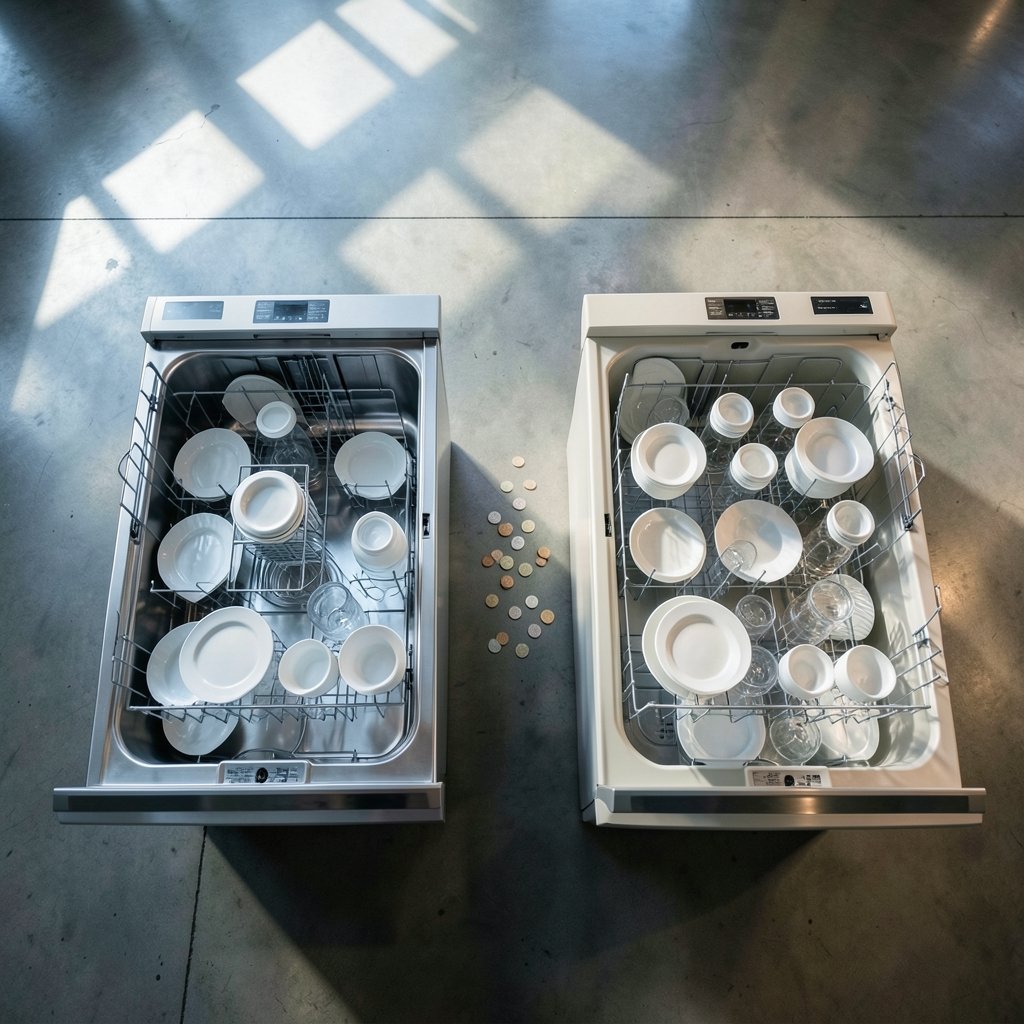
Why does one dishwasher cost $450 while the machine beside it costs $1,600, and both get your plates clean? That question stumps plenty of shoppers standing in a big-box appliance aisle. The answer is not a secret brand markup. It comes down to build quality, noise, drying method, efficiency, and a handful of costs most people never factor in until the machine is already installed. This guide breaks down dishwasher price the way a careful buyer should see it: sticker price, hidden extras, running costs, and the repair-versus-replace math that decides whether a cheap machine is actually cheap.
The Price Bands That Actually Exist
Dishwasher pricing falls into fairly predictable tiers. The ranges below reflect typical US retail patterns; treat them as a map, not a quote, because sales, tariffs, and regional competition move numbers around.
| Tier | Typical price | What you get | What you give up |
|---|---|---|---|
| Budget | $400–$550 | Basic wash cycles, plastic tub, louder operation (50+ dB) | Quietness, drying performance, flexible racks |
| Mainstream | $600–$900 | Stainless steel tub, 44–48 dB, third rack, decent drying | Premium drying, smart features |
| Premium | $1,000–$1,500 | 38–42 dB, advanced drying, adjustable racks, better build | Still not commercial speed |
| Luxury | $1,500+ | Near-silent operation, panel-ready fronts, custom interiors | Value per dollar, expensive repairs |
Most households land in the mainstream band, and that is usually the right call. The jump from $500 to $800 buys real improvements: a stainless tub that holds heat and resists staining, a quieter motor, and a third rack that ends the cutlery-basket traffic jam. The jump from $900 to $1,500 buys refinement more than cleaning power. If the goal is clean dishes with minimal hassle, the middle is where the value sits.
One pattern worth knowing: the same logic applies across appliances. Shoppers who overpay for sticker prestige often regret it, which is exactly the argument behind the best suv 2026 money judge real value not sticker price breakdown. A dishwasher is a smaller purchase, but the principle is identical.
Why Two Dishwashers With the Same Specs Cost Different Amounts
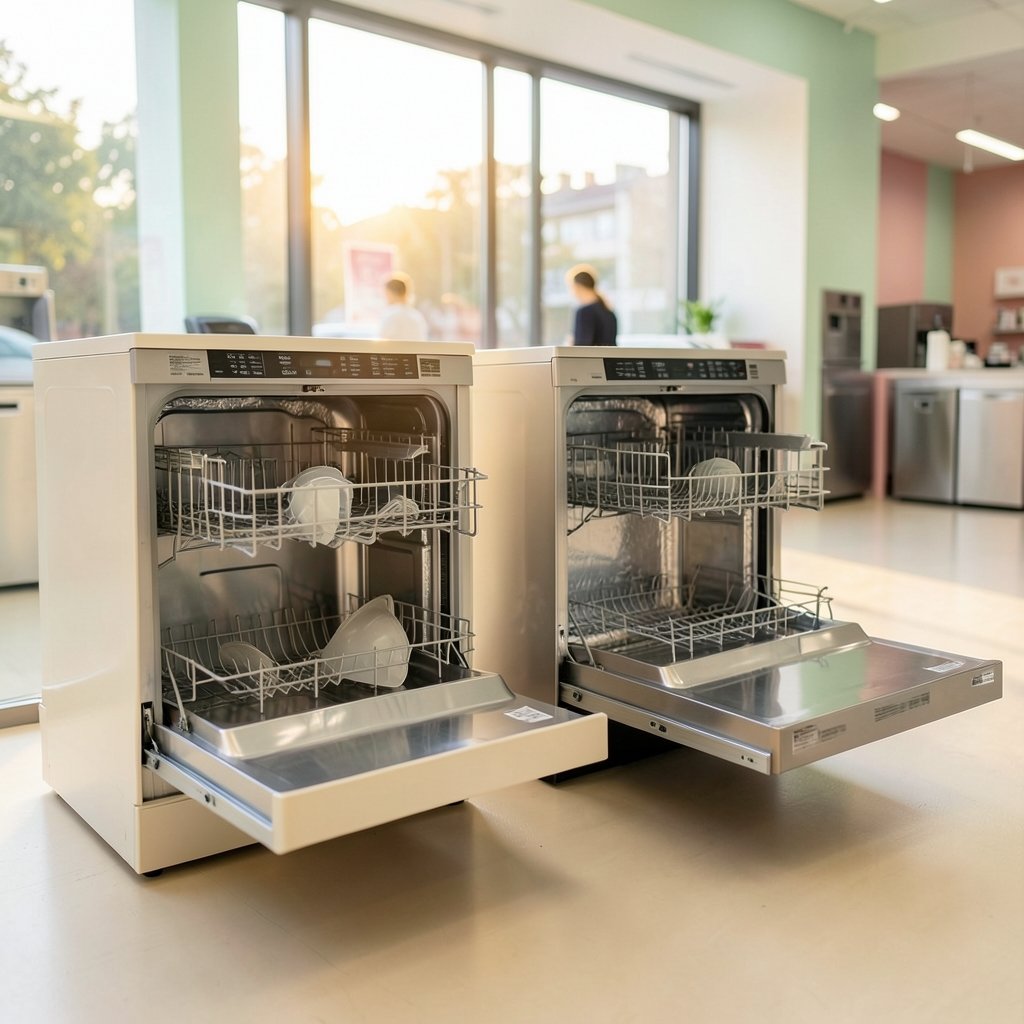
Spec sheets lie by omission. Two machines can list “52 dB” and “14 place settings” and still be wildly different products. Here is what actually drives the price gap.
The tub material
A plastic tub is cheaper to make and cheaper to buy. It also loses heat faster, which hurts drying and can leave dishes damp. A stainless steel tub costs more upfront but holds heat, resists odors, and generally lasts longer. This single difference explains a big chunk of the price step between budget and mainstream models.
Noise ratings
Decibels are logarithmic, so the gap between 50 dB and 44 dB is bigger than it looks. Quiet machines need better insulation, a stronger motor mount, and tighter engineering. If the kitchen opens onto a living area, paying for quiet is money well spent. If the dishwasher sits in a separate utility room, save the money.
Drying technology
Basic models rely on residual heat, which leaves plastic items wet. Mid-range machines add a heating element or a fan. Premium models use zeolite or similar moisture-absorbing systems that dry plastics properly. If you run a lot of plastic containers, drying technology matters more than any other feature.
Energy and water efficiency
Since 1 March 2021, dishwashers sold in the EU carry a rescaled energy label with classes A to G and no plus signs, under EU Regulation 2019/2017. In the US, federal energy standards for dishwashers were tightened effective January 2013 under 10 CFR Part 430. More efficient models usually cost more upfront and less to run. The trade-off is real but modest: the difference in annual electricity between a mid-tier and top-tier efficient model is often smaller than the price gap between them.
The Costs Nobody Puts on the Price Tag
The sticker is the beginning of the invoice, not the end. Budget for these before you commit.
- Delivery and haul-away. Many retailers charge $50 to $150 to deliver and remove the old unit. Some include it during promotions.
- Installation. A straight swap in an existing opening can be a do-it-yourself job. New plumbing, a new electrical connection, or cabinet modification pushes the bill to $150 to $400.
- Electrical and plumbing upgrades. Older homes may need a dedicated circuit or a new water line. This is where surprise costs live.
- Detergent and rinse aid. Cheap detergent in a good machine beats premium detergent in a bad one, but the running cost is real over a year.
- Extended warranties. Usually poor value on a mid-priced appliance. The money is better set aside for a future repair.
A practical tip from the installation side: measure the opening, not the old machine. Cabinet openings vary by half an inch, and a dishwasher that does not fit is a dishwasher you return. Also check the door swing clearance and whether the water supply valve actually turns off. Plenty of installers arrive to find a seized valve that turns a two-hour job into a half-day plumbing visit.
Running Costs: The Part That Keeps Charging You
Purchase price is a one-time hit. Running costs accumulate quietly for a decade or more.
Energy Star certified dishwashers use less energy and water than standard models, though the exact savings vary by model and should be checked against current model data rather than quoted from memory. As a general planning approach, compare the estimated annual energy use printed on the yellow energy guide label. Multiply the difference between two models by your electricity rate and by the years you expect to keep the machine. A $150 price premium for a model that saves $25 a year pays back in six years. A $300 premium for a $10 annual saving never pays back.
Water matters too, especially in regions with tiered billing. Efficient machines use noticeably less water per cycle than older units, and skipping the pre-rinse habit saves more water than most people realize. Scrape, don’t rinse, and let the machine do its job.
For context on how fast running-cost math adds up across a household’s tech purchases, the same logic shows up in the playstation plus premium price discussion: subscription-style costs look small monthly and enormous over five years. Appliances work the same way.
Repair or Replace? The Rule of Thumb That Mostly Works
Common consumer guidance suggests replacing an appliance when the repair cost approaches roughly half the price of a new unit. That is a rule of thumb, not a law, but it holds up well for dishwashers because the expensive failures cluster in predictable places.
- Pump failure: often $250 to $400 installed. On a $500 machine, replace. On a $1,200 machine, repair.
- Control board failure: $200 to $350. Same math.
- Door seal or latch: $80 to $150. Usually worth fixing on any machine.
- Leak from the tub: often the end. Tub replacement rarely makes economic sense.
Age matters as much as cost. A dishwasher past its tenth year is living on borrowed time, and a $300 repair on a nine-year-old unit often precedes a second failure within a year. The same repair-versus-replace judgment applies to other devices, and the reasoning in the laptop repair fix it price it avoid getting ripped off guide maps almost one-to-one onto appliance decisions.
One mistake people make constantly: accepting the first repair quote. Labor rates vary enormously between independent technicians and manufacturer service networks. Two calls routinely save $100 or more.
Where You Buy Changes the Price
The same model number often sells at different prices depending on the channel, and the differences are not random.
Big-box retailers price aggressively on entry-level models and use them as traffic drivers. Selection is broad, delivery is convenient, and price matching is common. Local appliance dealers often match or beat big-box prices on mid-range models and provide better installation and after-sale service. Online-only sellers can undercut both, but returns and installation support get complicated. Outlet and scratch-and-dent stores sell cosmetically imperfect units at genuine discounts, sometimes 30 to 40 percent off, with full warranties.
Timing matters as much as the channel. Appliance promotions cluster around holiday weekends and the launch of new model years, when last year’s models get cleared out. A machine that cost $850 in March can drop to $650 in September with identical internals.
There is also a geographic factor. Prices vary substantially by country because of VAT, import duties, and local competition, so cross-border comparisons only make sense when taxes are treated consistently. Shoppers comparing imported electronics run into the same issue, as the iphone philippines price comparison shows: the local tax and duty structure can swing the final number by a wide margin.
Tariffs, Supply Chains, and Why Prices Move
US tariffs on imported appliances and components have affected retail prices at various points, and the specific effects depend on trade policy that shifts with each administration. The practical takeaway for buyers is not to predict tariffs but to recognize the pattern: when import costs rise, entry-level models absorb the increase first because their margins are thinnest.
Supply chain disruptions have a similar effect. Dishwashers are bulky, expensive to warehouse, and shipped in limited quantities per container, so a logistics squeeze shows up in retail prices faster than it does for small electronics. Buyers who can wait a few months often find prices soften once inventories recover.
Practical Advice That Actually Saves Money
A few habits separate shoppers who pay fair prices from shoppers who overpay.
- Buy the middle, not the extremes. The $700 to $900 band delivers most of the quality of premium machines at half the price.
- Prioritize noise and drying if the kitchen is open-plan. Prioritize price and capacity if it is not.
- Check the energy guide label and do the payback math instead of trusting marketing claims.
- Measure before you buy, and confirm the water valve works.
- Get two repair quotes before replacing anything.
- Shop the model-year transition, not the holiday rush alone.
- Skip the extended warranty and keep the money for a real repair.
Conclusion
Dishwasher price is a story with three chapters: what you pay at the register, what you pay to get it running, and what you pay to keep it running for a decade. The sticker gets all the attention, but the second and third chapters decide whether the purchase was smart. Most households do best in the $600 to $900 range, where stainless steel tubs, quiet operation, and decent drying all show up without paying for luxury finishes. Measure the opening, check the energy label, budget for installation, and treat repair quotes the way you would treat any other bid: get more than one. Do that, and the machine that cleans your dishes will also be one you never resent paying for.
Frequently Asked Questions
How much should a good dishwasher cost?
Most households get the best value between $600 and $900. That range typically includes a stainless steel tub, noise levels around 44 to 48 dB, a third rack, and reliable drying. Budget models under $550 work fine for rentals or light use, while premium machines above $1,000 mostly buy quieter operation and better finishes rather than better cleaning.
Is it worth paying more for a quiet dishwasher?
It depends on where the kitchen sits. Decibels are measured on a logarithmic scale, so the difference between 50 dB and 44 dB is more noticeable than the numbers suggest. If the kitchen opens onto a living or sleeping area, paying extra for a quiet model is usually worth it. If the machine lives in a separate utility room, save the money.
How long do dishwashers last?
Most dishwashers last roughly 9 to 12 years with regular use. Machines with stainless steel tubs and better build quality tend toward the longer end. Failures often cluster around pumps, control boards, and door seals. A machine past its tenth year is a poor candidate for an expensive repair, because a second failure often follows within a year.
Should I repair or replace a broken dishwasher?
Use the half-price rule of thumb: if the repair costs close to half the price of a new machine, replace it. A $300 repair on a nine-year-old $500 dishwasher rarely makes sense. A $300 repair on a three-year-old $1,200 machine usually does. Always get a second quote, since labor rates vary widely between independent technicians and manufacturer service networks.
Do expensive dishwashers use less energy?
Not automatically. Efficiency depends on the specific model, not the price tier. Higher-priced machines often include efficient designs, but plenty of mid-range models perform just as well. Check the estimated annual energy use on the yellow energy guide label and do the payback math: divide the price difference by the annual savings to see how many years it takes to break even.
When is the best time to buy a dishwasher?
Appliance prices soften during model-year transitions, when retailers clear out last year’s units to make room for new ones. Holiday weekends also bring genuine promotions, and scratch-and-dent outlets sell cosmetically flawed units at 30 to 40 percent off with full warranties. Waiting a few months during a supply squeeze can also pay off once inventories recover.



