
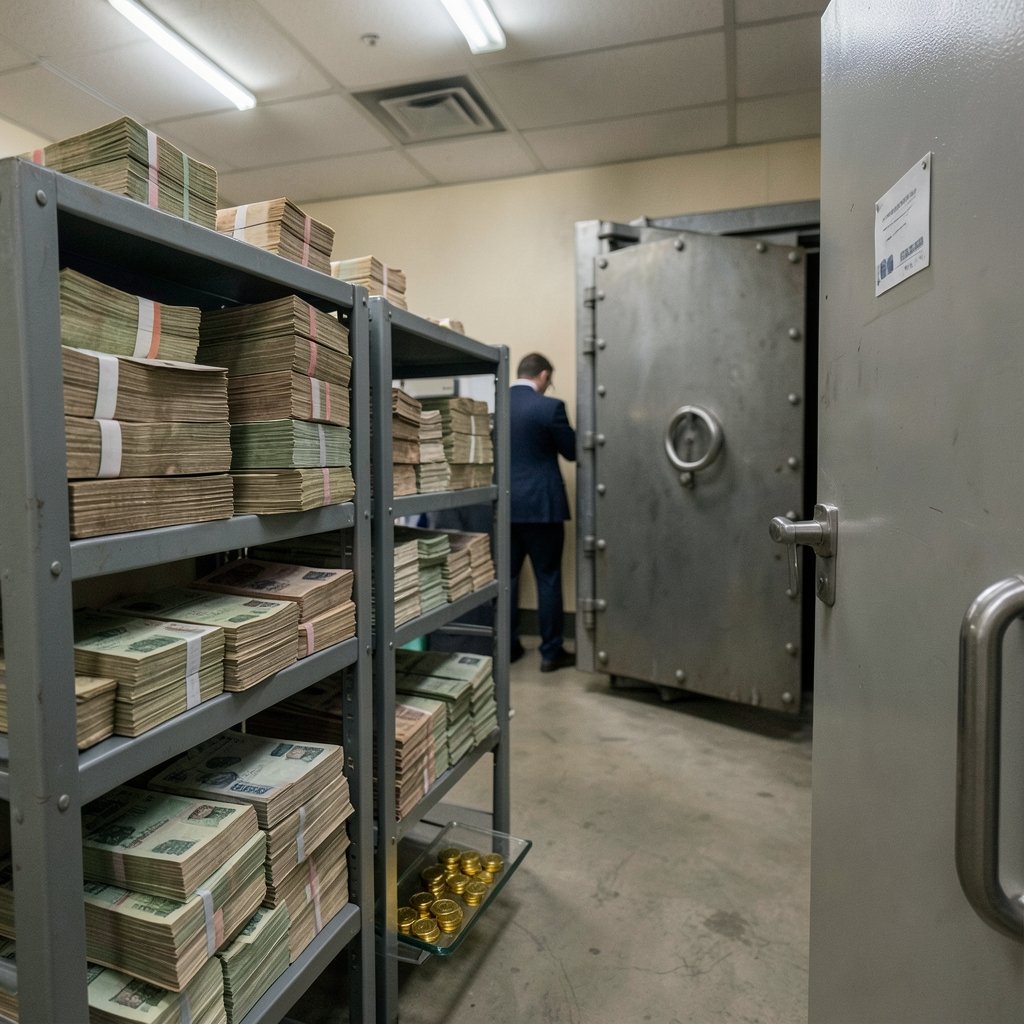
Quick Answer: What is fiat money?
Fiat money is currency that a government declares to be legal tender and that is not backed by a physical commodity like gold or silver. Its value rests on public trust, government authority, and the fact that people accept it for taxes and everyday payments. You encounter it every time you swipe a card, accept a paycheck, or hold a dollar, euro, or yen.
The main alternative is commodity money, whose value comes from the material itself, such as gold or silver coins. Some systems blend the two, like the gold-exchange standard that governed global finance until the early 1970s.
Before relying on any currency, check what backs it, who issues it, whether it holds legal-tender status, how its supply is managed, its inflation record, and how easily it converts into other assets.
A Question That Sounds Simple but Isn’t

Why does a piece of paper with a dead president’s face on it buy a week of groceries? The paper itself is nearly worthless. The ink costs pennies. Yet the whole economy runs on the promise that this slip of paper, or the number in your bank app, will still be accepted tomorrow.
That promise is the heart of fiat money. The word “fiat” comes from Latin, meaning “let it be done,” and that is essentially how fiat currency works. It exists because an authority says so, not because it can be melted down into something valuable. Once you understand this idea, headlines about inflation, interest rates, and central banking start to make a lot more sense.
Defining Fiat Money in Plain Terms
Fiat money is government-issued currency that is not backed by a physical commodity and derives its value from public trust and legal-tender status. That definition carries two moving parts: the absence of commodity backing and the state’s declaration that the money must be accepted for debts.
The second part matters more than people realize. When you pay taxes, the government demands its own currency. That creates built-in demand. Businesses accept dollars not because they love green paper but because they know the government accepts dollars and so does everyone else.
It helps to see fiat money next to its historical rivals.
| Feature | Fiat Money | Commodity Money | Representative Money |
|---|---|---|---|
| What backs it | Government authority and trust | The material itself (gold, silver) | A claim on a stored commodity |
| Intrinsic value | Almost none | High | Indirect, through the reserve |
| Who controls supply | Central bank and government | Mining output and reserves | Size of the commodity stock |
| Example | U.S. dollar today | Gold coins | U.S. dollar under Bretton Woods |
How the World Left Gold Behind
For much of history, money was commodity money. A gold coin was worth something because the gold was worth something. Then governments began issuing paper notes redeemable for gold, which worked as long as everyone believed the vault held enough metal.
The 20th century tested that belief. In 1933, the U.S. restricted private gold ownership through Executive Order 6102, and the Gold Reserve Act of 1934 moved monetary gold to the Treasury. The dollar was still tied to gold internationally, but the rules had changed. (Gold Standard)
The final break came in 1971, when President Nixon suspended the dollar’s convertibility into gold, ending the Bretton Woods system. That moment, often called the Nixon Shock, marked the point when major currencies became fully fiat. The Federal Reserve’s own historical account of the end of gold convertibility walks through how and why it happened.
Where Money Actually Comes From Now
Here is the part that surprises almost everyone: most money is not printed by the government. In modern economies, commercial banks create most money as deposits when they make loans. A bank doesn’t wait for a depositor to walk in before lending. It credits the borrower’s account, and new money appears in the system. Central banks create reserves, the settlement money banks use among themselves. (Identity threat detection really costs where money goes)
The Bank of England explained this process in a widely cited 2014 Quarterly Bulletin article on money creation in the modern economy, and it remains one of the clearest explanations available. Understanding it changes how you read news about “money printing.” Physical cash is a small slice of the pie. Most of the money supply is digital bookkeeping backed by loans and trust.
What Gives Fiat Money Its Value
If nothing tangible backs fiat currency, why does it hold value at all? Several forces work together.
Legal tender status. In the United States, federal statute states that U.S. coins and currency are legal tender for all debts, public charges, taxes, and dues. You can read the exact text of the legal tender statute at Cornell’s Legal Information Institute. This status doesn’t force a private shop to accept cash for a purchase in every circumstance, but it does mean courts and creditors must recognize the currency for debts.
Tax obligations. Governments collect taxes in their own currency, which guarantees steady demand.
Scarcity management. Central banks control supply, ideally in step with economic growth.
Collective belief. Money is a social agreement. It works because we all act as if it works, and that expectation becomes self-fulfilling.
Stability of institutions. Independent courts, credible central banks, and predictable rules make people willing to hold a currency rather than spend it immediately.
When any of these weaken, the currency weakens too. That is why countries with runaway inflation see people dump local cash for foreign currency, gold, or goods.
Why Fiat Money Is Debated
Fiat currency has loud defenders and loud critics, and both sides have points worth hearing.
Supporters argue that fiat money gives governments and central banks the flexibility to respond to recessions, fund public services, and smooth out economic shocks. A currency tied to gold limits how fast an economy can grow, since the money supply is chained to mining output. Fiat systems let policymakers expand or contract credit as conditions change.
Critics point to the temptation to create too much money. Because fiat supply isn’t anchored to a commodity, governments can inflate away debt or fund spending beyond their means. The claim that fiat money is inherently inflationary is contested among economists, though. Some argue that disciplined central banks with inflation targets, often around 2 percent, keep prices stable over long periods. Others say the system quietly transfers wealth from savers to borrowers and from ordinary people to those closest to newly created money. (Gift card scam works victims rarely get their money back)
The honest answer is that fiat money is a tool. Tools don’t have morals, but the people wielding them do.
Fiat Money in Everyday Life
You interact with fiat currency constantly, often without noticing.
Your paycheck is denominated in fiat money. Your savings account holds digital fiat that earns interest set by central bank policy. Your mortgage is a fiat-denominated debt whose real value shrinks when inflation rises. Even your grocery bill reflects the purchasing power of the currency at that moment.
Inflation numbers matter to households and to economists. When prices climb faster than wages, the same paycheck buys less. When inflation is low and predictable, planning gets easier. The test of a currency’s credibility is whether people can budget a year ahead without guessing.
Practical tip: track your own personal inflation rate by watching the categories you actually spend on, like rent, food, and transport. National averages can hide what’s happening in your specific life. And if you’re curious how inflation interacts with new forms of money, the debate over central bank digital currencies and how a CBDC differs from cash is worth following, since it touches the same questions of trust and state control.
Fiat Money vs. Other Kinds of Money
It’s easy to blur the lines, so here’s a quick distinction.
Fiat money has no commodity backing and relies on government authority and trust. The dollar, euro, and yen are examples.
Commodity money carries value in the material itself. Gold and silver coins are the classic cases.
Representative money is a claim on a commodity held in reserve. A paper note redeemable for a fixed amount of gold fits here.
Digital money is a format, not a category. A dollar in your banking app is still fiat money. Bitcoin, by contrast, is neither fiat nor commodity money; it’s a decentralized digital asset with no issuing government.
Cryptocurrencies and stablecoins raise their own questions. A stablecoin pegged to the dollar is a claim on fiat money, not fiat money itself, and the peg depends on reserves that may or may not hold up. Understanding what backs a token is the same discipline you’d apply to any currency.
How to Evaluate Any Currency, Including Your Own
Whether you’re a traveler, saver, or business owner, a short checklist helps.
- Identify the issuer and whether the currency has legal-tender status.
- Check the inflation record over one, five, and ten years.
- Look at how independent the central bank is from political pressure.
- Assess convertibility: can you move money out easily and at a fair rate?
- Review the country’s fiscal position and debt trajectory.
- Consider alternatives for savings, such as diversified assets, if you’re worried about purchasing power.
This same thinking applies when people explore newer money-making ideas, from side businesses to digital tools. The guide on how to make money with AI, for example, is really a lesson in evaluating claims about value and risk, which is the same skill you need to judge a currency.
Common Mistakes People Make
A few traps show up again and again.
Assuming fiat means fake. Fiat money is real money with real purchasing power. The word describes its backing, not its legitimacy.
Confusing cash with money. Most money exists as bank deposits. When people say “the government prints money,” they usually mean central bank reserve creation, which is a different process.
Ignoring inflation in long-term plans. A savings account earning 1 percent while inflation runs at 4 percent is losing ground. Nominal returns can hide real losses.
Trusting a currency because it’s familiar. Familiarity isn’t the same as stability. History is full of currencies that felt permanent right up until they weren’t.
Overlooking fraud risk in digital finance. As money becomes more digital, scams multiply. The breakdown of how a gift card scam works and why victims rarely get their money back shows how quickly value can vanish when trust is misplaced.
The Bigger Picture
Fiat money is one of the most consequential inventions of modern economic life, and it’s also one of the least understood. It replaced metal with trust, and trust has to be earned and maintained. Every central bank decision, every inflation report, and every budget debate is really a referendum on whether that trust is holding.
For individuals, the takeaway is practical: understand what your money is, watch its purchasing power, and diversify where it makes sense. For societies, the takeaway is older than economics itself. Money works because people believe in it, and belief is easier to spend than to rebuild.
FAQ
Why did countries abandon the gold standard?
Gold backing limited how fast money could grow, since supply depended on mining and reserves. During the Great Depression and later under Bretton Woods, governments found the constraint too rigid for managing recessions and funding war debts. The 1971 suspension of dollar-to-gold convertibility completed the shift to fiat currencies for major economies.
Is fiat money the same as paper money?
No. Paper money is a physical format, while fiat money is a category defined by its lack of commodity backing. A dollar bill is fiat money, but so is the digital balance in your bank account. Some paper notes, like gold certificates historically, were representative money rather than fiat. (Cbdc digital currency central bank money going digital) (Bank of England: What Is Money?)
Does fiat money always lose value?
Not always, and not at the same pace. Well-managed currencies can hold purchasing power for decades with modest inflation. The risk is that supply can be expanded without a commodity anchor, so discipline depends on institutions. Hyperinflation happens when that discipline collapses, but it is the exception, not the rule.
Who decides how much fiat money exists?
Central banks set monetary policy and influence the money supply through interest rates, reserve requirements, and asset purchases. Commercial banks also create money when they lend. The balance between these forces determines how much money circulates in an economy at any given time.
Can fiat money be replaced by cryptocurrency?
Cryptocurrencies offer an alternative model, but they haven’t replaced fiat money in everyday use. Most crypto assets are volatile and not widely accepted for taxes or wages. Stablecoins aim to mirror fiat value but depend on reserves. For now, fiat remains the backbone of payments, contracts, and government finance.
What should I watch to protect my savings from inflation?
Track real returns, meaning interest earned minus inflation. Consider assets historically used as inflation hedges, such as diversified stock funds, real estate, or inflation-protected bonds. Keep an emergency fund in cash for stability, and review your mix annually as conditions change.
Conclusion
Fiat money is currency backed by trust and government authority rather than gold or silver. It powers nearly every paycheck, loan, and purchase in the modern world, and it exists because institutions and people agree to accept it. That agreement is powerful but not automatic. Understanding how fiat money is created, what keeps it valuable, and where its weaknesses lie gives you a clearer view of your own finances and the headlines that shape them. The next time you tap a card or check a price tag, you’ll know exactly what you’re trusting.



