
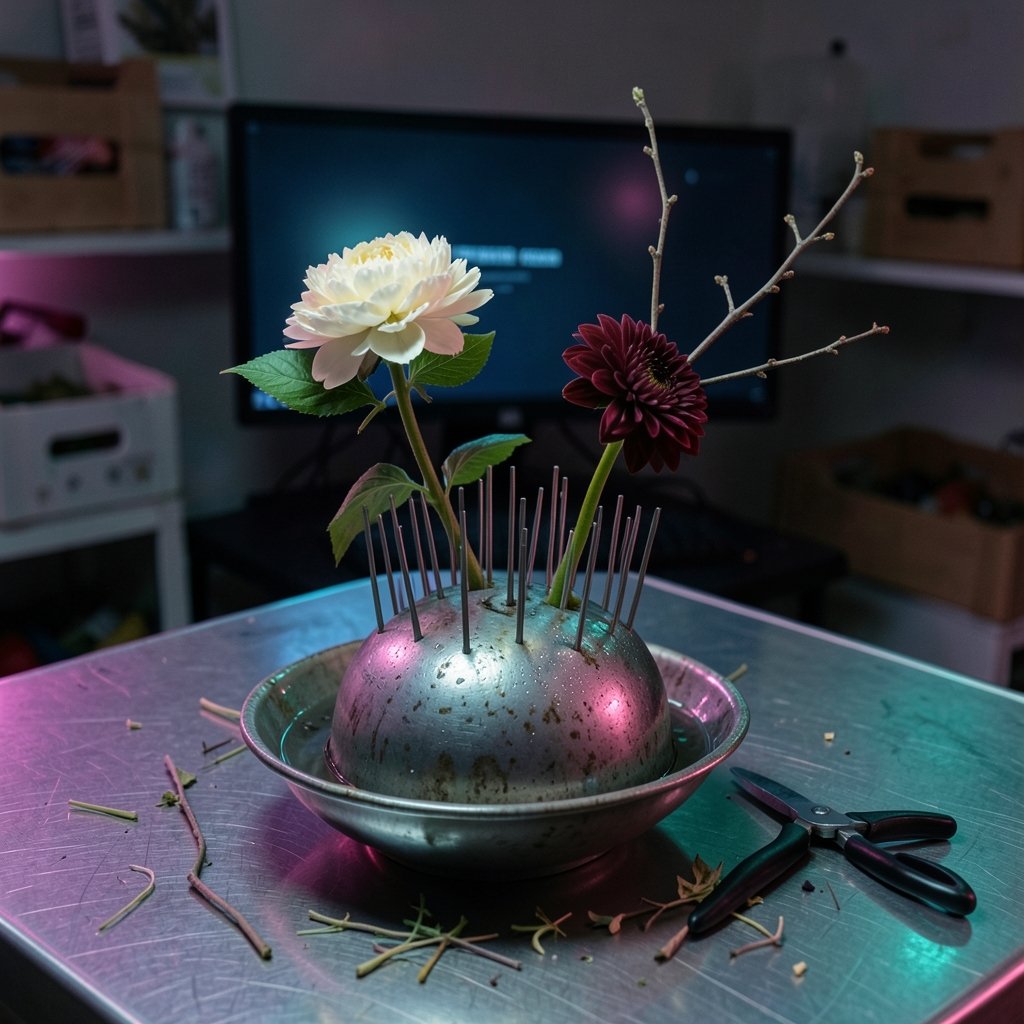
Have you ever built a bouquet that looked perfect in your hands, then watched every stem flop to one side the moment it hit the water? That slow collapse is the moment most people discover why flower frogs exist. The little spiked disc is one of the oldest tools in floristry, and it solves a problem that modern foam only pretends to fix.
What a Flower Frog Actually Is
A flower frog is a device that holds cut stems in place inside a vase, bowl, or shallow container. The most familiar version is a weighted disc, usually metal, studded with upright pins. You push the stem ends down onto the pins, and the flower stays exactly where you put it.
That is the whole job. No suction, no foam, no wire grid. Just weight, grip, and geometry.
The name has nothing to do with amphibians. The word “frog” here comes from an older sense of the term, referring to a holder or support, the same way a belt frog holds a tool. The device has carried that name for well over a century, and it stuck even as the object itself changed shape many times.
It helps to separate the frog from other stem-holding tools, because people often use the words interchangeably when they should not.
| Tool | How it holds stems | Best container | Reusable |
|---|---|---|---|
| Pin frog (metal disc with spikes) | Stems impaled on pins | Shallow bowls, low dishes | Yes, indefinitely |
| Glass or ceramic frog | Stems threaded through holes | Vases, wide-mouth jars | Yes, indefinitely |
| Hairpin frog (bent wire loops) | Stems gripped between loops | Any vase with a rim | Yes, indefinitely |
| Floral foam | Stems pushed into a soft block | Any container | No, single use |
| Tape grid | Stems held in taped squares | Open vases | No, single use |
The distinction matters in practice. Foam crumbles, sheds particles into the water, and cannot be reused. A frog outlives the flowers, the vase, and often the person who bought it.
Why the Pin Frog Became the Standard

The pin frog, sometimes called a kensan, has deep roots in Japanese ikebana, where precise stem placement is the entire point of the arrangement. A shallow dish of water plus a spiked metal holder gives the arranger total control over angle and position. Nothing drifts. Nothing leans.
Western floristry adopted the same logic. A heavy pin frog in a low bowl lets a designer set a stem at a 45-degree angle and trust that it will still be at 45 degrees an hour later. That reliability is why the tool survived the arrival of foam, floral wire, and every plastic gadget since.
There is also a quiet practical benefit that rarely gets mentioned: a pin frog holds a heavy bloom upright without any support structure above the water line. A single peony or dahlia in a shallow dish, pinned at the base, looks deliberate rather than drooping.
The Materials Question
Most vintage pin frogs are made of lead, sometimes coated, sometimes bare. The weight is the reason. Lead is dense enough that a small disc anchors a tall stem without tipping.
That density comes with a caveat. Lead is a known health hazard, and handling bare lead repeatedly, or using a lead frog in a container where the metal contacts water that touches food, is not a good idea. A lead frog used for cut flowers in a vase is a different risk category than one used near drinking water or food, but the sensible move is to keep bare lead frogs out of kitchen use and wash hands after handling them.
Modern frogs are made from cast iron, coated steel, brass, zinc alloy, and heavy glass. They weigh less than lead but avoid the handling concern entirely. For anyone buying new, the coated metal and glass options are the practical choice.
Glass frogs deserve a mention of their own. They are typically domed or disc-shaped with holes rather than pins, and they work by threading stems through the openings. They are heavier than they look, they never rust, and they photograph beautifully. The trade-off is that a glass frog grips less aggressively than a pin frog, so it suits sturdier stems better than delicate ones.
How to Use a Flower Frog Without Wrecking Your Stems
The most common mistake is impaling a stem too high or too forcefully. A pin frog is not a pincushion. The pins only need to bite into the base of the stem, an inch or so from the cut end.
Here is a sequence that works.
- Fill a shallow bowl or dish with water, leaving room for displacement.
- Set the frog in the center, or off-center if the design calls for asymmetry.
- Recut each stem at an angle with a sharp knife or snips.
- Push the stem straight down onto the pins, aiming for the cut end rather than the side of the stem.
- Check the angle before adding the next stem, because repositioning later means pulling the stem off the pins and starting again.
- Top up the water daily, since shallow containers evaporate fast.
A few practical notes that save grief:
- Soak woody stems first. A hardened rose or chrysanthemum stem can resist the pins. A short soak softens the base and makes impaling cleaner.
- Do not force a thick stem onto fine pins. It bends the pins and can crack the stem lengthwise. Use a frog with wider spacing for thick stems.
- Keep the water shallow. A pin frog is designed for low containers. In a tall vase, the frog sits at the bottom and does nothing useful.
- Clean the frog after every use. Pin frogs collect algae and stem residue between the pins. A soft brush and warm water handle it; a soak in diluted vinegar loosens mineral buildup.
The payoff for all this fuss is arrangement control. If you have ever tried to build a tight, low centerpiece and had it spread outward like a dropped deck of cards, a pin frog is the fix. The same instinct for making a small amount of material look intentional shows up in other corners of creative gifting, like the way a money flower bouquet fold cash into gift that lasts turns a handful of bills into something structured and deliberate rather than a loose bundle.
Choosing a Frog: Size, Weight, and Container Match
The single biggest cause of frog failure is a mismatch between the frog and the container. A small frog in a wide bowl tips. A heavy frog in a thin glass vase can crack it.
As a working rule, the frog should cover roughly a third of the container’s base diameter and weigh enough that the container feels bottom-heavy before any flowers go in. If the frog slides when you nudge it, it is too light for the job.
| Container type | Frog type that works | What to avoid |
|---|---|---|
| Shallow ceramic dish | Heavy pin frog, 3 to 4 inches | Small hairpin frogs that slide |
| Wide glass bowl | Glass dome frog or weighted pin frog | Bare lead frogs on thin glass |
| Standard vase neck | Hairpin frog or glass hole frog | Pin frogs, which sit useless at the bottom |
| Deep open vessel | Tape grid or a frog on a raised base | Any frog resting flat on the floor of the vase |
For narrow-necked vases, the frog is the wrong tool. A hairpin frog or a simple tape grid does the same job with less weight and no risk of scratching the glass.
The Vintage and Collecting Angle
Flower frogs are a recognized collecting category, and the range is wider than most people expect. Victorian-era glass frogs in amber and cobalt, cast-iron frogs shaped like animals, brass frogs with elaborate pierced patterns, and mid-century ceramic frogs in bright glazes all show up in antique markets.
Collectors tend to look for three things: intact pins with no bends, original finish with no heavy corrosion, and maker’s marks on the base. Glass frogs are judged on clarity and on whether the holes are uniform, since hand-finished holes vary.
The caution here is the same one that applies to any collectible: prices are set by what someone will pay, not by a fixed standard. Treat any claim about a frog being rare or valuable with skepticism until you have compared several sold examples.
Common Mistakes People Make
A few errors show up again and again, and each one is easy to avoid once you know it exists.
Using a frog as a substitute for a vase. A pin frog holds stems but does not hold much water. It belongs in a shallow container that already holds water, not on a bare shelf.
Pushing stems in at an angle. Angled insertion bends pins and splits stems. Go straight down, then adjust the stem above the water line.
Skipping the recut. A stem that has been out of water for an hour has sealed its base. Pushing a sealed stem onto pins means it never takes up water, no matter how well it is held.
Ignoring the weight of the finished arrangement. A tall, top-heavy design in a light bowl will tip regardless of the frog. Either shorten the stems or switch to a heavier container.
Storing a wet frog. Water trapped between pins grows algae and corrodes coated metal. Dry it before it goes in the drawer.
There is a broader lesson in all of this about matching a tool to the job rather than to the trend. The same clear-eyed comparison applies when people weigh software or household costs, which is why a breakdown like the benefits salesforce alternatives lower costs faster setup reads less like a sales pitch and more like a decision framework. The frog wins on the same grounds: it is cheap, it lasts, and it does one thing well.
Frog, Foam, or Wire: What Actually Works
For anyone arranging flowers at home a few times a year, the honest answer is that a single heavy pin frog and one shallow bowl will cover most needs. Foam is convenient for a one-off event but leaves debris and cannot be reused. Wire grids work in a pinch but shift as stems settle.
For anyone arranging regularly, the frog pays for itself quickly. It does not degrade, it does not need restocking, and it produces a cleaner look because the mechanics stay hidden below the water line.
The one case where a frog genuinely loses is a tall, narrow vase with a small opening. There, the frog has nowhere useful to sit, and a hairpin frog or a simple grid is the better answer. Knowing that limit is more useful than any general recommendation.
If the appeal of the frog is partly about making something small look considered, that instinct is worth following. The same thinking drives the way a money flower this venn diagram actually shows about money frames a handmade gift as a design problem rather than a craft project. Structure is what makes the result read as intentional.
A Note on Care and Longevity
A well-made frog will outlast most of the flowers it holds. The maintenance is minimal but not zero.
Rinse after every use. Dry thoroughly. Store it upright or wrapped so the pins do not bend against other objects. For coated metal, avoid abrasive pads that scratch the coating and expose the base metal. For glass, skip the dishwasher, since heat and detergent can cloud the finish over time.
A lead frog, if you inherit one, is best treated as a decorative object or used with cut flowers only, handled with care and kept away from food preparation areas. There is no need to fear it, but there is also no reason to treat it casually.
Conclusion
The flower frog is a rare thing: a tool that has survived more than a century of alternatives because it solves its problem completely. It holds stems where you put them, it never wears out, and it costs less than a decent bunch of flowers. The pin frog suits shallow bowls and precise designs, the glass frog suits wide vessels and sturdy stems, and the hairpin frog covers the narrow-necked vases the others cannot reach.
The mistakes are predictable and fixable. Match the frog to the container, recut the stems, push straight down, keep the water shallow, and dry the thing before it goes in a drawer. Do that, and the arrangement stays exactly where you left it.
Frequently Asked Questions
What is a flower frog used for?
A flower frog holds cut stems in place inside a vase or shallow bowl. The most common type is a weighted metal disc with upright pins that the stem ends are pressed onto. It keeps flowers at a fixed angle and position instead of letting them drift and slump.
Are flower frogs safe to use?
Coated metal, cast iron, brass, and glass frogs are safe for normal flower arranging. Vintage frogs made of bare lead deserve more care: handle them with clean hands, keep them away from food and drinking water, and wash hands afterward. Modern frogs avoid the concern entirely.
How do you keep flowers from falling out of a flower frog?
Push each stem straight down onto the pins so the pins bite into the base of the stem, about an inch from the cut end. Recut the stem first, since a sealed stem will not take up water. If stems still slip, the frog is too light for the container or the pins are too widely spaced.
Can you use a flower frog in a tall vase?
Usually not. A pin frog needs to sit near the water surface in a shallow container to be useful. In a tall vase it rests at the bottom and holds nothing. For tall vases, use a hairpin frog that grips the rim or a tape grid across the opening.
How do you clean a flower frog?
Rinse it under warm water after every use and work a soft brush between the pins to remove stem residue and algae. A soak in diluted white vinegar loosens mineral deposits. Dry it completely before storing, and avoid abrasive pads on coated metal.
Why is it called a flower frog?
The word frog has an older meaning as a holder or support, the same sense used for a belt frog that carries a tool. The name was applied to stem holders well over a century ago and stayed even as the object took many forms, from spiked metal discs to pierced glass domes.



