Garmin vs Apple Watch in 2027 is a contest between two very different ideas of what a watch should be. Garmin builds rugged sports watches for runners, cyclists, hikers and triathletes who train for hours and need battery life measured in days and weeks. Apple builds a polished smartwatch for iPhone owners who want calls, apps and payments on their wrist, with fitness tracking as one of many features.
The price gap is wide. A Garmin Forerunner 265 starts at around $449, a Forerunner 965 at around $599, and a Fenix 8 at around $999, while an Apple Watch SE 3 starts at around $249, a Series 11 at around $399, and an Ultra 3 at around $799. Check current pricing before buying, because both brands run frequent sales. Garmin costs more at the popular training models, and Apple costs more once you add cellular and a carrier plan.
This comparison measures both on the same things: price and ongoing cost, battery life, training and health data, GPS and outdoor maps, smart features, phone compatibility, durability, and support. One side wins clearly for serious training. The other wins clearly for everyday smartwatch use. The right pick depends on how you actually spend your hours outdoors.
Key takeaways
- Garmin wins on battery life, with 13 to 30 days on many models versus about 18 to 36 hours on Apple Watch.
- Apple Watch wins on smart features, with a bigger app store, cellular models, and deeper iPhone integration.
- Garmin wins for serious training, with training load, recovery scores, and full topographic maps on outdoor models.
- Garmin works with iPhone and Android, while Apple Watch only works with an iPhone.
- Both are durable and swim-proof, but Garmin’s button controls work better with gloves and in rain.
Garmin vs Apple Watch at a glance
| Feature | Garmin | Apple Watch |
|---|---|---|
| Starting price | About $299 to $999 | About $249 to $799 |
| Battery life | 13 to 30 days | About 18 to 36 hours |
| Phone compatibility | iPhone and Android | iPhone only |
| Best for | Serious training and outdoors | Everyday smartwatch use |
| Training data | Training load, recovery, maps | Workouts, rings, health sensors |
| Smart features | Notifications and payments | Apps, calls, cellular, payments |
| Controls | Buttons plus touch | Touch plus digital crown |
| Support | Online and phone support | Apple stores and online support |
Garmin: built for training, outdoors and long battery life
Garmin watches are training tools first. A Forerunner or Fenix measures training load, recovery time, VO2 max estimates, race predictions and sleep, and it presents them as advice: how hard to train today, how long to recover, and whether your fitness is rising or falling. For runners and triathletes, that coaching layer is the reason to buy one. It is the difference between a watch that records a run and a watch that tells you what the run meant.

Battery life is Garmin’s biggest advantage. A Forerunner 265 lasts about 13 days in smartwatch mode, and a Fenix 8 can last about 30 days, with weeks of GPS tracking on solar models. That means multi-day hikes, ultramarathons and training camps without a charger. The Apple Watch Ultra 3, the longest-lasting Apple model, reaches about 36 hours, so it needs charging every day or two. For general fitness buying advice, our guide to the best smartwatches for fitness puts these battery differences in context.
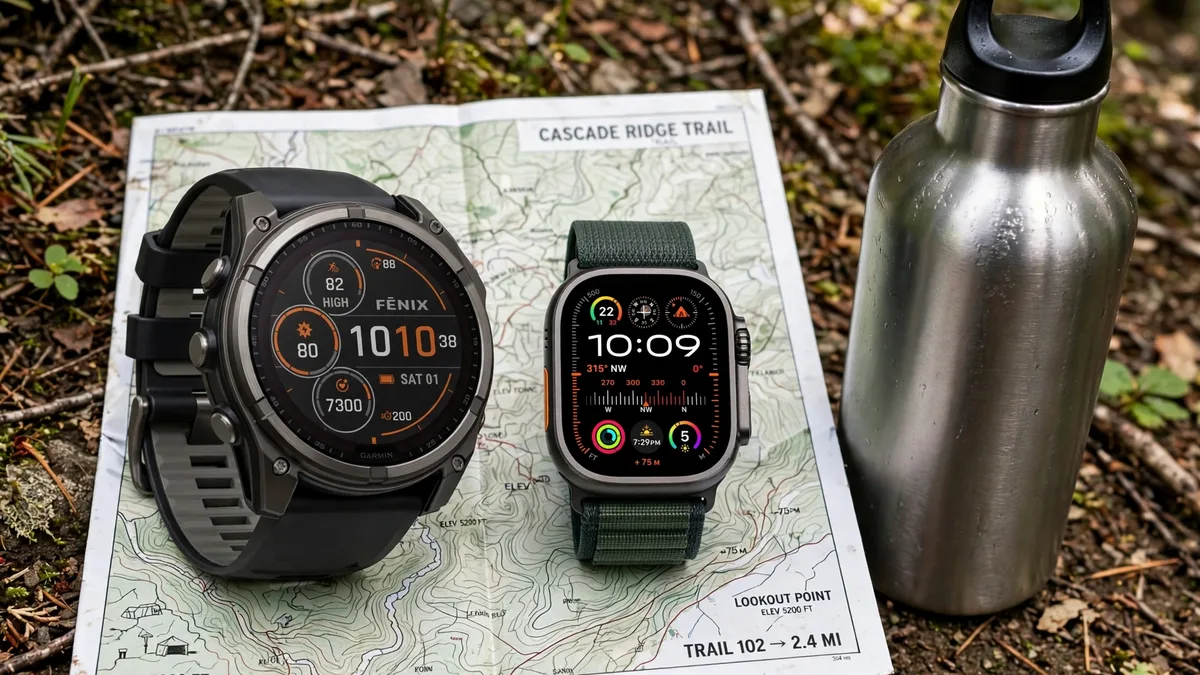
Outdoor navigation is the other Garmin strength. Fenix and Epix models carry full topographic maps, breadcrumb navigation, and turn-by-turn trail prompts, and they work with physical buttons that are easy to press with gloves or wet hands. The Apple Watch Ultra 3 has good GPS and a compass with backtrack, but its maps are thinner and its touch screen is harder to use in rain or with gloves on.
Garmin works with both iPhone and Android, and its Connect app is free, with no subscription needed for training data. Smart features are decent but limited: notifications, Garmin Pay, music storage and a small app store. There is no cellular model that makes calls without your phone, and the screen, while bright on AMOLED models, is not as sharp or as app-rich as Apple’s.
Pros: battery life measured in weeks, deep training and recovery data, full topographic maps on outdoor models, works with iPhone and Android, buttons that work in rain and with gloves, no subscription for training features.
Cons: higher prices on training models, fewer smart features and a smaller app store, no cellular calling, interface is more complex to learn, less polished as an everyday smartwatch.
Apple Watch: the best everyday smartwatch, with strong fitness
The Apple Watch is the better everyday device. The Series 11 and Ultra 3 have bright always-on displays, a large app store, cellular models that call, text and stream without a phone, and features such as fall detection, crash detection, ECG and blood oxygen sensing. It answers messages, pays for coffee, shows maps, and controls music from your wrist, and it does it all with a polish Garmin cannot match.
Fitness tracking is strong, and it keeps getting better. The Apple Watch records workouts with accurate GPS, measures heart rate and heart rate variability, tracks sleep stages, and uses its three activity rings to keep daily movement visible. The Ultra 3 adds a brighter screen, a longer battery, and a more rugged case for outdoor use, and it is the Apple model that comes closest to Garmin on a trail. Our review of the Apple Watch Ultra 3 review covers its outdoor performance in detail.
The limits are battery and compatibility. Most Apple Watch models last about 18 hours, and even the Ultra 3 lasts about 36 hours, so daily charging is part of the routine. A weekend hike without a charger is not realistic. The Apple Watch also only works with an iPhone, so Android users cannot use it at all, and switching phones later means giving it up. If hiking is your main use, compare the outdoor options in our guide to the best smartwatches for hiking before deciding.
Support is excellent, with Apple stores, online chat and a wide repair network. Prices start lower than Garmin’s training watches, at around $249 for the SE 3 and around $399 for the Series 11, but the Ultra 3 at around $799 plus a cellular plan closes the gap. Check current pricing before buying, because carrier deals and trade-ins change the real cost.
Pros: best smartwatch features and app store, cellular models work without a phone, advanced health sensors including ECG, bright always-on display, excellent support through Apple stores.
Cons: battery lasts about a day on most models, iPhone only, cellular adds a monthly carrier cost, maps and outdoor tools are thinner than Garmin’s, touch screen is awkward in rain or with gloves.
Verdict: which one should you buy?
Buy the Garmin if you train seriously or spend long days outdoors. It is the better pick for runners, cyclists, hikers and triathletes who need weeks of battery, training load and recovery data, and maps that work far from a charger. The Forerunner 265 is the sweet spot for most runners, and the Fenix 8 is the pick for multi-day outdoor trips.
Buy the Apple Watch if you own an iPhone and want a smartwatch first. It is the better pick for calls, messages, apps, payments and safety features, and its fitness tracking is more than good enough for most people who train a few times a week. The Ultra 3 is the right Apple model if you want the longest battery and the toughest case.
This is not a tie, because the two watches serve different owners. Garmin wins for training and the outdoors. Apple Watch wins for everyday smartwatch life. Pick the one that matches the hours you actually spend, not the one with the longer feature list.
How to choose
Start with your phone and your training. If you use Android, Garmin is the only option here. If you use an iPhone, ask how many hours a week you train and how far from a charger you go. More than five hours of training a week, or regular hikes and races, points to Garmin. A few gym sessions and daily walks point to Apple Watch.
Next, weigh battery life honestly. Garmin’s weeks of battery change how you use a watch: you wear it to bed every night, you track every workout, and you never think about charging. Apple’s daily charging is fine if you charge your phone every night anyway, but it breaks sleep tracking and multi-day trips unless you carry a charger.
Finally, compare the real cost. A Forerunner 265 at around $449 has no subscription and no carrier plan, while an Apple Watch Ultra 3 at around $799 plus a cellular plan can cost more over two years. The cheaper Apple Watch SE 3 at around $249 is the better value if you do not need the Ultra’s rugged case, so match the model to your use, not to the top of the range.
Checklist: before you buy
- Confirm your phone: Apple Watch needs an iPhone, Garmin works with iPhone and Android.
- Count your training hours and your longest outing without a charger.
- Check whether you need topographic maps, or whether basic GPS is enough.
- Try the size on your wrist: Fenix models are large and heavy, the SE is slim.
- Check water resistance and swim tracking for your sport.
- Confirm the return window, so you can test GPS accuracy and comfort on a real run.
Frequently asked questions
Is Garmin or Apple Watch better for running?
Garmin is better for serious runners, with training load, recovery advice, race predictions and longer GPS battery life. Apple Watch is good for casual runners and better as an everyday smartwatch.
Does Garmin work with iPhone?
Yes. Garmin works with both iPhone and Android through the Garmin Connect app. Apple Watch only works with an iPhone.
How long does the battery last on each?
A Forerunner 265 lasts about 13 days and a Fenix 8 about 30 days in smartwatch mode. Most Apple Watch models last about 18 hours, and the Ultra 3 lasts about 36 hours.
Do I need a subscription with Garmin or Apple Watch?
No. Garmin Connect is free and includes training data. Apple Watch has no subscription for core health features, though Apple Fitness+ is a separate paid service.
Which one is better for hiking?
Garmin is better for hiking, with full topographic maps, longer battery life and button controls that work with gloves. Apple Watch Ultra 3 is a capable alternative for shorter hikes with an iPhone.
Can I make calls without my phone on either watch?
Apple Watch cellular models can call, text and stream without your phone nearby. Garmin watches do not have cellular calling, so your phone needs to be in range for calls.
The bottom line
Garmin vs Apple Watch in 2027 is a choice between a training tool and a smartwatch. Garmin is the better watch for people who train hard and spend long days outdoors, because its battery lasts weeks, its training data is deeper, and its maps work far from a charger. Apple Watch is the better watch for iPhone owners who want a capable everyday device, because its apps, calls and smart features are unmatched, and its fitness tracking covers most people’s needs.
Buy the one that fits the life you already live. If your weekends are on trails and your weekdays include structured training, the Garmin will earn its place. If your watch is mostly a phone on your wrist with workouts on the side, the Apple Watch is the right call, and you will use it every day.