Globe is pressing local governments to speed telecom approvals as it works to expand connectivity across the Philippines. Local government unit (LGU) decisions can affect when planned network work moves forward. The process matters to people waiting for better connectivity, as well as to communities planning new infrastructure.
Fiber-to-the-home (FTTH) is a fixed broadband connection delivered by fiber-optic cable to a residence. It supports home internet service, while cell sites carry mobile network signals. Both kinds of projects can depend on local permits and clearances before construction can begin.
Globe’s request puts a practical issue in focus: national plans need local action before equipment and crews can reach a site. Each LGU handles applications within its own local setting, so the pace can affect when a planned project advances. Faster local decisions matter to the timing of that work.
Key Takeaways
- Globe is asking LGUs to speed telecom permitting as network expansion continues.
- National approval totals track permits and clearances, not completed towers.
- EO 32 sets processing timelines for telecom and internet applications.
- Local application steps and documents can differ among LGUs.
- Globe reported investment and deployment figures for the first half of 2026.
For residents, the timing can shape when planned mobile and home internet projects reach their communities. Local approval is one step in a larger process, not a guarantee of immediate service at every address. Faster approvals can help move planned infrastructure from preparation toward construction.
Globe LGU Permits Telecom Tower Philippines 2026: What the Approval Count Means
The national total reached 12,241 approvals across 707 cities and municipalities by September 2026. That total counts permits and clearances for telecommunications infrastructure projects approved across the country.
The 12,241 approvals do not mean 12,241 completed towers. Permits can cover different types of infrastructure projects, and a local approval does not show whether construction has finished.
Treat the national total as a measure of permitting activity, not as proof of completed infrastructure or equal service in every locality.
The Department of the Interior and Local Government (DILG) tracks local government permitting activity. The count spans approvals in many cities and municipalities, but it does not show the same level of coverage in each one.
A city’s approval figure may include clearances for several project types or sites. It also does not show how many applications remain under review or how long each project took to secure approval.
For communities, the distinction matters. An approval is one point in a project’s path; service depends on construction, network operations, and the location being served.
Use the total to understand the scale of national permitting activity, rather than to estimate a neighborhood’s service or the number of finished sites. Treat the count as a measure of permitting activity, not a count of newly built sites.
What Rules Are Meant to Speed Up Telecom Permitting?
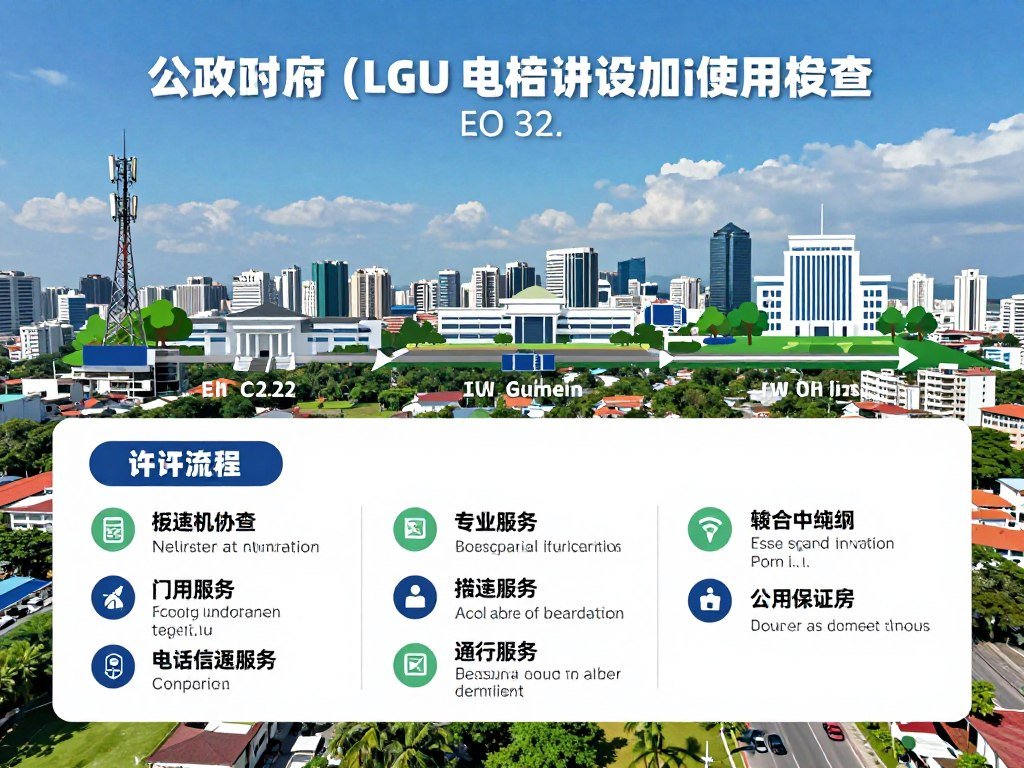
EO 32 gives LGUs a framework for processing telecom and internet infrastructure applications on prescribed timelines. The order aims to make permits more predictable and prevent application backlogs.
EO 32 directs government units to follow set processing timelines and use streamlined requirements. It also seeks to reduce delays that can hold up telecommunications projects.
What Executive Order 32 asks LGUs to do
Issued in 2023, Executive Order 32 sets a national approach to local permitting. Its goal is to help applications move through government offices without avoidable waiting.
The order focuses on three practical measures:
- Process telecom and internet applications within prescribed timelines.
- Use streamlined requirements for permits and approvals.
- Prevent backlogs from building up in local offices.
Globe reported a 20% improvement in permit processing and issuance from 2022 to mid-2024 under EO 32. That figure reflects a reported change in processing, not a guarantee that every LGU or application moves at the same pace.
How shared tower-license terms changed
A shared tower license covers the use of a telecommunications tower by more than one provider. In 2025, the license term increased from five years to 15 years.
The longer term can give tower arrangements a more stable basis, while local permits still govern project processing. These measures address different parts of infrastructure planning.
| Measure | Period | Rule or result |
|---|---|---|
| EO 32 | Issued in 2023 | Prescribed timelines for local applications |
| Permit-processing improvement | 2022 to mid-2024 | Globe reported a 20% improvement |
| Shared tower-license term | Changed in 2025 | Increased from 5 years to 15 years |
The longer shared tower-license term is a separate measure from the local permit-processing timeline.
Why Do Local Telecom Applications Still Face Delays?
A national processing framework does not prevent delays when local requirements and systems differ. Local implementation can affect how quickly a telecom application moves from review to approval.
Requirements vary among LGUs, and some areas have lacked electronic business one-stop-shops. Globe has said permitting is a critical step between network planning and deployment.

Why LGU processing can differ
Applicants may face different forms, fees, and submission routes in different cities or municipalities. Missing online one-stop-shops can add visits and paper handling.
Globe has also raised concerns about excessive fees and redundant documents. These barriers can slow infrastructure development even when national efforts aim to make approvals more predictable.
- Varying requirements among local government units.
- Missing electronic business one-stop-shops in some areas.
- Excessive fees that add cost to applications.
- Redundant documents that repeat information already filed.
Antipolo City, Bacoor City, and parts of Metro Manila have taken steps to simplify permitting. Globe has called for uniform standards, simpler requirements, and lower fees across local government.
What applicants should verify locally
Globe telecom tower permit requirements in the Philippines in 2026 depend on the relevant LGU’s implementation. A Globe telecom tower permit application falls under the local process governed by EO 32 timelines.
Applicants should confirm the current Globe telecom tower permit form and checklist with the LGU because requirements can vary. Globe has also called for onboarding workshops with LGUs and homeowners’ associations, which can help clarify local steps.
A single nationwide application form or checklist should not be assumed. Confirm the current checklist, fees, and submission route directly with the LGU handling the application.
How Much Is Globe Investing in Network Expansion?
Globe’s first-half 2026 capital expenditures reached P26.3 billion, and most of that amount was allocated to data-related initiatives. Data-related work received 91% of the total.
The P26.3 billion figure describes capital spending, not the number of projects completed. Capital expenditures fund network and data-related initiatives, including work that supports network expansion.

Globe’s investment commitment comes as local permits shape how quickly planned projects can proceed. Spending can support equipment, network capacity, and other data-related work, but it does not show that construction has finished at each planned site.
The 91% allocation points to the large share directed toward data initiatives. It does not mean every data project serves the same purpose or reaches customers on the same schedule.
Permitting is one part of the timing. Construction and deployment are separate steps, so a spending total cannot stand in for a count of built sites or installed fiber lines.
For a clear view of progress, investment and deployment figures answer different questions. The spending figure measures investment, while site and line counts measure deployment.
What Network Infrastructure Did Globe Deploy?
Globe’s first-half rollout included both 5G site construction and new FTTH connections. Those half-year results cover mobile sites and fixed broadband lines.
In the first half of 2026, Globe deployed 878 new 5G sites and 80,052 FTTH lines. Its longer-term totals cover construction and fiber deployment since 2021.

New 5G sites in the first half of 2026
The 878 new sites are mobile network additions reported for the first six months of 2026. A site supports wireless service, while a fiber line connects fixed broadband to homes.
Fiber lines and longer-term construction
Since 2021, Globe has constructed over 4,000 cell towers and deployed more than 3 million FTTH lines. These are cumulative totals, not figures for the first half of 2026 alone.
| Network measure | Period | Reported deployment | Network type |
|---|---|---|---|
| New 5G sites | First half of 2026 | 878 | Mobile |
| FTTH lines | First half of 2026 | 80,052 | Fixed |
| Cell towers | Since 2021 | Over 4,000 | Mobile |
| FTTH lines | Since 2021 | More than 3 million | Fixed |
The figures describe different network types and time spans. The first two rows report a half-year period; the last two give totals accumulated since 2021.
Cell towers and 5G sites are related to mobile service, but the reported measures are not interchangeable. Fiber lines instead serve fixed connections to homes and other locations.
Keep the reporting periods distinct when comparing the half-year and since-2021 totals.
Where Has Globe Reported 5G Coverage Above 98%?
Globe’s reported outdoor 5G population coverage exceeded 98% in Metro Manila and key cities in the Visayas and Mindanao. The figure applies outdoors, not to every room or address.
Outdoor population coverage does not guarantee identical indoor reception or service at each location. Building materials, local conditions, and a device’s network support can affect what a user receives.
Coverage figures help describe service across a population area, but they do not promise equal signal strength in every neighborhood. Residents checking a specific address should keep the distinction between outdoor coverage and indoor reception in mind.
Use this short checklist when assessing a location:
- Verify the exact locality or address.
- Distinguish outdoor coverage from indoor reception.
- Check device and network compatibility.
For more reporting on technology and connectivity, readers can follow the site’s technology and news updates.
Check availability at the specific address rather than assuming a regional figure guarantees indoor service.
Who Leads Globe Telecom and Who Owns It?
Carl Raymond R. Cruz is Globe Telecom’s president and CEO. He was re-elected to the company’s board on April 21, 2026.
Ayala Corporation and Singtel are Globe Telecom’s principal shareholders. That identifies its main shareholders, not a complete ownership breakdown.
Globe Telecom is headquartered at The Globe Tower, 2608 7th Avenue, Bonifacio Global City, Taguig, Metro Manila, Philippines. The address is its corporate headquarters.
The company had 63.1 million subscribers as of November 2025, the most among telecommunications networks in the Philippines at that time. That figure gives a snapshot of its scale, rather than a current subscriber count.
ST Telemedia Global Data Centres Philippines operates Globe’s data center business through a joint venture involving Ayala Corporation and Singapore-based STT GDC. It is relevant to Globe’s data center operations, not a full list of companies connected to the group.
The Globe Tower is the corporate headquarters, so customers should not assume it is a walk-in service center.
For customer support, use Globe’s official customer-service channels rather than assuming the corporate headquarters is a walk-in service location.
Conclusion
Predictable permitting gives network plans a clearer path toward construction. Cooperation between LGUs and telecom providers can reduce administrative friction and help planned infrastructure move through local review.
That coordination matters because network planning, local approvals, and construction happen at different stages. A clear process can help both applicants and local officials understand what comes next.
Anyone tracking a local project can check the relevant LGU’s current process and published application requirements. This is the most direct way to learn which local steps apply to a specific telecom project.
Check the relevant LGU’s current telecom-infrastructure application process for the latest local requirements.
FAQ
What is happening to Globe right now in the Philippines?
Globe is seeking faster LGU permitting as it expands its network in the Philippines. In the first half of 2026, the company recorded P26.3 billion in capital expenditures, with 91% allocated to data-related initiatives. It also deployed 878 new 5G sites and 80,052 FTTH lines. Those approvals and spending figures do not mean every planned project has reached construction.
Is Globe Telecom a Filipino company?
Globe Telecom is a Philippines-headquartered telecommunications company, with its main office in Taguig, Metro Manila. Its principal shareholders are Ayala Corporation and Singtel. That description names its principal shareholders, not every investor or a full breakdown of ownership. Globe serves customers across the country through mobile and fixed broadband services.
What is the address of Globe Telecom’s main office?
Globe Telecom’s main office is The Globe Tower, 2608 7th Avenue, Bonifacio Global City, Taguig, Metro Manila, Philippines. The address identifies the company’s corporate headquarters. It should not be treated as a walk-in customer-service location. Customers who need help with an account or service should use Globe’s official customer-service channels.
Who is the CEO of Globe Telecom Philippines?
Carl Raymond R. Cruz is Globe Telecom’s president and CEO. He was re-elected to the company’s board on April 21, 2026. His role places him at the head of the company’s leadership, while the board oversees corporate governance. The board re-election date is distinct from his title as president and CEO.
Where is the Globe Tower located?
The Globe Tower is in Bonifacio Global City, Taguig, Metro Manila. Its full street address is The Globe Tower, 2608 7th Avenue, Bonifacio Global City, Taguig, Metro Manila, Philippines. It serves as Globe Telecom’s headquarters. Customers looking for help with mobile or broadband service should contact Globe through its official support channels instead.
Where can I contact Globe Telecom?
Customers can contact Globe Telecom through its official customer-service channels. The Globe Tower address in Bonifacio Global City is the company’s corporate headquarters, not a confirmed walk-in support desk. Using official support options helps customers reach the right team for account, billing, or service concerns. The appropriate channel can depend on the type of help needed.
What companies are under Globe Telecom?
ST Telemedia Global Data Centres Philippines operates Globe’s data center business through a joint venture involving Ayala Corporation and Singapore-based STT GDC. That company is connected to Globe’s data center operations. It should not be read as a complete list of all companies or business interests associated with Globe Telecom and its shareholders.
Who are the owners of Globe?
Ayala Corporation and Singtel are Globe Telecom’s principal shareholders. They are the main shareholders named in the company profile, but that does not provide an exhaustive ownership breakdown. Globe is headquartered in the Philippines and operates telecommunications services there. Ownership details and day-to-day company leadership are separate matters.