How to Use AI for a Pet Grooming Business
Running a pet grooming business means juggling bookings, reminders, no-shows, coat notes, product orders, and a waiting room full of dogs, all while your hands are wet and your phone is ringing. AI can take a surprising amount of that admin off your plate, and in 2027 the tools are cheap and simple enough for a one-person salon to use.
The trick is to start with the jobs that eat your time but do not need your hands. Booking, reminders, and follow-up messages are the obvious first wins, because they happen every day and directly affect how many empty slots you have. Once those run smoothly, AI can help with pricing, marketing, and keeping track of every dog’s coat, skin, and temperament.
This guide walks through the whole setup step by step, from picking your first tool to measuring whether it is actually saving you time. You do not need to do everything at once.
Key takeaways
- Start with AI booking and reminders, because missed appointments and no-shows are the biggest hidden cost in a grooming salon.
- Keep a digital profile for every dog, with coat type, skin issues, temperament, and owner preferences, so AI reminders and recommendations stay accurate.
- Use AI to draft messages and social posts, but always read them before sending so they sound like you, not a robot.
- Track one number from the start, such as no-shows per month or rebooking rate, so you can tell whether the tools are paying off.
- Never let AI make decisions about a dog’s health or safety; flag skin problems, lumps, and behaviour changes to the owner and, when needed, a vet.
Step 1: Map the jobs that eat your time
Before you buy anything, spend one week writing down every admin task you do and how long it takes: booking calls, confirmations, rescheduling, price quotes, social media, ordering shampoo, and reminders. Most groomers discover that admin takes ten to fifteen hours a week, which is time that could be spent grooming.
Rank the list by time spent and by frustration. The tasks at the top are your first AI targets, and they are usually the same for every salon: bookings, reminders, and messages. This list also stops you buying tools you do not need, because you can check every new app against one question: does it remove something from this list?
Step 2: Set up AI online booking
Online booking is the single biggest time saver in a grooming business. Instead of phone tag, owners pick a service, pick a slot, and pay a deposit, while the system checks your calendar, blocks the right amount of time for the breed and coat, and sends a confirmation. AI booking tools go a step further by suggesting the right service length based on the dog’s breed and last groom, and by offering waitlist slots when a cancellation opens.
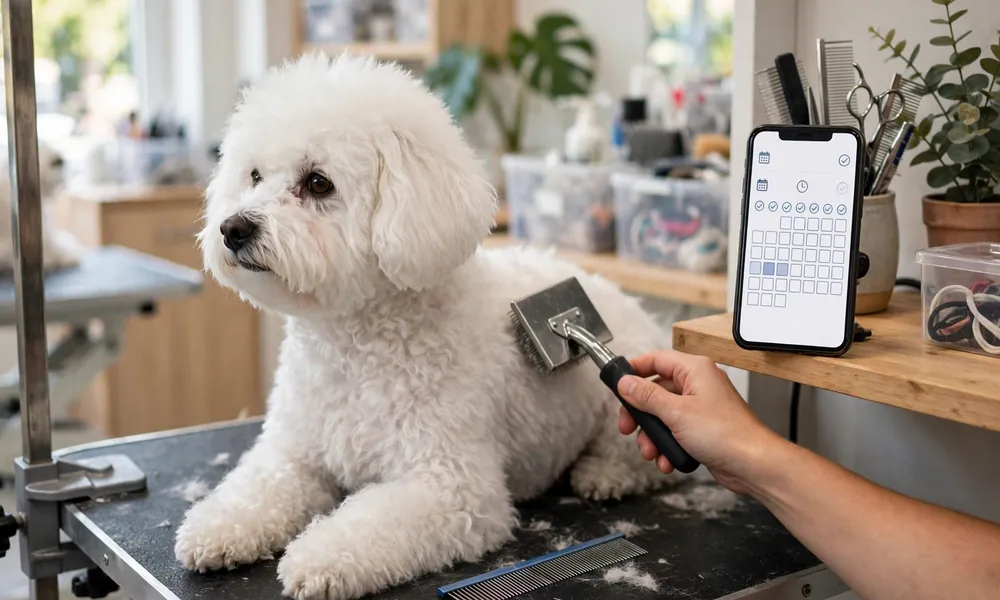
Set your services clearly, with honest time blocks: a full groom for a large doodle is not the same as a bath for a short-coated terrier, and underestimating the time is how salons end up running late all day. Ask for the dog’s breed, size, and coat condition at booking, and let the tool use that to set the slot length. Our guide to the best online booking software compares the leading options for small service businesses.
Step 3: Automate reminders and reduce no-shows
No-shows are the most expensive problem in grooming, because an empty slot cannot be sold twice. AI reminder tools send a confirmation a few days before the appointment and a reminder the day before, and they learn the best time to send them based on when your clients actually reply. Owners can confirm, reschedule, or cancel with one tap, and a cancelled slot can be offered automatically to someone on the waitlist.
Write the messages in your own voice and keep them short: the dog’s name, the date and time, and one clear action. A deposit or a cancellation policy also helps, and the booking tool can collect both automatically. Aim to cut no-shows by half within the first month; if the numbers do not move, try a different reminder time or channel, because some clients read texts and others only read email.
Step 4: Build a digital profile for every dog
A grooming business lives or dies on remembering the details: which shampoo irritates the spaniel’s skin, which clipper setting the poodle’s owner prefers, which terrier snaps when its paws are touched. Paper cards get lost and memory fades, but a simple digital profile keeps it all in one place, and AI can use it to flag things you might miss, like a dog due for a de-shedding treatment or a coat that has matted since the last visit.
After every appointment, spend two minutes updating the profile: coat condition, skin notes, temperament, products used, and what the owner asked for next time. Over a few months this becomes a genuinely useful record, and it lets you give personalised recommendations, such as a shorter summer cut or a soothing shampoo for dry skin. Keep the notes factual and kind, and never record a health diagnosis; that is a vet’s job, not a groomer’s.
Step 5: Use AI to handle messages and follow-ups
Owners message at all hours: price questions, availability checks, photos of a matted coat asking whether it can be saved. An AI assistant can answer the routine questions instantly, using your price list and your calendar, and pass the tricky ones to you with a summary. That means fewer missed enquiries and faster replies, which is often the difference between winning a new client and losing them.
Set clear boundaries: the assistant should never promise a result you cannot deliver, never quote a price for a dog it has not seen, and never give health advice. Draft replies in your tone, review them before they go out for the first few weeks, and keep a human in the loop for anything sensitive. A good follow-up message after the groom, asking how the dog settled and when to book next, is one of the cheapest ways to win repeat business.
Step 6: Let AI help with marketing and rebooking
Most grooming salons get new clients from word of mouth and local search, and AI can help with both. It can draft social media posts from the photos you already take, suggest the best time to post, and remind you to ask happy owners for a review. It can also spot clients who have not booked in a while and draft a gentle nudge, offering a slot that fits their usual pattern.
Keep the marketing honest and personal. Use real photos of real dogs you groomed, with the owner’s permission, and write captions that sound like you. AI should draft and organise, not invent: never let it claim a result you did not achieve or post a photo of a dog that is not yours. One genuine before-and-after post a week will do more for your bookings than a flood of generic content. To keep track of these client relationships in one place, our roundup of the best CRM software for small business covers the tools that work well for service businesses like yours.
Step 7: Price smarter and watch the numbers
AI can help you see which services actually make money and which ones quietly lose it. A large, matted doodle that takes three hours should not cost the same as a quick bath for a small terrier, and a tool that tracks time, products used, and revenue per appointment will show you the gaps. Use that data to adjust your price list once or twice a year, and to spot your most profitable services.
Start with three numbers: no-shows per month, rebooking rate, and average revenue per appointment. Check them monthly and compare them with the month before you started using AI tools. If no-shows fall and rebooking rises, the tools are paying for themselves; if nothing moves after two months, revisit your reminder timing and booking flow before buying something new.
Troubleshooting: when AI tools go wrong
The most common problem is a booking tool that lets owners book the wrong service or the wrong amount of time, which leaves you running late. Fix it by tightening the service descriptions, adding breed and size questions, and blocking a buffer of ten to fifteen minutes between appointments. Another common problem is reminders that go to the wrong number or email, usually because the contact details were typed in wrong at booking; a quick check at the first visit prevents most of this.
Sometimes the AI messages sound stiff or generic, and clients notice. That is a sign to rewrite the templates in your own words and keep the messages short. And sometimes a tool simply does not fit your salon: if you have tried it properly for a month and it still creates more work than it saves, cancel it and try a simpler one. The goal is less admin, not more software.
Checklist: before you switch on AI tools
- Write down your weekly admin tasks and pick the top three to automate first.
- Choose one booking tool and set honest time blocks for every service and breed size.
- Collect a deposit and a cancellation policy, and put both in the booking flow.
- Create a digital profile template for every dog, with coat, skin, temperament, and owner notes.
- Draft your reminder and follow-up messages in your own voice, and review AI replies for the first few weeks.
- Pick three numbers to track monthly, such as no-shows, rebooking rate, and revenue per appointment.
Frequently asked questions
How much does AI cost for a small grooming salon?
Most useful tools cost between $20 and $100 a month, and many offer a free trial. Booking and reminder tools usually pay for themselves if they prevent even two or three no-shows a month.
Will AI replace the personal touch my clients love?
No, if you use it well. AI should handle the admin so you have more time and attention for the dogs and their owners, not less. The personal touch is remembering a dog’s name and quirks, and a good digital profile helps you do that better.
Do I need to be technical to use AI tools?
No. The tools aimed at small service businesses are designed for owners, not developers, and most can be set up in an afternoon. If you can use a smartphone and a calendar app, you can use these tools.
What about owner privacy and their dogs’ data?
Only collect what you need, keep it in one secure system, and do not share owner details with anyone. Ask owners for permission before posting photos of their dogs online.
Can AI help me find new clients?
Yes, mainly by making you easier to find and easier to book: a clear online booking page, quick replies to enquiries, and regular reviews all help local search. AI can draft the posts and reminders, but the work still has to be good.
What should AI never do in my salon?
It should never diagnose a health problem, promise a grooming result you cannot guarantee, or make a decision about a dog’s safety. Skin problems, lumps, pain, and aggression should always be flagged to the owner, and health questions should always go to a vet. For a broader look at the AI tools small businesses use, see our guide to the best AI tools.
The bottom line
AI will not groom a single dog for you, and it should not try. What it can do is quietly remove the admin that eats your evenings: bookings that sort themselves out, reminders that cut no-shows, profiles that remember every coat and quirk, and follow-ups that bring clients back. Start with booking and reminders, add digital profiles next, and only then spend time on marketing.
Keep it simple, keep it in your own voice, and keep a human in charge of every decision that involves a living animal. Done that way, AI is not a gimmick for a grooming salon.