
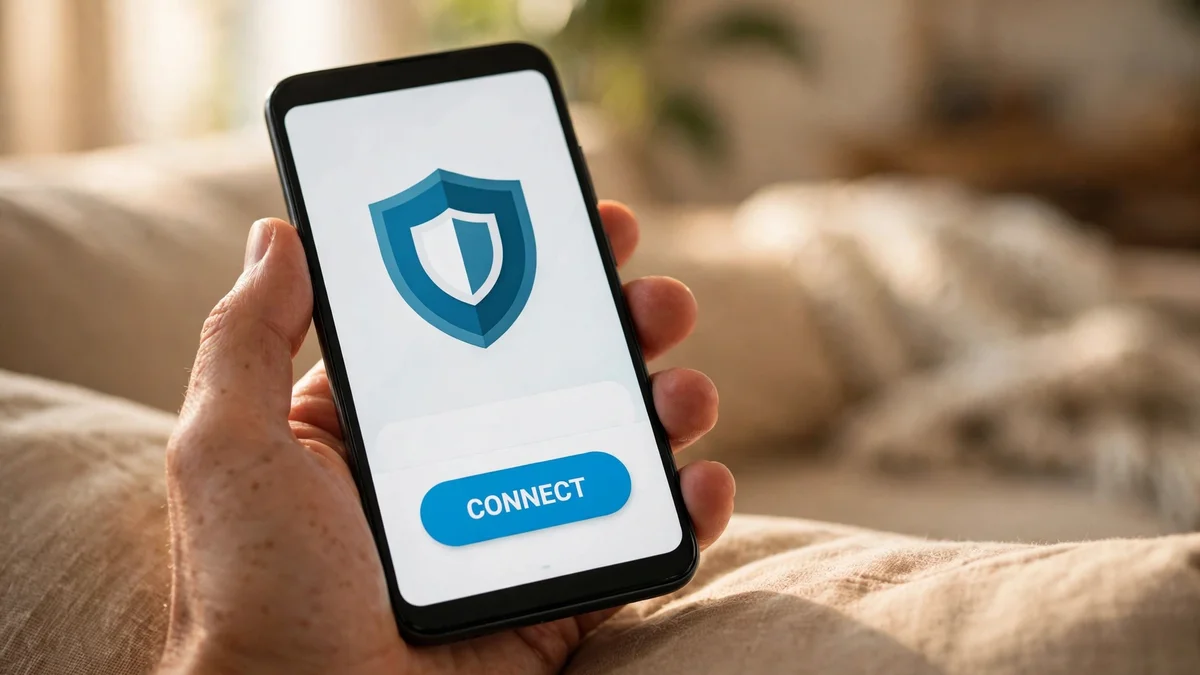
Learning how to use a VPN on Android takes about five minutes, and it is one of the simplest ways to protect your privacy on a phone. A virtual private network encrypts the traffic leaving your device, so the Wi-Fi network and your internet provider cannot easily see which sites you visit. On public Wi-Fi in cafes, airports and hotels, that protection matters most.
Android has built-in VPN support, and most providers offer their own app on Google Play, so you rarely need manual settings. You install the app, sign in, pick a server and tap connect. A small key icon then appears in the status bar while the encrypted tunnel is active.
This guide covers the full setup, from choosing a trustworthy app to turning on the kill switch and checking the VPN is actually working. It also covers manual setup and the most common problems.
Key takeaways
- Install your VPN from Google Play or the provider’s official app, and sign in before you connect.
- Android asks for permission the first time an app creates a VPN connection; approve it once and it will not ask again.
- Pick a server close to you for the best speed, and switch locations only when you need a specific country.
- Turn on the kill switch and always-on VPN so traffic never leaks if the connection drops.
- Check your IP address after connecting to confirm the VPN is active before you trust it on public Wi-Fi.
At a glance: using a VPN on Android
| Detail | What to know |
|---|---|
| Setup time | About 5 minutes with an app, about 10 minutes manually |
| Easiest method | Install the provider’s app from Google Play |
| Android versions | Works on Android 8 and later; settings names vary slightly by brand |
| What it protects | Traffic from apps and browsers on Wi-Fi and mobile data |
| What it does not do | It does not make you anonymous or replace antivirus software |
| Speed impact | Usually a small drop; nearest servers are fastest |
| Key settings | Kill switch, always-on VPN, and auto-connect on untrusted Wi-Fi |
Step 1: Choose and install a VPN app
Start by choosing a provider you trust, because it can see your traffic in the same way your internet provider could before. Look for a clear no-logs policy, independent security audits, modern encryption such as WireGuard or OpenVPN, and regular app updates. Free VPNs can work occasionally, but many limit speed, data or servers, so read the privacy policy first.

Open Google Play, search for the provider by name, and check that the developer name matches the official company before tapping install. Avoid lookalike apps with few downloads. Once installed, open the app and sign in with your subscription account. If you are still comparing providers, our roundup of the best VPNs for Android compares the leading apps on speed, privacy and price.
Do not install VPN apps from random websites or third-party stores. A fake VPN app is worse than no VPN at all, because it can see everything you do online. Stick to Google Play, keep the app updated, and uninstall any VPN app you no longer use.
Step 2: Sign in and allow the VPN connection
After signing in, the app will ask you to allow it to set up a VPN connection. Android shows a system dialog the first time any app requests this, warning that the app can monitor network traffic. That warning is normal for every VPN app. Tap Allow or OK to continue.
Some apps then ask which protocol to use or whether to connect automatically on untrusted Wi-Fi. Accept the defaults unless you have a reason to change them. WireGuard is usually fastest, while OpenVPN is the most widely supported.
If the permission dialog does not appear, check that you are signed in and that the app can run in the background. On Samsung, Xiaomi and other customised versions of Android, battery optimisation can block VPN apps. Open Settings, find the app under Apps, and allow background activity so the connection stays alive.
Step 3: Pick a server and connect
Tap the large connect button, often labelled Quick Connect, and the app will choose a server for you. For the best speed, let it pick the nearest server, usually in your own country or a neighbouring one. Only choose a faraway location when you have a specific reason to appear there.
Most apps also let you pick a country and city from a server list, and some mark servers for streaming or peer-to-peer traffic. Unless you need one of those, a standard server is fine. After a second or two, the app should show Connected, with a small key icon in the status bar.
Leave the VPN connected while you browse, bank or shop, and disconnect when you no longer need it, for example on your trusted home network. Many people leave it on all day, which is fine if the speed is acceptable.
Step 4: Turn on the kill switch and always-on VPN
A VPN only protects you while it is connected, so the most important setting handles drops. Open the app’s settings and turn on the kill switch, which blocks all internet traffic if the VPN connection fails. Without it, your phone quietly falls back to an unprotected connection and you may never notice.
Next, turn on always-on VPN in Android itself. Go to Settings, then Network and internet, then VPN, tap the gear icon next to your VPN profile, and enable Always-on VPN. On the same screen, enable Block connections without VPN, which stops any traffic outside the tunnel.
Also look for an auto-connect option, which starts the VPN whenever you join an untrusted Wi-Fi network, where you might otherwise forget to connect. Our guide to the best VPN for privacy in 2027 explains which providers offer the strongest kill switch and no-logs protections.
Step 5: Check that your VPN is working
Before you trust the connection, verify it. With the VPN connected, search for what is my IP address and note the location shown. It should match the server country you selected, not your real city. If it still shows your home city, disconnect and reconnect, or try a different server.
Also run a DNS leak test from your browser. A leak means your DNS requests, which reveal the sites you visit, are going to your internet provider instead of through the VPN. If a test shows your provider’s DNS servers, switch protocols in the app or contact the provider’s support.
Finally, test your speed with the VPN off, then again with it on and connected to a nearby server. A drop of 10 to 20 percent is normal. If speeds fall by half or more, try a different server in the same country or switch from OpenVPN to WireGuard.
Step 6: Set up a VPN manually without an app
You can also set up a VPN without an app, which is useful for a work VPN or a server you run yourself. You need the server address, your username and password, and the protocol details from your provider or IT administrator. Go to Settings, then Network and internet, then VPN, tap the plus icon, and fill in the name, type and server address.
Android supports IKEv2, L2TP/IPSec and PPTP, although PPTP is outdated and should be avoided because its encryption is weak. After saving the profile, tap it, enter your credentials and tap Connect. The same key icon appears in the status bar.
Manual setup gives you fewer features than an app: no kill switch, no server list, and no auto-connect rules. Use it when your employer requires it or you only need one fixed server. For everyday privacy, the app is easier and safer, because it keeps everything up to date for you.
Troubleshooting: common VPN problems on Android
If the VPN will not connect, first check your internet without it, then restart the app and try a different server. Switching protocols often fixes stubborn connections, especially on restricted networks that block VPN traffic. If the app keeps crashing, clear its cache in Settings under Apps, or reinstall it.
If the VPN connects but websites will not load, the cause is often a DNS problem or an overloaded server. Try another server in the same country, restart the VPN, and check that private DNS is set to Automatic. Some ad blockers and firewalls also use Android’s VPN slot, and only one VPN connection can run at a time.
Battery drain and slow speeds usually come from a weak server or a phone that keeps switching between Wi-Fi and mobile data. Connect to a nearer server and turn the VPN off on a trusted home network. A VPN is one layer of protection, not a complete security setup, so pair it with the best antivirus for Android if you want malware scanning too.
Checklist: using a VPN on Android safely
- Install the VPN only from Google Play or the provider’s official site.
- Approve the system VPN permission once, and check for the key icon in the status bar.
- Turn on the kill switch and always-on VPN with blocked connections without VPN.
- Use the nearest server for speed, and change location only when you need to.
- Verify your IP address and run a DNS leak test after the first connection.
- Keep the app updated, and remove VPN apps you no longer use.
Frequently asked questions
Is using a VPN on Android legal?
Using a VPN is legal in most countries, including the United States, the United Kingdom and most of Europe, for ordinary privacy and security. A VPN does not make illegal activity legal, and a few countries restrict VPN use, so check local rules before you travel.
Does a VPN slow down my Android phone?
A VPN adds a small amount of overhead because traffic is encrypted and routed through a server. On a nearby server you may not notice it. If speeds drop sharply, switch to a closer server or to WireGuard.
Can I use a free VPN on Android?
Yes, and some reputable providers offer a limited free plan, but free VPNs usually cap data, speed or servers. Avoid free apps with no clear company or privacy policy, because running a VPN costs money and an app with no visible business model may be selling your data.
Why does Android show a key icon when my VPN is on?
The key icon means a VPN is active and routing your traffic. If you see it and did not turn on a VPN, check Settings under Network and internet, then VPN, to see which app or profile is connected.
Should I leave my VPN on all the time?
Leaving it on is safe and gives continuous protection, especially if you move between Wi-Fi networks during the day. If you only use a VPN on public Wi-Fi, auto-connect on untrusted networks gives you most of the benefit without running it at home.
Can I use two VPN apps on Android at the same time?
No, Android allows only one active VPN connection at a time. If you connect a second VPN app, the first one disconnects. The same limit applies to apps that use the VPN slot for other features, such as some ad blockers.
The bottom line
Using a VPN on Android comes down to three habits: install a trustworthy app, connect to a nearby server, and turn on the kill switch and always-on VPN so the protection never silently drops. The key icon in your status bar then tells you at a glance that your traffic is encrypted.
Take five minutes to verify the setup with an IP check and a DNS leak test. The VPN will protect you on public Wi-Fi, on mobile data and on any network you do not control, which is exactly where an Android phone needs it most.



