Isomorphic Labs has raised $5 billion in a Series C funding round, the largest single financing ever secured by a drug-discovery company, as Alphabet’s artificial intelligence unit pushes its first AI-designed medicines toward human trials. The London-based company announced the round on 17 November 2026, six months after closing a $2.1 billion Series B in May.
The round was co-led by Greenoaks and Sequoia Capital, with Andreessen Horowitz joining as a new investor and Alphabet continuing what the company described as a significant investment. Every existing investor also took part, including Thrive Capital, MGX, GV, CapitalG, Temasek and the UK Sovereign AI Fund.
The size of the raise says as much about AI drug discovery as it does about one company. Isomorphic has now pulled in roughly $7.7 billion in external funding since 2025, a sum unthinkable for a preclinical biotech firm a decade ago. The question is whether that capital can shorten the long road from a molecule designed on a computer to an approved medicine.
Key takeaways
- Isomorphic Labs raised $5 billion in a Series C announced on 17 November 2026, co-led by Greenoaks and Sequoia Capital.
- The round came just six months after a $2.1 billion Series B, taking external funding since 2025 to about $7.7 billion.
- Andreessen Horowitz joined as a new investor, while Alphabet and all existing investors, including Thrive Capital and Temasek, also participated.
- The money will fund Isomorphic’s IsoDDE drug-design engine, its internal and partnered medicine pipeline, and new AI-led bioengineering infrastructure.
- No valuation was disclosed, and the company has not yet named a development candidate or started a clinical trial, so the science remains unproven in humans.
What the announcement actually says
Isomorphic Labs, spun out of Google DeepMind in 2021, describes itself as an AI company focused on designing and developing new medicines. Its announcement framed the Series C as an oversubscribed round, meaning demand from investors exceeded the amount the company set out to raise. The stated priorities are to advance its foundational simulation models, scale its internal and partnered medicine candidate pipeline, and build global AI-led bioengineering infrastructure.
The funding follows a clear pattern of acceleration. The Series B, announced in May 2026 and led by Thrive Capital, was itself $2.1 billion, at the time one of the largest biotech rounds on record. The Series C is roughly 2.4 times larger and arrived in half a year, a pace rare even in capital-hungry drug development. BioSpace reported that the $5 billion round breaks the industry record for the most money raised in a single round by a biotech company.
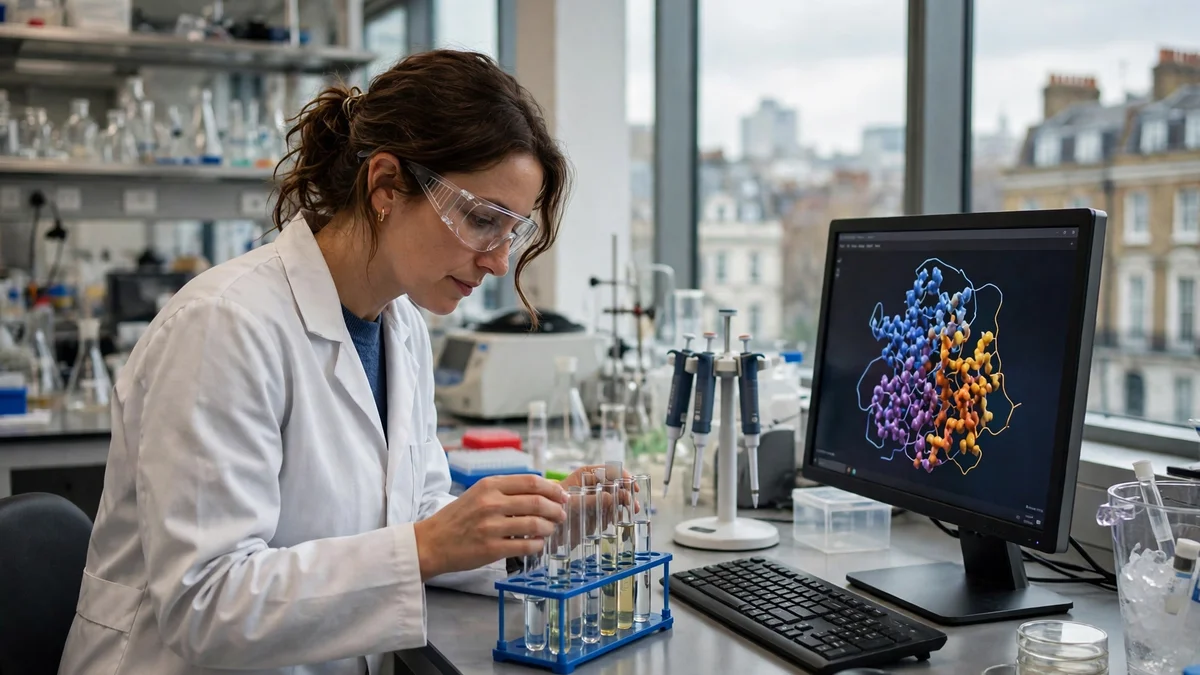
That pace is not an accident. Isomorphic’s work sits at the intersection of two of the most heavily funded areas in technology and life sciences: large AI models and drug discovery. Its platform, called IsoDDE, is a drug-design engine built on the protein-structure work DeepMind pioneered with AlphaFold. The idea is to simulate how a potential drug molecule interacts with its target, design better candidates on a computer, and only then test them in the laboratory. The company has said its oncology and immunology programmes have shown positive preclinical results, though it has not published the underlying data in detail.
The investor list also tells a story. Alongside the two co-leads, the round brought in Andreessen Horowitz for the first time and drew continued backing from Alphabet, the parent company that still owns a large stake. The participation of the UK Sovereign AI Fund underlines the strategic interest governments now take in AI drug discovery, while the return of every existing investor suggests the company’s backers are willing to keep doubling down before a single product reaches patients. For context on how the wider industry is thinking about AI timelines, the Novartis chief executive has said AI could cut four years from drug development.
Why the money matters for pharma R&D
Drug discovery is famously slow and expensive. A new medicine typically takes more than a decade to reach the market and costs well over $1 billion in research and development, with most candidates failing along the way. The promise of AI-first drug discovery is to attack the earliest, most failure-prone stage: choosing which molecules to test at all. If a model can predict how a molecule will behave before it is synthesised, researchers can discard dead ends faster and spend laboratory time on the candidates most likely to work.
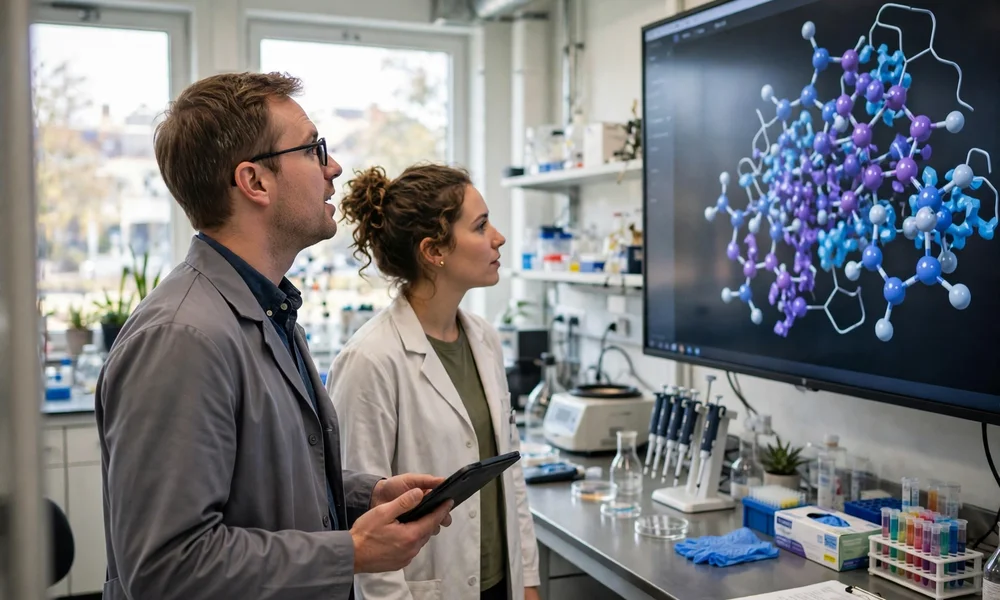
Isomorphic is not working alone. It has partnerships with three of the world’s largest pharmaceutical companies: Eli Lilly, Novartis and Johnson & Johnson. Those deals matter because they give the company’s platform access to real disease targets, real patient data and, eventually, real clinical-trial infrastructure. A drug-design engine is only as good as the problems it is pointed at, and the partnerships are the mechanism by which its models get tested against the hardest problems in medicine.
The scale of the capital also changes what the company can attempt. Five billion dollars buys compute, but it also buys wet-lab capacity, the physical laboratories where AI-designed molecules are synthesised and tested, and the specialist staff to run them. The company’s language about “AI-led bioengineering infrastructure” points to exactly that: a loop in which models design molecules, laboratories test them, and the results feed back into the models. Progress in adjacent AI biology is moving fast too, and OpenAI has said its GPT-6 models show intrinsic protein-design capabilities, a reminder that Isomorphic is competing in a field where the underlying technology is advancing on several fronts at once.
The background: from DeepMind spinout to record fundraiser
Isomorphic Labs was founded in 2021, spun out of DeepMind, the Alphabet AI lab best known for AlphaFold, the system that solved the decades-old problem of predicting a protein’s three-dimensional structure from its amino-acid sequence. That breakthrough, which earned DeepMind’s Demis Hassabis a Nobel Prize in Chemistry in 2024, gave the new company a scientific foundation few biotech startups could match.
The company’s first years were quiet by design. It built its platform, signed its pharma partnerships and raised a $600 million Series A in 2025, before fundraising accelerated sharply in 2026. The $2.1 billion Series B in May was followed by the $5 billion Series C in November, a six-month doubling that mirrors the way capital has chased the most credible AI companies. Total external funding of about $7.7 billion since 2025 makes Isomorphic one of the best-funded private companies in either AI or biotech.
London, where the company is based, also benefits. The UK government has made life sciences and AI two of its strategic priorities, and the UK Sovereign AI Fund’s participation in the round is a direct expression of that policy.
The caveats that matter
The most important caveat is also the simplest: Isomorphic Labs has not yet put a drug into a human being. The company has not named a development candidate, the formal step at which a molecule is selected for safety testing and clinical trials. Its reported positive preclinical results come from laboratory and animal studies, which are a necessary but far from sufficient predictor of whether a drug will work in people. Most drug candidates that look promising in the laboratory still fail in the clinic.
The absence of a disclosed valuation is also worth noting. When a company raises $5 billion without announcing what the round values it at, outside observers cannot tell how much of the company investors bought. Private companies are under no obligation to disclose valuations, but it leaves a gap in the public picture, and any figure circulating in press reports should be treated as an estimate, not a confirmed fact.
There is also a broader question about whether AI drug discovery can deliver on its timeline promises. Designing a molecule that binds to a target is only one step. A drug must also be safe, stable, manufacturable at scale and effective in the messy reality of human biology, problems that simulation can inform but cannot yet solve on its own.
| Detail | What is known |
|---|---|
| Announced | 17 November 2026, London |
| Round size | $5 billion Series C |
| Co-leads | Greenoaks and Sequoia Capital |
| New investor | Andreessen Horowitz (a16z) |
| Continuing investors | Alphabet, Thrive Capital, MGX, GV, CapitalG, Temasek, UK Sovereign AI Fund |
| Previous round | $2.1 billion Series B, May 2026, led by Thrive Capital |
| Valuation | Not disclosed |
| Clinical status | No development candidate named; no drug in clinical trials yet |
None of this makes the raise a bad bet. It makes it a bet whose outcome will not be known for years, which is the normal condition of drug development. The difference is the size of the stake and the speed at which it has grown.
Checklist: reading this funding news honestly
Use these checks before drawing conclusions from the headline figure.
- Separate the round size from the science: $5 billion is a financing fact, not evidence that a drug works.
- Look for a named development candidate and a clinical-trial start date, the first verifiable milestones.
- Remember the valuation was not disclosed, so any reported figure is an estimate, not a confirmed fact.
- Weigh the pharma partnerships: Eli Lilly, Novartis and Johnson & Johnson give the platform real targets to test against.
- Compare with the Series B: the round is about 2.4 times larger and came six months later, which signals investor confidence but also raises expectations.
- Watch for published preclinical data, not just company statements, before judging the platform’s results.
Frequently asked questions
How much did Isomorphic Labs raise in its Series C?
Isomorphic Labs raised $5 billion in a Series C announced on 17 November 2026. The round was co-led by Greenoaks and Sequoia Capital, with Andreessen Horowitz joining as a new investor and Alphabet continuing its investment.
What is Isomorphic Labs?
Isomorphic Labs is an AI drug-discovery company spun out of Google DeepMind in 2021 and owned by Alphabet. It builds AI models that design potential new medicines, using its IsoDDE drug-design engine, and works with pharmaceutical partners including Eli Lilly, Novartis and Johnson & Johnson.
How does the Series C compare with the Series B?
The Series C, at $5 billion, is roughly 2.4 times the $2.1 billion Series B announced in May 2026, which was led by Thrive Capital. The two rounds came just six months apart, taking the company’s external funding since 2025 to about $7.7 billion.
What will the money be used for?
According to the company, the funding will advance its foundational simulation models, scale its internal and partnered medicine candidate pipeline, and build global AI-led bioengineering infrastructure. Its early focus is on oncology and immunology programmes.
Has Isomorphic Labs put a drug into clinical trials?
Not yet. The company has reported positive preclinical results but has not named a development candidate or started a clinical trial. The first candidate entering human trials will be the key test of whether its AI-designed molecules work in patients.
Why are investors putting so much money into AI drug discovery?
Drug development is slow and expensive, with most candidates failing, so a technology that could pick better molecules earlier is commercially valuable. The bet is that AI models can shorten research timelines and improve success rates, though that has not yet been proven in the clinic. Readers weighing the tools in this space can compare our roundup of the best AI tools for medical research.
The bottom line
Isomorphic Labs’ $5 billion Series C is the largest drug-discovery financing ever raised, and it arrives as AI’s role in medicine moves from demonstration to industrial scale. The money, the investor list and the pharma partnerships all point in the same direction: the company now has the resources to test its drug-design engine at a scale no rival can easily match.
What it does not yet have is a drug in a human being, and that is the milestone that will decide whether the round is remembered as a turning point or a cautionary tale. Watch for the first named development candidate and the first clinical-trial filing.