John Deere has acquired Orchard AI, a San Francisco startup whose cameras count the fruit on every tree in an orchard, in a deal that pushes the farm machinery maker deeper into artificial intelligence. Deere announced the purchase of Orchard Robotics, which trades as Orchard AI, on 19 November 2026, and did not disclose the price.
The deal is about a shift in precision agriculture, from knowing what is happening in a field to knowing what is happening on a single plant. Orchard AI mounts AI-powered cameras on farm vehicles that capture hundreds of images of every tree, vine or plant on every pass through a field, and turns those images into fruit counts, yield estimates, fruit size and colour, and canopy measurements.
For growers of high-value crops such as apples, grapes, cherries and almonds, that level of detail is the difference between spraying a whole orchard and spraying only the trees that need it. Deere says the combination will let a grower spot the parts of an orchard with heavy bloom and receive a prescription for where to spray, delivered to a phone in the field or to the tractor’s screen.
Key takeaways
- John Deere announced on 19 November 2026 that it has acquired Orchard Robotics, operating as Orchard AI.
- Orchard AI’s vehicle-mounted cameras capture hundreds of images per tree or vine on every pass, producing fruit counts, yield estimates and canopy data.
- Financial terms were not disclosed, and Orchard AI will continue operating as a Deere subsidiary.
- The technology will be integrated with Deere’s equipment, including its G5 in-cabin display.
- The deal continues Deere’s nine-year run of buying computer vision, autonomy and robotics companies.
What Deere actually bought
Orchard AI, founded in 2022 by Charlie Wu, a computer science student who left Cornell University to become a Thiel Fellow, calls itself the AI farming company. Its product is FruitScope, a camera-based crop-scanning platform that mounts AI-powered cameras on farm vehicles and analyses the images to give growers a picture of every plant in their orchard or vineyard, all season long.
The system captures hundreds of images per tree on every pass, and the analysis produces yield estimates, fruit counts, fruit size and colour, and canopy measurements. That data is the raw material for decisions a grower makes throughout the season: how much fruit to expect, which blocks need attention, and where to spend money on spraying, thinning or irrigation.
Deere’s announcement says the deal combines Orchard AI’s detailed, plant-level crop insights with its own expertise in precision agriculture, equipment and farm technology. Tim Marquis, Deere’s director of farm systems innovation, said the acquisition connects crop-level intelligence with John Deere technology and equipment that can precisely execute the work in the field.
Orchard AI’s chief executive, Charlie Wu, and the FruitScope product will continue operating inside Deere, and the company will carry on under its own name as a Deere subsidiary, with its existing team and products. Deere has not set a timeline for integrating the technology into commercial equipment, and it has not disclosed the financial terms.
Why plant-level data changes farming
Precision agriculture has always been about resolution: the finer the picture, the better the decision. The first generation worked at the field level, telling a grower what was happening across a whole block. The second worked at the zone level, dividing fields into areas. Orchard AI works at the plant level, and that is a different kind of information, because a single orchard can contain trees in very different condition.

The practical payoff is in inputs. If a grower knows which trees have heavy bloom and which do not, spraying can be targeted rather than blanket, which saves chemicals, money and time, and reduces the environmental impact. Yield estimates per tree, rather than per field, also change how a grower plans labour, storage and sales, because the harvest can be forecast before it happens.
The labour and logistics side is easy to overlook but may matter as much as the spraying. A harvest forecast built from per-tree counts tells a grower how many pickers to hire, how much cold storage to reserve, and when to line up buyers, weeks before the fruit is ready. For a high-value crop, getting those calls wrong is expensive, and a forecast that is right is worth more than the cost of the cameras that produced it.
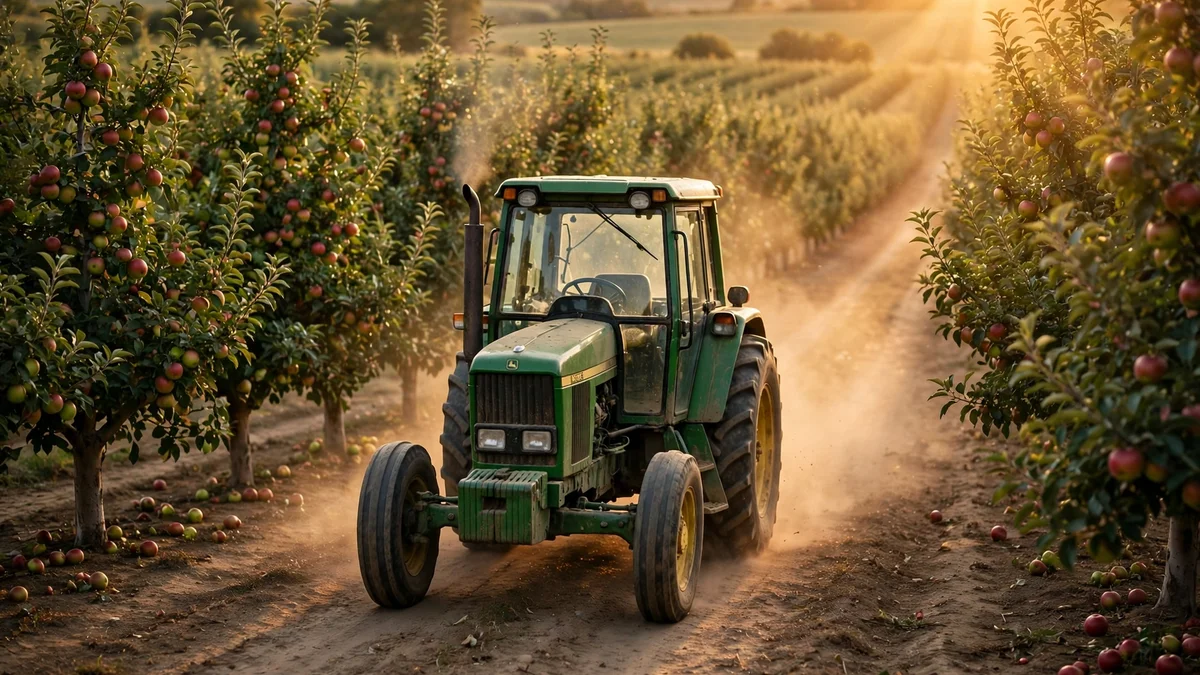
Deere’s advantage is that it owns the machines that do the work. The company can integrate Orchard AI’s software into its equipment offerings, including the G5 in-cabin display, so the intelligence and the action live in the same system. A prescription generated from camera data can go straight to the sprayer on the same vehicle, without a separate step.
For readers who follow how AI is being applied to practical, data-heavy work, our guide to the best AI tools for data analysis covers the software that turns large datasets into decisions, which is the same problem Orchard AI solves in the field.
The background: nine years of buying the future
The Orchard AI purchase continues a nine-year buying run in which Deere has acquired computer vision, autonomy and robotics companies. The best-known is Blue River Technology, bought in 2017, which became the basis for See and Spray, Deere’s system for targeting weeds with herbicide. Bear Flag Robotics, bought in 2021, brought autonomous tractors. Sentera, which supplies drone imagery and AI-powered crop intelligence, and GUSS Automation, which builds autonomous sprayers for orchards and vineyards, were both acquired in 2025.
The pattern is consistent: Deere buys a company that sees something, and then connects that vision to machines that act on it. Orchard AI fits the pattern exactly, because it sees every plant, and Deere builds the sprayers, tractors and displays that can act on what is seen.
The timing also matters. Deere announced the deal several days ahead of releasing its full-year 2026 financial results, which were due on 25 November, shortly after the opening bell. The company’s stock was down slightly the day after the announcement, trading around 613.66 dollars in morning trading on 20 November, down roughly 1.79 percent from the previous day, which suggests investors treated the deal as a strategic move rather than a financial event.
The specialty crop market is the right place for this technology. High-value crops such as grapes, tree fruit, cherries and almonds justify the cost of detailed sensing in a way that commodity grains do not, and the growers in those markets are the ones most likely to pay for plant-level intelligence.
The caveats that matter
The biggest caveat is the missing price. Deere has not disclosed the financial terms, so it is impossible to judge whether the company paid a fair price or an expensive one. The absence of a number is normal for a deal of this size, but it leaves the most basic question about the acquisition unanswered.
| Detail | What is known |
|---|---|
| Announced | 19 November 2026 |
| Acquired | Orchard Robotics, operating as Orchard AI, San Francisco |
| Price | Not disclosed |
| Founded | 2022, by Charlie Wu, a Cornell student who became a Thiel Fellow |
| Technology | Vehicle-mounted AI cameras; hundreds of images per tree per pass; FruitScope platform |
| Data produced | Fruit counts, yield estimates, fruit size and colour, canopy measurements |
| Integration | Into Deere equipment, including the G5 in-cabin display; no timeline disclosed |
| Deere results due | Fourth-quarter and full-year fiscal 2026, 25 November 2026 |
There is also no timeline for integration. Deere has not said when Orchard AI’s technology will appear in commercial equipment, and integrating a startup’s software into a machinery company’s product line is a slow job. Growers who want the technology will have to wait, and the wait could be measured in seasons rather than months.
Finally, the technology has to work in the real world, not just in demonstrations. Cameras on a moving vehicle, in dust, rain and changing light, have to produce reliable counts, and a yield estimate that is wrong is worse than no estimate at all. Orchard AI’s system has been tested with growers, but the scale of deployment inside Deere will be the real test.
Checklist: reading the Deere deal honestly
Use these checks before deciding what the acquisition means for farming.
- Remember the price is undisclosed: the deal cannot be judged on value until it is known.
- Separate the technology from the timeline: there is no disclosed date for commercial integration.
- Ask whether plant-level data actually changes decisions, or whether it is just more precise information about the same choices.
- Watch Deere’s full-year results on 25 November for any comment on the strategy.
- Look at the pattern: Blue River, Bear Flag, Sentera, GUSS and now Orchard AI is a consistent strategy, not a one-off.
- Check the real-world performance: cameras in dust and rain are a harder test than cameras in a demonstration.
Frequently asked questions
What did John Deere buy?
Orchard Robotics, which operates as Orchard AI, a San Francisco agriculture technology company that builds camera-based crop intelligence for high-value crop growers. The deal was announced on 19 November 2026, and the price was not disclosed.
What does Orchard AI do?
It mounts AI-powered cameras on farm vehicles that capture hundreds of images of every tree, vine or plant on every pass through a field, and turns them into fruit counts, yield estimates, fruit size and colour, and canopy data.
Who founded Orchard AI?
Charlie Wu, who founded the company in 2022 after leaving Cornell University to become a Thiel Fellow. Wu and the FruitScope product will continue inside Deere.
How will the technology be used?
Deere plans to integrate Orchard AI’s software into its equipment, including the G5 in-cabin display, so growers can receive prescriptions for where to spray, delivered to a phone in the field or to the tractor’s screen.
What other companies has Deere bought?
Blue River Technology in 2017, Bear Flag Robotics in 2021, and Sentera and GUSS Automation in 2025, all in computer vision, autonomy and robotics for agriculture.
When will the technology reach farmers?
Deere has not set a timeline for integrating Orchard AI’s technology into commercial equipment, so there is no disclosed date yet.
The spreadsheet side of farm data is covered in our report on the best AI tools for spreadsheet analysis, and the research behind crop intelligence is covered in our guide to the best AI tools for research papers.
The bottom line
John Deere’s purchase of Orchard AI is a logical next step in a strategy the company has followed for nine years: buy the ability to see, and connect it to machines that can act. Plant-level crop intelligence is the finest resolution precision agriculture has reached, and for growers of high-value crops, the difference between spraying a whole orchard and spraying only the trees that need it is real money.
Whether the deal pays off depends on two things Deere has not yet shown: a price that makes sense, and a timeline for getting the technology into farmers’ hands. Until those appear, the acquisition is a clear statement of direction, and the results due on 25 November will be the first chance to hear Deere explain it in its own numbers.