

What would you do if a shower of dollar bills suddenly fluttered down onto the sidewalk in front of you? Most people say they would look up first. In reality, most people look down and start grabbing. That gap between what we imagine and what actually happens is where the strange, messy story of money falling begins. Cash dropped from a building, a helicopter, or a moving car sets off a chain reaction of physics, law, and human behavior that almost nobody is prepared for. This article walks through what really happens when money falls, from the way a single bill drifts on the wind to the legal question of who owns a twenty-dollar bill that lands at your feet.
Why a Falling Dollar Bill Never Lands Where You Expect
Paper money is astonishingly light. A US one-dollar bill weighs about one gram, and its large surface area relative to that weight turns it into a tiny glider. Drop a bill from a tenth-floor balcony and it will not fall straight down. It will rock, slide, and catch every gust, often traveling a full block before touching ground.
This is the first practical lesson anyone learns when they try a money drop: the money never lands in a neat pile. Organizers who plan a drop from a rooftop or a bucket lift consistently underestimate the spread. Bills scatter across lanes of traffic, into gutters, onto parked cars, and over fences. A modest handful of cash can create a debris field hundreds of feet wide.
Wind is not the only variable. Rain makes bills heavy and limp, so they drop faster and stick to wet pavement. Dry, breezy afternoons produce the widest scatter. And because bills are so light, they are also easy to lose entirely. Money that lands in a storm drain or under a bus is gone for good, no matter how carefully the drop was planned.
There is a second physical problem that surprises people: falling money does not fall evenly. A stack of bills released at once tends to stick together in clumps, then peel apart mid-air. Some clumps land as bundles. Others burst open at the last second and spray outward. The result is an unpredictable pattern that no amount of planning can fully control.
The Sacramento Bucket Lift and the Anatomy of a Cash Drop
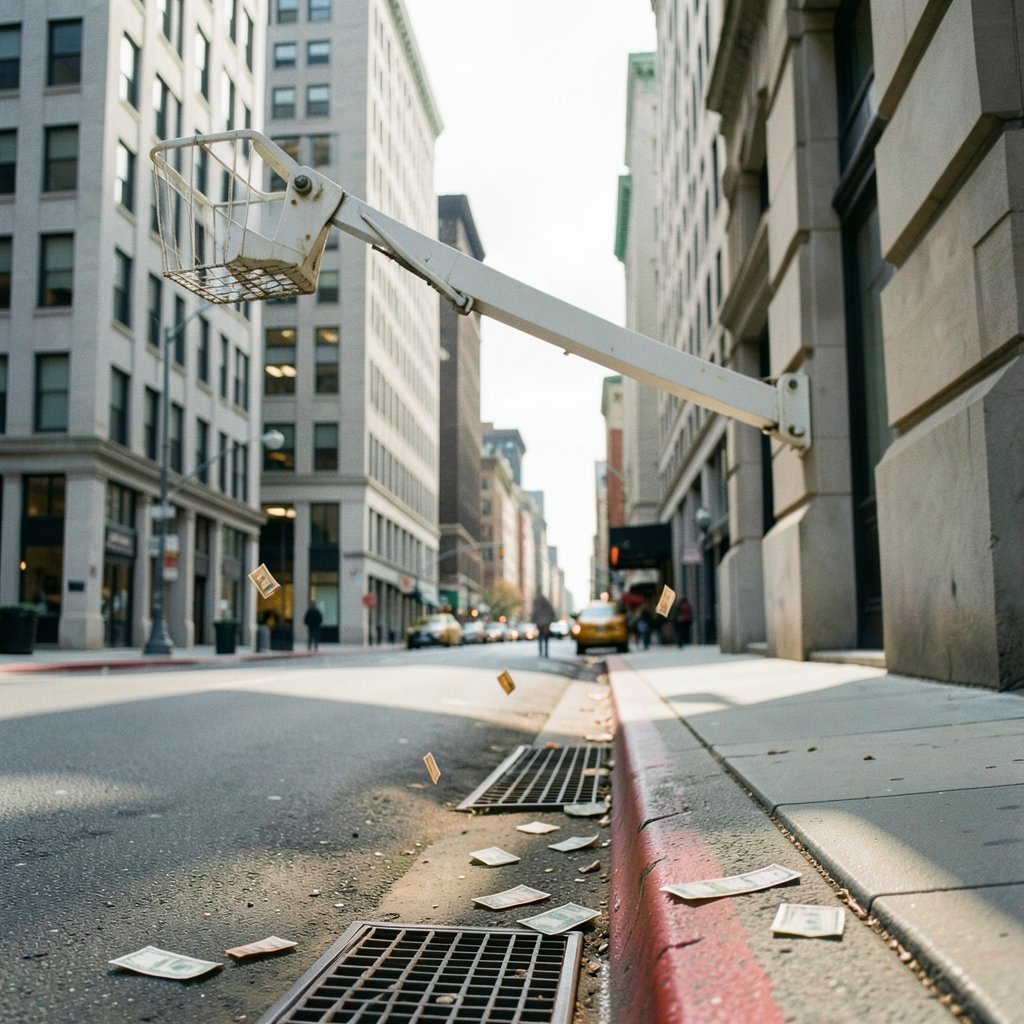
The most widely reported modern example came on January 4, 2019, when a man in downtown Sacramento, California, threw roughly $1,000 in one-dollar bills from a bucket lift. Reports at the time said he was marking the anniversary of a friend’s death. Police reportedly concluded that no crime had been committed.
That detail matters more than it might seem. Throwing your own money into the air is generally not illegal in itself. You are allowed to give your cash away, and you are allowed to be eccentric about how you do it. The legal trouble, when it comes, usually attaches to the people on the ground rather than the person in the lift.
The Sacramento case also illustrates the crowd problem. A cash drop in a public place draws people fast, and a crowd that forms suddenly around a scattering of small objects behaves differently from a crowd that arrives gradually. People look down instead of ahead. They stop in the middle of streets. They change direction without warning. Traffic that was flowing normally a minute earlier now has pedestrians in the roadway.
What the Crowd Does That Nobody Plans For
Public-safety agencies treat sudden crowd convergence as a genuine hazard, and the reasoning is well documented. The 1989 Hillsborough disaster inquiry in the United Kingdom became a landmark in crowd-safety thinking precisely because it showed how quickly a dense, moving crowd can become dangerous when people are funneled toward something they all want. A money drop creates a miniature version of that dynamic: a sudden focal point, a rush of people, and no crowd management at all.
In practice, the crowd around a cash drop tends to do three things:
- Converge on the densest cluster of bills, ignoring the ones drifting farther away.
- Stop and crouch in place, creating stationary obstacles in moving foot traffic.
- Move against the flow, doubling back for bills they spotted behind them.
None of these behaviors is malicious. They are simply what people do when something valuable appears at their feet. But together they turn a sidewalk into an obstacle course, and that is before anyone gets pushed.
Who Owns Money That Falls? The Finder Doctrine Explained
Here is where the story gets genuinely interesting. Suppose a bill lands at your feet and the person who dropped it is nowhere in sight. Can you keep it? The answer is more complicated than the old playground rule suggests.
Under the common-law finder doctrine, a person who finds lost property has rights to it that are good against everyone except the true owner and anyone who had a prior rightful claim to possession. In plain terms: you are not a thief for picking up a bill, but you are also not its owner. You hold it in a kind of legal limbo, and the true owner can reclaim it. The Cornell Legal Information Institute’s explainer on the finder doctrine lays out how these competing claims are sorted out.
That distinction is the heart of why “finders keepers” is a myth. The phrase describes a social convention, not a legal rule. A finder who knows, or reasonably should know, who the owner is and keeps the property anyway can cross the line into theft. Legal scholars call this larceny by finding, and it turns on the finder’s state of mind at the moment of pickup.
The Intent Question That Decides Everything
The key legal test is not whether you picked the money up. It is what you believed when you did it. If you watched a person throw cash from a lift and then pocket a bill, you know exactly who the owner is, and keeping it looks very different from finding a crumpled bill on an empty street with no one around.
In England and Wales, the governing statute is the Theft Act 1968, and section 2(1)(c) addresses property that the finder believes the owner cannot be discovered. The leading case, R v Woodman, established that a person can be guilty of theft even for property on premises they do not own, if they know the property belongs to someone else. The principle generalizes: the more obvious the owner, the weaker the finder’s claim.
For readers thinking about how these rules play out in everyday disputes over found valuables, the same logic applies to gift cards and prepaid balances, where the original purchaser often retains rights even after the card changes hands. The piece on why the gift card scam works and victims rarely get their money back explores how ownership questions get messy when value changes hands informally.
Dropping Money from Aircraft and Other Regulated Heights
Throwing cash from a bucket lift is one thing. Dropping it from an aircraft is another, and the rules are much clearer. In the United States, 14 CFR § 91.15 prohibits dropping objects from an aircraft in a way that creates a hazard to persons or property, with narrow exceptions for jettisoning in an emergency. The regulation does not single out money, but a cascade of lightweight paper objects over a populated area is exactly the kind of hazard the rule is written to prevent.
The practical reasons are obvious once you think about them. A bill dropped from altitude can travel a long way on the wind, and a pilot has no way to predict where it will land. A drop over a highway could distract drivers. A drop over a stadium could trigger a crush. Even a drop over open ground creates a scramble if people see it happening.
For anyone planning a promotional stunt, the safer pattern is to hand money out rather than drop it. Money that passes from hand to hand stays controlled. Money that falls from the sky belongs to the wind, the crowd, and eventually whoever gets to it first.
The Real Risks of a Public Cash Drop
Setting aside the legal questions, a public money drop carries a cluster of practical risks that organizers routinely underestimate. Understanding them is the difference between a memorable stunt and a call to emergency services.
| Risk | Why it happens | Practical mitigation |
|---|---|---|
| Crowd crush | Sudden convergence on a focal point | Announce in advance, use barriers, staff the perimeter |
| Traffic hazard | People stepping into roads while looking down | Choose a closed or low-traffic location |
| Injury from falls | Running, pushing, uneven ground | Avoid stairs, curbs, and wet surfaces |
| Property damage | Trampling, grabbing from vehicles | Keep the drop area clear of parked cars |
| Lost cash | Wind, drains, theft | Use enclosed spaces or hand out instead |
The traffic hazard deserves special attention because it is the one most likely to cause serious harm. A person chasing a bill across a street is not watching for cars. A driver encountering a dozen people crouching in the roadway has almost no reaction time. No amount of cash on the ground is worth that trade.
There is also a quieter risk that rarely makes headlines: the money can end up somewhere it was never meant to go. Bills that blow into storm drains, land on rooftops, or get swept into landscaping are effectively destroyed from the drop’s point of view. If the goal was to give money to people, a large share of it may simply vanish.
What Actually Works If You Want to Give Money Away
For anyone genuinely interested in handing out cash, the lessons from cash drops point in one direction: control the distribution. Handing bills directly to people, using envelopes, or running a structured giveaway removes almost every risk that a drop creates. It also removes the ambiguity about who owns the money, which matters if a dispute ever arises.
If a public spectacle is the point, the safer approach is to combine a controlled giveaway with a clear announcement. Tell people where to gather, keep the area staffed, and avoid any moment where a crowd is invited to lunge at something on the ground. The spectacle can come from the event itself rather than from the physics of falling paper. (Monetary Policy)
For organizations thinking about the broader economics of publicity stunts and security spending, the calculus is worth examining carefully. Programs that look cheap on paper often carry hidden costs in crowd management, insurance, and cleanup. A breakdown of where the money actually goes in identity threat detection and its real costs shows how easily visible spending masks the larger expenses underneath, and the same pattern holds for any high-visibility public event.
When “Money Falling” Means Something Else Entirely
It is worth pausing on a linguistic wrinkle. In financial writing, money falling usually has nothing to do with physical cash. It describes a market dropping, a currency losing value, or a portfolio shrinking. The phrase “the market is falling” and the phrase “money is falling from the sky” use the same words to mean nearly opposite things.
That ambiguity matters for anyone searching the topic. A reader looking for information about a cash drop and a reader looking for information about currency depreciation will land on the same phrase and find very different content. If the context is financial rather than physical, the relevant concepts are inflation, exchange rates, and asset prices rather than wind resistance and crowd safety.
The distinction extends to digital money as well. As central banks explore new forms of currency, the question of what “money” even means keeps shifting. A primer on CBDC digital currency and central bank money going digital explains how the physical bill in your hand relates to the ledger entries that increasingly stand in for it. Falling physical cash is a spectacle. Falling digital balances are a line on a screen. (Money supply)
Conclusion
Money falling from the sky looks like a simple, joyful thing, and that is exactly why it goes wrong so often. The physics of a one-gram bill guarantees a wide, unpredictable scatter. The law of finders guarantees that whoever picks it up is not automatically its owner. And the behavior of a crowd guarantees that a sudden focal point will draw people into traffic, onto wet pavement, and into each other’s way.
The Sacramento bucket lift showed that throwing your own money is legal and can even be meaningful. It also showed how quickly a personal gesture becomes a public event with public risks. The better path, if the goal is generosity, is to hand money out rather than let it fall. Control the distribution, keep the crowd calm, and skip the scramble. The money still gets where it is going, and nobody has to chase a dollar bill into a storm drain to make it happen.
Frequently Asked Questions
Is it illegal to throw money from a building?
In most places, throwing your own cash from a building is not a crime in itself. The legal problems usually arise afterward, from the crowd that gathers, the traffic disruption, or people who keep money they know belongs to someone else. Local ordinances about public safety and littering can also apply, so the specific location matters.
Can I keep money I find on the ground?
You can pick it up, but you do not automatically own it. Under the finder doctrine, your claim is good against strangers but not against the true owner. If you know or should know who the owner is and you keep the money anyway, you may cross into theft. The safest approach is to make a reasonable effort to find the owner.
What happens if money falls from an aircraft?
In the United States, dropping objects from an aircraft in a way that creates a hazard to people or property is prohibited under 14 CFR § 91.15, with narrow emergency exceptions. A cascade of lightweight bills over a populated area would generally fall under that prohibition, and the pilot would also have no way to predict where the money would land.
Why does a falling dollar bill drift so far?
A US one-dollar bill weighs about one gram and has a large surface area, so air resistance affects it strongly. Instead of falling straight down, it rocks and slides on the wind, often traveling a full block or more before landing. Breezy, dry conditions produce the widest scatter, while rain makes bills heavy and causes them to drop faster.
Is “finders keepers” a real legal rule?
No. It is a social convention, not a legal principle. The finder doctrine gives a finder rights against everyone except the true owner and prior rightful possessors, and it usually requires reasonable efforts to return the property. Keeping found money while knowing who owns it can be prosecuted as larceny by finding.
What is the safest way to give away cash in public?
Hand it out directly rather than dropping it. Direct distribution keeps the money controlled, removes the wind and scatter problem, and eliminates the crowd crush and traffic hazards that a falling cash drop creates. If a public event is the goal, announce it in advance, staff the area, and avoid any moment that invites a crowd to lunge at the ground.



