
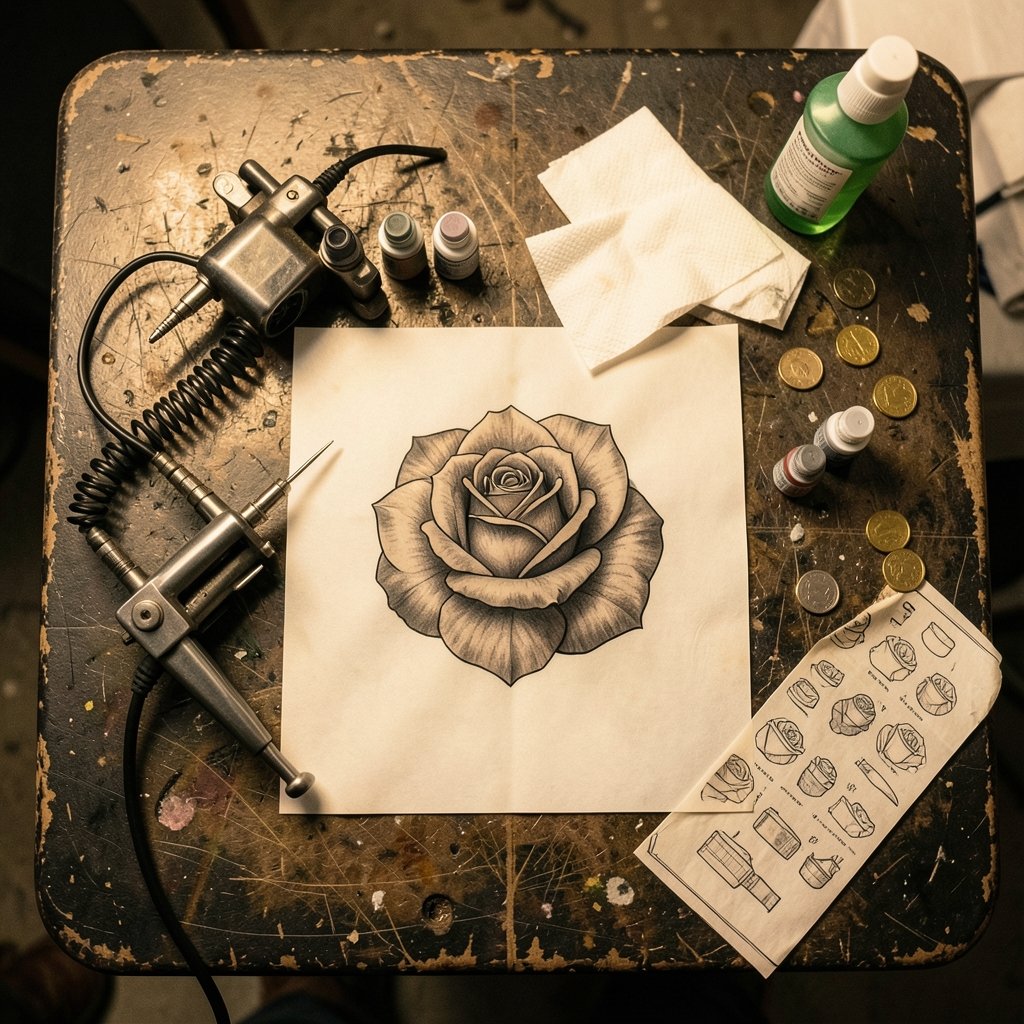
What does it say about a person who chooses a rose made of folded cash as permanent ink? A money rose tattoo is one of those designs that looks simple at first glance and then opens up into a dozen questions: Is it about greed, love, hustle, luck, or all four at once? And practically speaking, how do you get one that still looks sharp five years from now? (Tattoo)
This guide covers the symbolism, the styles, the placement decisions, and the mistakes that turn a clever idea into a muddy blob. It also flags what nobody can honestly tell you, because the research on tattoo symbolism is thinner than most articles admit.
What Is a Money Rose Tattoo?
A money rose tattoo is a design in which a rose is built from, wrapped in, or drawn alongside paper currency. The most common version shows a bloom whose petals are folded dollar bills, echoing the folded-bill roses people give as gifts. Other versions wrap a banknote around a conventional rose stem, tuck bills between petals, or pair a rose with coins, gold bars, or a dollar-sign motif.
The concept borrows from a real object. Folded-money flowers are a familiar craft and gift form, and the tattoo trade simply translated that object into ink. There is no official registry, standard, or governing body that defines the symbol, which is exactly why meanings vary so widely from wearer to wearer. (Gift card scam works victims rarely get their money back)
The Symbolism: Love, Money, and the Tension Between Them
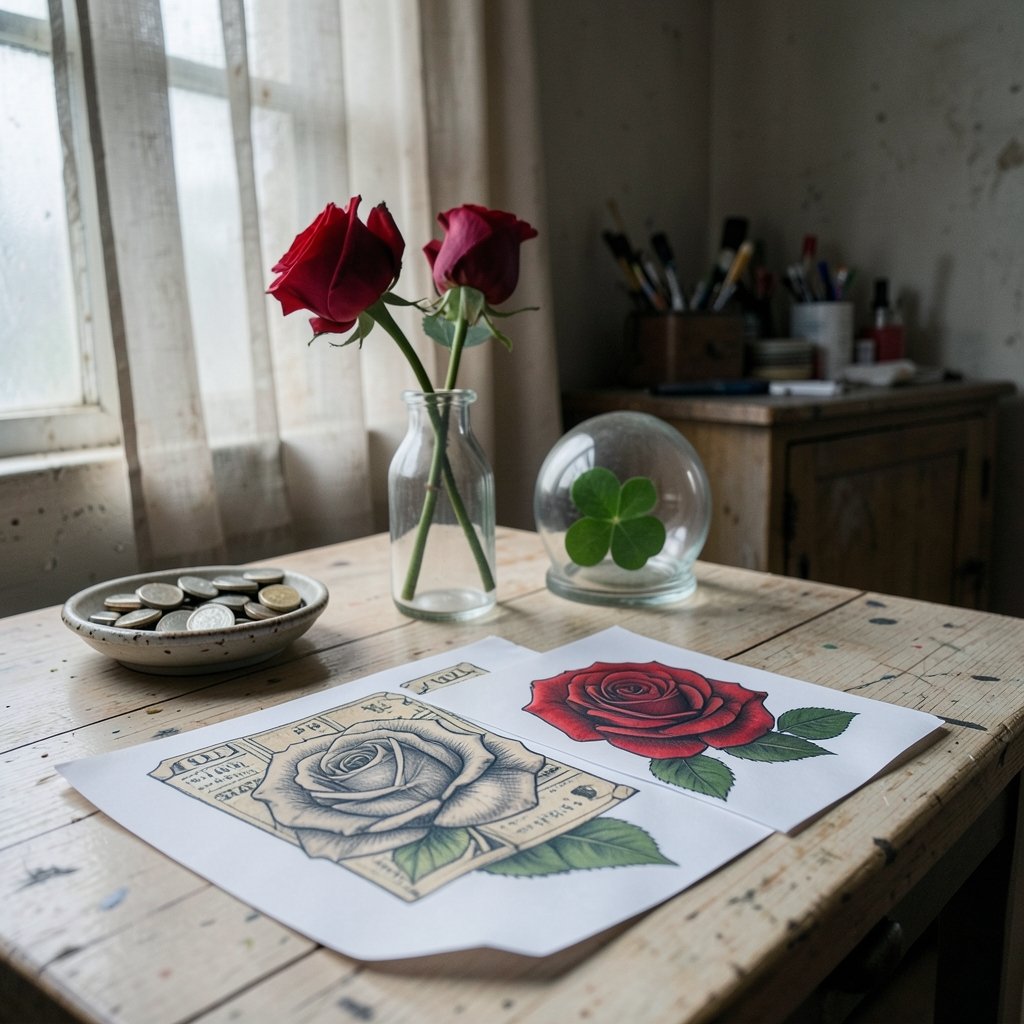
Most interpretations rest on a simple pairing. The rose carries love, beauty, passion, and sometimes loss, while the currency carries wealth, ambition, effort, and status. Put them together and you get a built-in tension that makes the design interesting.
Common readings include:
- Love and money entwined. A reminder that relationships and finances are never fully separate.
- The hustle. A statement about work, ambition, and building something from nothing.
- Beauty that fades. A rose is temporary; so, arguably, is money.
- Self-worth. Some wearers read the design as a claim that they are worth more than their bank balance, or the reverse.
- Luck and prosperity. Especially when paired with coins or clovers.
Here is the honest part: no authoritative source codifies any of this. Tattoo symbolism is assigned by the person wearing it and the artist drawing it. Anyone who tells you a money rose “officially means” one specific thing is selling confidence, not evidence.
That said, research on why people choose symbolic tattoos does exist in the medical and social-science literature, and it consistently points to identity, memory, and self-expression rather than a fixed dictionary of symbols. If you want to dig into that, look for peer-reviewed studies on tattoo motivation through PubMed or Google Scholar.
Style Options and What Each One Costs You in Longevity
Style matters more than most first-timers expect. The same concept can look elegant, aggressive, or illegible depending on how it is drawn.
| Style | Look | Best for | Watch out for |
|---|---|---|---|
| Fine-line | Delicate, thin, minimal | Small wrists, fingers, behind the ear | Fades and blurs fastest; tiny dollar details turn to smudges |
| Black and grey | Shaded, soft, classic | Forearms, shoulders, thighs | Needs contrast or it reads flat |
| Neo-traditional | Bold outlines, strong color | Larger pieces, sleeves | Demands an artist with real range |
| Realism | Photographic bills and petals | Medium to large pieces | Expensive, and unforgiving if the artist is average |
| Illustrative or sketch | Loose, hand-drawn feel | People who want something less literal | Can look unfinished to some eyes |
The practical rule: the smaller and finer the design, the faster the currency details disappear. Tiny numbers, seals, and portrait lines are the first things to blur. If the money element is the whole point of the tattoo, give it room.
Placement: Where a Money Rose Actually Works
Placement drives both how the tattoo ages and how often you see it.
- Forearm. The most popular spot for a reason: visible to you, easy to cover, and large enough for detail.
- Hand and fingers. High impact, high fade. Hands take a beating from sun, water, and friction.
- Shoulder and upper arm. Good for medium pieces and easy to extend into a sleeve later.
- Thigh. Plenty of space, low sun exposure, and easy to hide at work.
- Back and ribs. Best for large, detailed work, but ribs hurt and you will not see it daily.
One practical tip that saves people real regret: photograph the stencil placement from three angles before the needle starts. A design that looks centered in a mirror can sit oddly when your arm rotates. Artists will happily move a stencil; they cannot move a finished tattoo.
Designing It Well: Practical Advice That Actually Helps
Most disappointing money rose tattoos fail for boring, fixable reasons rather than bad taste. Here is what tends to work.
- Decide the message before the image. Are you saying “love over money,” “money is beautiful,” or “I built this”? The answer changes the composition, beyond the caption.
- Choose one focal point. Either the rose or the currency should dominate. Designs where both compete end up busy.
- Skip realistic currency detail at small sizes. Suggest bills with folds, bands, and edges instead of rendering a full note.
- Ask for a stencil test on the actual body part. Paper designs lie. Skin curves.
- Check the artist’s healed work rather than relying only on fresh photos. Fresh tattoos flatter everyone. Healed ones tell the truth.
- Budget for a second session. Good shading and detail often need a touch-up, and planning for it prevents a rushed first sitting.
Common mistakes worth naming: cramming a detailed bill into a two-inch space, choosing an artist whose portfolio is all one style when you want another, and skipping sunscreen. Sun exposure is the single biggest cause of tattoo fading, and currency details are the first casualties.
Legal and Cultural Questions People Ask
Two concerns come up often, and both deserve a straight answer.
Is it legal to tattoo currency? In the United States, depicting currency in artwork is broadly permitted, but reproducing currency for certain purposes is restricted. The relevant rules live in Treasury regulations, commonly cited as 31 CFR Part 499, which govern reproductions of U.S. currency. A tattoo is not a reproduction of currency in any practical sense, and there is no indication that tattoo artists are targeted under these rules. Still, this is a genuinely open question with no clear official guidance specific to tattoos, so treat confident claims in either direction with skepticism.
Is it culturally sensitive? Money imagery carries class and status connotations that vary by community and country, and rose symbolism differs across cultures too. There is no reliable cross-cultural survey to point to. The practical move is simple: if the design references a specific cultural tradition, ask someone from that tradition rather than trusting a forum thread.
If your interest runs toward the financial side of the symbolism, the broader question of what money represents is worth exploring. Central bank digital currencies, for instance, are changing how cash itself looks and functions, which is a useful read if your tattoo features a specific banknote.
Money Rose Tattoo vs. Other Money-Inspired Designs
The money rose is not the only option, and comparing it against alternatives sharpens the decision.
| Design | Core message | Feel |
|---|---|---|
| Money rose | Love and wealth intertwined | Romantic, layered |
| Dollar sign | Pure ambition or irony | Blunt, graphic |
| Money bag | Getting paid | Playful, cartoonish |
| Snake and cash | Risk, temptation, hustle | Edgy, aggressive |
| Folded-bill rose (object) | A gift, not a statement | Sentimental |
The rose version tends to attract people who want something softer than a dollar sign but more personal than a money bag. It also ages better than most lettering-based money designs, which tend to look dated as fonts cycle out. (Identity threat detection really costs where money goes)
Aftercare and Long-Term Looks
Aftercare is unglamorous and decisive. Keep the fresh tattoo clean, follow your artist’s written instructions over anything you read online, and resist the urge to pick at peeling skin. Once healed, two habits protect the investment: daily sunscreen on exposed tattoos and moisturizing to keep the skin smooth so lines stay crisp.
Touch-ups are normal, not a sign of failure. Fine-line work often needs one within a year or two. Ask upfront whether touch-ups are included and for how long.
If you are weighing the cost of a good artist against a cheap one, the math usually favors patience. The same logic applies to almost any spending decision where quality compounds over time, whether that is a tattoo or a security budget.
Conclusion
A money rose tattoo works best when you treat it as a personal statement rather than a symbol with a fixed definition. The rose and the currency each carry loose, flexible meanings, and the power of the design comes from how you combine them. Pick a style that suits the size you can actually accommodate, choose an artist whose healed work you have seen, and plan for the details to soften over the years.
And keep a healthy skepticism toward anyone who claims the design has one true meaning. Tattoos are personal by nature. The best money rose is the one that says what you want it to say, drawn well enough to keep saying it for decades.
Frequently Asked Questions
What does a money rose tattoo symbolize?
Most commonly it pairs love and beauty (the rose) with wealth and ambition (the currency). Wearers often read it as a statement about the relationship between money and what matters more, or as a nod to hard work and self-worth. There is no official definition, so the meaning is set by the person wearing it.
How much does a money rose tattoo cost?
Pricing depends on size, style, and artist rates, which vary widely by city and reputation. A small fine-line piece costs far less than a detailed realism design on a forearm. Most artists charge hourly or by the session, and detailed work frequently needs two sittings. Ask about touch-up policies before you book.
Does a money rose tattoo age well?
It can, but small, highly detailed versions fade fastest. Currency details like numbers, seals, and portrait lines blur first, especially on hands and fingers. Larger designs with strong contrast and clear outlines hold up best. Sunscreen and moisturizer make a measurable difference over the years.
Where should I place a money rose tattoo?
The forearm is the most practical choice: visible, coverable, and roomy enough for detail. Thighs offer space and low sun exposure. Hands and fingers look striking but fade quickly. Ribs and back suit large pieces but are harder to see and more painful to sit through.
Is it legal to get currency tattooed on you?
In the U.S., depicting currency in artwork is broadly permitted, though Treasury regulations restrict certain reproductions of U.S. currency. A tattoo is not a reproduction in any practical sense, and there is no clear official guidance specific to tattoos. Anyone stating a definitive rule either way is going beyond the available evidence. (Cbdc digital currency central bank money going digital)
Can I bring my own money rose design to an artist?
Yes, and many artists prefer it, but expect them to redraw it. Tattoo designs need to work on curved skin, at a specific size, with line weights that survive healing. A good artist will adapt your idea rather than copy it exactly, and that adaptation is usually why the finished piece looks better than the sketch.



