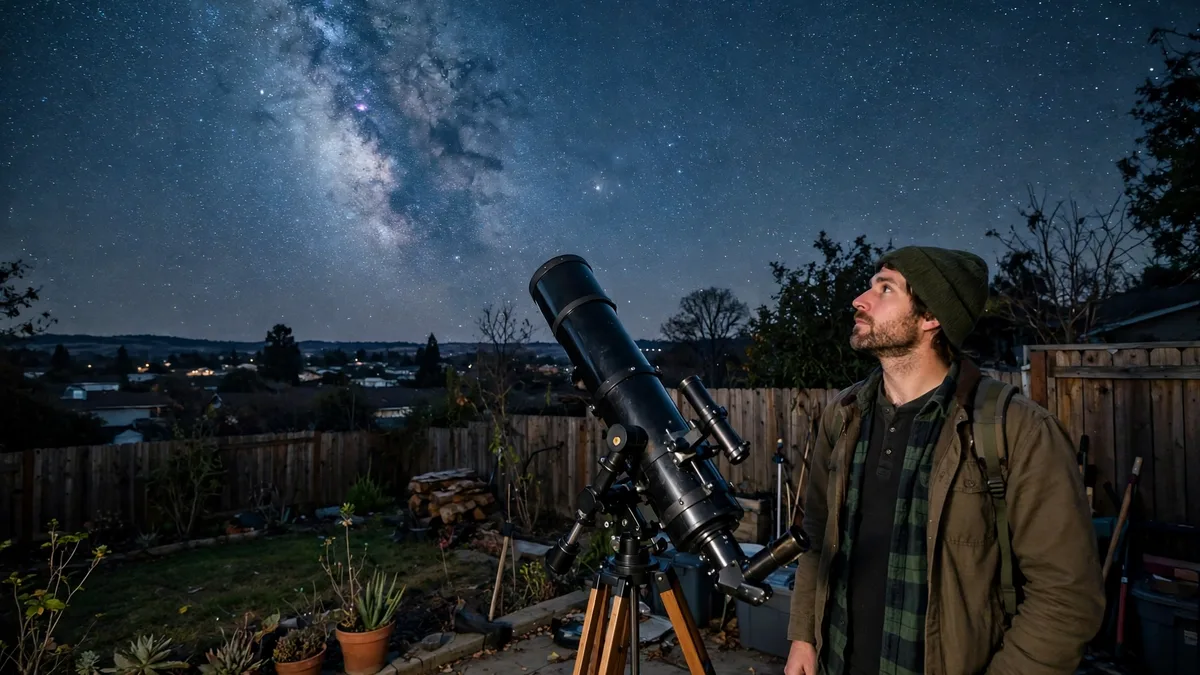
Two amateur astronomers have used OpenAI’s artificial intelligence tools to pick out signals that could be planets orbiting distant stars, OpenAI said in a case study published on 24 November 2026 and reported on 25 November 2026. The pair worked independently, searching publicly available observations from NASA’s Kepler and TESS space telescopes, and both have handed their strongest findings to professionals for independent checks.
Neither researcher has confirmed a new exoplanet. What they found are candidates: repeating dips in starlight that look the way a passing planet would look, but that could still turn out to be something else. That distinction matters: planet hunting has a long history of promising signals that faded under closer inspection.
The story is still a striking one. A decade ago, searching telescope archives for planets was work for specialists with institutional access. Now an engineer who photographs the night sky for fun and a startup founder who has always loved astronomy have each built their own search programmes with AI help, and professionals are taking the results seriously.
Key takeaways
- Kevin Bond, an engineer at OpenAI, used Codex to search Kepler observations of about 100,000 stars and flagged more than 200 signals, including 10 from already confirmed planets.
- Ethan Byrd, founder of the email infrastructure startup Primitive, used Astra to search observations of about 19 million stars and identified 49 candidates.
- Two of Bond’s strongest candidates, around the stars KIC 5689121 and KIC 6691030, were independently found by an astronomer at the SETI Institute.
- Byrd has sent one of his strongest candidates to researchers working on NASA’s TESS mission, with two more awaiting submission.
- No new exoplanet has been confirmed: every signal still needs follow-up observation before it can be called a planet.
What the two searches actually found
Bond came to astronomy through astrophotography, and his search began with a practical question: could he write a programme that finds planets in data other people had already looked at? Using Codex, OpenAI’s coding agent, he compared published detection methods, combined the strongest ideas into one search programme, and tested whether small code changes improved it. One AI agent scanned the light curves, records of each star’s brightness over time, while another checked the candidates it flagged.
He ran it on public data from NASA’s Kepler Space Telescope, a planet-hunting mission that operated from 2009 to 2018. It flagged more than 200 signals, including 10 from planets already confirmed, a useful check that it was finding real planets rather than noise. Two stars stood out: KIC 5689121, a cool star about half the size of our sun in Lyra, dimming every 13.8 days, and KIC 6691030, a faint northern star dipping every 4.8 days, consistent with a planet smaller than Neptune.
Bond contacted an astronomer at the SETI Institute, who searched the same Kepler data independently and found two of the same signals. That does not confirm a planet, but it rules out a class of mistakes: the dips are really in the data, not artefacts of one person’s code. As our guide to how AI agents work explains, chaining specialised agents together lets each focus on a narrow job, which is part of why the approach is spreading beyond software work and into science.
Byrd worked separately and took a different route. He tried several AI models before settling on Astra, and his searches covered about 19 million stars drawn from TESS, the Transiting Exoplanet Survey Satellite NASA launched in 2018, and other public archives. He asked Astra to review published detection methods, build two search programmes, and run first checks on the signals they surfaced: one looked broadly for candidates, the other at stars with potentially habitable zones. His first analysis found 49 candidates; one of his strongest is now with TESS researchers, and two more await submission.
How the search worked
Both searches relied on the transit method, the workhorse of exoplanet hunting. When a planet passes in front of its host star from our point of view, it blocks a tiny fraction of the star’s light, typically well under one percent. If that dip repeats at regular intervals, it may be a planet circling the star once per orbit. Stars flicker for their own reasons, instruments introduce noise, and a single star can be observed for years.

That is where the AI tools earned their place. Instead of writing every line of detection code by hand, Bond and Byrd described what they wanted and let the models draft, test and refine the software. The human still set the questions, chose the data and judged the output, but the models did much of the heavy lifting. The same pattern is explained in our introduction to what machine learning is.
The scale is the point. Bond’s search covered roughly 100,000 stars; Byrd’s covered about 19 million. No individual could inspect that many light curves by eye, and even professional teams rely on automated pipelines. What has changed is who can build one: the barrier is no longer a research group and a grant, but a good question, public data and a capable model.
The background: AI has been hunting planets for years
This is not the first time AI has pointed astronomers at a planet. In 2017, researchers trained a neural network on 15,000 signals from Kepler that astronomers had already examined, and the model spotted an eighth planet around the star Kepler-90. Since the first exoplanets were announced in 1992, astronomers have confirmed more than 6,400 planets beyond our solar system, and automated searches have done much of the finding.
What is new is the shift in who runs the search. Professional teams still lead the field, but citizen science has a long history in astronomy. NASA’s Exoplanet Watch invites volunteers to observe known planets, the American Association of Variable Star Observers has coordinated amateur observations for more than a century, and Unistellar sells smart telescopes that feed observations to professional research. Bond and Byrd fit that tradition; the difference is that their tools can now read the literature, write the code and run the analysis too.
NASA’s telescope missions supply the public archives both men mined, and its broader programme continues to draw attention and funding, as our report on NASA’s Artemis programme and a proposed $2 billion boost shows. Kepler and TESS were built to find planets; Artemis is built to return people to the Moon. Different missions, same logic: public investment in space produces data others can build on, sometimes in ways the original planners never imagined.
OpenAI has been publishing case studies of its models doing real scientific work, and astronomy is a natural showcase: the data is public and the results can be checked by outsiders. Bond is an OpenAI engineer, which raises a question about independence; it is worth noting that Byrd, who has no connection to the company, reached similar results by a separate route after trying other models first.
The caveats that matter
A transit-like dip is a candidate, not a discovery. Stars have spots that rotate in and out of view, binary stars can mimic planetary signals, and instruments can produce repeating artefacts. A candidate becomes a validated planet only after follow-up observations rule out the alternatives and pin down the planet’s size and orbit.
None of that follow-up has happened yet. Bond’s two strongest signals have the encouraging detail of an independent match from a SETI Institute astronomer, but that confirms the signal is in the data, not that a planet caused it. Byrd’s leading candidate is waiting in a queue for TESS researchers to examine. Until those checks are done, the honest description is “possible exoplanets”, exactly the word OpenAI itself used.
There is also a limit to what the two searches prove about AI. They show capable models can help skilled amateurs build serious search tools quickly, which is a real result. They do not show that AI beats professional pipelines. The professionals have larger teams, better instruments and, crucially, the follow-up telescope time that turns candidates into confirmations.
| Detail | What is known |
|---|---|
| Announced | OpenAI case study published 24 November 2026; reported 25 November 2026 |
| Kevin Bond | OpenAI engineer; used Codex on Kepler data covering about 100,000 stars |
| Ethan Byrd | Founder of Primitive; used Astra on observations of about 19 million stars |
| Signals found | Bond: more than 200, including 10 confirmed planets; Byrd: 49 candidates |
| Standout candidates | KIC 5689121, dip every 13.8 days; KIC 6691030, dip every 4.8 days |
| Independent check | SETI Institute astronomer found two of Bond’s signals in the same data |
| Follow-up status | One Byrd candidate sent to TESS researchers; two more awaiting submission |
| Confirmed planets | None yet; all findings remain unconfirmed candidates |
Checklist: judging this claim honestly
Use these checks before sharing the story or drawing conclusions from it.
- Check the wording: “candidate” means unconfirmed; “discovered” would mean something stronger, and it has not been earned yet.
- Look for the follow-up: a candidate only becomes a planet after independent observations rule out stellar activity and binary stars.
- Ask who checked the work: Bond’s signals gained weight because a SETI Institute astronomer found the same dips independently.
- Separate the two claims: the AI assistance is demonstrated, the planets are not yet.
- Note the sample: 49 candidates from 19 million stars is a tiny yield, which is normal for transit searches and not a weakness.
- Watch what happens next: the test is whether TESS researchers confirm any of these candidates in the coming months.
Frequently asked questions
Did OpenAI’s Astra actually discover new exoplanets?
No, not yet. Astra helped Ethan Byrd identify 49 candidates, and Codex helped Kevin Bond flag more than 200, but none has been confirmed. Confirmation needs follow-up observations.
Who are the two amateur astronomers?
Kevin Bond is an engineer at OpenAI who came to astronomy through night-sky photography, and Ethan Byrd is the founder of the email startup Primitive, who has loved astronomy for years. They worked independently.
What is the difference between Codex and Astra in this story?
Codex is OpenAI’s coding agent, which Bond used to build his Kepler search programme. Astra is a newer OpenAI model that Byrd used to design two searches and analyse TESS and other archive data.
How does the transit method work?
When a planet passes in front of its star as seen from Earth, it blocks a small fraction of the star’s light. If the dip repeats at regular intervals, it may be a planet completing one orbit, though stellar activity can mimic it.
What are KIC 5689121 and KIC 6691030?
KIC 5689121 is a cool star about half the size of the sun in Lyra, dimming every 13.8 days. KIC 6691030 is a faint northern star dipping every 4.8 days, consistent with a planet smaller than Neptune.
How can I follow or join this kind of citizen science?
NASA’s Exoplanet Watch, the American Association of Variable Star Observers and Unistellar’s telescope network welcome volunteers, and the Kepler and TESS archives are public. Expect a steep learning curve: telling a planet from noise still takes care and patience.
The bottom line
Two amateurs with AI help have done something genuinely interesting: they searched vast public telescope archives, found signals that look like planets, and got professional astronomers to take a second look. The independent match on Bond’s signals and the TESS queue for Byrd’s candidate show the work is being treated seriously by people whose job is to be sceptical.
What happens next is slower: telescope time, careful checks, and the possibility that some or all of these candidates turn out to be something else. That is how planet hunting works. If even one signal is confirmed, it will be a small milestone for citizen science and a vivid demonstration of what capable AI tools put within reach of a determined amateur.