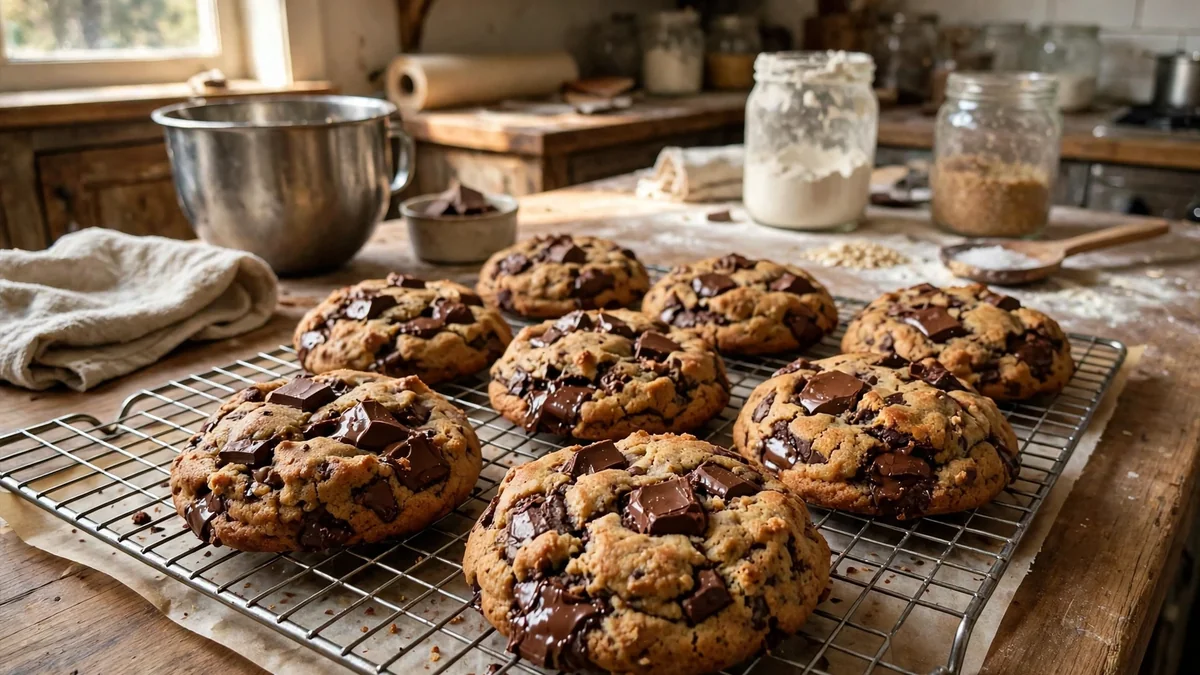
Saif Manna started selling cookies from his college apartment kitchen in March 2021, mixing every batch by hand because he did not own a stand mixer. He was studying political science at Temple University in Philadelphia, and he set up a table in his apartment building lobby or on campus and sold cookies to students passing by. Five years later, the 27-year-old runs Manna Bakery, a Philadelphia bakery-cafe with around 20 employees, and he told Fortune the business brings in about $120,000 a month, with $1.8 million projected in its first year with a storefront.
The numbers are eye-catching, but the more useful part of the story is how little money it took to get there. Manna did not raise a large round of funding or spend heavily on advertising. He sold in person, built relationships with other small businesses, borrowed a pizzeria’s kitchen in the small hours, and waited more than two years for a storefront that was mostly ready. Opening cost a little over $100,000, financed mostly through a loan and savings from his pop-ups.
That discipline is the real lesson. In a business where, as Manna puts it, every dollar counts, the decision that mattered most was patience: passing up spaces that would have cost $300,000 or more to fit out, and waiting for the right one. For anyone turning a hobby into a business, the story is a practical counterweight to the idea that you need a big budget to start.
Key takeaways
- Saif Manna launched his cookie business in March 2021 from his college apartment at Temple University, and his Philadelphia bakery now brings in about $120,000 a month, according to Manna in an interview with Fortune.
- He grew through face-to-face selling, cafe pop-ups and farmers’ markets, once selling 800 to 1,000 pastries in three hours.
- He scaled production by borrowing a pizzeria’s kitchen at 2 a.m., at far less than the cost of renting a commercial kitchen.
- He waited more than two and a half years for the right storefront, opening for a little over $100,000 after passing on spaces needing buildouts of $300,000 or more.
- The $1.8 million projection and the $120,000 monthly figure are Manna’s own figures as reported to Fortune; the exact address beyond West Berks Street and the precise employee count have not been confirmed beyond “around 20”.
What happened at Manna Bakery
Manna launched the business in March 2021, while he was still a student. He did not overthink it: he set up a table in his apartment building lobby or on campus and sold cookies to students passing by, not thinking about permits. His building, home to roughly 200 residents, let him sell there. Word spread to neighbouring buildings, and he began taking Google Forms orders for pickup downstairs.
A turning point came when a customer suggested he take his pop-ups beyond Temple’s campus and named several cafes in the city. One was Herman’s Coffee, known for hosting pop-up vendors. Manna found the owner’s contact information and asked to sell his pastries there, and despite a packed schedule he secured a date and showed up with pastries baked in his apartment kitchen. Other cafe owners saw the lines and began inviting him to their shops through Instagram, and the arrangement benefited them too, since his customers often bought coffee as well. That is the moment the business stopped being a one-man stall and became a small network.
By 2023, farmers’ markets were inviting him in. Some had waiting lists stretching for years, Manna said, but demand for his pastries helped him secure a spot, first at a small market in Germantown and then at larger ones across the city. The markets gave him something the rotating cafe pop-ups could not always provide: a consistent place for customers to find him every week, until the bakery became part of their weekly habits. He eventually sold 800 to 1,000 pastries in three hours at a market, and in 2026 Philadelphia magazine named his extra-brown-butter chocolate chunk cookie the best cookie in the city. For small firms weighing the tools that help them keep track of customers, our guide to the best CRM software for small business in 2027 covers the options worth comparing.
How a pizzeria kitchen at 2 a.m. changed the maths
As sales grew, Manna’s apartment kitchen could not keep up. Instead of renting a commercial kitchen, he reasoned that restaurants are not cooking around the clock, so their kitchens sit empty for hours when closed. He thought of his friend Viraj Thomas, owner of Philadelphia’s Char Pizza, met over coffee after Thomas reached out to him.
It started with a simple favour: Manna asked Thomas if he could use the pizzeria’s large commercial mixer, since his small home mixer could only handle so much dough. As he put it, he needed to mix one time instead of ten. That favour became a weekly arrangement, then twice a week, then use of the larger oven, until he was baking pastries there five days a week.
As demand grew, he began hiring. The first hire was his now-wife, Stefaniya Surikova, who he joked was a free hire because he did not need to pay her. He gradually added bakers until a team of four was producing pastries for the farmers’ markets, but even with extra help the operation was reaching its limits. He has said he was working 18 hours a day, every day, and on days he was not baking he handled inventory, sourcing and administration. That is the point at which a hobby business either hires properly and finds a real home, or burns out its founder. That pattern echoes the wider trend in our report on more Americans starting million-dollar businesses, where the founders who last are usually the ones who fix the capacity problem before it fixes them.
Waiting two and a half years for the right space
He spent more than two years searching, passing up locations that would have required substantial renovations, and estimated a buildout could easily cost $300,000 or more. Eventually a space on West Berks Street, formerly occupied by Essen Bakery, became available, already holding much of the equipment he needed. As he put it, the space was basically ready: he just had to get a few chairs and open. He bought the existing equipment at a significant discount, and told Fortune the total opening cost was a little over $100,000, financed mostly by a loan and savings from his pop-ups.
He has said some people might call that luck, but after waiting two and a half years, he calls it patience. The most important business decision, in his words, was to wait for the right place: other properties would have left him carrying much more debt, potentially hurting profitability for years. Food businesses have slim margins, he said, and every dollar counts.
The caveats that matter
Keep the figures in their proper frame. The $120,000 a month and the $1.8 million first-year projection are Manna’s own figures, reported to Fortune. The monthly figure annualises to about $1.44 million, and the $1.8 million projection includes plans for another farmers’ market pop-up, a pantry, workshops and supper clubs, so it is not a simple extension of current trading. They are a founder’s reported numbers, not audited accounts, and the team is around 20, not an exact headcount.
| Detail | What is known |
|---|---|
| Founder | Saif Manna, 27, former political science student at Temple University |
| Launched | March 2021, selling cookies from his college apartment kitchen |
| Early selling | Table in the apartment lobby, Google Forms orders, cafe pop-ups and farmers’ markets |
| Market peak | 800 to 1,000 pastries sold in three hours at a farmers’ market |
| Storefront | Lease signed 1 March 2026 on West Berks Street; opened 30 July 2026; open four days a week, with plans to expand to five, then six |
| Opening cost | A little over $100,000 including equipment, renovations and maintenance, mostly a loan plus pop-up savings |
| Revenue | About $120,000 a month (about $1.44 million annualised), as reported by Manna to Fortune; $1.8 million first-year projection including pop-ups, pantry, workshops and supper clubs |
| Team | Around 20 employees; early team of four bakers plus his now-wife Stefaniya Surikova as first hire |
Checklist: starting a food business on a small budget
Use these checks before spending serious money on a food business.
- Prove demand in person first, at a market or pop-up, before signing a lease or buying equipment.
- Price in line with local competitors and protect ingredient quality, rather than chasing margin by cutting corners.
- Find unused capacity nearby, such as a restaurant kitchen in its off-hours, before paying for your own space.
- Build the menu around what you can realistically produce each day, mixing fresh-baked items with things made a day ahead.
- Wait for a space that is mostly ready, and walk away from any buildout that would load you with debt.
- Give customers a story they cannot get elsewhere, and teach your staff to tell it.
Frequently asked questions
Who runs Manna Bakery?
Saif Manna, a 27-year-old who started the business in March 2021 at Temple University, and now runs the Philadelphia bakery-cafe with around 20 employees.
How much does the bakery make?
Manna told Fortune the bakery brings in about $120,000 a month, or about $1.44 million a year at that rate, and he projects $1.8 million in its first year with a storefront, including new pop-ups, a pantry range, workshops and supper clubs.
How did it start?
From his college apartment kitchen, mixing batches by hand without a stand mixer, selling from a table in his lobby and on campus, then through Google Forms, cafe pop-ups and farmers’ markets.
How did he scale without a commercial kitchen?
He borrowed the kitchen of Char Pizza, owned by his friend Viraj Thomas, baking from 2 a.m. while the pizzeria was closed, since it did not open until 4 p.m., at far less than the cost of renting a dedicated commercial kitchen.
How much did the storefront cost to open?
A little over $100,000, including equipment, renovations and maintenance, financed mostly by a loan and savings from his pop-ups. He waited more than two and a half years for a space on West Berks Street that was already mostly equipped, passing on spaces needing buildouts of $300,000 or more.
What is the bakery’s best-known product?
His extra-brown-butter chocolate chunk cookie, named the city’s best cookie by Philadelphia magazine in 2026. He also sells savoury items with family stories behind them, including a chicken sumac bun inspired by his grandmother’s musakhan.
Starting small and growing on relationships is a pattern that shows up well beyond food, and the tools for running a lean operation have changed fast. For a sense of how small firms are using new technology to stay lean, see our guide to what an AI-first business is.
The bottom line
Saif Manna’s bakery grew from a college apartment to about $120,000 a month without a large budget, a big advertising spend or a costly buildout. The growth came from selling in person, building relationships with cafes and markets, borrowing a kitchen in its empty hours, and waiting more than two years for a storefront that was mostly ready. The figures are his own as reported to Fortune, and the $1.8 million projection depends on new pop-ups, a pantry range, workshops and supper clubs.
The advice he gives other founders is the same advice his story demonstrates: go out and meet people in your industry, because people like to help, and do what you can with what you have. For a food business, that meant a rooftop as a walk-in fridge in winter and a pizzeria’s mixer at 2 a.m. For any small business, it means proving demand before spending.