

When did you last look out your living room window and see more smudge than street? Most people notice the grime only after a professional crew has finished and the glass turns nearly invisible. Professional window cleaning produces cleaner glass and a different level of clarity, safety, and durability.
This guide walks through how the trade actually works, from the water-fed pole systems that keep workers off ladders to the legal and insurance details that separate a real business from a person with a bucket. It also covers what a fair quote looks like, common mistakes homeowners make, and how to judge a job before you pay for it.
What Professional Window Cleaning Actually Involves
Professional window cleaning is the systematic removal of dirt, mineral deposits, pollen, bird droppings, and atmospheric film from glass, frames, tracks, and screens using specialized tools and methods. It is not simply “washing windows harder.” The trade has its own equipment, safety standards, and sequencing.
A typical residential job moves through several stages:
- Assessment. The crew checks glass type, existing damage, hard-water staining, and access points.
- Dry removal. Loose debris is brushed or blown away so it does not turn into an abrasive paste.
- Washing. A scrubber or water-fed brush loosens bonded soil with a detergent or purified water.
- Rinsing and squeegeeing. Clean water flushes residue, and a squeegee or pure-water rinse leaves a streak-free finish.
- Detailing. Frames, sills, tracks, and edges are wiped so drips do not dry into new spots.
The order matters. Skipping the dry pass is one of the most common mistakes, because grit dragged across glass under a squeegee can leave fine scratches that never buff out.
The Equipment That Does the Heavy Lifting
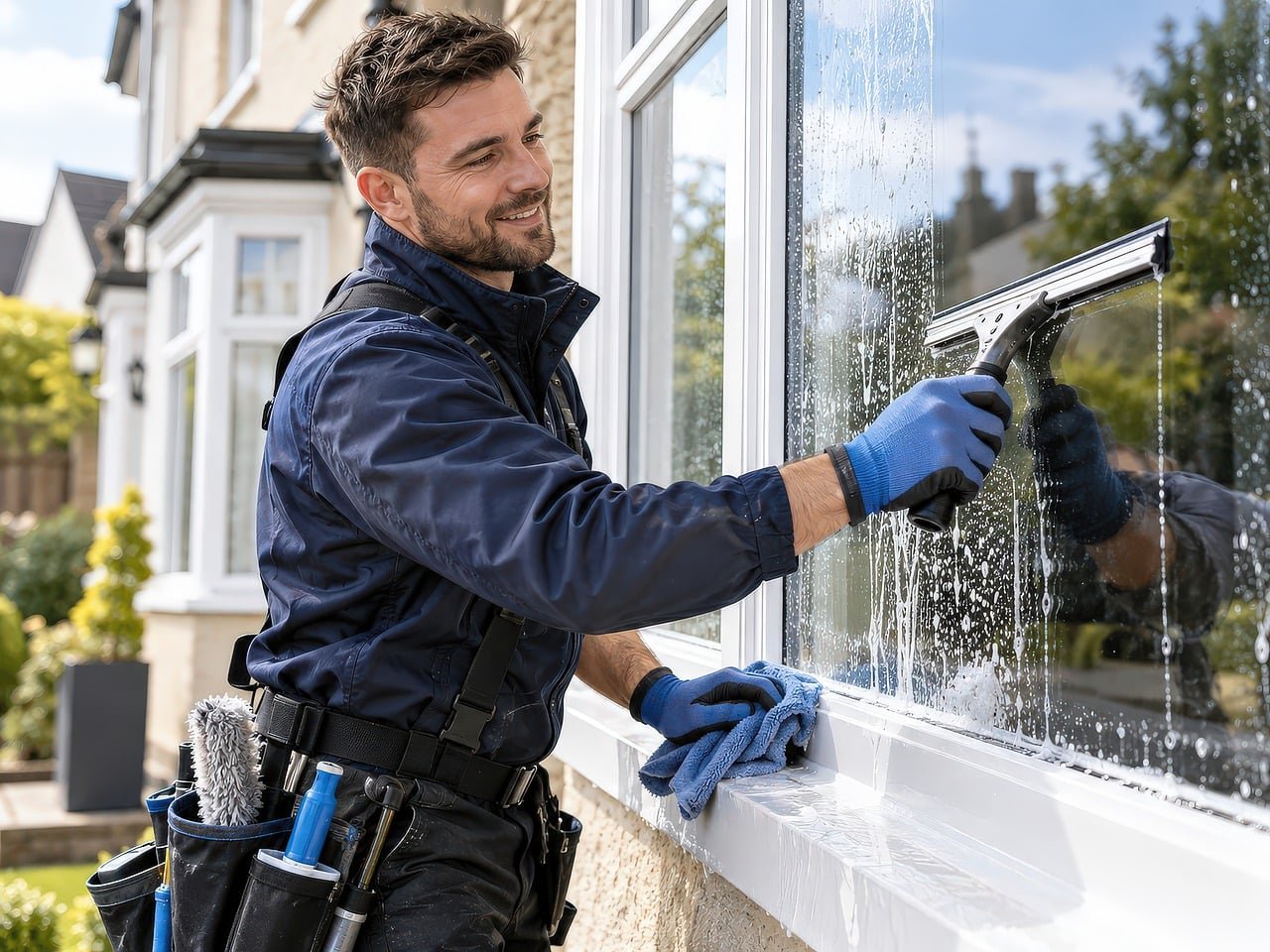
The modern trade relies on a handful of core tools, and each exists for a reason.
| Tool | What it does | Why pros use it |
|---|---|---|
| Squeegee | Pulls water off glass in one pass | Fast, streak-free finish on flat panes |
| Water-fed pole | Reaches upper floors from the ground | Eliminates most ladder work |
| Pure water system | Filters minerals out of tap water | Dries spot-free without wiping |
| Scraper | Lifts paint, stickers, hard deposits | Removes bonded debris safely when angled right |
| Microfiber detailing cloth | Dries edges and frames | Prevents drip marks after the main pass |
The water-fed pole deserves special attention. By pumping deionized or reverse-osmosis purified water through a telescopic pole, a technician can clean three or four stories from the ground. Pure water has no dissolved minerals, so it evaporates without leaving the white spotting that tap water causes. That single innovation has reshaped the industry, because it removes the biggest hazard in the job: the ladder.
Safety Comes Before Shine
Falls are the leading cause of serious injury in the window cleaning trade, and the safety rules reflect that. Anyone working at height is generally covered by fall-protection requirements, whether that means guardrails, personal fall-arrest systems, or proper ladder placement at the correct angle. In the United States, the relevant rules sit in workplace safety regulations; in the United Kingdom, the Work at Height Regulations set out a hierarchy that puts avoidance of work at height first, then prevention of falls, then mitigation of consequences. (Fall Protection)
Beyond falls, professionals manage chemical handling (detergents and degreasers), electrical hazards from overhead lines and exterior outlets, heat stress on summer jobs, and repetitive strain from squeegee work. A reputable crew will carry method statements or job hazard assessments for commercial sites and will not send someone up a ladder in high wind.
For homeowners, the practical takeaway is simple: if a quote seems suspiciously cheap and the crew arrives without proper ladders, harnesses, or pole equipment, the savings are being funded by someone else’s risk.
How to Judge a Quote Without Getting Burned
Pricing for professional window cleaning varies widely by region, property size, and access difficulty. Rather than chase the lowest number, compare quotes on what they actually include.
Ask each provider:
- Is the price per pane, per window, or per hour? Per-window pricing that includes both sides of the glass and the frames is usually the fairest comparison.
- Are screens, tracks, and sills included? Many low quotes cover glass only, then add charges later.
- Is there a minimum call-out? Small jobs often carry a flat minimum.
- What happens if something breaks? A real business carries liability insurance and will say so without hesitation.
- Who actually shows up? Subcontracted crews are common, but you should know in advance.
A useful cross-check: the same logic that applies to choosing any local service applies here. If you have ever compared auto glass or tinting quotes and noticed how much the fine print changed the real cost, you already know the drill. The same care pays off when you check before you book auto glass window repair near me or weigh car window tinting options and local legal limits. Window cleaning quotes hide similar traps in the details. (Window cleaner (occupation))
Residential vs Commercial: Different Jobs, Different Standards
The two markets overlap in technique but diverge sharply in scope and risk.
Residential work is usually scheduled seasonally, focuses on appearance, and involves lots of interior detailing around furniture, blinds, and fragile items. Access is often the hard part: dormers, conservatory roofs, and steep glazing.
Commercial work runs on contracts, often monthly or quarterly, and covers storefronts, office towers, and retail glass. It brings stricter safety documentation, out-of-hours scheduling, and sometimes rope access or suspended platforms for high-rise facades. Commercial clients care about consistency because dirty glass is a visible brand problem.
If you run a small business, the same principle that makes you fuss over your storefront applies to your equipment and workspace. Professionals who care about presentation tend to care about their tools too, which is why serious gamers invest in gear that actually performs, as covered in this look at gaming accessories that matter to professional players. Details signal standards in every trade.
Common Mistakes Homeowners Make
Even careful people sabotage their own windows. These are the recurring errors that professionals see most often.
Using dish soap on exterior glass. Dish soap leaves a film that attracts dust, so windows get dirty faster. Proper glass cleaners or pure water rinse clean.
Cleaning in direct sun. Solution dries before it can be squeegeed, leaving streaks and water spots. Pros work shaded sides first or start early.
Scrubbing off paint or stickers with a dry blade. A dry scraper drags grit and scratches glass. Lubrication is not optional.
Ignoring the frames and tracks. Dirty tracks release dust every time the window opens, and grimy frames wick dirt back onto clean glass.
Skipping screens. Screens hold pollen and grit that blow onto wet glass. A pro removes and rinses them.
Choosing the cheapest bid. Uninsured operators create a liability problem if a ladder tips or a pane cracks.
There is a mirror-image lesson in home maintenance generally: the tool you use changes the outcome more than the effort you put in. The same is true of housework gadgets, which is why guides on robot vacuum cleaning solution alternatives that actually work stress matching the method to the surface rather than brute force.
How Often Should Windows Be Cleaned?
There is no universal schedule, but a practical rule of thumb works for most homes.
| Property type | Typical frequency | Notes |
|---|---|---|
| Urban or near a highway | Every 4 to 8 weeks | Traffic film and soot build fast |
| Suburban home | 2 to 4 times a year | Spring and fall minimum |
| Coastal property | Every 4 to 6 weeks | Salt spray etches glass over time |
| Rural or wooded lot | 2 to 3 times a year | Pollen season drives one visit |
| Commercial storefront | Monthly or biweekly | Appearance is the point |
Hard-water staining is the exception. Once calcium deposits bond to glass, they need a specialist treatment, and delay makes them harder to remove. If your sprinklers hit the windows, book more often than the table suggests.
The Business Side: Insurance, Licensing, and Trust
Professional window cleaning is a business, and the good ones look like one. Expect a written quote, a business name on the vehicle, and proof of public liability insurance. Licensing varies by jurisdiction, and in many places window cleaning is not separately licensed, which makes insurance and references the real trust signals.
Ask for references from jobs similar to yours, especially if you have large or high windows. A crew that handles a two-story suburban house well may not be equipped for a glass atrium.
Two more practical checks help. First, confirm the crew knows how to handle specialty glass, including self-cleaning coatings, which should not be abraded. Second, ask whether they carry their own water supply. Pure-water systems need a tank and filtration, and a crew that shows up with hoses and tap water is not offering the same service.
DIY vs Professional: An Honest Comparison
DIY window cleaning is fine for ground-floor panes and the occasional touch-up. It stops making sense as soon as height, volume, or hard-water staining enters the picture.
| Factor | DIY | Professional |
|---|---|---|
| Cost | Low upfront | Higher per visit |
| Safety | Risky above one story | Trained, equipped, insured |
| Speed | Slow, especially inside and out | Fast with pole systems |
| Finish quality | Streaks common | Spot-free with pure water |
| Hard-water removal | Usually ineffective | Specialist treatment available |
| Risk of damage | Higher (scratches, drips) | Covered by insurance |
The honest middle ground: handle ground-floor glass yourself between visits, and bring in a pro for upper floors, large panes, and post-renovation cleanup. That split keeps costs reasonable without gambling on a ladder.
One more crossover worth noting: many home maintenance problems are really access problems. If a window-mounted unit is making noise, the fix often starts with understanding how the unit sits in the frame, as explained in this guide to finding and fixing a rattling window air conditioner. Clean windows and quiet appliances both come down to getting the installation details right.
Conclusion
Professional window cleaning earns its price through method, not muscle. Pure-water pole systems keep workers on the ground, proper sequencing prevents scratches, and insurance and documentation protect everyone involved. The result is glass that looks almost absent, which is exactly the point.
For homeowners, the practical path is clear. Get itemized quotes that include frames and screens, verify insurance, ask how high work is handled, and schedule by environment rather than by habit. Do the ground floor yourself if you like, but let trained crews take the height. Your windows will last longer, your view will be sharper, and nobody has to balance on a stepladder in the wind to make it happen.
Frequently Asked Questions
How much does professional window cleaning cost?
Pricing varies by region, home size, and access. Most providers quote per window or per job rather than per hour, and interior work, screens, and hard-water removal often cost extra. Always ask for an itemized quote so you can compare like for like.
Is professional window cleaning worth it?
For single-story homes with a few panes, DIY can be enough. The value rises sharply with height, large or numerous windows, hard-water staining, or post-construction cleanup, where the equipment and insurance a pro brings prevent damage and injury that would cost far more than the service.
How often should windows be professionally cleaned?
Most suburban homes do well with two to four visits a year. Homes near busy roads, coastlines, or industrial areas may need cleaning every four to eight weeks because traffic film, salt, and soot bond quickly to glass.
Do professionals clean the inside as well as the outside?
Many do, usually for an added charge. Interior cleaning takes longer because of furniture, blinds, and floor protection, so it is often quoted separately. Ask explicitly whether frames, tracks, and screens are included on both sides.
What is a water-fed pole, and why does it matter?
A water-fed pole feeds purified, mineral-free water through a telescopic brush so a technician can clean upper windows from the ground. Because the water dries without spotting, the result is streak-free, and the worker avoids ladder work entirely, which is the biggest safety gain in the trade.
How do I verify a window cleaning company is legitimate?
Ask for proof of public liability insurance, a written quote, and references from similar jobs. Confirm whether the crew is employed or subcontracted, and check that they carry their own water supply and proper equipment. A legitimate business will answer all of this without hesitation.



