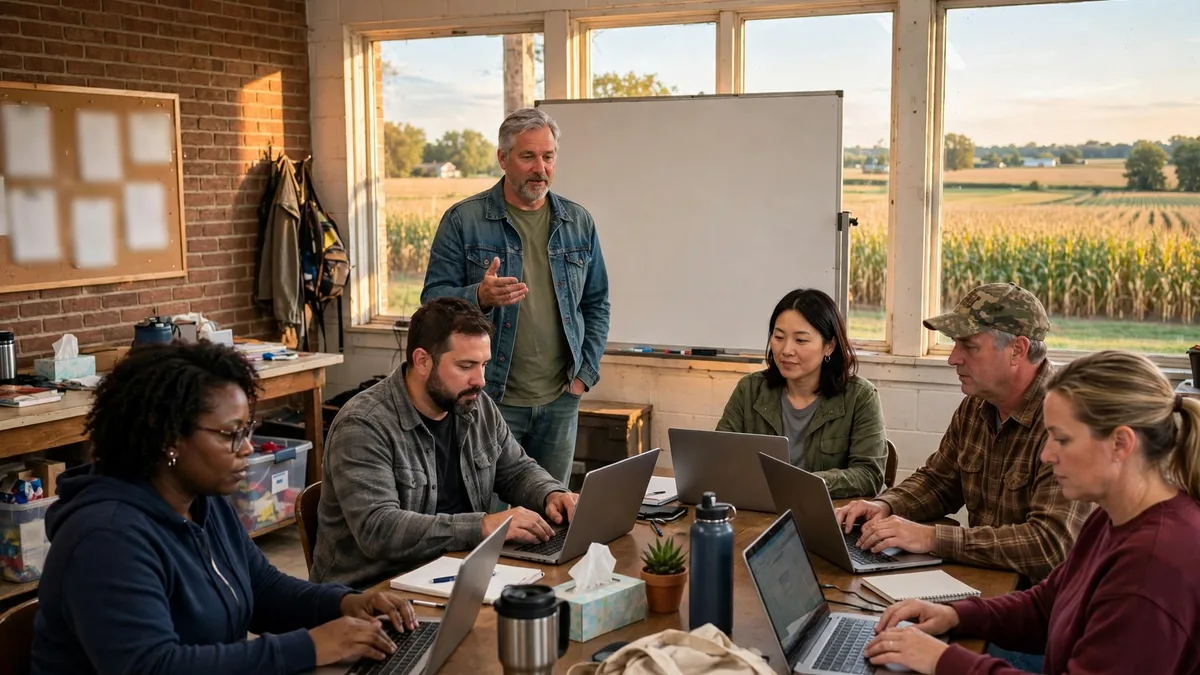
A Small Ohio Town Is Training Its Next AI Workforce From Scratch
The rural Ohio AI apprenticeship taking shape in Windham, a small village in Portage County, starts from a simple observation: the next generation of AI talent may not come from the places employers usually look. According to Forbes, Hope Town, a nonprofit based in the village, is developing The Forge, a residential AI apprenticeship designed to prepare underserved adults for work in an increasingly technology-driven economy. The first cohort is expected in March 2027, and it will be small on purpose.
Windham is surrounded by cornfields, not office parks. That is part of the point. The program is built on the idea that talent is spread far more widely than opportunity, and that people who have been overlooked by the technology industry may still have the aptitude, the drive and the life experience to do the work. Forbes reported the story on 29 November 2026, and a republication of the piece describes The Forge as an attempt to connect two problems at once: employers searching for AI-capable workers, and capable adults who lack access to training, resources and the right introductions.
What makes the project stand out is not only the subject it teaches. It is the way the training is wrapped in housing, food, transport, coaching and paid work, so that participants can focus on learning instead of juggling the practical barriers that so often end a course before it begins. Hope Town has spent years building that support system, and The Forge is its attempt to connect it to one of the largest workforce openings of the decade.
Key takeaways
| At a glance | The Forge, Windham, Ohio |
|---|---|
| Organisation | Hope Town, a nonprofit in Windham, Ohio |
| Programme | The Forge, a residential AI apprenticeship |
| First cohort | Ten competitively selected adults, expected in March 2027 |
| What it combines | AI education, professional development, workplace skills and paid internships |
| Support included | Housing, food, transportation, coaching and essential support |
| Employer role | Internship partners help shape training around their operational needs |
| Founder | Ted St. John, founder and chief executive of Hope Town |
| Reported by | Forbes, 29 November 2026, by contributor Paul Baier |
The Forge in Windham, Ohio
The Forge is not a short course or a weekend bootcamp. According to the Forbes account, it is a residential apprenticeship, which means participants live where they learn, and the learning is tied directly to paid work. That residential element matters in a rural setting, where a promising course can still be out of reach if the learner has no reliable transport, no stable place to stay, or no income while they study. By bringing those pieces together, Hope Town is trying to remove the obstacles that usually sit between a motivated adult and a new career.
Who the apprenticeship is for
The Forge is aimed at underserved adults, a broad description that covers people who have talent and motivation but have not had a clear route into technology work. Forbes does not present the programme as a course for recent graduates or for people who already hold technology degrees. It is framed instead as a way in for adults who have been shut out by cost, by distance, by caring responsibilities, or by a work history that does not fit the usual hiring template.

For adults weighing a change of direction, the broader question of which roles AI will actually create is worth studying alongside any single programme. Our guide to what jobs AI will replace looks at the other side of the same shift: the roles most exposed to automation, and the human skills that remain hard to replace. The Forge sits on the optimistic side of that ledger, counting on training and support to move people toward the work that AI creates rather than away from it.
How employers shape the training
One of the clearest ideas in the Forbes piece is that employers are not meant to be passive recipients of graduates. Internship partners will help shape the training around their operational needs, giving apprentices practical experience with real business systems. That is a different model from a classroom course that teaches a fixed syllabus and then hopes employers find it relevant. Here, the workplace is part of the classroom.
The logic is straightforward. A company that helps design the training is more likely to trust the result, and an apprentice who has already worked inside a real business is more likely to be hired by it. The paid internships are the bridge between the two. They give participants income and experience at the same time, and they give employers a low-risk way to see how someone works before offering a permanent role.
Support beyond the classroom
Technical training on its own is rarely enough to change a life, and the Forbes account spends as much time on the support around The Forge as on the AI content. Participants will receive housing, food, transportation, coaching and essential support, allowing them to concentrate on learning and preparing for employment. Each of those items removes a reason to drop out, and together they amount to a recognition that adult learners carry responsibilities that a full-time student often does not.
Why a rural town, and why now
Rural communities have often been last in line for technology training, and the reasons are familiar. Teachers trained in technology are scarce, courses are concentrated in cities, and the cost of travel or relocation puts many programmes out of reach. The Enterprise Technology Association’s profile of Hope Town makes a related point about rural Ohio more broadly: people in Appalachian communities can fall further behind with each new technology unless they are given a way to use it productively. AI, in that account, is a chance to close gaps rather than widen them.
The pattern is not unique to Ohio. Research on how AI is reshaping work suggests the effects fall unevenly across different communities, and our report on how AI reshapes work for Black and Latino workers looks at one part of that uneven picture. The Forge is a local answer to the same national question: who gets a route into the new work, and who is left to watch it happen elsewhere?
What it means for other communities
The Forge is small, but its model is designed to travel. The Forbes piece ends with St. John looking beyond Windham, arguing that if AI professionals can be developed from an underserved population in rural Ohio, the same approach could matter for communities across America. That is an aspiration rather than a proven result, and it should be read as one. Ten people in one village do not prove a national model. They do, however, provide a test that other communities can learn from, whether it succeeds or not.
For the apprentices themselves, the meaning is simpler and more immediate. A programme like this is a chance to build a career without leaving home, without going into debt, and without pretending that the barriers they face do not exist. That is the promise in St. John’s closing words in the Forbes piece: the aim is not simply to teach people AI, but to create pathways to economic independence, meaningful careers and futures they may never have imagined possible.
A checklist for judging AI apprenticeships
Frequently asked questions
What is The Forge?
According to Forbes, The Forge is a residential AI apprenticeship being developed by Hope Town in Windham, Ohio. It combines AI education, professional development, workplace skills and paid internships, with housing, food, transport and coaching included for participants.
Who can apply to The Forge?
The programme is aimed at underserved adults, and Forbes reports that the first cohort will be ten competitively selected adults. No detailed eligibility criteria or application process had been published in the reporting available at the time of writing, so prospective applicants should watch for an official announcement from Hope Town.
When does the first cohort start?
Forbes reports that the first cohort is expected in March 2027. That date comes from the Forbes account of the programme, and it has not been independently confirmed by a separate published source, so it should be treated as the programme’s stated expectation rather than a confirmed start date.
Is The Forge only for people in Windham?
The programme is based in Windham, Ohio, and it is residential, so participants will live where they learn. Forbes frames it as a model that could eventually expand to other underserved communities, but there is no published detail yet about cohorts outside Windham.
What kind of AI work will graduates do?
Forbes describes the aim as preparing people to operate and maintain the AI systems that businesses use, through training shaped by internship partners around their operational needs. The exact roles will depend on which employers take part and what their systems require.
How is Hope Town AI different from The Forge?
Hope Town AI is the organisation’s technical-assistance initiative, which helps businesses with AI adoption, automation and digital transformation, and runs AI classes including a 12-session academy across three tracks, according to the Enterprise Technology Association. The Forge is the residential apprenticeship that sits alongside it, focused on training the workforce those businesses need.
The bottom line
The Forge is a modest idea with a large ambition: to show that a small rural town, given the right support and the right employer partners, can train capable AI workers from a population that the technology industry has largely overlooked. The first cohort of ten people, expected in March 2027, will be the first real test of whether housing, coaching, paid internships and employer-shaped training can add up to lasting careers.
Until those outcomes are known, the fairest reading is that Hope Town has built a thoughtful model on a strong local foundation, and that Forbes has reported its ambitions faithfully. The programme deserves attention because it takes the barriers seriously instead of wishing them away. Whether it becomes a template for other towns will depend on what its first graduates actually go on to do.