
What makes a currency strong enough to survive gold rushes, sanctions, inflation shocks, and global market storms? South Africa’s rand has done all of that. It is one of the most actively traded currencies in the world, yet it belongs to an economy that many outsiders still misunderstand. For anyone traveling to South Africa, doing business with South African firms, or simply trying to understand how money works in a complex emerging economy, the rand offers a fascinating case study. From its birth on Valentine’s Day in 1961 to the polymer notes in today’s wallets, South African money tells a story about national identity, economic discipline, and the constant tug-of-war between local politics and global finance.
The Rand’s Origins and the Meaning Behind the Name
The word “rand” comes from the Witwatersrand, the gold-bearing ridge in Gauteng where much of South Africa’s mineral wealth was discovered in the late 19th century. When the country replaced the South African pound on 14 February 1961, it adopted a decimal system: one rand equals 100 cents. That shift from pounds, shillings, and pence was part of a broader wave of decimalisation across the Commonwealth.
The timing mattered. The change came just months before South Africa became a republic, so the earliest rand coins and notes carried the portrait of Queen Elizabeth II before being replaced with the national coat of arms. For collectors, that transition is a neat reminder that currency is never just a medium of exchange. It carries the politics and symbols of the moment it was issued.
Today, the South African Reserve Bank (SARB) issues banknotes, while the South African Mint, a subsidiary, produces coins. The SARB itself was established in 1921 under the Currency and Banking Act, making it one of the older central banks in the developing world. (Banknotes and coin)
What Notes and Coins Actually Look Like

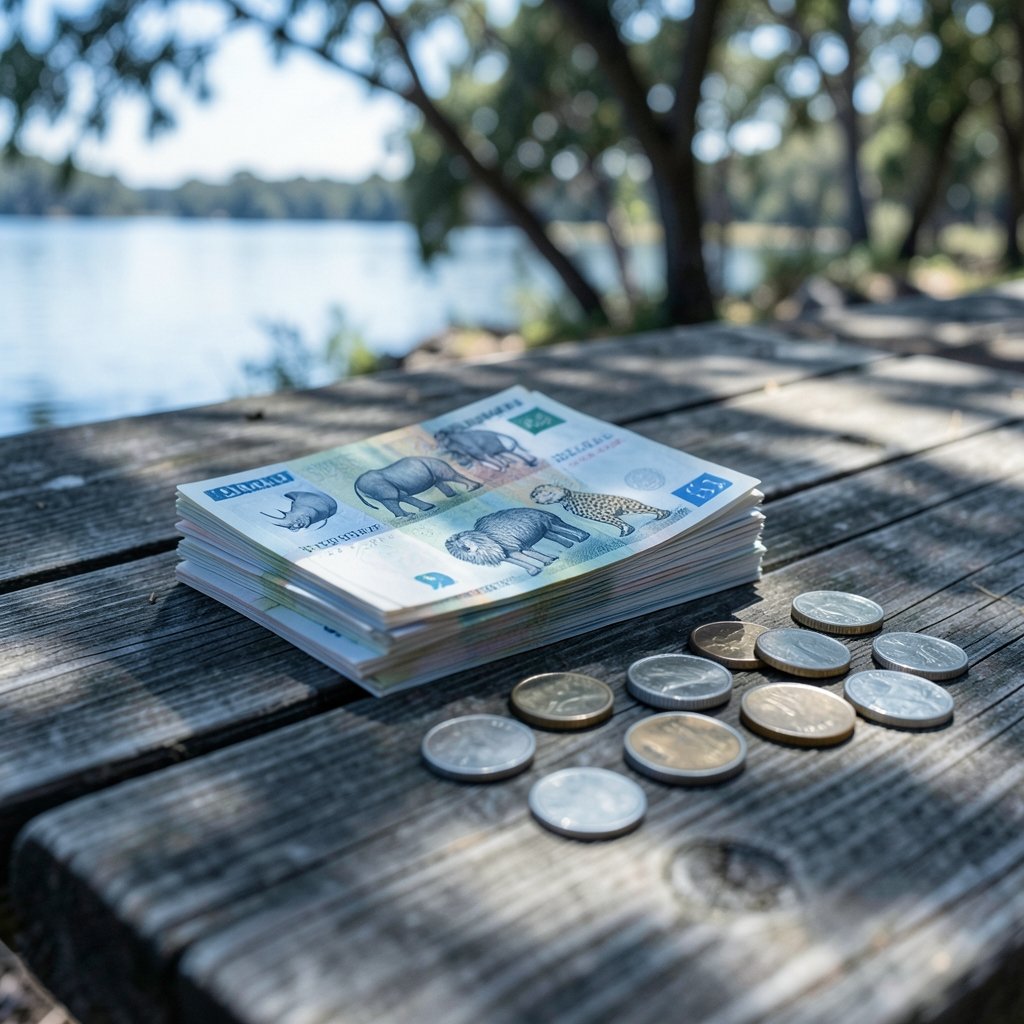
The current banknote series is known as the Nelson Mandela series. Introduced from 2012, it features Mandela’s portrait on the front and the “Big Five” animals on the back: the rhino on the R10, the elephant on the R20, the lion on the R50, the buffalo on the R100, and the leopard on the R200. A refreshed series with updated security features was announced around 2018 and rolled out gradually between 2019 and 2023.
| Denomination | Front | Back | Colour family |
|---|---|---|---|
| R10 | Nelson Mandela | Rhinoceros | Green |
| R20 | Nelson Mandela | Elephant | Brown |
| R50 | Nelson Mandela | Lion | Red |
| R100 | Nelson Mandela | Buffalo | Blue |
| R200 | Nelson Mandela | Leopard | Orange |
Coins are a different story. Circulating coins now run from 10 cents to R5. The 1-cent and 2-cent coins were withdrawn from circulation in 2002. They technically remain legal tender, but they are no longer minted, and prices are now rounded to the nearest 10 cents in cash transactions. A common mistake visitors make is assuming they can still spend old copper coins at a till. In practice, cashiers will usually refuse them, and the coins are worth more to collectors than their face value.
Security Features: How to Spot a Fake
Counterfeiting is a real concern in any cash-heavy economy, and the SARB publishes security-feature guides for each denomination. The key features to check include:
- Watermark: Hold the note up to the light to see the portrait or denomination.
- Security thread: A thin line embedded in the paper that appears as a dark line in transmitted light.
- Colour-shifting ink: On higher denominations, the number changes colour when the note is tilted.
- Raised print: Genuine notes have a slightly textured feel on the portrait and text.
- Microprinting: Tiny text that becomes illegible when photocopied.
In practice, the fastest check is the feel. Genuine South African notes have a distinct, slightly rough texture that photocopies cannot replicate. If a note feels slick or unusually smooth, treat it with suspicion. Tourists and small businesses are the most common targets, and the same caution applies to digital fraud. Understanding how a gift card scam works and why victims rarely get their money back is a useful complement to cash-handling awareness, because fraudsters often pivot between physical and digital methods.
The Rand as a Floating, Commodity-Linked Currency
Since the 1980s, the rand has floated. Exchange controls were progressively relaxed over the decades but never fully abolished, which means the currency is not entirely free of official influence. South Africa’s financial markets are deep and sophisticated for an emerging economy, and the rand is consistently among the most heavily traded emerging-market currencies in global foreign-exchange turnover surveys.
The rand is often described as a commodity-linked currency. Its value is sensitive to gold and platinum group metal prices, because those exports generate foreign exchange. It is also highly sensitive to global risk sentiment. When investors are nervous, they pull money out of emerging markets, and the rand weakens quickly. When risk appetite returns, it strengthens. This makes the rand a useful barometer of global mood, but it also makes it volatile, which matters for anyone holding it or planning a trip.
For travellers, the practical lesson is simple: do not buy all your rand months in advance. Spread your currency purchases over time, or use a card with low foreign transaction fees, so you are not caught by a sudden swing.
Inflation and the 3-6% Target
South Africa’s inflation history is a story of extremes. The 1970s and 1980s saw very high inflation, and the rand lost purchasing power rapidly. Inflation spiked again in the late 1990s and early 2000s. In response, the SARB adopted an explicit inflation-targeting framework in 2000, with a target band of 3% to 6% as measured by the consumer price index.
That framework changed how South Africans think about money. Instead of guessing what inflation might do, businesses and households could anchor their expectations to a published band. It has not always been met, particularly during periods of currency weakness or global energy shocks, but it has provided a credible anchor.
For ordinary households, the effect is visible in everyday budgeting. A loaf of bread or a litre of petrol costs many times what it did in the 1990s. Anyone planning long-term savings in rand needs to account for inflation, which is why many South Africans hold a portion of their wealth in offshore assets or inflation-linked bonds.
Digital Money and the Future of Payments
South Africa has one of the more advanced banking sectors in Africa, with widespread card acceptance, mobile banking, and instant payment rails. Cash remains important, especially in informal settlements and rural areas, but digital payments are growing fast.
The next frontier is central bank digital currency. Central banks worldwide are researching or piloting digital versions of their currencies, and the debate over privacy, inclusion, and control is intense. Readers curious about how this works can explore what CBDCs are and how central bank money is going digital, which explains the basic mechanics and the trade-offs. For South Africa, a digital rand could improve financial inclusion, but it also raises questions about surveillance and the role of commercial banks.
Meanwhile, the country’s financial regulators have been tightening their scrutiny of bank security. Recent breaches elsewhere have prompted a regional rethink, and South Korea’s bank security checks in 2026 following major breaches offer a useful comparison for how other markets are responding to the same pressures.
Exchange Controls and Taking Money Out
South Africa maintains exchange controls, which limit how much money residents can move offshore without approval. Individuals can use a discretionary allowance each year, and there are additional allowances for foreign investment and travel. These rules are relaxed from time to time, but they have never been abolished.
For visitors and foreign investors, the rules are different. Non-residents can generally repatriate capital and profits, provided they follow the correct documentation. The practical advice is to keep records. Banks and authorised dealers will ask for proof of the source of funds, and missing paperwork is the most common reason transfers get delayed.
A common mistake is assuming that because the rand is freely traded on global markets, moving money in and out of South Africa is equally frictionless. It is not. The currency trades freely, but the plumbing around it does not.
The Rand in Daily Life: Practical Tips
For anyone spending time in South Africa, a few habits make money management easier:
- Carry some cash. Card acceptance is good in cities, but smaller vendors, taxis, and market stalls often prefer cash.
- Watch for card skimming. Use ATMs inside banks or shopping centres rather than on the street.
- Budget for tipping. Tipping is customary in restaurants and for car guards, usually around 10% to 15%.
- Check the note series. Older notes are still valid, but some vendors may be unfamiliar with them.
- Keep small denominations. Breaking a R200 note for a small purchase can be difficult in informal settings.
The broader lesson: South African money is a currency and also a system with rules, habits, and infrastructure that reward a little preparation. The same applies to the wider financial system, where understanding where the money actually goes in identity threat detection helps consumers see why banks spend heavily on protecting accounts.
Why the Rand Matters Beyond South Africa
South Africa is a member of the BRICS group and a major exporter of gold, platinum, and agricultural products. Its currency is therefore a reference point for other African markets and a proxy for emerging-market sentiment more broadly. When the rand weakens sharply, it often signals that investors are retreating from riskier assets everywhere.
That interconnectedness cuts both ways. Global events, from US interest rate decisions to commodity price swings, show up quickly in the rand’s value. For South Africans, this means the cost of imported goods can change fast. For outsiders, it means the rand is a useful early warning indicator.
Conclusion
South African money is more than paper and metal. The rand carries the story of a country that decimalised in 1961, survived decades of inflation, built one of Africa’s most sophisticated financial markets, and now sits at the centre of debates about digital currency and exchange controls. Understanding how the notes are secured, why the currency swings, and how inflation targeting shapes everyday budgeting gives readers a practical edge, whether they are visiting, investing, or simply curious about how a commodity-linked currency behaves. The rand rewards attention, and a little knowledge goes a long way.
Frequently Asked Questions
What is the South African currency called?
The currency is the rand, divided into 100 cents. It was introduced on 14 February 1961, replacing the South African pound at a rate of two rand to one pound.
Why is the rand so volatile?
The rand is a commodity-linked emerging-market currency. Its value responds to gold and platinum prices, global risk sentiment, and domestic political and economic news. Because South Africa’s markets are open and liquid, money moves in and out quickly, which amplifies price swings.
Are old South African banknotes still valid?
Notes from the Nelson Mandela series introduced from 2012 remain valid, including the refreshed versions rolled out between 2019 and 2023. Very old notes from earlier series may still be exchangeable at the Reserve Bank, but shops will often refuse them, so it is best to exchange them at a bank.
Can I still use 1-cent and 2-cent coins?
The 1-cent and 2-cent coins were withdrawn from circulation in 2002. They technically remain legal tender but are no longer minted, and in practice cashiers will usually refuse them. Cash prices are rounded to the nearest 10 cents.
What is the Reserve Bank’s inflation target?
The South African Reserve Bank has used an inflation-targeting framework since 2000, with a target band of 3% to 6% measured by the consumer price index. The bank adjusts interest rates to try to keep inflation within that band.
How much cash can I take out of South Africa?
South Africa maintains exchange controls, so residents face annual allowances for moving money offshore, while non-residents can generally repatriate capital with the right documentation. The rules are relaxed periodically, so it is worth checking the current allowances with an authorised dealer before making large transfers.



