
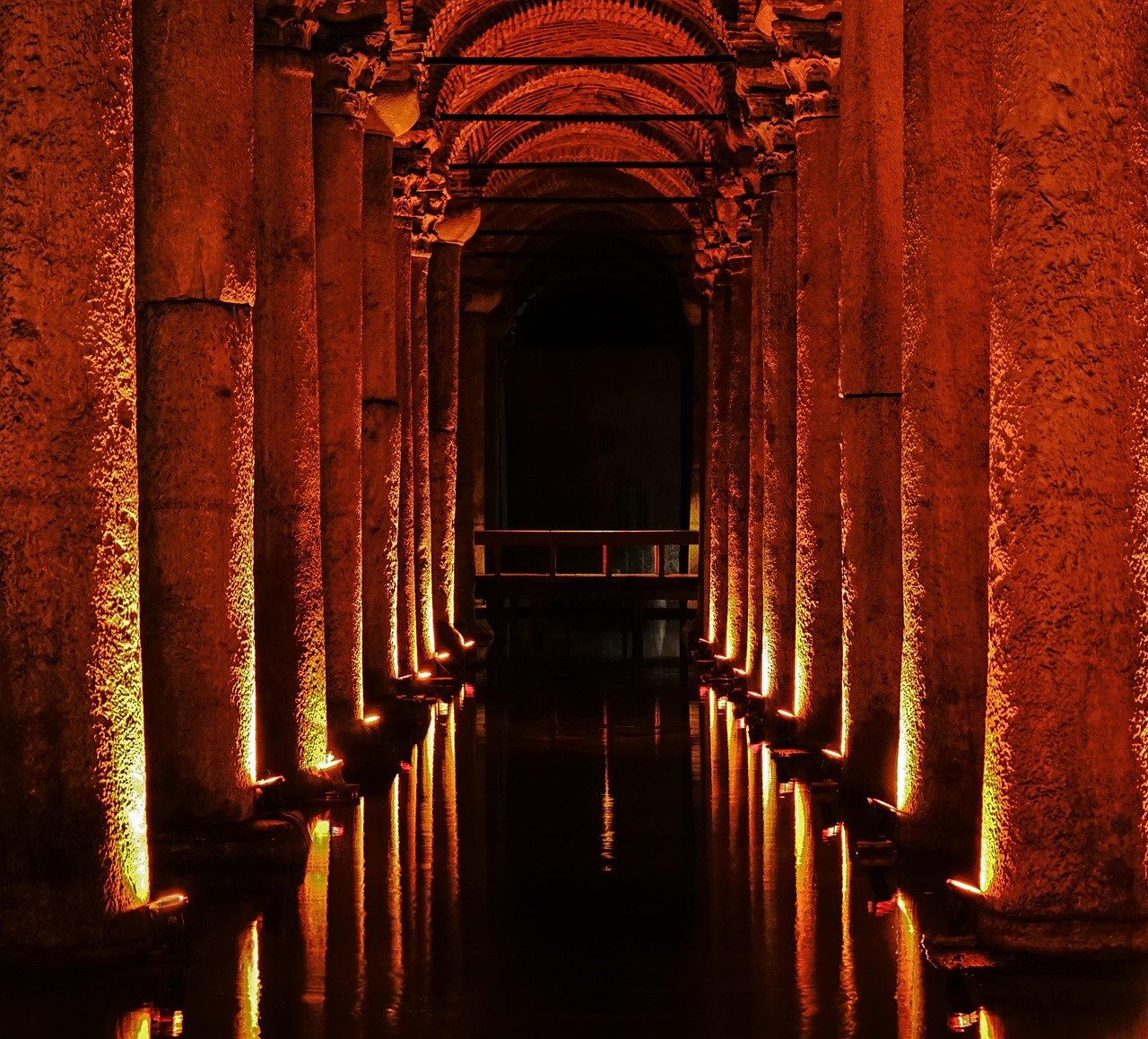
What if one of Istanbul’s grandest buildings sits not on the skyline, but beneath it? That is exactly the case with the Sunken Palace Cistern, known in Turkish as Yerebatan Sarnıcı and in English as the Basilica Cistern. It is the largest covered cistern still standing in Istanbul, a forest of marble columns standing in shallow water, hidden under the streets of the historic peninsula. Visitors who walk down its steps leave behind the noise of the city and enter a cool, dim, echo-filled space that looks more like a temple than a water tank.
This guide covers what the cistern is, who built it and why, what you will actually see inside, the legends attached to its most famous features, and the practical details that make a visit smoother. It also separates what is documented from what is folklore, because the two get mixed together constantly.
What Is the Sunken Palace Cistern?
The Sunken Palace is the popular nickname for the Basilica Cistern. The Turkish name, Yerebatan Sarnıcı, translates roughly as “cistern sinking into the earth,” which describes the experience of descending into it. The English name comes from the fact that the structure was built beneath a basilica, a type of large public building used in the Byzantine world for civic and legal business.
Functionally, it is a water storage reservoir. Its job was to hold drinking water for the Great Palace of the Byzantine emperors and the surrounding district. It is not a natural cave, a church, or a tomb, although its columns and vaulted ceiling give it a solemn, almost sacred atmosphere that leads many visitors to assume otherwise.
It is also not the only cistern in the city. Istanbul sits on a peninsula with limited rivers, so Byzantine engineers built dozens of covered reservoirs to guarantee supply during sieges and dry seasons. The Basilica Cistern is simply the largest and most spectacular survivor of that network.
Who Built It, and When?
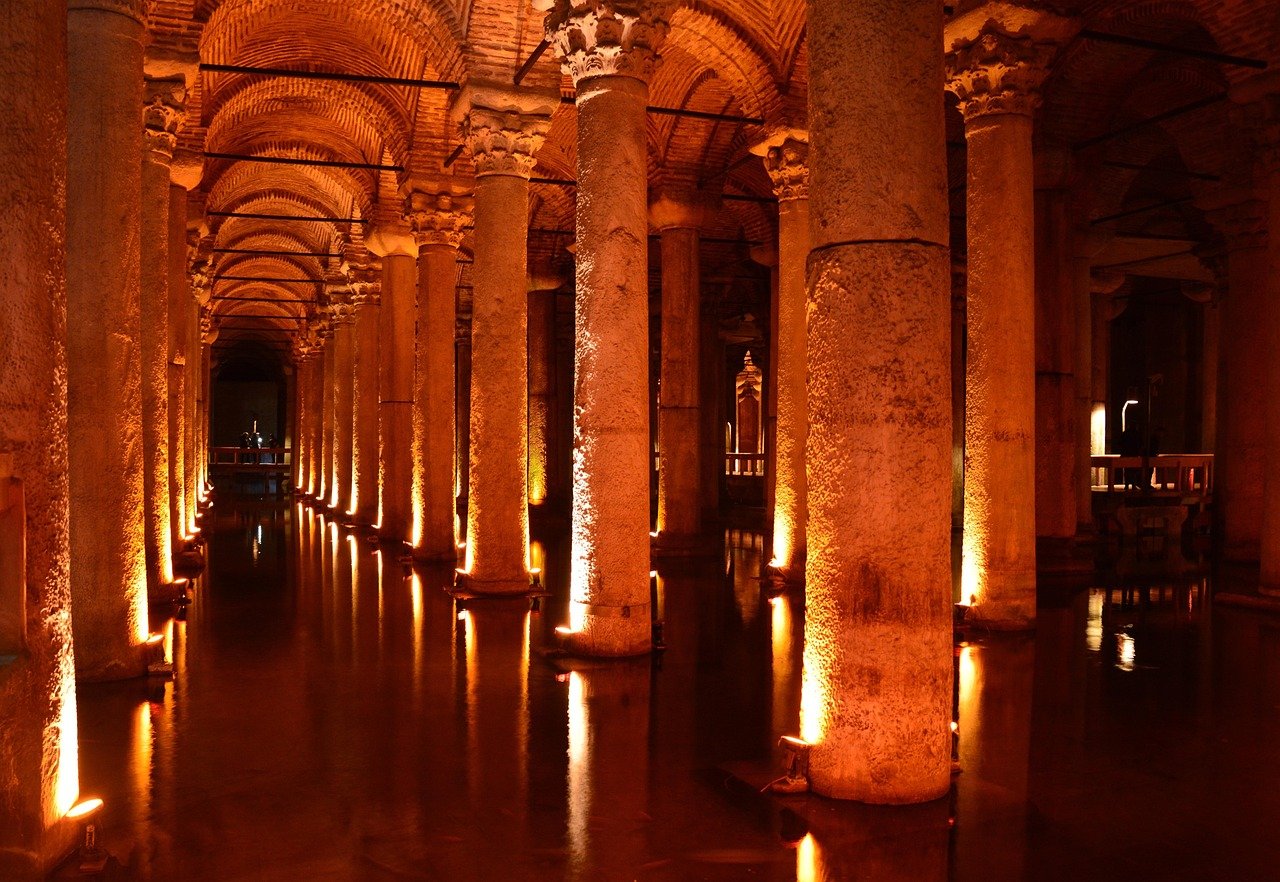
The cistern was built in 532 CE under the Byzantine emperor Justinian I. The timing matters. In 532, Constantinople was shaken by the Nika riots, a massive uprising that devastated parts of the city. Justinian’s response included a large rebuilding program, and the cistern belongs to that wave of construction. It was a statement of imperial capacity as much as a piece of infrastructure.
The scale of the project reflects that ambition. The structure measures roughly 140 meters by 70 meters and covers about 9,800 square meters. Capacity figures are quoted in different ways depending on the source, commonly around 80,000 cubic meters of water, with some accounts describing roughly 100,000 tons. Treat exact numbers with mild caution: published figures vary, and official museum or municipal sources are the safest reference for current data.
Why the Columns Look Mismatched
The cistern is supported by 336 marble columns, arranged mostly in 12 rows of 28, each about 9 meters tall. Look closely and you will notice that the capitals, the decorative tops of the columns, are not uniform. Some are Ionic, some Corinthian, and the proportions differ from column to column.
This is not sloppy workmanship. It is spolia, the practice of reusing architectural elements from older buildings. When time and money are short, and when older structures are damaged or disused, recycling columns is a practical solution. The result is a space that reads like a catalogue of earlier styles, which is part of why the cistern fascinates architectural historians.
What You Actually See Inside
The first thing most people notice is the raised walkway. Visitors do not wade through the water; a platform carries them through the columns at a comfortable height, which makes the site accessible and protects the structure. Beneath the walkway, shallow water still covers the floor, and fish sometimes move through it.
The second thing people notice is the lighting. The space is deliberately dim, with warm light picking out column bases and the vaulted brick ceiling above. Photography is possible, but phone cameras struggle, so expect grainy results unless you have a device with good low-light performance.
The third thing is the sound. Water drips, footsteps echo, and voices carry. It is worth pausing in the middle of the hall to notice how different the acoustic environment feels from the street above.
The Medusa Heads
In the northwest corner sit two column bases carved with Medusa heads. One is positioned sideways; the other is upside down. They are the single most photographed feature in the cistern, and the most mythologized.
Here is the honest answer about them: nobody knows for certain where they came from or why they are oriented that way. The heads are reused material, like the columns, so they likely came from an older Roman or Byzantine structure. The orientation has attracted many explanations, from practical (the base was the right size and shape to support the column, so it was laid that way) to symbolic (some claim the sideways and inverted placement neutralizes the petrifying gaze of the Gorgon). Those symbolic readings are speculation, not documented history. They are enjoyable to hear and worth repeating as legend, but they should not be presented as fact.
The Weeping Column
Another famous feature is the Column of Tears, often called the weeping column. It is decorated with peacock-eye or teardrop motifs, and it has a small hole in it. Folk tradition holds that inserting a finger into the hole and making a wish brings good luck, and that the column “weeps” for the workers and enslaved people who died during construction.
That story is folk tradition, not recorded history. There is no contemporary documentation tying the column to a specific tragedy. The decoration itself is real and worth examining; the legend is a layer added over time.
A Short History of Forgetfulness and Rediscovery
The cistern served its purpose for centuries. It was used into the Ottoman period, supplying water to the palace complex and nearby residents. Over time, however, it fell out of active use and was largely forgotten by the city above it.
Its rediscovery is usually credited to the 16th century, and often specifically to Petrus Gyllius, a scholar who documented Byzantine antiquities in Istanbul. Local residents reportedly told him they could lower buckets through holes in their basements and pull up water, sometimes with fish in it. That detail, whether or not every element is exact, captures how thoroughly the structure had vanished from public awareness: people were drawing water from a reservoir they no longer knew existed.
Restoration followed across the centuries, with major work in the 1980s and further campaigns in the 2010s and 2020s. Restoration chronology is one area where sources genuinely differ, so if exact dates matter to you, check current official visitor information rather than relying on older guidebooks.
Today the cistern operates as a museum and one of the city’s most visited attractions. It has also hosted occasional cultural events, which is a neat reversal: a space built to hide water now draws crowds to stand inside it.
Practical Tips That Actually Help
First-hand accounts from visitors converge on a few points that guidebooks often skip.
Go early or late. The cistern is popular and the walkway is narrow in places. Mid-morning and midday bring tour groups. The first slot of the day and the last hour before closing are calmer, and the low lighting looks better in photographs anyway.
Expect moisture and a temperature drop. The space is cool and humid year-round. A light layer helps in summer, when the contrast with the street is sharp.
Watch your footing. The walkway is generally sound, but water on the surface and uneven transitions near the Medusa heads catch people out. Wear shoes with grip rather than smooth soles.
Do not rely on flash. Flash photography is typically restricted, and it flattens the scene anyway. Steady hands and a higher ISO setting do more good.
Read up before you descend. The site is atmospheric but sparse on signage in some areas. Knowing the Justinian context, the spolia story, and the difference between legend and record turns a pretty photo stop into a genuinely interesting hour.
Common mistakes to avoid: treating the Medusa orientation as settled fact, assuming the cistern was a church, expecting to see the whole thing in ten minutes, and skipping the Column of Tears because the crowd is thick around the Medusa heads. The weeping column rewards a closer look.
How It Compares to Other Istanbul Cisterns
The Basilica Cistern gets the crowds, but it is not the only option. A quick comparison helps set expectations.
| Feature | Basilica Cistern (Sunken Palace) | Smaller historic cisterns |
|---|---|---|
| Scale | Largest covered cistern surviving in the city | Modest, often a few dozen columns |
| Atmosphere | Dramatic lighting, raised walkway, event venue | Quieter, rawer, often less visited |
| Signature features | Medusa heads, weeping column | Varies; usually fewer set pieces |
| Crowds | Heavy at peak times | Usually light |
| Best for | First-time visitors wanting the full spectacle | Repeat visitors seeking atmosphere |
If you have time for only one, the Sunken Palace is the obvious choice. If you have already seen it and want a quieter experience, the smaller cisterns scattered through the historic peninsula offer a different, more intimate view of the same engineering tradition.
Why the Cistern Still Matters
The Basilica Cistern is a rare thing: a piece of infrastructure that doubles as a monument. Most Roman and Byzantine water systems survive as ruins, fragments of pipe, or faint outlines in the ground. This one survives as a complete, walkable interior, with its columns, capitals, and vaulting intact enough to convey how the space would have felt when it was full.
It also illustrates a broader point about Byzantine Constantinople. The city’s water supply depended on a system of aqueducts bringing water from outside the walls and reservoirs storing it inside. The cistern is the storage end of that chain, and its size tells you how seriously the emperors took the risk of running dry during a siege.
For visitors, that context is what turns a photogenic underground hall into a lesson in urban planning, imperial politics, and the recycling economy of the ancient world, all in one dim, dripping room.
Conclusion
The Sunken Palace Cistern earns its nickname. Descending into it feels like leaving Istanbul for another city entirely, one built of marble columns, shallow water, and lamplight. Built in 532 CE under Justinian I, supported by 336 reused columns, and largely forgotten for centuries before its rediscovery, it is both an engineering achievement and a monument to imperial ambition.
The key to enjoying it is knowing what you are looking at. The Medusa heads are mysterious but not magical; the weeping column is decorated but its legend is folklore; the mismatched capitals are evidence of practical reuse, not disorder. Go early, bring a layer, watch your step, and give yourself more than ten minutes. For anyone planning a trip through the historic peninsula, the cistern pairs naturally with the city’s other Byzantine sites, and you can find more context and travel guidance at
FAQ
What is the Sunken Palace Cistern?
It is the popular name for the Basilica Cistern in Istanbul, Turkish Yerebatan Sarnıcı. It is the largest covered cistern surviving in the city, built in 532 CE under the Byzantine emperor Justinian I to store water for the Great Palace and surrounding district.
How many columns are inside the Basilica Cistern?
There are 336 marble columns, arranged mostly in 12 rows of 28, each roughly 9 meters tall. Many were reused from older structures, which is why the capitals mix Ionic and Corinthian styles.
Why are the Medusa heads sideways and upside down?
No one knows for certain. The heads are reused material, and the orientation has attracted many theories, from practical support requirements to symbolic claims about neutralizing the Gorgon’s gaze. The symbolic explanations are speculation, not documented history.
Was the Basilica Cistern a church?
No. It was a water reservoir, built beneath a basilica, which was a large public building used for civic and legal business in the Byzantine world. Its temple-like atmosphere comes from the columns and vaulting, not from religious use.
How long does a visit take?
Most visitors spend 30 to 45 minutes inside, though the walkway is short and some people move through in 15. Going early or late avoids the heaviest crowds and gives you room to linger at the Medusa heads and the weeping column.
Is the cistern suitable for children and older visitors?
Generally yes. The raised walkway removes the need to walk in water, but surfaces can be damp and some transitions are uneven. Sturdy shoes help, and the space is cool, so a light layer is useful even in summer.



