

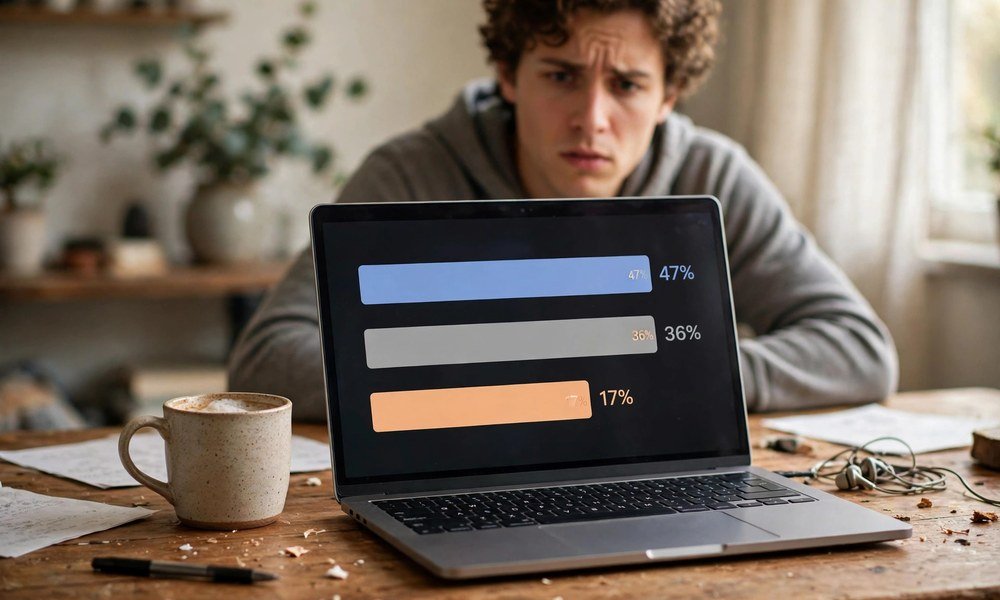
A small cafe puts a poll on its website on a Monday morning. Which new drink should join the menu, the question asks, with three options below it. By Friday the poll has forty one votes, and the winner takes forty seven percent. The owner orders the ingredients, prints a new menu board, and trains the staff on the new drink. In the first week only four customers order it. Most of the votes arrived in the first hour, from a link shared in a group chat by one regular customer. The poll never measured what customers wanted.
That is the quiet failure of a bad poll page. A poll looks like the cheapest research a business can run. One question, a few options, and an answer in days. But a poll page that is badly built does not give a cheap answer. It gives a confident wrong answer, and a confident wrong answer is more expensive than no answer at all, because the business acts on it. The stock order goes out, the promotion runs, and the real preference of real customers never gets a hearing.
This is an opinion, and it is a direct one. Most small businesses do not have a polling problem. They have a poll page problem. They ask one question with a page that invites skewed votes and low participation, then they treat the result as a vote of the whole customer base. The cost arrives as skewed votes, low participation, wrong conclusions, wasted promotion, and damaged trust, and the bill is larger than the cost of building the page properly.
Key takeaways
- A bad poll page skews votes, because the loudest visitors vote first and the quiet majority never sees it.
- Low participation makes a poll look precise while it measures almost nobody.
- Wrong conclusions follow bad options, because a missing option and a leading question push votes toward one answer.
- Wasted promotion follows a wrong result, because the business spends real money marketing a choice customers never made.
- Trust is the real cost: a poll that promises a voice and then ignores the result teaches visitors not to vote.
What a bad poll page actually costs
Start with the simplest number: how many votes arrived, and from whom. A poll page that turns one hundred visitors into nine votes has not measured one hundred visitors. It has measured nine, and those nine are the visitors who happened to see the page, cared enough to tap, and found an option that matched their view. A result that reads sixty percent for one option can mean six votes out of ten, and the page shows the same bars either way.
The skew gets worse when the page shows live results before voting. A visitor who sees one option leading by a wide margin will often vote for the leader, or will skip the poll because the result looks settled. The page therefore shapes the votes it collects, and each new vote makes the lead look stronger. A page that hides results until after voting collects a truer picture than a page that flashes a leader board at every visitor before they choose.
Repeat voting is the third cost, and it is the one that owners notice last. A poll page with no limit on votes per visitor invites the same person to vote many times, and a motivated person will do exactly that. The business will never see the duplicate votes in the percentage bars. It will see only a winner, and it will act on a winner that one person created. A page that limits each visitor to one vote and states the vote total alongside the percentages gives the business a result it can defend.
The fourth cost is the promotion that follows the wrong result. A poll that picks a new product, a new opening time, or a new service is only the start of the spend. The business orders stock, prints signs, buys social promotion, and tells staff to push the winning option. The guide to how to set up a business website poll page shows how much of that waste comes from decisions made before the first vote, such as the question wording, the voting rules, and the closing date. A poll is cheap to run and expensive to follow.
Why poll pages go bad
Poll pages go bad for a simple reason: the question is written around the answer the business already wants. A cafe that wants to add oat milk asks which milk customers prefer, with oat milk first, in bold, and the other options listed as plain text below. A gym that wants evening classes asks which time works best, with evening first and morning last. Many visitors will give the hoped for answer, either to be helpful or because the layout nudges them. The result then confirms a decision that was already made, and the business calls that confirmation research.
The second reason is the missing option. A poll with three options and no way to say none of these forces every voter into a choice that may not match any real preference. A visitor who likes none of the options will either skip the poll, which shrinks the vote total, or pick the least bad option, which inflates a winner that nobody truly wants. A plain explanation of what a business website poll is for small businesses draws the line clearly: a poll counts votes on one fast choice, and it only works when the options cover the real choices. When the options miss the real choice, the poll measures the page.
The third reason is the missing close. Many poll pages stay open for months, with no closing date and no published result. Votes trickle in long after the decision was made, and the percentages drift as seasons change and new visitors arrive. A page with a stated closing date, a published result, and a note about what the business will do next turns a poll into a decision. A page without those things turns a poll into a decoration that slowly misleads everyone who reads it.
The human side of a skewed vote
Behind every skewed poll is a visitor who tried to take part and found the page working against them. A regular customer opens the poll, reads a question that assumes a preference the customer does not hold, and finds no option that fits. The customer closes the page without voting. The page refused the help that was offered, by narrowing the choice to options that missed the point.
The damage shows up when the business acts on the result. The cafe adds the drink that won the poll, and the regular customers who never voted walk in, look at the new menu, and find nothing they asked for. They simply order what they always ordered, and they stop opening poll links. The next poll starts from a smaller and more skewed pool, because the people who felt ignored have already left the audience.
There is also a quiet cost inside the business. Staff who watch a poll result clash with what customers say at the counter start to distrust the page. After a few rounds like that, the team stops checking the poll at all, and the page becomes a ritual that marketing runs and nobody believes. A poll that produces numbers nobody trusts is worse than no poll.
The caveats that matter
A bad poll page is not the only reason a vote total stays low, and it would be unfair to blame the page for every thin result. A poll differs from a survey in a way that limits what it can prove. A survey asks several questions and explores reasons, while a poll counts votes on one fast choice. The honest test is to compare the page against itself: change one thing, such as hiding results until after voting, and watch the vote total move. If it moves, the page was shaping the result.
| Detail | What is known |
|---|---|
| Skewed votes | Live results and repeat votes push the count toward one option. |
| Low participation | Nine votes from one hundred visitors hides behind a clean percentage. |
| Wrong conclusions | Leading questions and missing options create a winner nobody chose. |
| Wasted promotion | Stock, signs, and ads follow a result customers never made. |
| Trust damage | A poll with no published result teaches visitors not to vote again. |
| Stale results | A poll with no closing date mixes votes from different seasons. |
| Honest test | Change one element and watch the vote total before blaming the audience. |
Checklist: pricing a poll page honestly
- Write the vote total next to every percentage, and never report a percentage alone.
- Hide results until after voting, or label live results clearly so visitors know what they see.
- Limit each visitor to one vote, and say so on the page.
- Check that the options cover the real choices, including a way to say none of these.
- Set a closing date, publish the result, and tell visitors what the business will do next.
- Compare the poll result with what customers say at the counter before spending on promotion.
Frequently asked questions
How much does a bad poll page really cost a small business?
It costs the wrong decision, the promotion that follows it, and the trust of visitors who will not vote again.
Why do so few visitors vote on a poll page?
Most skip the poll because the question does not match their view, the options miss the real choice, or the result looks settled already.
Can a bad poll page really skew the result?
Yes, and that is its most common failure. Live results nudge visitors toward the leader, and repeat votes inflate one option.
Is the problem the page, or the fact that nobody acts on the result?
Both, and they feed each other. A skewed page produces a result nobody trusts, and a result nobody acts on teaches visitors that voting is pointless.
How many votes make a poll result useful?
There is no single number. A poll with nine votes should never decide a stock order, while a poll with several hundred votes can support a small, reversible choice.
Can a poll page replace a survey?
No. A poll counts votes on one fast choice, while a survey explores reasons across several questions. A clear comparison in what a business website survey is for small businesses shows where each tool fits. A business that needs reasons should run a survey, not a poll with a longer question.
The bottom line
A bad website poll page is not a harmless widget. It is a fast way to manufacture a wrong answer and then spend real money on it. It skews votes toward the loudest visitors, hides a tiny vote total behind clean percentages, turns a leading question into a winner, and wastes promotion on a choice customers never made. None of that damage arrives as a single large loss, which is why it survives for so long. It arrives as a menu item nobody orders and a team that stops trusting its own polls.
The fix is not a new polling tool. It is one fair question, a full set of options, one vote per visitor, hidden results until after voting, a closing date, and a published result. A poll page that respects the voter will earn votes worth counting. That is the whole argument: the page is cheap to fix, and the cost of leaving it broken is paid every time a wrong winner gets a marketing budget.
Note: this piece is an opinion about poll pages for small business websites, and the numbers used are illustrations of the pattern, not measurements from any single business.



