
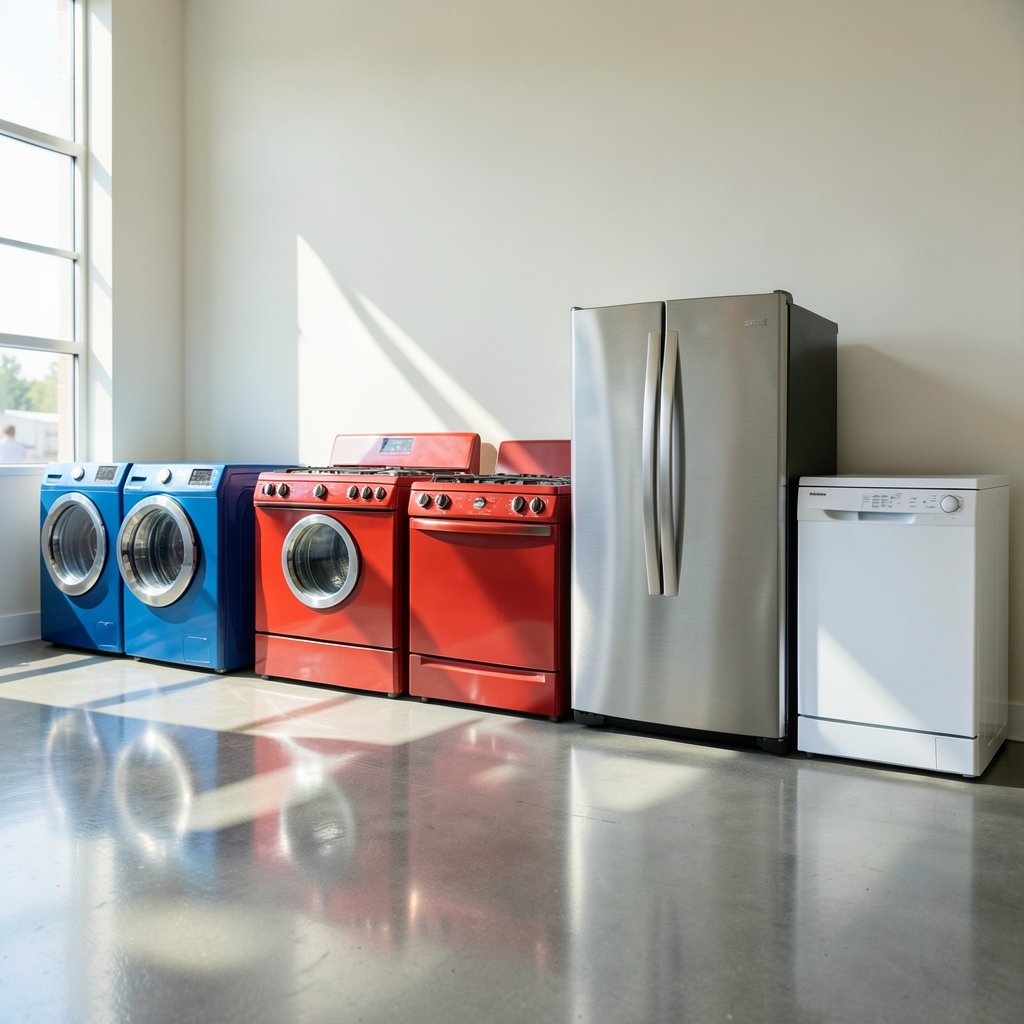
What if the name on the front of your refrigerator tells you almost nothing about who actually built it, where it was built, or how long it will last? That sounds like a trick question, but it is the single most useful idea to grasp before shopping for appliances. The “top appliance brands” are not one fixed list. They shift depending on whether you measure sales, reliability, service networks, or smart-home features. And the badge on the door is often just one piece of a much larger corporate puzzle. (Best e bike brands pick one that fits your life)
This guide breaks down how rankings actually work, which names dominate which categories, and the practical mistakes that cost people money. No hype, no invented statistics. Just a clear framework you can use before you spend four figures on a machine that is supposed to last a decade.
Why “Top” Depends Entirely on What You Measure
Ask five people to name the best appliance brand and you will get five answers, each backed by a different definition of “best.” That is not confusion. It is the nature of the question.
A brand can lead in market share and still rank mid-pack in reliability surveys. It can top unit sales in one region and barely register in another. It can win on price and lose badly on service wait times. Before you trust any “top 10” list, find out what the listmaker measured.
Here is how the main yardsticks differ:
| Metric | What it captures | What it hides |
|---|---|---|
| Market share | Who sells the most units or revenue | Whether buyers are happy |
| Reliability ratings | Failure rates reported by owners | Sample bias and self-reporting gaps |
| Consumer satisfaction | Overall owner sentiment | Long-term durability |
| Service network | How fast repairs happen | Product quality itself |
| Feature set | Smart integration, capacity, efficiency | Whether features get used |
The takeaway is simple. Popularity and reliability are not the same thing. A brand that sells the most washing machines might not be the brand with the fewest repair calls. Treat every ranking as a lens, not a verdict.
The Global Players Behind the Nameplates
The appliance industry is heavily consolidated. A handful of multinationals own dozens of familiar names, and ownership is frequently non-obvious. A brand that markets itself as proudly American or European may be owned by a company headquartered on another continent. Brand origin is not the same as ownership origin or manufacturing origin.
Historically, the major global white-goods players have included Haier (which acquired GE Appliances in 2016), Whirlpool, Bosch and Siemens through their joint venture BSH, LG, Samsung, Electrolux, and Midea. Consolidation has continued, so verify current ownership before you assume anything.
The ownership chains matter for a practical reason. When you buy an appliance, you are really buying into a service network, a parts supply chain, and a warranty administrator. Those things usually follow the parent company, not the badge. A brand name you recognize from your childhood may now be serviced through an entirely different organization.
A few ownership relationships worth knowing, though you should confirm each one is current:
- GE Appliances sits under Haier
- Frigidaire sits under Electrolux
- Maytag and KitchenAid sit under Whirlpool
- Many European premium names sit under BSH
This is why two refrigerators from “different” brands can share internals, compressors, or service depots. It is also why a great experience with one badge does not guarantee the same experience with a sibling brand.
Category by Category: Where Brands Actually Compete
Rankings fragment sharply by product category. A company that dominates refrigeration may be an afterthought in dishwashing. Shopping by category, not by brand loyalty, is one of the smartest habits you can build.
Refrigeration
Refrigeration is a crowded field where capacity, efficiency, and layout matter more than badge prestige. French-door and side-by-side formats have become the default in many markets, and ice-maker reliability is a recurring complaint across brands. Look at compressor warranty length, which often outlasts the general warranty by years.
Laundry
Washers and dryers reward attention to cycle times, drum capacity, and vibration control. Front-loaders generally use less water, but maintenance habits (leaving the door ajar, cleaning seals) matter enormously. A mid-tier machine treated well often outlasts a premium machine treated badly.
Cooking
Ranges, cooktops, and ovens split into gas, electric, and induction. Induction has gained ground for speed and safety, but it requires compatible cookware. Brand differences here often come down to control precision and how easy the surface is to clean.
Dishwashing
Dishwasher quality hinges on noise levels, rack flexibility, and drying performance. Third-rack cutlery trays and adjustable tines sound like marketing fluff until you live with a badly designed interior for ten years.
The pattern across all four categories is the same: specifications beat slogans. If you want to see how brand promises play out in the real world, the AI chatbot case studies on 2027 ROI numbers offer a useful parallel on how carefully brands measure their own claims.
Reliability Data: What It Can and Cannot Tell You
Consumer reliability surveys are the closest thing shoppers have to a durability crystal ball. They are also imperfect. Most rely on self-reported owner experiences, which introduces known biases. People who had a dramatic failure are more likely to respond than people whose machine just quietly worked for eight years.
Even so, reliability data is worth reading if you interpret it correctly:
- Check the survey year. Appliance platforms change, and a rating from three years ago may describe a model that no longer exists.
- Look at the sample size and methodology as well as the star rating.
- Separate frequency of repair from severity of repair. A brand with many small fixes can beat one with rare catastrophic failures.
- Cross-reference at least two independent sources before drawing conclusions.
What reliability surveys consistently show is that the gap between the best and worst brands is usually smaller than the gap between a well-maintained appliance and a neglected one. That is not an excuse to ignore data. It is a reminder that how you use and care for a machine is a variable you control.
Energy Rules and Smart Features Are Reshaping the Field
Two forces are quietly rearranging the competitive landscape: regulation and connectivity.
Energy-efficiency standards affect which product lines brands bring to market and how they price them. In the United States, Department of Energy standards shape design choices. In the European Union, energy labelling rules drive consumer attention toward efficiency classes. These are regulatory facts, not brand marketing, and they can shift competitiveness quickly. When a standard tightens, brands with newer platforms gain an edge and older designs get retired.
Smart-home integration has become a genuine differentiator. Interoperability standards such as Matter and Thread aim to let appliances talk to each other and to voice assistants regardless of manufacturer. Adoption timelines still vary by brand, so treat “works with everything” claims with healthy skepticism until you confirm the specific standard and version supported.
Here is where a practical mindset helps. Smart features are wonderful until the app is abandoned. A connected oven whose companion app stops receiving updates in four years becomes a dumb oven with extra parts. Ask yourself whether you would still want the appliance if every connected feature vanished tomorrow. If the answer is yes, the smart layer is a bonus rather than a dependency.
Warranty and Service: The Part Nobody Advertises
If there is one underrated factor in choosing among top appliance brands, it is the service network. A stellar machine with a two-week repair wait is, functionally, a broken machine for two weeks. Warranty terms and service coverage vary widely, and they are often more decision-relevant than the logo on the door.
Practical things to check before buying:
- Who performs repairs? In-house technicians or contracted third parties?
- What is the parts availability window? Some brands guarantee parts for a set number of years.
- Is the warranty prorated? Some coverage shrinks in value over time.
- What voids it? Improper installation is a common exclusion, and it catches people off guard.
- How far is the nearest authorized servicer? Rural buyers should check this carefully.
A common mistake is assuming a premium price buys premium service. It does not automatically. Another is skipping registration, which some brands require to activate the full warranty. Register the product the day it arrives, keep the receipt, and photograph the model and serial plates. Those three habits have rescued more warranty claims than any brand comparison ever will.
Common Mistakes That Cost Shoppers Money
Even well-informed buyers stumble in predictable ways. Watch for these traps.
Buying on brand loyalty alone. A brand that made a great dishwasher in 2015 may have changed ownership, platforms, or service partners since. Verify the specific model.
Ignoring the installation cost. Delivery, haul-away, new hoses, electrical work, and cabinet modifications can add hundreds to the sticker price. Budget for them.
Chasing the biggest capacity. Oversized refrigerators and washers can crowd a kitchen or waste energy. Measure your space twice.
Skipping the noise rating. Dishwashers and range hoods are judged in decibels, and open-plan homes make noise a daily issue.
Overlooking efficiency rebates. Utilities sometimes offer incentives for efficient models. Check before you buy, not after.
Trusting a single review. One glowing review and one furious review tell you almost nothing. Patterns across dozens of reviews tell you a lot.
If you enjoy seeing how brand promises get stress-tested against real outcomes, the breakdown of e-commerce brands using AI chatbots to recover 30% of carts in 2027 is a good reminder that the gap between marketing and measured results is often wide.
A Practical Buying Framework
Here is a sequence that works for almost any appliance purchase.
- Define the job. List the three features you will use weekly. Ignore the rest.
- Measure your space. Width, depth, height, and door swing. Include clearance for hoses and ventilation.
- Set a total budget. Include delivery, installation, and any accessories.
- Shortlist three models across at least two brands. Avoid single-brand tunnel vision.
- Check reliability patterns, not single reviews, and confirm the survey year.
- Confirm the service network and warranty terms in writing.
- Verify energy ratings and any available rebates.
- Register the product the day it is installed.
That framework will not tell you which brand is “best,” because no brand is best at everything. It will tell you which appliance is best for your kitchen, your habits, and your repair reality.
Conclusion
The search for top appliance brands is really a search for the right trade-offs. Market leaders win on scale, reliability leaders win on fewer breakdowns, and service networks win on the days that actually matter. Ownership is tangled, rankings are methodology-dependent, and the badge on the door is only the beginning of the story. Measure what counts, verify the specifics, and treat every list, including this framework, as a starting point rather than a finish line. Do that, and the machine in your kitchen will earn its place for years rather than months.
FAQ
Which appliance brand is the most reliable?
There is no single answer, because reliability rankings depend on the survey, the year, and the product category. A brand that leads in laundry may rank mid-pack in refrigeration. Read the methodology, check the survey year, and cross-reference at least two independent sources before deciding.
Do appliance brand names tell me who made the product?
Often not. The industry is heavily consolidated, and many familiar names are owned by multinationals. GE Appliances sits under Haier, Frigidaire under Electrolux, and Maytag and KitchenAid under Whirlpool. Ownership affects service networks and parts supply, so verify current ownership before you buy.
Is a more expensive appliance always more reliable?
No. Price reflects features, materials, brand positioning, and marketing as much as durability. A mid-tier machine that is well maintained often outlasts a premium machine that is neglected. Compare specifications and reliability patterns rather than assuming cost equals quality.
How long should major appliances last?
It varies widely by category and usage, and manufacturers publish different expectations. Rather than relying on a single number, check the warranty length, the parts availability window, and the service network in your area. Those three factors tell you more about long-term ownership than a lifespan estimate.
Are smart appliances worth the extra cost?
Only if you would still want the appliance without the connected features. Interoperability standards like Matter and Thread are improving, but app support can end before the hardware does. Buy for the core function first, then treat smart features as a bonus.
What should I check before buying any appliance?
Measure your space, set a total budget including installation, shortlist models across at least two brands, confirm warranty terms in writing, verify the nearest authorized servicer, check energy ratings and rebates, and register the product the day it arrives. Those steps prevent most buyer regret.



