
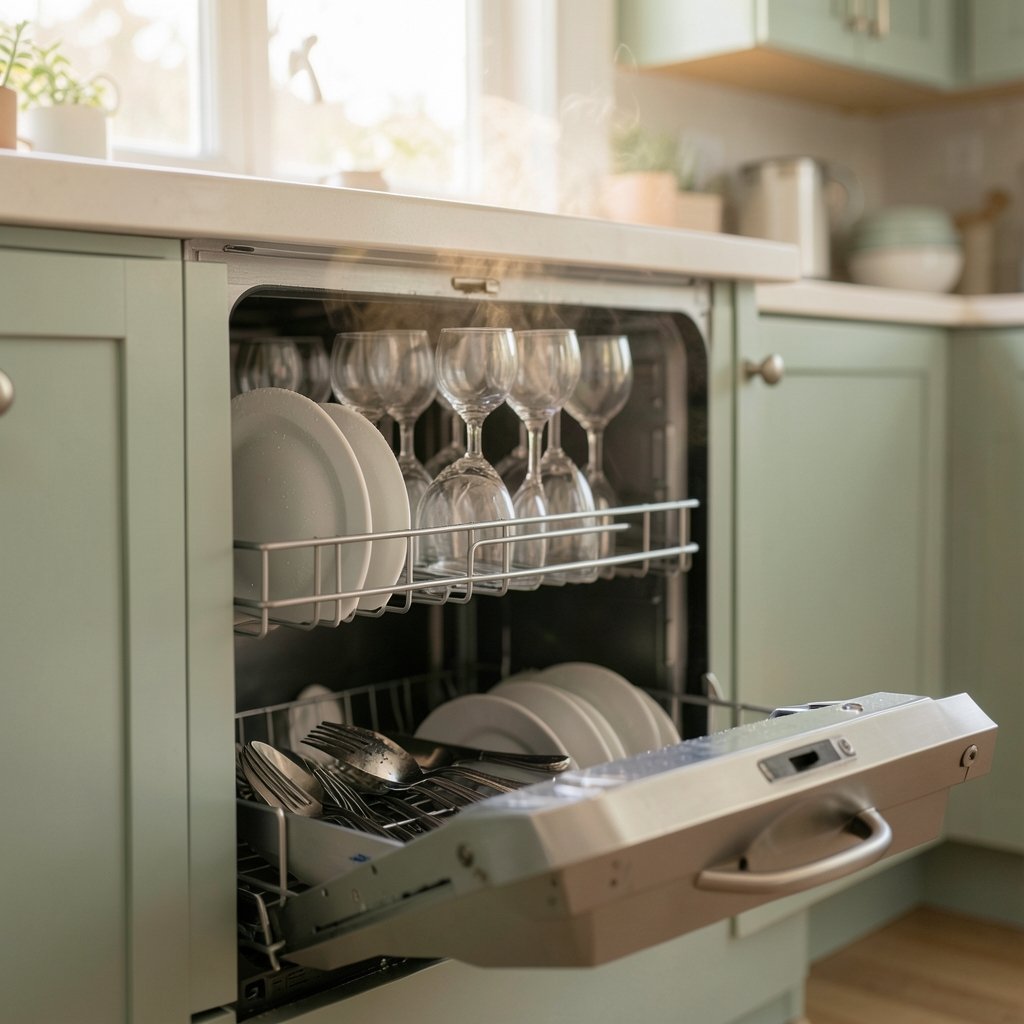
What makes a dishwasher “top rated” in the first place? That question sounds simple until you notice that three respected testing labs can hand the crown to three different machines in the same year. The label is not a single standard. It is a mix of cleaning power, energy use, noise, drying, repair history, and price, weighted differently by whoever is doing the testing. Understanding those weights is the real shortcut to buying well.
Why “top rated” is a moving target
Consumer testing outlets use different methods and weights, so their top picks often disagree. One lab may punish a model for a weak drying cycle, while another barely scores drying at all. A third may weigh long-term reliability surveys heavily and knock a strong performer down the list for repair rates.
That is not a flaw in the system. It reflects a genuine truth: a dishwasher that suits a quiet open-plan kitchen is not the same machine that suits a busy family of five who run three loads a day. The smart move is to read two or three independent rankings, find the models that appear on more than one list, and then check whether the testers cared about the things you care about.
The numbers behind the ratings
Federal rules give every rating a floor to stand on. Under energy-conservation standards that took effect in 2013, standard-size dishwashers were capped at 307 kWh per year, and compact models at 222 kWh per year. The same standards limited standard dishwashers to 5.0 gallons per cycle and compact units to 3.5 gallons. Those figures may have been revised since, so treat them as a baseline rather than the final word.
Energy Star is a voluntary label that sits above the federal minimum. A machine has to beat the base standard by a set margin to earn it, and that margin has been tightened several times. If efficiency is a priority, the label is a reasonable filter, but it is not a ranking. Plenty of excellent machines clear the bar.
What independent testers actually measure
Most credible labs run a similar core battery of tests, even if they weight the results differently. Knowing the categories helps you decode any ranking you read.
| Test category | What is measured | Why it matters to you |
|---|---|---|
| Cleaning performance | Soil removal across dish types and cycle settings | The core job; weak cleaning cannot be fixed later |
| Energy use | Annual kWh against federal and Energy Star levels | Shows up on every utility bill |
| Water use | Gallons per cycle | Matters in drought-prone or metered areas |
| Noise | Decibels during operation | Critical in open-plan homes |
| Drying | Residual moisture after the cycle ends | Plastic items expose weak drying fast |
| Cycle time | Duration of normal and heavy cycles | Affects daily scheduling |
| Reliability | Repair rates from owner surveys | Predicts year-five headaches |
Noise: the decibel trap
Noise is rated in decibels (dB), and the scale is not intuitive. A few decibels of difference is a noticeable change, not a rounding error. Typical quiet models sit in the low-to-mid 40s dB, and anything under about 45 dB is generally considered quiet.
Here is a practical tip that catches a lot of buyers: showroom floors are loud, so every dishwasher sounds silent there. A machine rated at 44 dB will feel very different in a quiet kitchen at 10 p.m. than it does beside a dozen other running units. If your kitchen opens onto a living area, treat the dB rating as a hard filter, not a nice-to-have.
Cycle time: the trade-off nobody mentions
Many modern dishwashers run two to three hours or more on a normal cycle to hit efficiency targets, compared with roughly one hour for older models. That is not a defect. Longer cycles with less water and lower temperatures are how manufacturers meet energy rules while still cleaning properly.
The catch is scheduling. A household that runs a load after dinner and expects dry dishes before bed needs to check cycle length before buying. Some models offer a faster express cycle, but it usually trades efficiency or cleaning power to get there.
Drying methods and why they split opinions
Drying is where reviews disagree most, and where the spec sheet tells you the least. The two broad approaches are condensation drying, which uses residual heat, and fan or zeolite drying, which actively pulls moisture out of the tub. Active drying tends to handle plastics better. Heat-based drying uses less machinery and often less energy.
The practical test is simple: if your load is heavy on plastic containers, lids, and kids’ tableware, drying performance should carry real weight in your decision. If your load is mostly ceramic and glass, which hold heat well and dry readily, you can relax about it.
Reliability: the rating that surveys capture and labs cannot
No bench test predicts whether a machine will need a repair in year four. That is why owner surveys matter. Annual reliability surveys have repeatedly flagged large brand-level differences in repair rates, which is why a model can top a performance chart and still be a questionable purchase.
A few habits that work in practice:
- Read the reliability data separately from the performance data, because they measure different things.
- Look for patterns across several survey years rather than one.
- Check how easy it is to get service in your area, rather than only how often the brand breaks.
- Note that a long warranty and a low repair rate are not the same thing.
Sizing, installation, and the mistakes people make
Standard width is 24 inches in the US and 60 cm in Europe. Compact and apartment models are 18 inches wide. Measuring the cavity is the obvious step, and it is the one people skip. (Best polling rate for mouse)
Common mistakes that show up again and again:
- Measuring the old unit instead of the opening, then discovering the new machine will not clear a countertop overhang.
- Forgetting to check the door swing against a nearby cabinet or drawer pull.
- Assuming a quiet rating survives installation under a hollow counter without insulation.
- Ignoring water hardness, then blaming the machine for cloudy glassware that a rinse aid and adjusted salt level would fix.
- Skipping the filter clean, which is the single most common cause of “it stopped cleaning properly” complaints.
If you are the type who researches purchases down to the last spec, the same discipline that goes into picking a mouse polling rate or choosing the best conversion rate optimization approach for a startup applies here: define what you actually need, then filter hard. A dishwasher is a ten-year appliance, and the research pays off more than most gadget purchases.
Where rebates and incentives fit
Utility rebates and efficiency incentives can offset part of the cost, and programs change yearly, so check what is live in your area before you buy rather than after. The savings are real but rarely advertised at the point of sale.
How to build your own shortlist
Rather than chasing a single “best” label, build a shortlist with a repeatable method.
- Write down your non-negotiables: width, noise ceiling, drying needs, and budget.
- Pull the top picks from at least two independent testing outlets.
- Cross-reference those picks against reliability survey data.
- Check the energy and water figures against current federal and Energy Star levels.
- Read owner reviews specifically for repair complaints, rather than only star ratings.
- Confirm local service availability and rebate eligibility.
- Measure the cavity, the door swing, and the clearance before ordering.
That process takes an evening. It beats buying on a single badge.
Matching the machine to the household
The same top-rated model can be perfect for one home and wrong for the next. A few profiles worth thinking through:
A couple in a quiet apartment should weight noise and cycle flexibility heavily, and can accept a smaller capacity. A family with young children should prioritize drying, cycle speed, and a robust lower rack. A household on metered water should look hard at gallons per cycle. Someone replacing a machine that lasted fifteen years should check reliability data before chasing features, because longevity is the thing they clearly valued.
Reading reviews without being fooled
Owner reviews are useful and also noisy. A few filters help. Ignore reviews written in the first week, when everything works. Weight reviews that mention a specific failure and a specific timeframe. Be skeptical of a cluster of five-star reviews posted within days of each other. And remember that people rarely write reviews to say a machine has quietly worked for six years, which skews the average toward drama in both directions.
The same skepticism applies to product imagery and video now. If a listing’s photos look oddly perfect, it is worth knowing how to detect AI generated images before you trust a marketplace seller, and the same instinct applies to promotional clips, where practical checks can spot AI generated videos that misrepresent a product.
Conclusion
Top-rated dishwashers earn the label through a combination of cleaning power, efficiency, quiet operation, drying, and repair history, and no single outlet weights those factors the same way. The buyers who end up happiest are not the ones who found the one true “best” model. They are the ones who defined their own priorities first, cross-checked two or three independent rankings, verified the efficiency and reliability data, and measured the cavity before ordering. Do that, and the shortlist almost builds itself.
FAQ
What does “top rated” actually mean for a dishwasher?
It means the model scored highest under one particular tester’s method and weighting. Because testing outlets use different methods and weights, their top picks often disagree. A rating is a signal worth cross-checking, not a universal verdict.
Is a quieter dishwasher always better?
Not automatically, but noise is one of the few specs with a hard ceiling for many buyers. Anything under about 45 dB is generally considered quiet, and models in the low-to-mid 40s are common among quiet units. In an open-plan home, that threshold matters more than most feature differences.
Why do modern dishwashers take so long to finish a cycle?
Many run two to three hours or more on a normal cycle to meet efficiency targets, compared with roughly one hour for older models. Longer cycles with less water and lower temperatures are how manufacturers hit energy and water limits while still cleaning well.
How much water and energy should a dishwasher use?
Under standards that took effect in 2013, standard-size models were capped at 307 kWh per year and 5.0 gallons per cycle, with compact models at 222 kWh and 3.5 gallons. Those figures may have been revised since, so confirm the current limits before comparing models.
Does an Energy Star label mean it is top rated?
No. Energy Star is a voluntary efficiency label that sits above the federal minimum, and the required margin has been revised several times. It filters for efficiency, not for cleaning performance, drying, noise, or reliability.
How much weight should reliability surveys carry?
A lot, because no bench test predicts a repair in year four. Annual owner surveys have repeatedly shown large brand-level differences in repair rates. Compare several survey years, and check local service availability alongside the repair data.



