
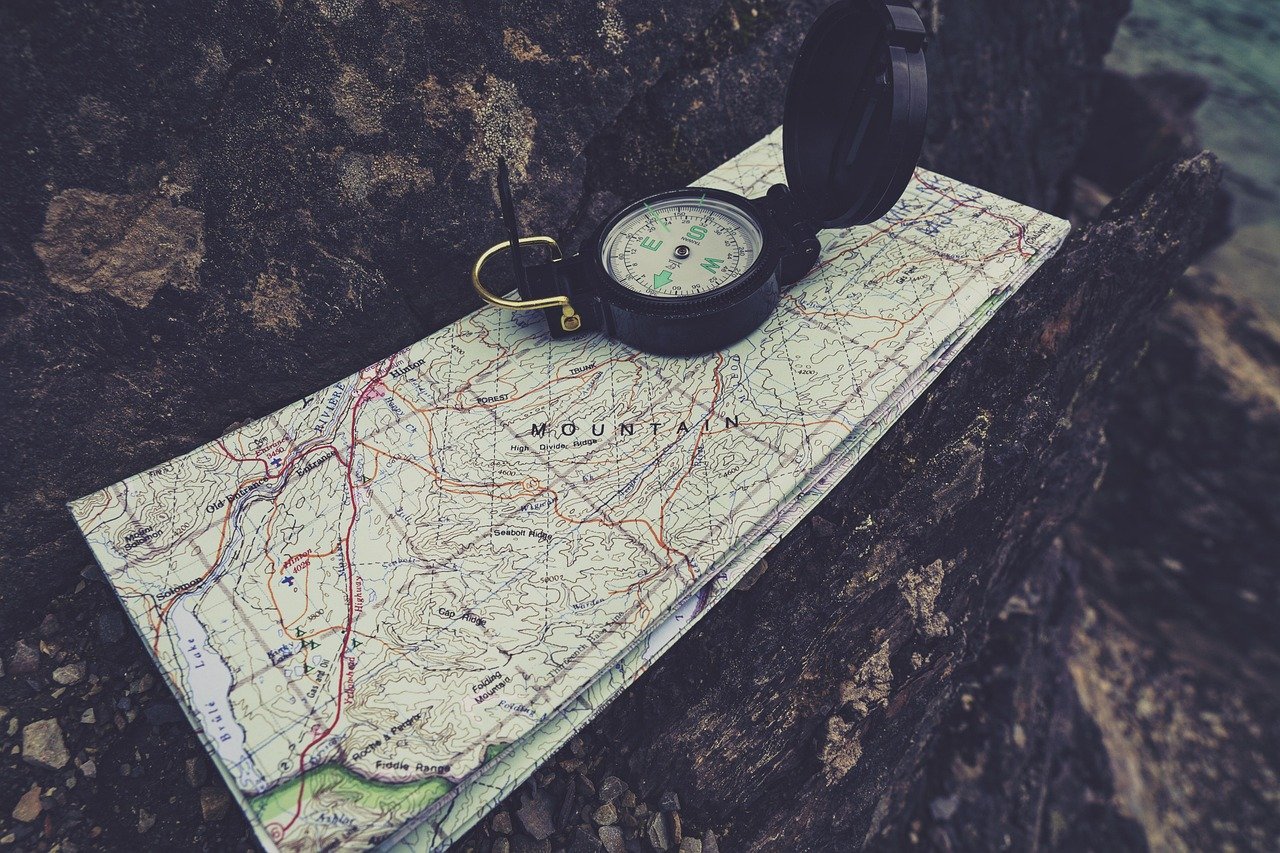
What happens when your phone dies six miles from the trailhead and the fog rolls in? For most hikers, the honest answer is a vague sense of unease. A compass is the cheapest insurance against that feeling, yet plenty of people carry one without really knowing what to do with it. The good news: the core skill takes about twenty minutes to learn and a lifetime to sharpen.
This guide walks through the whole process, from naming the parts to walking a bearing in the field. It also covers the mistakes that trip up beginners most often, including the one involving magnetic declination that quietly sends people off course by hundreds of meters.
What the Parts of a Baseplate Compass Actually Do
Before anything else, a reader needs to recognize what they are holding. A standard baseplate compass has six features worth knowing:
| Part | What it does |
|---|---|
| Baseplate | Flat plate with a straight edge for lining up on a map |
| Direction-of-travel arrow | The big arrow on the baseplate that points where you walk |
| Magnetized needle | The red end points toward magnetic north |
| Rotating bezel | Dial marked in degrees (0 to 360) that you turn by hand |
| Orienting arrow and lines | Markings inside the housing that align with the needle and with map grid lines |
| Declination adjustment | A fixed scale or small screw that offsets the orienting arrow |
A quick practical tip: before trusting any compass, lay it flat on your palm and watch the needle settle. If it wobbles for more than a few seconds or sticks, something nearby is interfering. Metal picnic tables, car hoods, phone speakers, and even a magnetic watch strap can throw the needle off. Step away and check again.
True North vs. Magnetic North: The Idea That Trips Everyone Up
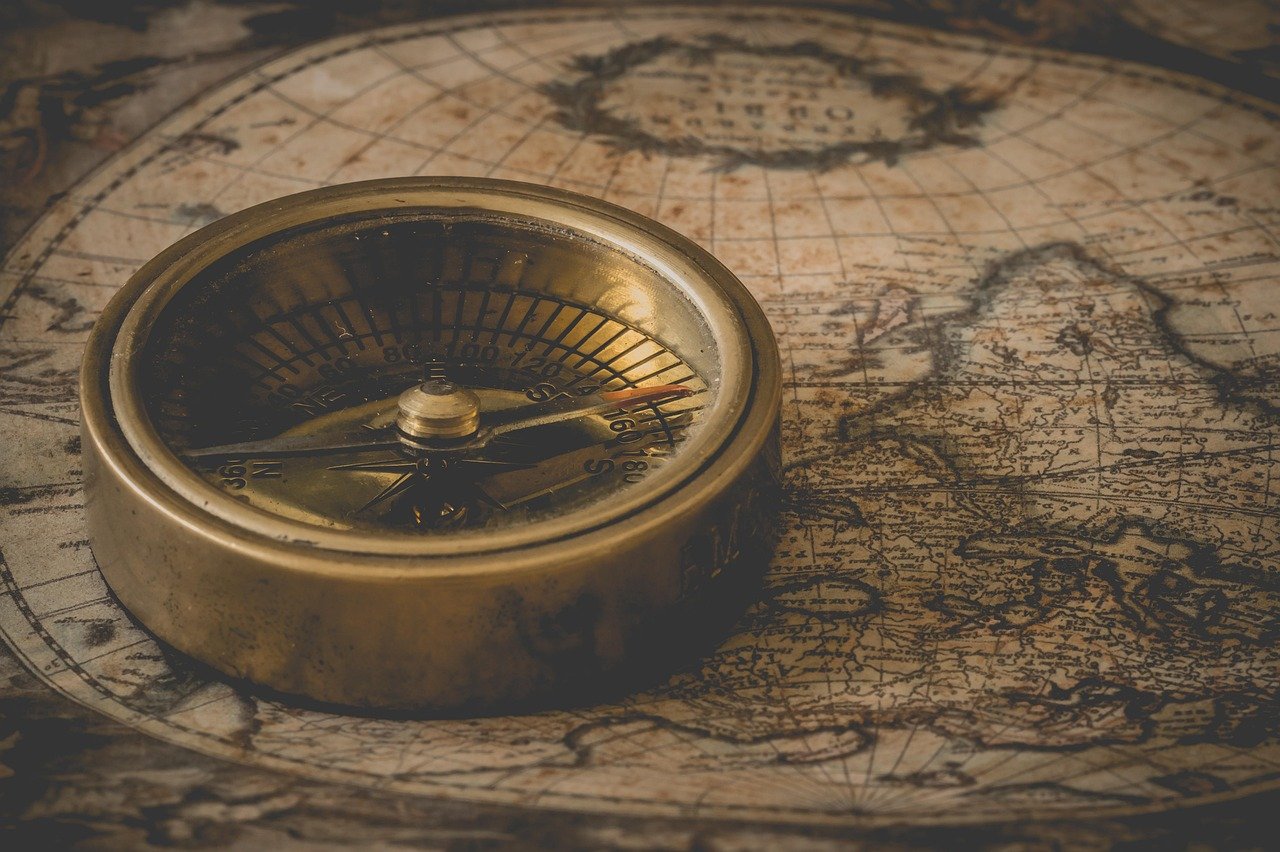
Here is the concept that separates people who own a compass from people who can use one. The needle does not point to the North Pole. It points to magnetic north, a moving region that sits hundreds of kilometers away from the geographic pole, and the gap between the two is called magnetic declination.
Declination is not a fixed number. It changes depending on where you stand on the planet, and it drifts slowly over time, on the order of a tenth of a degree per year in many regions. In parts of North America the offset is small enough to ignore for casual walks. In other places it is large enough to matter a great deal. The official geomagnetism resources from national agencies explain how declination is measured and why it shifts, and any serious navigator should check the current value for their area before a trip.
There is also a sign convention trap. In North America, declination is usually written east-positive, meaning east declination puts magnetic north to the right of true north. Some countries and older textbooks flip it. Always check which convention the map, app, or instructor is using before you start adding and subtracting.
The Two Ways to Handle Declination
- Set it on the compass. Turn the small screw or rotate the housing so the orienting arrow sits offset from the housing’s north mark by the declination angle. Once set, the compass does the math for you every time.
- Do the math yourself. Leave the compass at zero and add or subtract the declination when converting between a map bearing and a field bearing.
The first method is safer for beginners because it removes a mental step in the field, when cold hands and tired brains make errors more likely. The second is useful when borrowing a compass or working with a fixed-declination model.
How to Take a Bearing from a Map
This is the classic skill, and it follows a clean sequence. Start with the map oriented so its north lines run away from you, and place the compass on the map.
- Lay the straight edge of the baseplate along the line you want to travel, from your position to your target.
- Make sure the direction-of-travel arrow points toward the target, not back at you.
- Rotate the bezel until the orienting lines inside the housing line up with the map’s north-south grid lines.
- Read the number at the direction-of-travel arrow. That is your grid bearing.
- Adjust for declination if your compass is not already set for it.
One subtlety that catches people out: on many topographic maps, the vertical grid lines point to grid north, which is slightly different from true north. The difference is called grid convergence, and it is usually tiny. For precise work, topographic map reading guidance from national mapping agencies explains the three norths and how to reconcile them.
How to Follow a Bearing in the Field
Now the part that actually gets you home. Hold the compass flat in front of your chest, away from metal and electronics.
- Turn your whole body until the red needle sits inside the orienting arrow.
- Look up, pick a landmark along the direction-of-travel arrow, and walk to it.
- Repeat. Do not stare at the compass while walking, because you will drift and you will trip.
The landmark technique matters more than beginners expect. Walking while watching a needle produces a wandering path, and a wandering path across a few hundred meters can put you on the wrong ridge. Pick a tree, a boulder, a distinctive rock outcrop, walk to it, then take a fresh reading.
A back-bearing is a useful sanity check. Add or subtract 180 degrees from your heading, and you get the direction back to where you started. If you can see your starting point, sighting the back-bearing confirms you are on line. It is also the standard technique for retracing a route in poor visibility.
Common Mistakes That Send People Off Course
Most navigation errors are not dramatic. They are small, boring, and cumulative. Here are the ones that show up again and again in outdoor education. (Navigation products and services)
Forgetting to set declination. The single biggest cause of systematic error. A five-degree mistake over a kilometer puts you roughly ninety meters off target, which is easily the difference between the right trail junction and the wrong one.
Holding the compass near metal. Zippers, trekking poles, phone cases with magnetic clasps, and car doors all deflect the needle. Take two steps away and re-check.
Reading the wrong end of the needle. The red end points north. The white or black end points south. It sounds obvious until you are tired and the light is fading.
Confusing bearing with heading. A bearing is a number. A heading is the direction you are actually walking. Wind, terrain, and obstacles push you off your heading, which is why frequent checks matter.
Not accounting for pace count. Distance matters as much as direction. Counting paces over a known stretch (say, 100 meters) gives a rough ruler for the terrain ahead. Practice on flat ground, then recalibrate on hills, because stride length shrinks when climbing.
Trusting a phone over a physical compass. GPS is excellent, but batteries fail and screens crack. The overlap between digital tools and a baseplate compass is where real confidence lives. The same logic applies to other everyday gear decisions where the cheap, reliable option beats the fancy one; the same reasoning shows up in comparisons like this breakdown of Xbox game pass cost 2025 real prices whether its worth, where paying more does not automatically buy more value.
A Short History Worth Knowing
The magnetic compass is not a European invention. It was in use in China by the eleventh century, described in Shen Kuo’s Dream Pool Essays around 1088, and it reached European navigation by the thirteenth century. That long history explains why compass conventions vary so much between countries: different traditions developed their own sign rules and mnemonics, and those habits stuck. (Compass)
How to Practice Without Getting Lost
Skills fade without repetition. The best way to build compass confidence is to practice in a place where being wrong is harmless.
- Set a short course in a park. Pick three points a few hundred meters apart, take bearings between them, and walk each leg.
- Practice map-to-field and field-to-map. Take a bearing from the map, walk it, then take a bearing from the field back to a known point on the map.
- Deliberately introduce error. Walk a bearing with the wrong declination setting and see how far off you end up. That lesson sticks harder than any lecture.
- Practice in bad weather. Navigation is easiest when the sun is out and the trail is obvious. The skill matters most when it is not.
If you are also sorting out everyday gear decisions, the same principle of checking the real numbers rather than the marketing applies to subscriptions and devices. Readers comparing password managers, for example, often find that feature lists look identical until you dig into the details, as in this 1password vs proton pass comparison.
When a Compass Beats a Phone
Phones are remarkable. They also run out of battery, lose signal, and fail in the cold. A baseplate compass weighs almost nothing, never needs charging, and works in a whiteout. The practical approach is to carry both and to know which one you would trust if the other failed.
There is a broader pattern here that shows up in all kinds of gear. A device that does one job simply and reliably often outperforms a multi-function gadget in the moment it matters. The same argument appears in discussions of power bank pass-through charging: what it is and when it helps, where understanding the basic mechanism matters more than the spec sheet.
Conclusion
Learning to use a compass is less about memorizing steps and more about building a habit of checking. Set the declination once, verify the needle is clear of interference, take the bearing, pick a landmark, walk, and repeat. Do that a few dozen times in good conditions, and the process becomes automatic in bad ones.
The compass will not replace a map, a phone, or good judgment. What it does is give you an independent check on all three, and that independence is the whole point. A needle that points north without asking for a battery is a small, stubborn kind of freedom.
Frequently Asked Questions
Do I really need to adjust for magnetic declination?
For short walks in areas with small declination, the error may not matter. For anything involving distance, poor visibility, or unfamiliar terrain, yes. A few degrees of uncorrected error compounds over a kilometer, and the correction takes seconds once the compass is set.
What is the difference between a bearing and an azimuth?
In everyday use, they mean the same thing: a direction expressed in degrees from north. Some texts reserve azimuth for a direction measured clockwise from true north and use bearing more loosely. Check the convention in whatever material you are learning from.
Why does my compass needle point somewhere other than north?
Almost always local magnetic interference. Move away from metal objects, vehicles, electronics, and magnets, then let the needle settle. If it still behaves oddly, the compass may be damaged or the housing may contain a bubble.
Can I use a compass without a map?
Yes, but your options shrink. You can follow a bearing, take a back-bearing, and walk a straight line. Without a map you cannot easily convert a bearing into a position, so the compass becomes a tool for holding direction rather than for finding your way to a specific point.
How accurate is a baseplate compass?
Even a careful user typically lands within a few degrees, and that is before terrain, fatigue, and pace-count error enter the picture. Treat the compass as a guide to a corridor rather than a laser line, and use landmarks and back-bearings to stay inside it.
What should a beginner practice first?
The orienting step. Turn the bezel, align the orienting lines with the map grid, and read the number. Do that twenty times on a kitchen table before heading outside. Everything else builds on it.



