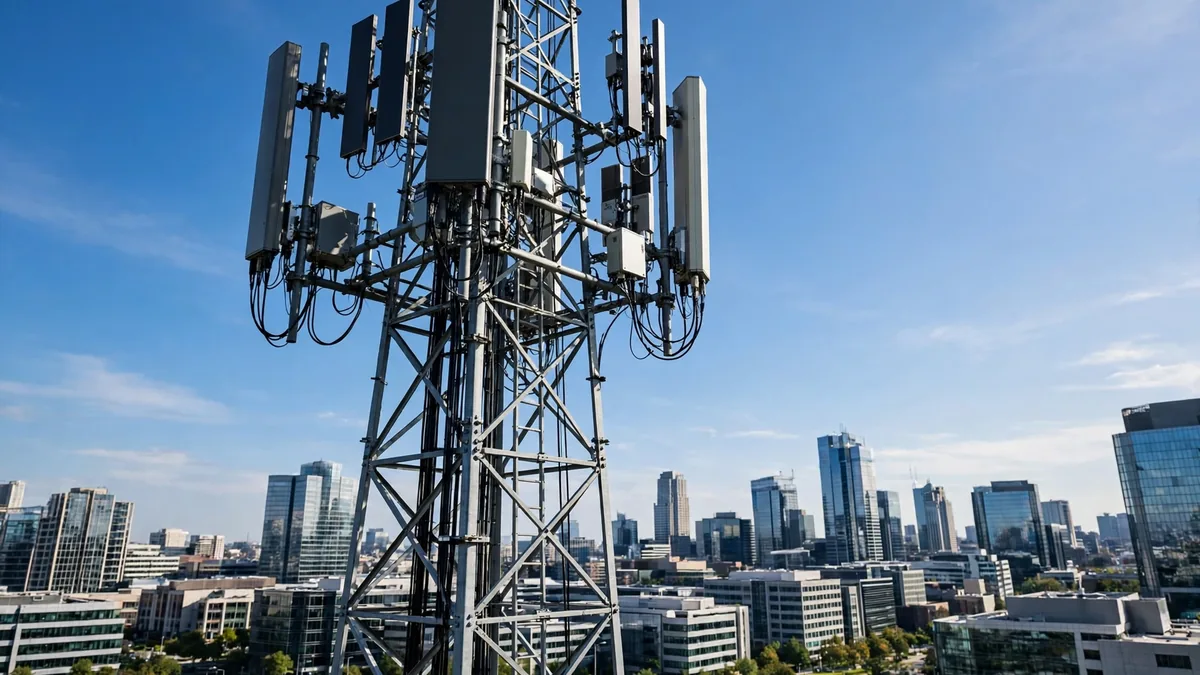
5G is the fifth generation of mobile network technology, the system that connects your phone to the internet when you leave your WiFi behind. It succeeds 4G, and it was designed to do three things at once: move data faster, respond more quickly, and connect far more devices in the same area without slowing down.
That sounds like a simple upgrade, but 5G is a bigger change than 4G was. It uses new radio frequencies, new antenna designs and a rebuilt core network, and it was built with more than phones in mind: factories, vehicles and hospitals are expected to use it for machines and sensors that need a reliable, instant connection.
The rollout has been uneven, though, and that is where most of the confusion comes from. Some people see the 5G icon on their phone and notice little difference, while others get speeds that beat their home broadband. Both experiences are real, because 5G is not one single network: it comes in different flavours, with very different performance depending on where you are and which frequencies your carrier uses.
Key takeaways
- 5G is the fifth generation of mobile network technology, replacing 4G with faster speeds, lower latency and far greater capacity.
- It uses three kinds of spectrum: low-band for wide coverage, mid-band for the best balance, and high-band mmWave for extreme speed over short distances.
- Real-world 5G speeds typically range from 100 Mbps to over 1 Gbps, depending on the band and your location.
- Latency, the delay before data starts moving, can drop to around 10 milliseconds on 5G, which matters for gaming, video calls and remote control.
- You need three things to use 5G: a 5G-capable phone, a carrier plan that includes it, and coverage where you are.
5G at a glance
| Detail | What it means |
|---|---|
| Full name | Fifth generation of mobile network technology, successor to 4G LTE |
| Typical download speed | 100 to 900 Mbps on mid-band; over 1 Gbps on mmWave in ideal conditions |
| Typical latency | Around 10 to 30 milliseconds, versus 30 to 50 milliseconds on 4G |
| Spectrum bands | Low-band, mid-band and high-band (mmWave) |
| Peak theoretical speed | Up to 10 Gbps under laboratory conditions |
| Device capacity | Up to one million connected devices per square kilometre, by design |
| First commercial launches | 2019, in South Korea and the United States |
| What you need | A 5G phone, a compatible plan and coverage in your area |
What 5G actually is
5G is a set of standards for mobile networks, defined by the 3GPP, the industry body that writes the specifications carriers and phone makers follow. The name covers both the radio technology linking your phone to a tower and the core network behind the towers that routes your data. When your phone shows 5G, it is connected to a tower using those new standards.
The key point is that 5G was not designed only to make phones faster. Its authors had three goals, and only the first is about speed. The second is latency: cutting the delay between tapping something and the network responding, which matters for video calls, gaming and anything controlled remotely. The third is capacity: serving a huge number of devices at once, from phones to sensors to vehicles, without grinding to a halt.
How 5G works
Like 4G, 5G works through a network of base stations, the towers and small antennas you see on rooftops and lampposts. Your phone talks to the nearest base station over radio waves, the base station passes the data to the carrier’s core network, and the core network sends it on to the internet. As you move, your phone hands over from one base station to the next without dropping the connection.
What is new is how the radio link is used. 5G base stations use a technique called massive MIMO: many antennas working together to send focused beams of signal to individual devices instead of broadcasting in all directions. Beamforming steers those beams toward your phone as you move, improving speed and efficiency
The other big change is network slicing. A 5G core network can be divided into virtual slices, each tuned for a different job: one might prioritise low latency for emergency services, another huge capacity for a stadium, and a third ordinary phone users.
The three bands: low, mid and high
Not all 5G is the same, and the difference comes down to spectrum, the radio frequencies a carrier is allowed to use. Low-band 5G uses frequencies below 1 GHz. These signals travel for kilometres and pass through walls well, so they cover whole cities and rural areas, but their speeds are only modestly better than good 4G, often 50 to 250 Mbps.
Mid-band 5G, roughly 1 to 6 GHz, is the sweet spot. It covers a reasonable area, works indoors, and delivers the speeds people associate with 5G, typically 100 to 900 Mbps. Carriers have spent billions acquiring mid-band spectrum
High-band 5G, also called mmWave, uses frequencies above 24 GHz. It can deliver speeds over 1 Gbps with very low latency, but the signals travel only a few hundred metres and are blocked by walls, windows and even rain. It is used in dense spots such as stadiums, airports and busy downtown streets. If you are curious how fast your own connection really is, learning how to check your internet speed on your phone gives you a real number instead of a guess based on the icon in the status bar.
5G vs 4G: what actually changes
Speed is the most visible difference. A typical 4G connection delivers 20 to 100 Mbps, while a typical mid-band 5G connection delivers several times that. In practice, a full-length film in high definition downloads in a minute or two on 5G instead of ten or more on 4G, and large app updates and cloud photo backups finish far faster.
Latency is the more important difference for many uses. On 4G, the delay between your phone sending a request and the network responding is usually 30 to 50 milliseconds. On 5G it can fall to around 10 milliseconds. That makes video calls feel more natural, online games respond faster, and remote control of machines or vehicles practical for the first time.
Benefits and risks of 5G
The benefits go beyond faster downloads. For users, 5G means smoother video calls, instant cloud gaming, and large files that move in seconds. For businesses, it means factories where machines report problems instantly and hospitals where specialists can guide procedures remotely. For cities, it means traffic systems and public safety networks that respond in real time.
The risks are more practical than technical. Coverage is still patchy: fast mid-band and mmWave 5G is concentrated in cities, while rural areas often get low-band 5G that feels much like 4G. A 5G phone can also use more battery when it hunts for a weak 5G signal, The biggest cost is infrastructure: carriers must install many more small antennas than 4G needed, which is why the rollout has taken years and is still going.
Health concerns about 5G have been widely discussed, but the radio frequencies it uses are non-ionising, the same kind as 4G, WiFi and FM radio, and they do not carry enough energy to damage DNA. Regulators set exposure limits well below the levels where tissue heating could occur, and the World Health Organization has found no adverse health effects linked to mobile phone use within those limits.
Real-world uses of 5G
For most people, 5G is first a phone upgrade: faster streaming, quicker downloads and video calls that hold up on the move. Mobile gaming benefits the most, since low latency matters more than raw speed, and cloud gaming services that stream the game from a server become genuinely usable on a phone.
Fixed wireless is another growing use. Some carriers now sell 5G home internet, where a small receiver in your home connects to the mobile network instead of a cable or fibre line. In areas without good broadband, that can be the fastest option available, If you are weighing a new phone for a 5G plan, the choice between Android and iPhone in 2027 matters, since 5G band support and modem performance differ between models.
Do you need 5G?
For most people, the honest answer is that 5G is useful but not urgent. If you already have a 5G phone and coverage where you live and work, you get faster downloads, better video calls and a connection that holds up in crowds, all without thinking about it. If you are buying a new phone, choosing one with 5G is sensible, since almost every new model includes it.
If your current phone is 4G and works well, there is no need to rush. 4G remains fast enough for streaming, browsing, messaging and video calls, and carriers will keep running 4G networks for years. The biggest reason to switch is a specific need: you regularly download large files on the move, you play cloud games on your phone, or 5G home internet is the best broadband where you live. When 5G is not available, a strong WiFi connection is still the fastest option in most homes, and guides that improve Starlink WiFi speed through an app setting show how much difference the right setup makes.
Checklist: getting the most from 5G
- Check that your phone actually supports 5G and that your plan includes it, since some older plans do not.
- Look up your carrier’s coverage map for the places you live, work and travel, not just your home town.
- Run a speed test in a few locations to see whether you are on low-band, mid-band or mmWave 5G.
- Keep your phone software updated, since carriers and phone makers regularly improve 5G performance.
- Turn off 5G or switch to automatic mode if the signal is weak, since hunting for 5G can drain the battery.
- Compare 5G home internet with cable or fibre before switching, since speeds depend heavily on your distance from the tower.
Frequently asked questions
Is 5G faster than home WiFi?
Sometimes. Fast mmWave or mid-band 5G can beat a slow home broadband connection, but a good fibre connection with modern WiFi is usually faster and more consistent than 5G.
Does 5G work everywhere?
No. Coverage depends on your carrier and location. Cities usually have good mid-band coverage, suburbs have a mix, and rural areas often have only low-band 5G, which is closer to 4G in speed.
Will 5G replace WiFi?
No. The two serve different purposes. WiFi is cheap, fast and private inside buildings, while 5G covers you everywhere else. Most phones use both, switching to WiFi at home and 5G on the move
Does 5G drain the battery faster?
It can, especially when the signal is weak and the phone keeps searching for a 5G tower.
Do I need a new SIM for 5G?
Usually not. Most existing SIM cards work with 5G as long as the phone and plan support it. Some very old SIMs may need replacing
What comes after 5G?
6G is already being researched, with early standards work expected around 2028 and commercial launches in the early 2030s. It aims for even lower latency, higher speeds and built-in support for sensing and AI
The bottom line
5G is the fifth generation of mobile networks, and its real advances are speed, responsiveness and capacity together, not speed alone. Low-band 5G covers wide areas, mid-band delivers the speeds most people notice, and mmWave provides extreme performance in small, busy places. Knowing which band you are on explains why the 5G icon sometimes feels transformative and sometimes feels like nothing changed.
For most people, 5G is a gradual upgrade rather than a revolution: worth having in a new phone, useful on the move, and increasingly important for the machines and services around us. The network will keep improving as carriers add mid-band spectrum and more antennas