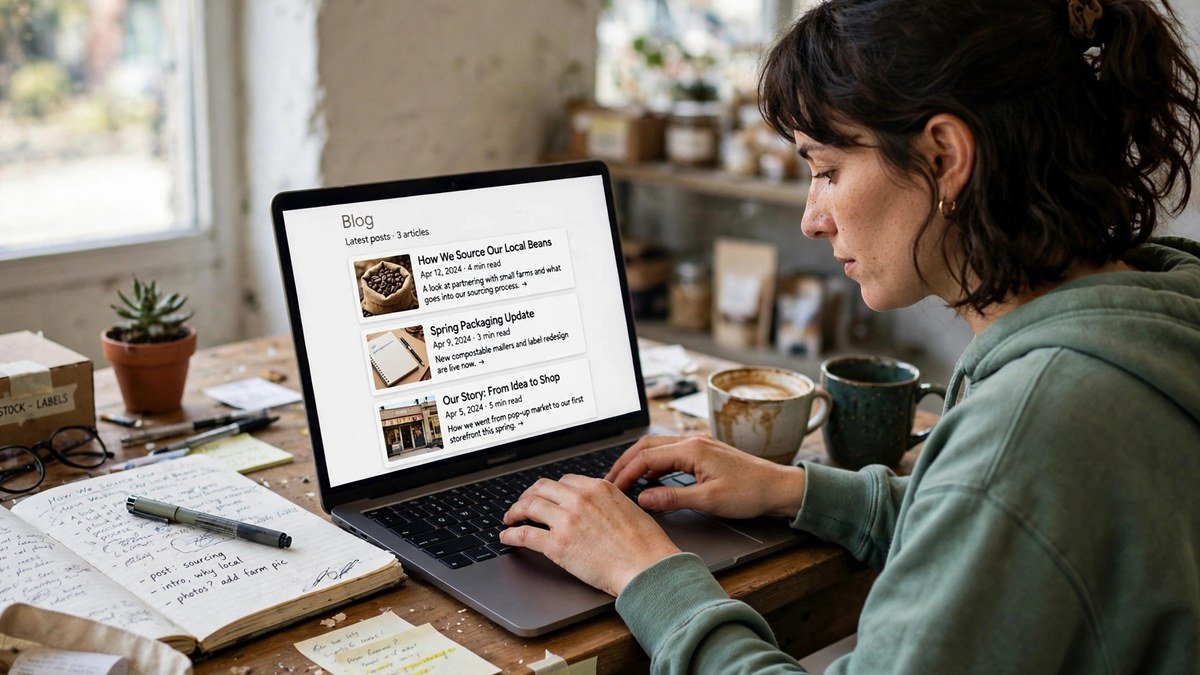
A business website blog for small businesses is a section of a company website where the business publishes short, useful articles for customers. It lives on the same domain as the main site, uses the same design, and every post points back to a service or a question a customer asked before buying. It is not a separate personal blog or a news feed. It is part of the website itself, written for people who are close to buying.
For a small business, the blog is usually small. A dozen posts can be enough, if each one answers a real question. A bakery writes about cake sizes and delivery times. A plumber writes about the cost of a repair and how long it takes. None of these posts tries to entertain a wide audience. Each one helps one kind of customer, at the moment that customer is deciding.
This article explains what a business blog is, what it is made of, what it is not, and why it matters. It does not explain how to build one. By the end, a reader should be able to look at any website and tell in a minute whether its blog is a real part of the business or a decoration.
Key takeaways
- A business blog is a section of a company website, on the same domain, where the business answers customer questions.
- Its parts are posts, categories, a listing page, a business voice, and links to services and contact.
- It is not a personal blog, a news feed, or a social media account.
- Its value is trust and enquiries, not page views: one good post can work for months.
- A few honest, specific posts beat fifty thin posts that say nothing.
A plain definition
A business website blog is a set of articles published on a company website, written by or for the business, for the benefit of its customers. The articles answer questions, explain services, and show how the business thinks about its work. They are public and searchable, and they stay on the site long after publication, so a post written in January can still bring in an enquiry in September.
The first is that the blog sits on the company website, on the same domain. That matters because every post then helps the main site, and every visitor can move from a post to a service page in one click. A blog on a separate domain splits that value in two.
The second detail is that the blog is written for customers, not for other businesses in the same trade, and not for search engines. A post that impresses other plumbers but confuses homeowners has missed its audience. The test is plain: would a customer with a real question find this post useful before spending money.
The third detail is that the articles are meant to last. A business blog is not a diary of the week, and it is not a feed of announcements. A post about the cost of a service, the time a job takes, or the mistake customers make most often stays relevant for a year or more.
The parts of a business blog
A business blog has five parts. The first part is the posts themselves. Each post answers one question or explains one service, in plain language, with specific numbers where they exist: prices, waiting times, sizes, and limits.

The second part is the categories: three to five topics that match the services the business sells. Categories let a reader who liked one post find three more on the same problem without searching, and they tell a new visitor at a glance what the business writes about.
The third part is the listing page, the single page where every post appears together, usually reached from the menu under Blog. It shows titles, summaries, dates, and categories. A clear listing page makes the whole blog feel organised.
The fourth part is the voice of the business. A business blog should sound like the people who do the work, not like a marketing agency. That means naming real prices, real waiting times, and real limits, and admitting where a job is not suitable. Customers can tell the difference, and they trust the first kind far more.
The fifth part is the connection to the rest of the site. Every post should link to a service page, a quote form, or a contact page. A blog that never mentions how to buy is a magazine, and one that mentions buying in every sentence is an advert. Answer the question fully first, then offer one clear next step.
What a business blog is not
A business blog is not a personal blog. A personal blog exists to share ideas and experiences with whoever finds them interesting. A business blog exists to help customers decide, and its audience is people who might buy. A business post should answer and stop.
It is not a news feed either. News is about what happened today, and it goes stale tomorrow. A post about the cost of a service or the time a job takes is still useful months later. A business that fills its blog with announcements and staff news will find that visitors stop reading.
It is not social media. A social post is short, casual, and gone in a day. A blog post is longer, more careful, and meant to be found by search months after publication. The tools that create blogs for small teams often blur this line, offering to turn a short prompt into a post, and that is where a human eye matters most: only a person who knows the customers can tell whether the result answers a real question.
Finally, a business blog is not a sales page in disguise. A post that promises an answer and then spends five paragraphs selling is worse than no post at all, because it teaches the reader not to trust the next one. A post that admits a job costs more than hoped, or that a cheaper option exists, earns more trust than one that hides both facts.
Why it matters for a small business
A small business has one advantage that large content sites do not have: it knows the real questions, the real prices, and the real mistakes customers make, because it hears them every week. When someone searches for how much a job costs or how long it takes, they are partway through a buying decision, and the business that answers clearly and honestly is the one they call.
The second reason is quieter. A blog gives the business something to point to. When a customer asks a question by email, the answer can be a link instead of a long reply typed from scratch. Over a year, those savings add up to real hours.
The third reason is trust. A buyer who finds a recent post that answers a real question, with specific numbers and an honest note about limits, learns more about the business in two minutes than the homepage could teach in ten. A blog set up with that purpose in mind is easier to keep alive, which is why the guide to setting up a business website blog starts by deciding the purpose before writing a single post.
None of this happens in a week. Expect two or three months before search traffic builds, and three to six before the first real enquiries arrive. The honest measure is enquiries, calls, and contact form visits from readers, not page views alone.
The limits that matter
A business blog has real limits, and an owner should know them before expecting too much. It will not fix a weak service, it will not replace advertising in the short term, and it will not bring in customers if the posts do not answer real questions.
| Detail | What is known |
|---|---|
| What it is | A section of a company website, on the same domain, answering customer questions. |
| Who it is for | Customers close to buying. |
| How many posts | A dozen honest posts can be enough; fifty thin posts are not. |
| How long it lasts | A good post stays useful for a year or more. |
| How fast it works | Two to three months for traffic, three to six for enquiries. |
| What it is not | Not a personal blog, not a news feed, not social media. |
| What it needs | Real questions, real prices, and a steady rhythm. |
| What breaks it | Stale posts, thin posts, and answers that hide the price or the limit. |
The most common break is neglect. A page full of old dates and thin posts answers every question about the business badly, and the real cost of a bad blog page is measured in visitors who leave without complaining. The fix is not more posts, but fewer posts, kept current, each answering a question a real customer asked.
Checklist: judging whether a business blog fits
- Customers ask the same questions again and again, by phone, by email, or in person.
- The business can name real prices, waiting times, and limits in writing.
- Someone on the team can write one honest post every two weeks, or the business can pay for that time.
- The website has service pages and a contact page that the blog can link to.
- The owner will judge the blog by enquiries, not by page views alone.
- The blog can stay on the same domain, under the same design, as the rest of the site.
Frequently asked questions
What is a business website blog?
It is a section of a company website where the business publishes articles for customers, on the same domain and in the same design as the rest of the site.
How is it different from a personal blog?
A personal blog exists to share ideas with anyone interested. A business blog exists to help customers decide, so its topics come from real customer questions, and every post points to a service or a next step.
Does a small business need a blog?
Not every small business does. A business needs one if customers ask the same questions again and again, and if the team can write honest, specific answers on a steady rhythm.
How many posts does a business blog need?
A dozen good posts can be enough to start. Each post should answer one question fully, with real numbers where they exist. Fifty thin posts will do less good than twelve that answer clearly.
How long before a business blog brings in customers?
Expect two to three months before search traffic builds, and three to six before the first real enquiries arrive.
Can a business blog replace advertising?
No, not in the short term. Advertising brings visitors today. A blog brings visitors who searched for an answer, and it keeps bringing them for months.
The bottom line
A business website blog is a simple idea: a section of the company website where the business answers, in public, the questions customers ask before buying. Its parts are posts, categories, a listing page, a voice that sounds like the people who do the work, and links to the services and contact details that turn a reader into a customer.
It is worth having when the business has real questions to answer and the discipline to answer them honestly, on a rhythm a small team can hold. A dozen honest posts, kept current, will do more for a small business than fifty thin ones ever will.
Note: this article explains what a business blog is and how it works as a concept. Building one, choosing a platform, and planning the first posts are separate steps, covered in the setup guide linked above.