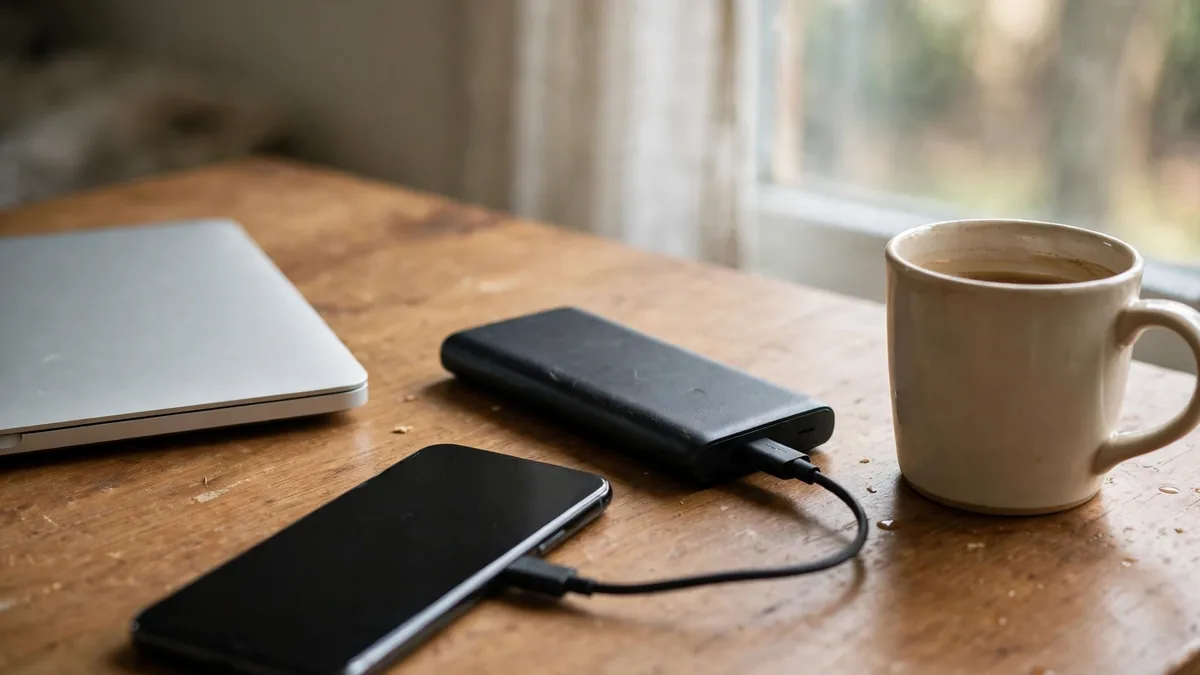
A power bank is a portable battery pack that stores electrical energy and delivers it to your phone, tablet, earbuds or laptop when no wall socket is available. Inside the slim case sits a rechargeable lithium-ion or lithium-polymer cell, a circuit board that manages charging, and one or more USB ports.
The idea is simple, but the details matter. A power bank rated at 10,000 milliamp-hours (mAh) does not deliver a full 10,000 mAh to your phone: conversion losses and heat mean you get roughly 60 to 70 percent of the labelled figure, still enough to recharge most phones one and a half to two times.
Power banks have become everyday carry for commuters, travellers and students, from pocket-sized 5,000 mAh models that give a single top-up to heavy 27,000 mAh bricks that can charge a laptop. This guide explains how portable charging works, what the numbers on the box mean, and how to choose one that fits your life.
Key takeaways
- A power bank is a rechargeable battery pack that charges your devices away from a wall socket.
- The mAh number on the box is the capacity of the internal cells, not the charge your phone receives, which is typically 60 to 70 percent of that figure.
- Wattage, not mAh alone, decides charging speed: a 10,000 mAh bank at 22.5 watts charges a phone far faster than a 20,000 mAh bank at 10 watts.
- USB-C Power Delivery is the standard that matters most in 2026, because it charges phones, tablets and many laptops through one cable.
- Buy from a known brand, check the airline limit of 100 watt-hours for carry-on, and never leave a power bank in a hot car.
Power banks at a glance
| Detail | What to know |
|---|---|
| What it is | A portable rechargeable battery with USB output ports |
| Typical capacity | 5,000 to 27,000 mAh for everyday models |
| Usable charge | About 60 to 70 percent of the labelled mAh |
| Main battery type | Lithium-ion or lithium-polymer cells at 3.7 volts |
| Key charging standard | USB-C Power Delivery, up to 100 watts or more |
| Flight limit | Under 100 watt-hours in carry-on luggage, no airline approval needed |
| Typical lifespan | 300 to 500 full charge cycles before noticeable capacity loss |
| Recharge time | 2 to 6 hours depending on input wattage and capacity |
What a power bank actually is
A power bank is a self-contained battery with a charging circuit and output ports, packaged to travel in a pocket or bag. The core is one or more lithium cells, the same chemistry that powers phones and laptops. A small circuit board between the cells and the ports controls how fast energy flows out and shuts the bank down if it overheats or short-circuits.
Most power banks have at least one USB-C port and often a USB-A port as well. The USB-C port usually works both ways: it takes power in when you recharge the bank and sends power out when you charge a device. Some models add a built-in cable, a small display, or a wireless charging pad, but the battery and the circuit are what do the real work.
How portable charging works

Charging happens in two stages. First, you fill the power bank by plugging it into a wall charger, storing electricity as chemical energy in the lithium cells. Its speed depends on the wattage of the wall charger and the maximum input the bank accepts: a 20,000 mAh bank with 18-watt input takes about five hours to fill, while one with 45-watt input fills in under three.
Second, you connect your device to the power bank. The circuit board boosts the 3.7 volts stored in the cells up to the 5 volts, 9 volts or higher that USB charging uses. Your phone’s own charging circuit then decides how much current to accept, which is why a phone charges fast at first and slows down as it approaches full.
Energy is lost at every step. The boost from 3.7 volts to 5 volts or more creates heat, the cable loses a little power to resistance, and your phone’s charging circuit loses more. Those losses explain why a 10,000 mAh power bank delivers about 6,000 to 7,000 mAh of usable charge, roughly one and a half charges for a phone with a 4,000 mAh battery.
Capacity, wattage and the numbers on the box
The two numbers that matter most are capacity and wattage. Capacity, given in milliamp-hours, tells you how much energy the bank holds, while wattage tells you how fast that energy can move. A high-capacity bank with low wattage charges your phone slowly, while a smaller bank with high wattage charges it quickly but runs out sooner.
Watt-hours are the more honest measure of capacity, because they account for voltage. A power bank’s watt-hour rating equals its mAh divided by 1,000, multiplied by 3.7 volts, so a 10,000 mAh bank holds about 37 watt-hours and a 27,000 mAh bank about 100. Airlines use watt-hours for their safety limits, and many banks now print the figure on the case.
Fast charging protocols add another layer. USB Power Delivery, usually written as USB PD, lets a charger and a device agree on a higher voltage, raising wattage without unsafe current. A power bank with 22.5-watt USB PD charges a modern phone from empty to about half full in roughly 30 minutes. For laptops, look for 45 watts or more, and for the largest laptops, 65 to 100 watts.
Types of power banks
Everyday pocket banks
The smallest power banks hold 5,000 to 10,000 mAh and are built for a single top-up during the day. They slip into a jacket pocket or a small bag and usually have one USB-C port, making them the right choice for commuters and anyone who mostly charges at home.
High-capacity travel banks
Travel banks hold 20,000 to 27,000 mAh and can recharge a phone three to four times, a tablet once, and a small laptop partway. They are heavier, but they are the standard choice for flights, festivals and long days away from power. The 27,000 mAh size sits just under the 100 watt-hour airline limit, so it can fly without special approval.
Laptop power banks
A smaller group of banks is designed for laptops, with 60 to 140 watts of USB-C Power Delivery output and capacities of 24,000 mAh or more. These can keep a laptop running for several extra hours at close to normal speed. They cost more and weigh more, but for people who work from trains, planes and cafes, they replace the need to hunt for a socket.
Benefits and risks of portable charging
The main benefit is freedom from the wall. A power bank turns any bag into a charging station, which matters on flights, on public transport, at conferences and during power cuts. Topping up during the day also means you can avoid charging your phone overnight to 100 percent every night, the pattern that wears lithium batteries out fastest.
There are real risks to take seriously. Lithium batteries store a lot of energy in a small space, and a damaged or poorly made bank can overheat, swell or catch fire. That is why the cheapest no-name banks are a bad bargain: they often lack proper safety circuits and use low-grade cells. Buy from a brand with a real warranty, and stop using any bank that swells or gets hot while idle.
Power banks in the real world
On a flight, a power bank is often the only way to keep a phone or tablet alive, since many seats still lack working USB ports. A 10,000 mAh bank covers a long-haul flight for one phone with charge to spare, and a 20,000 mAh bank covers a phone and a tablet.
At work, a power bank lives in a desk drawer or a laptop bag as backup for long meetings and site visits. During a power cut, a fully charged bank keeps a phone running for calls and messages.
If you are comparing models before you buy, the best power banks in 2027 roundup groups current options by capacity and use case. For a smaller everyday option, the best portable chargers in 2027 list focuses on compact models that fit a pocket.
Power banks vs wall chargers and wireless charging
A wall charger is faster and cheaper per watt, because it draws unlimited power from the grid and loses almost nothing in conversion. A power bank is slower and heavier, but it works anywhere. The two are complements, not rivals: the wall charger fills the bank at home, and the bank carries that energy out into the world.
Battery care applies to both sides. Your phone’s battery lasts longest between roughly 20 and 80 percent charge, and the same logic applies to the power bank itself. The guide to how to extend laptop battery life explains the same lithium-battery principles, and they apply to the cells inside a power bank too.
Checklist: choosing the right power bank
- Match capacity to your day: 10,000 mAh for one phone top-up, 20,000 mAh for travel or two devices.
- Check the output wattage: at least 18 to 22.5 watts for fast phone charging, 45 watts or more for a laptop.
- Make sure it has USB-C Power Delivery, the standard most phones and laptops now use.
- Confirm the watt-hour rating is under 100 Wh if you plan to fly with it.
- Buy a known brand with a warranty and proper safety certification, never the cheapest unbranded option.
- Check the bank’s own recharge speed, so a 20,000 mAh model does not take all night to refill.
Frequently asked questions
How many times will a 10,000 mAh power bank charge my phone?
About one and a half times. The bank delivers roughly 60 to 70 percent of its labelled capacity after conversion losses, so a phone with a 4,000 mAh battery gets around 6,000 to 7,000 mAh of usable charge.
Can I take a power bank on a plane?
Yes, in carry-on luggage, as long as it is under 100 watt-hours, which covers banks up to about 27,000 mAh. Power banks are not allowed in checked luggage on most airlines, and banks between 100 and 160 watt-hours usually need airline approval.
Is it safe to leave my phone charging on a power bank overnight?
It is safe with a quality bank, because both stop charging when the battery is full. It is still better to unplug once charged, because keeping a phone at 100 percent for hours adds wear to its battery.
Why does my power bank charge slowly?
Usually one of three reasons: the cable is a slow charging-only cable, the bank’s output wattage is low, or the phone is hot and has reduced its charging speed. Try a different USB-C cable and a cooler spot before blaming the bank.
How long does a power bank last?
Most last 300 to 500 full charge cycles, roughly two to four years of regular use, before capacity drops noticeably. Storing it half-charged in a cool place slows that decline.
Can a power bank charge a laptop?
Yes, if it supports USB-C Power Delivery at 45 watts or more and your laptop charges over USB-C. Smaller or low-wattage banks will charge a laptop very slowly or not at all.
The bottom line
A power bank is a simple idea executed well: a battery, a safety circuit and a USB port, packaged so you can carry stored energy with you. The numbers on the box need a little translation, because the mAh figure is the capacity of the internal cells rather than the charge your phone receives, and wattage decides speed more than capacity does.
For most people, a 10,000 mAh bank with 22.5-watt USB-C Power Delivery covers daily life, and a 20,000 mAh bank covers travel. Buy a known brand, keep it under 100 watt-hours for flights, and replace it if it swells or overheats.