A useful AI tool can still be the wrong place for a confidential document, even when private AI sounds reassuring. You may want help with work or personal tasks without exposing sensitive data. Privacy matters because a prompt can include details you would not share in a public post.
The choices can feel unclear. The word “private” can describe different technical setups, not one guaranteed product feature. What happens to your information depends on how a tool processes, stores, and shares it.
This guide explains those choices in plain language. It will help you weigh AI’s usefulness against your control over information, whether you are choosing a personal app or a system managed by an organization.
The practical question is not just whether an AI tool is called private, but what happens to the information you give it.
Key Takeaways
- “Private” describes a range of technical arrangements, not a single guarantee.
- Check where prompts go and who can access them.
- Training, retention, and infrastructure boundaries are separate questions.
- On-device AI can process some information without an internet connection.
- Match the privacy setup to the sensitivity of the task.
What Is Private AI and What Does It Protect?
Private AI is an AI setup designed to let one organization use models with its own information while restricting who can access that information. The key is control: a company sets the boundary for data use and access. A private label alone does not guarantee that the organization controls every part of the system.
The setup may run on an organization’s own infrastructure or in a managed environment with restricted access. Private AI can use proprietary data and organization-specific models, but it does not have to be custom-trained. It also does not always run on the organization’s own servers or stay isolated from every provider.
RAG is a method that retrieves relevant information from an organization’s documents and supplies it to a model when responding. This can help a model answer questions using current internal material without building every detail into the model itself.
Treat the organization’s actual control over data flow and access as the defining test, not the label on a product.
That boundary can support data privacy by limiting which people, systems, and services can handle sensitive data. The organization must still decide which information belongs inside the private environment and which users need access.
Data sovereignty means the organization retains control over where its data goes and who may access it. Location can matter when a business has legal or contractual duties about data handling.
Rules that affect data handling include HIPAA, GDPR, CPRA, and the U.S. Privacy Act of 1974. Their requirements vary, so an organization needs to map its own data and duties before choosing a setup.

Private AI can help protect records, but it does not replace sound access rules or compliance work. The organization needs to know which systems process its prompts and which people can reach the records.
How Is Private AI Different From Public AI?
The main difference is who controls the environment processing the prompt, not simply whether a provider promises not to train on it. Infrastructure matters, along with access and service terms. Paid access or a training opt-out alone does not prove that data stays inside an organization-controlled boundary.
A public AI service is commonly delivered through a hosted application or API. The provider manages the service, and its terms set how inputs may be retained or used. Publicly available access does not mean every user can read another person’s prompts.
Private AI restricts access to an organization’s authorized users. The organization may control the environment directly or rely on a dedicated setup. A third party can still provide parts of the service, so the boundary needs a clear definition.
| Attribute | Public AI service | Private AI deployment | Practical question |
|---|---|---|---|
| Where inference runs | Provider-managed shared or hosted infrastructure | Organization-controlled or dedicated environment | Where does the prompt go? |
| Data use | Retention or training depends on provider terms | Controls follow the organization’s arrangement | Are training and retention addressed separately? |
| Access | Provider’s service controls | Organization-authorized access | Who can read prompts and logs? |
The table separates three questions that are easy to blend together. Training describes whether inputs help improve models; retention describes how long a service keeps them.
A provider’s infrastructure boundary is another matter. A service may promise not to train on prompts while still processing or storing them on provider-managed systems.
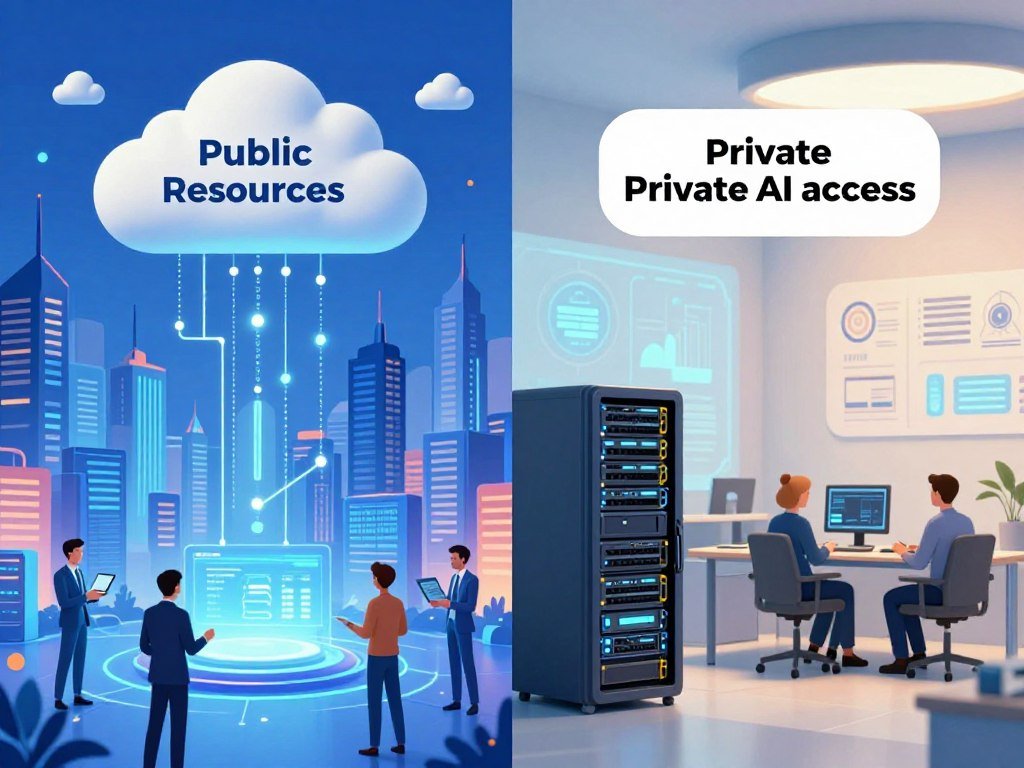
When you compare tools, ask what information users may share and where it travels. Compare the actual data path and retention terms before treating two tools as equivalent.
Where Can Private AI Run?
Private AI can run on equipment an organization owns, in a dedicated provider environment, or across a carefully governed mix. Ownership is only one choice; operations and isolation also shape the design. Each setup shifts responsibility between the organization and its provider.
A private cloud can offer a dedicated boundary without requiring the organization to own every server. NIST’s cloud computing reference architecture describes cloud roles and deployment models, including private and hybrid clouds.
On-Premises and Air-Gapped Systems
On-premises systems run in an organization’s own data center or other facility. The organization has direct physical control over hardware and network links, but it must run and maintain that equipment.
An air-gapped system has no direct connection to outside networks. Some government and defense work needs processing in a tightly isolated environment. The added separation can limit data movement, but it also makes updates and support harder.
Private Cloud and Dedicated Tenancy
A provider can operate infrastructure in a private cloud or dedicated tenancy. The organization gets a dedicated boundary while the provider handles much of the hardware work.
Dedicated does not mean the organization has no duties. It still needs clear rules for access, support, backups, and the movement of information between systems.
Virtual Private Cloud and Hybrid Setups
A virtual private cloud uses an isolated network within a public cloud account. It can offer more control over network settings, while the cloud provider still runs the underlying infrastructure.
Hybrid setups send different data classes to different environments. For instance, an organization may keep restricted records in one environment and route lower-risk tasks elsewhere.

Hybrid routing errors can send sensitive information across the wrong boundary. In a hybrid design, test the classification and routing rules that decide where each prompt is processed.
What Can Organizations Do With Private AI?
A private AI system is most compelling when the input itself is something the organization cannot afford to expose. The document matters as much as the model. Private AI examples fit best when a task involves confidential records or valuable intellectual property.
A private AI chatbot can search internal policy documents without making every employee browse a large file library. Healthcare teams may summarize protected patient information, while finance teams can review sensitive transactions.
Legal teams may work with privileged material, and manufacturers may search proprietary designs or process information. Government offices can use controlled files for policy or case work when their rules allow it.
- Healthcare: summarize clinical documents.
- Finance: review transaction patterns.
- Legal and government: search controlled case or policy files.
- Manufacturing and R&D: find information in product and process records.
These use cases can make private AI useful for an enterprise, but the benefits depend on the task. A tool that finds the right passage in organization proprietary data may save review time, while a weak answer still needs human review.
Some work does not need a private setup. Published marketing copy and other low-sensitivity material may not justify added infrastructure, controls, and support.

Choose one real task and name the record it needs. Test the case against what would happen if a specific document reached an unauthorized person.
What Makes an AI System Private in Practice?
A privacy claim is strongest when the architecture and operating rules can show where data goes and who can reach it. Proof beats labels. Protect prompts, linked documents, and logs as parts of the same data path.
Protect the Data Path
Encryption helps protect information while it travels between systems and while it sits in storage. Limiting what a prompt sends also reduces exposure, especially when a full document is not needed.
On-device AI processes information on a phone or computer. Some models can work offline when the app supports it, so prompts do not need to reach a cloud service for each response.
A private AI app for Android can run models on the phone. The Google Play Private AI app runs language models on-device and works offline. Its listed models include Gemma 2, Llama 3.2, Phi-3.5 mini, Orca mini, Rocket 3B, Mistral, NeuralBeagle, OpenHermes, WizardLM, and Silicon Maid.
The app’s premium feature supports compatible GGUF model files. Local processing can reduce data movement, but app features alone do not answer every organization’s governance question.
RAG connects a model to an organization’s documents so it can retrieve relevant details for an answer. The access rules for those documents still matter, since retrieval can expose records to a model or user.
Control Access and Keep Evidence
Identity controls help limit access to people who need it. Monitoring can show how a service was used, while retention and deletion rules set how long records remain.
Logs need protection too. They may contain prompts, names, or details that are not obvious in a system dashboard. Differential privacy, federated learning, and homomorphic encryption are different techniques, not interchangeable guarantees.
NIST’s privacy-enhancing technology testbeds evaluate protections and risks in practical settings. These methods can support privacy goals, but teams still need to test what a system reveals.
- Encrypt data in transit and storage.
- Restrict access by role.
- Set retention and deletion rules.
- Protect and review logs.
For a related check on app permissions and logging, see this guide to free VPN privacy limits. Check prompt logs and support records as carefully as the primary data store.
How Much Does Private AI Cost in Practice?
Private AI can range from a free on-device app to a business system with ongoing infrastructure and staffing costs. The price depends on the setup, not just the model. Subscription fees and dedicated infrastructure costs describe different things.
A private AI option for free may be an on-device app that runs a local model. An organization-run system also needs a budget for compute, storage, security, maintenance, and staff.
Workload volume affects the cost. Heavy use can require more capacity, while unused compute still costs money when an organization keeps it ready.
Consumer subscriptions show what access to hosted models can cost, but they do not prove that a service uses a private AI deployment. In the United States, Google AI Plus costs $4.99 per month, with usage limits twice the standard limits.
Google AI Pro costs $19.99 per month and has limits four times the standard limits. Google AI Ultra costs $99.99 or $199.99 per month, with limits five or 20 times AI Pro limits, depending on the subscription.
Gemini’s free plan has a 32K-token context window. Google AI Pro and Ultra have a 1M-token context window. A context window sets how much text a model can handle at once.
Google said personal Gemini accounts without an AI subscription would have access only to Flash-Lite starting October 9, 2026. That plan change concerns model access, not whether an organization controls the service’s infrastructure.
For a broader view of chatbot plans and features, see this AI chatbot plan comparison. Before comparing prices, decide whether the requirement is privacy architecture, more model usage, or both.
Which Consumer AI Tools Offer More Privacy?
Consumer tools can offer privacy through local processing, a secured cloud environment, or limited retention, and those are not the same promise. Each protects a different boundary. Check the exact feature, because a platform can mix local and cloud processing.
What is a private AI app? The phrase can mean a local model, a personal app, or an app with privacy controls. Users should check where the model runs and what the app stores.
On-Device Apps and Personal AI
An app that runs models on a phone differs from a cloud service that sends prompts to a provider. On-device processing may work offline, while a personal app can still use cloud models for some features.
Google AI Studio personal apps began rolling out October 13, 2026, to users 18 and older in select markets, including the United States. They run privately on the user’s device without requiring a developer account.
Private AI Compute in the Cloud
Google Private AI Compute is a cloud system, not on-device processing. It uses Gemini models in a hardware-secured environment, custom Tensor Processing Units, and Titanium Intelligence Enclaves.
Google’s September 23, 2026 update describes encrypted cloud memory with keys held only on users’ devices. The system decrypts information temporarily in a secure enclave, and devices verify server software against a tamper-proof public record.
Google says the service supports Pixel 10 Magic Cue suggestions and Recorder summaries in more languages. The approach relies on a protected cloud boundary, rather than keeping every calculation on the phone.
A report on AI privacy methods compares local models and secure cloud environments. It also explains that a privacy feature can have limits, even when it adds a technical barrier.
AI Search and Research Tools
Brave Search runs its own index and offers AI answers. Brave says those answers are encrypted, deleted after 24 hours of inactivity, and do not retain IP addresses.
Brave Search is free, while Search Premium costs $3 per month to remove ads. That paid plan does not by itself prove a private processing boundary.
Perplexity’s free tier includes unlimited quick searches and limited daily Pro searches and model choices. Consensus offers 15 free Pro searches per month, with unlimited Pro searches starting at $10 per month.
A private AI search engine can mean a search product with specific privacy controls, not a promise that every model interaction stays on your device. Search and research tools also differ in their indexes, model choices, and retention rules.
Read the current privacy terms for the exact tool and feature you plan to use.
How Can You Check a Provider’s Privacy Promise?
Ask a provider to trace one prompt from entry to deletion, including every model, log, and support system it touches. A clear path matters. Training terms answer only one part of the privacy question.
The policies below show how plans can differ. Prices and training rules do not, by themselves, prove that an organization controls the full private environment.
| Service or plan | Price | Training or data policy | What the policy does not establish |
|---|---|---|---|
| Claude Pro | $20 per month | No training on subscriber data by default | Whether customer-controlled infrastructure holds data |
| Claude Team | $25 per user per month | Team conversations not used for training | Every retention or log-access detail |
| ChatGPT Free, Go, and Plus | Free-tier price not stated here | Training by default, with forward-looking opt-out in Data Controls | Whether an architecture boundary exists |
| ChatGPT Team | $25 per user per month | Conversations not used for training | Where inference runs |
| Microsoft 365 Copilot | $30 per user per month | Data stays within the tenant under the stated policy | Whether the specific tenant and service terms fit |
Other providers set distinct terms. Gemini free-tier conversations may be used to improve Gemini, while Workspace conversations and documents have separate enterprise terms that restrict training use.
Perplexity Pro costs $20 per month, and queries may be used. DeepSeek stores data on servers in China, subject to the People’s Republic of China’s data laws.
Mistral Le Chat Pro costs $15 per month and is identified as EU-based and GDPR-compliant. A chat product and an API can have different features and terms, so check the endpoint you plan to use.
For a technical setup example, this guide explains a Mistral API call and key safety. Treat the API and its provider as part of the prompt’s path.
Use this checklist when reviewing a provider:
- Trace one input end to end.
- Ask what is retained and for how long.
- Identify runtime third-party models.
- Check who can read logs.
- Confirm deletion and export terms.
Keep the answers and supporting evidence with the organization’s AI governance records.
Store the contract terms, technical notes, and review date together so staff can find them later.
Conclusion
The right choice is the one whose privacy controls match the sensitivity of the work. More control has a cost in staff time and ongoing operations, so it fits best when the information justifies that effort.
For low-sensitivity tasks, a service with suitable terms may be more proportionate than a dedicated system. Start by classifying one intended AI workload, then document its data path and who can access it.
Start with one real task, classify its data, and verify its path before expanding its use.
FAQ
What is the difference between public AI and private AI?
Public AI usually runs through a provider’s service, while private AI restricts access within an organization-controlled or dedicated boundary. The difference involves more than a promise about model training. Check retention separately, since a service may avoid training on prompts while keeping them for another purpose. Also ask where inference runs and who can read prompts or logs.
How much does private AI cost?
Consumer tools can be free or subscription-based, while an organizational deployment adds infrastructure and staffing costs. Google AI Plus costs $4.99 per month in the United States, but that price does not prove a private deployment. An organization also needs to budget for compute, storage, security, and maintenance. Its workload volume and idle capacity affect the operating cost.
Which AI is actually private?
A more credible privacy claim lets you check where inference runs, what the service retains, who can access prompts and logs, and whether data trains models. Local processing and a secured cloud enclave use different approaches. A local model may work without sending prompts online, while a cloud enclave still processes information in a provider’s environment. Review the exact feature, not just the product name.
What to not ask an AI?
Do not enter passwords, payment credentials, or confidential personal or business information until the service’s data handling and access controls are approved. A prompt can be stored in chat history, logs, or support systems. Even a tool that does not train on prompts may retain them for other reasons. Use sample or public information while you assess the service.
Can private AI work offline?
Yes, on-device models can work offline when the app supports that mode. The model and needed files must be available on the phone or computer. Cloud-based processing requires an internet connection because the prompt must reach the service. Offline use can limit which models or features are available, so check the app’s behavior before relying on it.
Does paying for an AI plan make it private?
No, paying for an AI plan does not by itself make the service private. A paid plan may change usage limits or training terms, but it may still process prompts on provider-managed infrastructure. Privacy also depends on retention, logs, and access controls. Check whether the plan offers a boundary your organization controls, rather than assuming the subscription price settles the question.