

What should you do when you find a small white oval tablet stamped with “4H2” and nobody in the house recognizes it? That single question sits at the center of a surprisingly serious safety issue. The imprint looks like a clear label, but it is not a guarantee. Imprint codes get reused, misreported, and confused across products, and the stakes of a wrong guess are high because the most commonly reported match is a controlled medication that depresses the central nervous system.
This guide walks through what “4H2” is most often reported to be, how pill identification actually works, where people go wrong, and the practical steps that protect you or anyone else who might swallow an unknown tablet.
The Most Common Match: Carisoprodol 350 mg
Pill-identification databases most commonly associate a white, oval tablet imprinted with 4H2 with carisoprodol 350 mg, a muscle relaxant sold under the brand name Soma. The manufacturer is often listed as Qualitest Pharmaceuticals, though that detail deserves a caveat: manufacturer listings in aggregator databases drift over time, and the association between this imprint and this product is not something to treat as carved in stone.
Carisoprodol works by blocking pain signals between nerves and the brain, and it is prescribed for short-term relief of muscle pain and stiffness. It is not a mild drug. It causes drowsiness, dizziness, and impaired coordination, and it is metabolized in the body into meprobamate, a sedative with its own history of dependence concerns. That metabolic step matters because it means the effects linger and stack up, especially with repeated doses.
The other key fact is regulatory. Carisoprodol is a Schedule IV controlled substance in the United States, a status it received through federal scheduling in 2012. Schedule IV sits below Schedule II but above non-controlled prescription drugs, and it signals that the substance carries a recognized risk of abuse and dependence. Its status is not universal, though. Different countries regulate carisoprodol differently, and in some places it is available with far looser restrictions or not at all.
Why One Imprint Match Is Never Proof
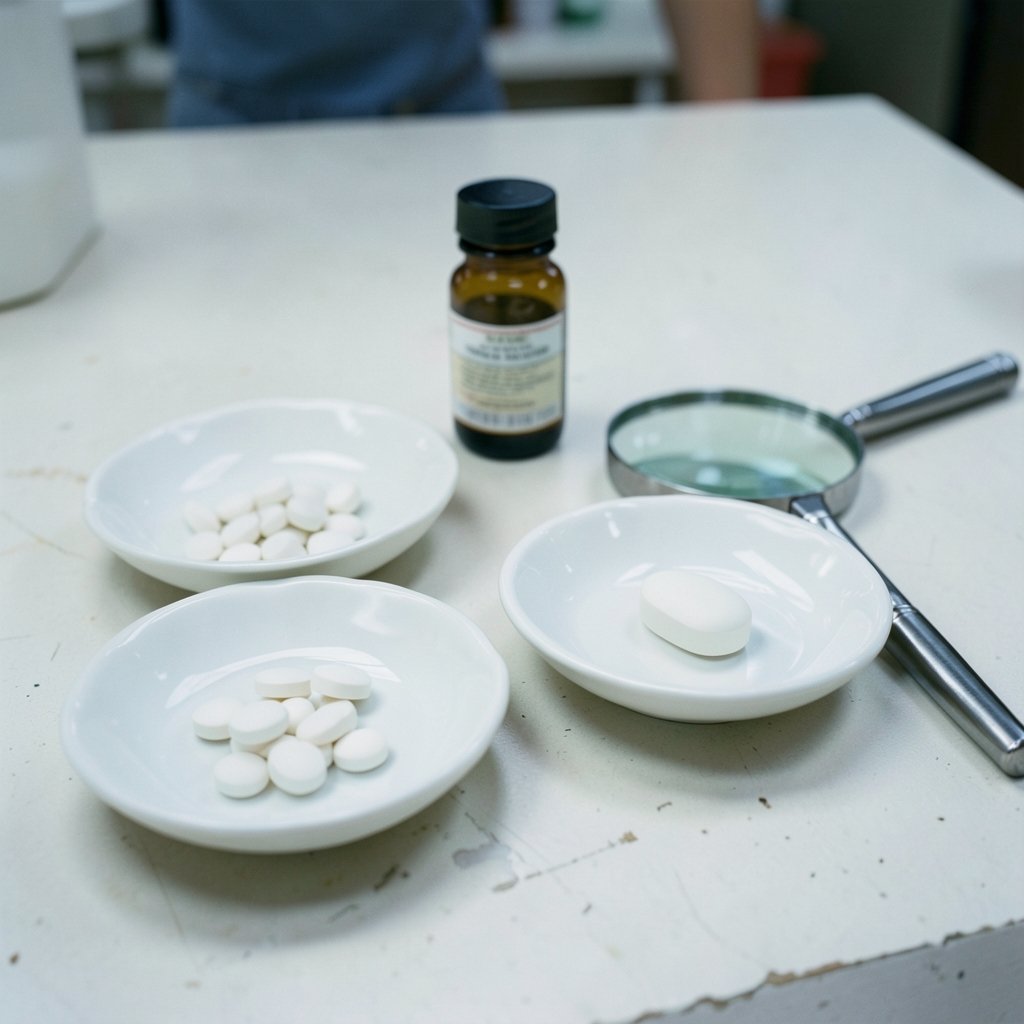
Here is where most people go wrong. They type “4H2” into a search engine, see carisoprodol pop up, and consider the case closed. That is a mistake, and a potentially dangerous one.
Pill imprints are not unique identifiers. The same letter-and-number code can appear on different products from different manufacturers, and codes are sometimes reused, retired, or misreported in databases. Databases also disagree with each other. One source may list a single candidate; another may list several. A single match tells you what a pill might be, not what it is.
Think of an imprint the way you would think of a first name. Knowing someone is called “Chris” narrows things down, but it does not tell you which Chris you are looking at. You need more identifying details, and even then you want confirmation from someone with authority to give it.
A practical habit that helps: cross-check at least two independent sources before you put any weight on an identification. If both agree, your confidence rises. If they conflict, stop and treat the tablet as unknown. And if the pill is one you found on the floor, in a drawer, or in a bag that is not yours, the identity question is secondary to the safety question. Do not taste it, do not swallow it, and do not assume it is harmless because it looks plain.
This same principle of verifying before acting shows up elsewhere in everyday life. People assume a white wall will ruin a projector image until they test it, and they assume hard water is harmless until white dust coats the furniture. The lesson in how a projector screen on white walls actually improves the picture is that assumptions deserve testing. With pills, the testing is a pharmacist’s job, not yours.
How to Identify an Unknown White Oval Pill Safely
The safe path is methodical. None of these steps requires swallowing anything.
- Describe the pill precisely. Note the shape (oval), color (white), imprint (“4H2”), and any scoring line, coating, or unusual smell. Photograph it on a plain background with a ruler or coin for scale.
- Use a recognized pill identifier. The U.S. National Library of Medicine’s Pillbox tool and consumer pill identifiers let you search by imprint, shape, and color. Read the database’s own disclaimer about imprint limits before trusting a result.
- Ask a pharmacist. This is the single most reliable step available to the public. Pharmacists see imprints daily, understand manufacturer variations, and can flag controlled substances. Many pharmacies will identify a pill for free, no purchase required.
- Call poison control if ingestion is possible. In the U.S., Poison Control can be reached at 1-800-222-1222. If a child or pet may have swallowed the tablet, call immediately rather than waiting for symptoms.
- Store or dispose of it safely. Once identified, keep it out of reach of children and pets. If it is unidentified, do not flush it casually; use a drug take-back program or follow local disposal guidance.
What actually works in practice, according to people who handle this regularly, is the combination of a photo and a pharmacist. What does not work is asking a friend, searching a social media group, or comparing the pill to a photo of a similar-looking tablet. Lighting, camera angle, and tablet wear make visual comparison unreliable.
Common Mistakes to Avoid
The first mistake is assuming a white oval pill is a benign over-the-counter painkiller. White and oval is the most generic appearance a tablet can have. The second is trusting a single database result. The third is ignoring the controlled-substance angle: if the tablet is carisoprodol, it is a drug with real interaction risks, including dangerous sedation when combined with alcohol or opioids.
A fourth mistake is keeping unidentified pills “just in case.” An unknown tablet in a medicine cabinet is a hazard waiting for a confused moment, a curious child, or a late-night headache. If you cannot identify it, get rid of it properly.
What Carisoprodol Does and Why the Warnings Matter
If the tablet is indeed carisoprodol 350 mg, understanding its profile helps explain why identification matters so much. Carisoprodol is a CNS depressant. It slows brain activity, which is why it relaxes muscles and why it also makes people sleepy, foggy, and slow to react. Official labeling carries strong warnings about sedation, about driving and operating machinery, and about combining the drug with alcohol or opioid painkillers, a combination that can suppress breathing.
Because it converts to meprobamate, carisoprodol can produce dependence with prolonged use, and withdrawal is a documented concern. It is not a drug to take casually, share with friends, or use to push through a workday. The Schedule IV classification reflects exactly this profile.
There is also a broader public-health angle. Counterfeit and illegally manufactured pills increasingly mimic the appearance of legitimate tablets, including controlled ones. A white oval pill bought online or offered at a party has no reliable connection to the imprint on its surface. The imprint tells you what the tablet is pretending to be, not what is inside it. That is why the only trustworthy identification comes from a pharmacist or an analytical lab, and why an unknown pill should always be treated as potentially hazardous.
When the Imprint Points Somewhere Else
It is worth repeating that “4H2” could, in some databases or some batches, map to a different drug or strength. Imprint reuse is real, and the pill-identification ecosystem is not perfectly synchronized. If two sources disagree, the honest answer is “unknown,” and unknown means hands off.
This is not a reason to panic. It is a reason to slow down. The person who pauses, photographs the tablet, and asks a pharmacist is doing exactly the right thing. The person who guesses is taking a risk that no search result can justify. If you want a mental model for careful verification, it is the same discipline that keeps a whiteboard readable: you clean it properly and check the surface rather than assuming a quick swipe did the job, as explained in this guide to cleaning a whiteboard so it stops ghosting. Small verification habits prevent big messes.
A Note on Household Safety and Storage
Most unknown-pill situations start at home. A tablet rolls out of a drawer, a bottle loses its label, a relative’s old prescription lingers in the bathroom cabinet. A few practical habits cut the risk dramatically.
Keep all medications in their original labeled containers. Store them up and away, ideally locked, especially if children or pets live in or visit the home. Do a cabinet clean-out twice a year and take expired or unidentified drugs to a take-back site. Never move pills into unlabeled baggies or pill organizers without marking them, because that is how a white oval becomes a mystery in the first place.
If you find an unidentified tablet, treat the discovery as a prompt to audit the whole cabinet. Odds are good that one stray pill is not the only loose end. And if a child has swallowed something unknown, skip the research phase entirely and call poison control. Speed matters more than certainty in that moment.
Conclusion
A white oval pill stamped “4H2” is most commonly reported as carisoprodol 350 mg, a Schedule IV muscle relaxant that converts to meprobamate and carries serious sedation warnings. But “most commonly reported” is not the same as “confirmed.” Imprints are not unique, databases disagree, and counterfeit tablets exist. The responsible move is simple and takes minutes: photograph the pill, check a recognized identifier, and confirm with a pharmacist. If ingestion is possible, call poison control at 1-800-222-1222. Curiosity about an unknown tablet is fine. Experimenting with one is not.
What is the white oval pill with 4H2?
It is most commonly reported in pill-identification databases as carisoprodol 350 mg, a muscle relaxant sold under the brand name Soma. The manufacturer is often listed as Qualitest, though that detail can change in databases. A single imprint match is not proof of identity, so confirm with a pharmacist before drawing conclusions.
Is carisoprodol a controlled substance?
Yes. In the United States, carisoprodol is a Schedule IV controlled substance, a status it received through federal scheduling in 2012. That classification reflects a recognized risk of abuse and dependence. Its status varies by country, so regulations are not universal.
Can I identify a pill by its imprint alone?
No. Pill imprints are not unique identifiers. The same code can appear on different products, and codes are sometimes reused or misreported. Databases frequently disagree or list multiple candidates for one imprint. Cross-check at least two sources, and treat a pharmacist’s confirmation as the reliable answer.
What should I do if I find an unknown pill?
Do not swallow it or taste it. Photograph it on a plain background, note the shape, color, and imprint, and search a recognized pill identifier. Then ask a pharmacist, who can identify most tablets quickly and for free. If a child or pet may have swallowed it, call Poison Control at 1-800-222-1222 right away.
What are the risks of taking carisoprodol?
Carisoprodol is a central nervous system depressant. It causes drowsiness, dizziness, and impaired coordination, and it carries strong warnings about driving and about combining it with alcohol or opioid painkillers, which can dangerously suppress breathing. It also metabolizes into meprobamate, a sedative linked to dependence with prolonged use.
Why do pill databases disagree with each other?
Databases are updated on different schedules, draw from different manufacturer submissions, and handle discontinued or reformulated products differently. Imprint reuse adds another layer of confusion. Because of this, conflicting results are common and should be read as a signal to seek professional confirmation rather than to pick whichever answer seems most convenient.



