
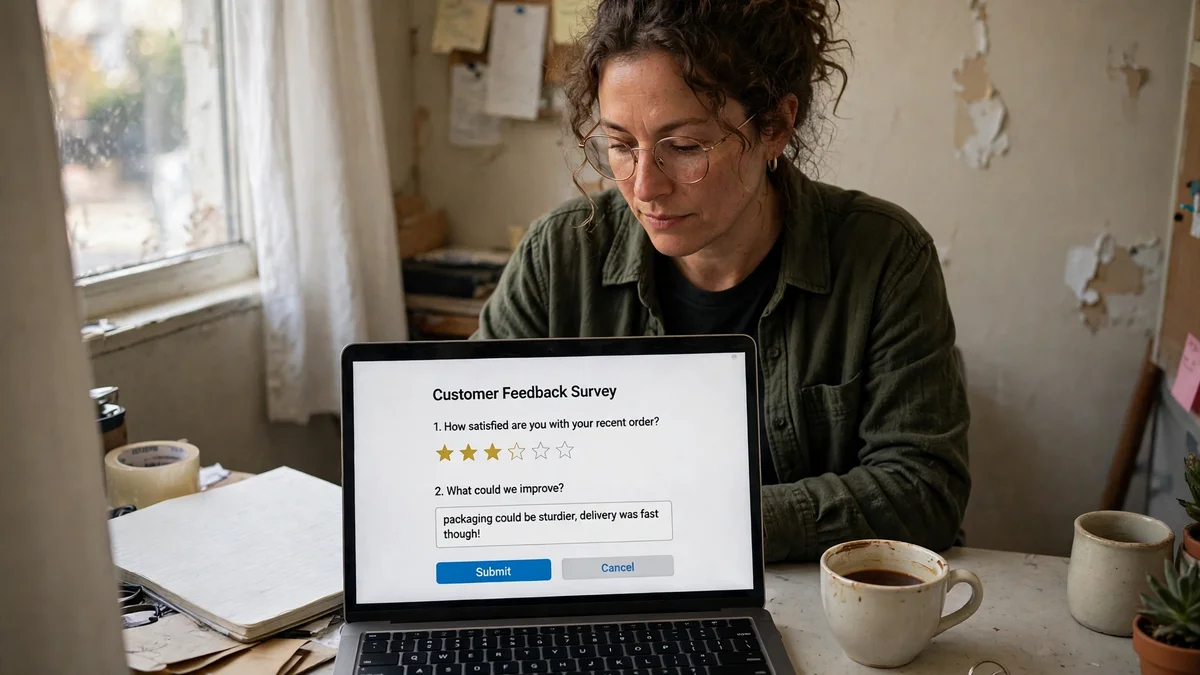
A small business owner opens the survey dashboard on a Monday morning and finds four tools waiting with four different scores. One tool says customers love the checkout page. Another tool says the same page confuses visitors. A third tool has no new answers at all because nobody finished its twelve question form. The fourth tool wants a renewal payment before it will show the results.
This is the normal result of optimizing for every survey tool on the market. Each tool gets its own questions, its own design, its own trigger rules, and its own slice of the visitor traffic. None of them gets enough answers to mean anything, and the business ends up with more dashboards than decisions.
The fix is not a fifth tool. The fix is to pick one survey tool, tune it properly, and let the rest go. One tool with one clear question at the right moment will tell a business more than four tools competing for the same visitor.
Key takeaways
- Survey sprawl starts when each new tool gets its own questions, triggers, and dashboard, and none of them collects enough answers to trust.
- Every extra survey tool costs money, staff time, and visitor patience, and the cost grows each time a new pop up is added without removing an old one.
- One well tuned survey tool beats four shallow ones, because a single stream of answers can be read, compared, and acted on in the same week.
- Low response rates, conflicting scores, and duplicate questions are the usual signs that the survey setup has grown past the point of usefulness.
- The fix is a freeze on new tools, a cull of unused surveys, one owner for the whole feedback system, and a single question that matters.
What survey tool sprawl actually looks like
Sprawl rarely arrives as a decision. It arrives as a trial here and a plugin there. A marketing manager signs up for one tool to run a post purchase survey. A support lead adds a second tool to collect a satisfaction score after each ticket. A web designer installs a third tool for exit surveys on the pricing page. Each step looks small. Together they build a feedback system that nobody fully controls.
The first sign is duplicate questions. A customer who buys a product gets a survey from the checkout tool, another survey from the email tool, and a pop up survey the next time that customer visits the site. The customer answers the first one and ignores the rest, or ignores all three because the business now looks desperate for opinions. Response rates fall, and the team blames the questions instead of the pile up.
The second sign is conflicting scores. One tool reports a satisfaction score of 8.4 out of 10. Another tool reports 6.1 for the same week. The difference is not the customers. It is the sample. One tool asks buyers right after payment, when satisfaction runs high. The other tool asks visitors who are about to leave the site, when frustration runs high. Both numbers are honest. Neither number means anything on its own, because the business never decided which moment matters most.
None of this happens because the tools are bad. SurveyMonkey, Survicate, Hotjar, and Qualaroo are capable products, and each one can serve a small business well. The problem is the habit of treating every new tool as a solution instead of treating the feedback system as one thing that needs one owner and one design. A business with one website and one customer journey does not need four survey systems. It needs one survey that asks the right question at the right moment and gets read every week.
Why one tuned survey tool beats four tuned survey tools
The instinct behind sprawl is easy to understand. Each tool promises something the others lack. One tool has better templates. Another tool has a nicer widget. A third tool connects to the email platform. Each promise is true, and each one pulls the business in a different direction until the feedback system is four half finished systems instead of one finished one.
A team that knows one survey tool well can answer a question in seconds. Which page has the highest exit rate. Which question gets the most answers. Which answer changed after the last website update. A team spread across four tools cannot answer any of those questions without opening four dashboards and reconciling four different ways of counting a response.
A single tool also gives the business a single sample. When every visitor sees the same survey at the same moment, the answers can be compared week to week. A score that moves from 7.2 to 6.4 means something changed. When four tools split the traffic, each tool sees a different slice of visitors, and a score that moves may mean nothing more than a change in which tool showed up that day.

The money argument is the simplest one. Four tools at 25 dollars a month cost 1,200 dollars a year before any paid add ons. That is a real budget line for a small business, and it buys four dashboards that nobody reads. One tool at a higher tier usually costs less than the pile, and it buys a system that one person can actually run. The cheapest way to get survey data is not to buy the cheapest tool. It is to buy one tool and use it properly.
This is the same pattern that shows up with other business software. Our opinion on why a business should stop optimizing for every CRM platform makes the same case for customer records, and the logic holds here too: tuning one system deeply beats tuning three systems shallowly, because the value of a tool comes from the team knowing it well, not from the number of tools on the invoice.
The human cost of too many survey tools
The cost that never appears on an invoice is the time of the people who run the system. A small team has a fixed number of hours, and every hour spent inside a survey admin screen is an hour not spent talking to a customer, fixing a product, or answering a support ticket. When the survey system is four tools deep, the hours add up fast.
The caveats that matter
Stopping the sprawl does not mean stopping surveys. A business still needs to hear from customers, and a well run survey is still one of the cheapest ways to do it.
A single tool is also not the right answer for every business. A company with two very different audiences, such as retail buyers and wholesale partners, may need two different survey flows. The test is simple. If the second tool serves a genuinely different audience or a genuinely different question, keep it. If it serves the same visitors with the same questions, cut it.
Timing matters too. Do not rip out four tools in one afternoon and replace them with a new one the same day. Pick the tool that already has the most answers, move the best questions into it, run the old tools alongside for two weeks, then switch the old ones off one at a time. A careful cut beats a dramatic one. Check the response limits before paying, and check them again before the busiest season. Our guide to the best tools for managing a small business website survey explains the limits and starting prices of the main options, so the choice can be made on numbers instead of habit.
| Detail | What is known |
|---|---|
| Typical number of tools in a sprawling setup | Three to five, each with its own questions and dashboard |
| Most common cost | Four tools at about 25 dollars a month each, around 1,200 dollars a year |
| First warning sign | The same customer gets the same question from two or more tools |
| Second warning sign | Two tools report different satisfaction scores for the same week |
| Third warning sign | A dashboard that nobody on the team has opened in a month |
| Best fix | Freeze new tools, keep the one with the most answers, move the best questions into it |
| Best habit | One owner reads the answers for twenty minutes every week and fixes one thing |
| When a second tool is justified | When it serves a different audience or a genuinely different research question |
Checklist: judging your survey setup honestly
- Count the survey tools the business pays for, including free trials that never got cancelled, and write the number down.
- Open each dashboard and check the date of the most recent answer, then switch off any tool with no answers in the last thirty days.
- Read the live questions on the website as a visitor would, and remove any question that another tool already asks.
- Pick the tool with the most answers and the clearest reports, and name one person as its owner.
- Set a response limit check before the busiest month, so the survey never stops collecting answers mid campaign.
- Book twenty minutes every week to read the answers together and fix one thing the answers point to.
Frequently asked questions
How many survey tools does a small business actually need?
Most small businesses need one. One tool can run a post purchase survey, an exit survey, and a satisfaction score if the questions are kept short and the triggers are set carefully.
What is the first step to cutting survey sprawl?
Count what exists. List every survey tool, every live survey, and every trigger on the website. The list is usually longer than anyone expects, and seeing it written down is what makes the cut possible. Switch off the tools with no recent answers first.
Why do satisfaction scores differ between tools?
Because each tool asks at a different moment to a different slice of visitors. A tool that asks right after payment sees happy buyers. A tool that asks visitors who are about to leave sees frustrated people.
Does one survey tool mean fewer questions?
Yes, and that is the point. A visitor will answer one short question. The same visitor will close a twelve question form.
How do I pick which survey tool to keep?
Keep the one with the most answers, the clearest reports, and the easiest setup for the team that will run it. Check the response limits and the price at the tier the business will actually use, not the free tier.
What should replace the tools I switch off?
Nothing, at first. Move the best question from each switched off tool into the one that stays, and leave the rest behind. Most questions in a sprawling setup were never read, and the business will not miss them.
The bottom line
A survey tool is a listening device, and a business can only listen to one conversation at a time. Four tools do not mean four times the listening. They mean four times the noise, four times the cost, and four times the chance that the answer that matters gets buried in a dashboard nobody opens.
Pick the tool that already works, move the best question into it, switch the rest off, and spend the saved money and the saved hours on the fix the answers point to. That is the whole strategy, and it fits on a sticky note. A poll is a different job from a survey, and our guide to the best AI tools for creating polls for small teams covers where to run a quick vote instead of a survey, because the format should match the question, not the other way round.
Note: This is an opinion piece based on patterns seen across small business survey setups. Prices and response limits change often, so check the current terms of any tool before buying.



