
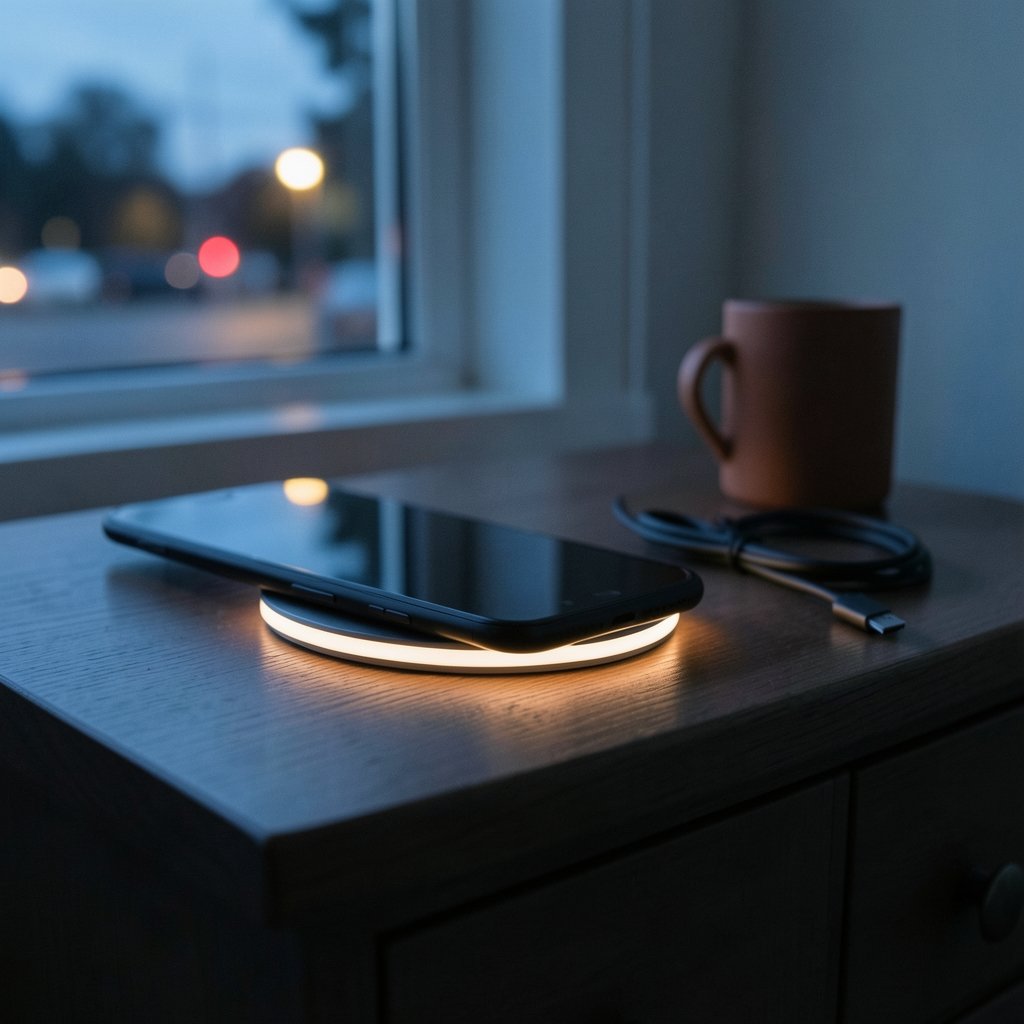
Does your phone feel like a hot plate after twenty minutes on a wireless pad? You are not imagining it, and you are not doing anything wrong. Wireless charging simply produces more heat than a cable, and that fact has real consequences for how long your battery lasts. But the size of the problem depends far more on how you charge than on the word “wireless” itself.
This comparison walks through the physics, the measured numbers, and the practical fixes. It separates the heat that is harmless from the heat that quietly ages your battery, and it shows where cheap gear, bad alignment, and sloppy habits turn a convenience into a slow cooker. (Best no code app builders startups practical 2027 comparison)
Why wireless charging runs hotter than a cable
A cable delivers electricity almost directly. Power flows from the adapter into the phone, with one conversion from alternating current to direct current along the way. A wireless pad adds steps. A coil in the pad creates an alternating magnetic field, and a second coil inside the phone turns that field back into electricity. Energy crosses an air gap, and every one of those conversions leaks a little power as heat.
The numbers are not small. According to reporting summarized by Engadget and covered by DigitalToday, roughly 20 to 30 percent of the energy in a wireless charging session is lost as heat. Converting household AC power to DC adds another 5 to 10 percent of loss. Put together, charging a phone from 0 to 100 percent takes about 15 Wh over a cable but around 21 Wh on a pad, a gap of up to 40 percent.
That extra electricity does not vanish. It becomes warmth in the back of your phone, in the pad, and in the air between them. A cable has nowhere near as much opportunity to waste energy, which is why it still wins on speed and efficiency in most comparisons.
The measured gap: cable versus pad

The table below sums up the differences that matter most in daily use. Figures come from published testing and reporting, not from manufacturer marketing.
| Metric | Wired charging | Wireless charging |
|---|---|---|
| Energy for a full charge | About 15 Wh | About 21 Wh |
| Energy lost as heat | Minimal | 20 to 30 percent of input |
| Extra AC-to-DC loss | 5 to 10 percent | 5 to 10 percent plus induction loss |
| Worst-case efficiency drop | Small | Falls to roughly half with poor alignment |
| Typical heat source | Battery and charging chip | Coils, pad surface, and battery |
One detail stands out. A 2020 study cited in that reporting found wireless charging could use up to 40 percent more power than wired charging. A 2024 test by the repair firm iFixit found Apple’s MagSafe used about 36 percent more power than a cable. Two different methods, two similar answers. The pattern is consistent enough that you can plan around it.
Heat is not automatically damage
Here is where the conversation usually goes wrong. People feel a warm phone and assume the battery is being destroyed. Temperature matters, but what matters is how hot the cell actually gets and for how long, not whether a coil was involved.
Chinese tech coverage of this question makes the point clearly. A roughly 200-day comparison test found that phones charged wirelessly showed slightly less battery wear than wired ones after identical discharge cycles. An engineer’s real-world test charging an iPhone 8 Plus wirelessly for six months showed about 4 percent battery loss, essentially identical to wired charging over the same period. A reader survey of around 230 iPhones, analyzed with regression methods, found no significant link between charging method and maximum battery capacity. (Zendesk ai vs freshdesk freddy 2027 helpdesk ai comparison)
The reason is built-in protection. Most phones throttle charging once the battery approaches about 45°C. In ordinary daily use, a phone dropped on a pad rarely gets near that ceiling. The warmth you feel on the back glass is often the pad and the coil, not the battery itself.
So the honest answer to “is wireless charging bad for your battery” is: not by itself. Context decides.
When the heat actually becomes a problem
The damage cases share a common theme. Heat stacks on top of heat.
Cheap, uncertified pads
A bargain pad without proper certification may lack reliable temperature sensing and foreign-object detection. It keeps pushing power when it should back off. This is the single most common mistake people make. Saving a few dollars on the pad is a false economy when the phone costs many times more.
Poor coil alignment
If the phone and pad coils do not line up, efficiency can collapse to about half. The pad keeps drawing power, the phone keeps receiving less of it, and the difference turns into heat. Small phones on large pads and phones in thick cases are the usual offenders. A case that is too thick or contains metal can make alignment worse and trap warmth. If you use a heavy case, it is worth checking whether wireless charging through a thick phone case actually works well for your specific model before relying on it daily.
Charging under pillows and blankets
Soft surfaces insulate. A phone charging under a pillow cannot shed heat, so its temperature climbs until the phone throttles or stops. Charging on a bed or sofa is one of the few habits that genuinely risks accelerated wear.
Charging while gaming or navigating
Run a demanding game or a navigation app while charging wirelessly and you are adding processor heat to charging heat. In a car, sunlight through the windshield adds more. The center-console pad is convenient, but it is also a warm place to leave a phone that is already working hard.
MagSafe and magnetic alignment change the math
Magnetic mounting systems exist largely to solve the alignment problem. A ring of magnets snaps the coils into place, which keeps efficiency closer to its best case and reduces the stray heat that misalignment creates. That is a real engineering benefit, not a gimmick.
It does not make wireless charging as efficient as a cable, and iFixit’s MagSafe measurement of about 36 percent more power than wired confirms that. But it narrows the gap and makes the heat more predictable. If you are choosing between a flat pad and a magnetic system, alignment is a better reason to pick magnetic than raw wattage.
A practical heat comparison by scenario
The table below ranks common situations by how much heat stress they put on a battery. It reflects the physics and testing described above rather than a single controlled experiment.
| Scenario | Heat level | Why |
|---|---|---|
| Cable on a hard surface, phone idle | Low | Direct transfer, little waste |
| Magnetic wireless pad on a desk, phone idle | Moderate | Alignment good, losses still present |
| Flat pad, phone slightly off-center | Moderate to high | Efficiency can drop toward half |
| Wireless pad under a pillow or blanket | High | Heat cannot escape |
| Wireless charging during gaming or navigation in sun | High | Processor heat plus charging heat plus sunlight |
| Uncertified pad with poor temperature control | High | Little or no thermal protection |
The pattern is clear. The pad is not the villain. The combination of a pad with trapped heat, bad alignment, or heavy load is.
What actually works in practice
These habits consistently reduce heat without giving up convenience.
- Charge on a hard, open surface. A desk or nightstand lets air move. A bed does not.
- Center the phone every time. If your pad has a guide or magnets, use them. A centimeter of drift costs efficiency.
- Take thick cases off when charging wirelessly, or choose a case rated for it. Metal plates and card holders are especially bad.
- Skip wireless charging when the phone is already hot. After a long gaming session or a sunny drive, let it cool first.
- Buy certified gear. Certification is not a guarantee of cool operation, but it usually means basic thermal and foreign-object safeguards exist.
- Use a cable when speed matters. If you need a fast top-up before leaving, a cable is simply more efficient and cooler.
If you want a broader look at how hardware choices affect daily tech costs and performance, comparisons like the honest Mac versus PC breakdown for 2027 follow the same principle: match the tool to the job rather than the marketing.
The bigger picture: energy, cost, and waste
The heat story has a second act. Every watt lost as heat is a watt you paid for and did not store. Multiply a 40 percent gap across millions of charging sessions and the electricity waste becomes significant. Coverage of the Engadget findings described it this way, noting that wider wireless charging adoption raises questions about power consumption and environmental cost as well as battery health.
For an individual, the difference is small on a monthly bill. For a household with several devices charging nightly on pads, it adds up quietly. The practical takeaway is not to abandon wireless charging. It is to use it where it shines, such as a desk or nightstand where you are not in a hurry, and to keep a cable nearby for fast top-ups.
How to judge a pad before you buy
A few specs tell you more about heat behavior than any “cool charging” label.
| What to check | Why it matters |
|---|---|
| Certification mark | Indicates basic safety and thermal safeguards |
| Magnetic alignment | Keeps coils centered, reducing stray heat |
| Built-in fan or metal base | Helps move heat away from the phone |
| Power rating matched to your phone | Overpowered pads can push harder than needed |
| Reviews mentioning temperature | Real-world heat reports beat spec sheets |
Vendors that publish temperature data or include active cooling are usually more serious about the problem. Treat claims of “ice-cold fast charging” with skepticism until independent testing backs them up.
Conclusion
Wireless charging does run hotter than a cable. The measured gap is real: roughly 20 to 30 percent of energy lost as heat, up to 40 percent more electricity used for a full charge, and efficiency that can halve when the phone sits off-center. But heat only becomes damage when it has nowhere to go. A well-aligned, certified pad on an open desk is a different animal from a cheap pad under a pillow.
The sensible approach is to treat wireless charging as a convenience for slow, casual top-ups and a cable as the tool for speed and efficiency. Keep the phone centered, keep it out of blankets, and keep an eye on how warm it feels. Do that, and the heat question stops being scary and becomes just another detail you have already handled.
FAQ
Is wireless charging worse for my battery than a cable?
Not automatically. The extra heat is real, but phones throttle charging near 45°C, and real-world tests have found little to no difference in battery wear between the two methods under normal conditions. Problems arise mainly with uncertified pads, poor alignment, or charging in insulated places.
Why does my phone get so hot on a wireless pad?
Because wireless charging converts electricity to a magnetic field and back again, losing roughly 20 to 30 percent of the energy as heat. If the coils are misaligned, efficiency can drop to about half, which means even more of the power turns into warmth instead of charge.
Does a thick case make wireless charging hotter?
It can. A thick case increases the distance between the phone’s coil and the pad’s coil, which lowers efficiency and raises heat. Cases with metal plates or card holders are worse because metal can interfere with the field and trap warmth.
How much more electricity does wireless charging use?
Charging a phone from 0 to 100 percent takes about 15 Wh over a cable and around 21 Wh on a pad, a difference of up to 40 percent. Tests of Apple’s MagSafe found it used roughly 36 percent more power than wired charging.
Can I leave my phone on a wireless charger overnight?
Many people do, and with a certified pad on a hard surface it is generally fine because the phone stops charging when full and manages its own temperature. The risky version is charging overnight under a pillow or blanket, where heat cannot escape.
Do magnetic chargers run cooler than flat pads?
They often do, because magnets keep the coils aligned and alignment is a major factor in efficiency. Magnetic systems still use more power than a cable, but they reduce the stray heat caused by a phone drifting off-center.



