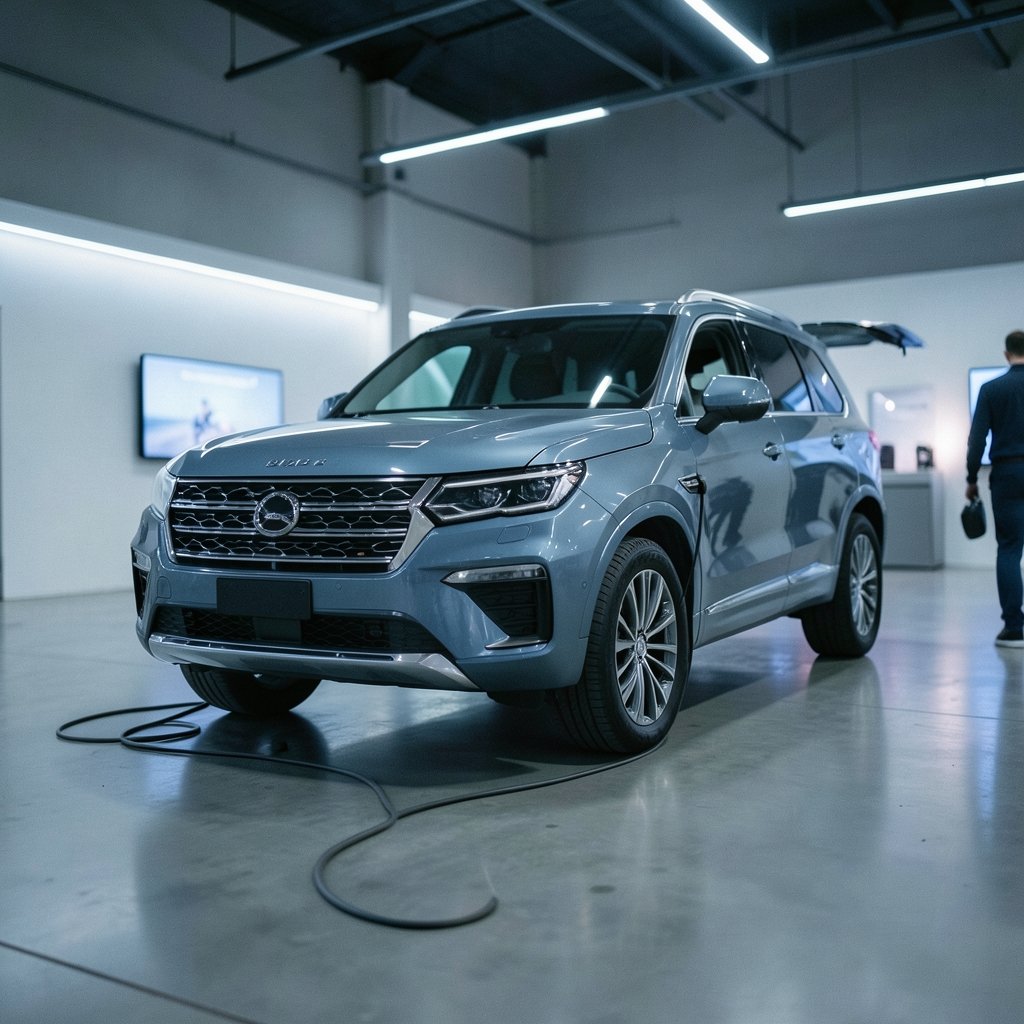
What if the biggest question about the 2027 Audi Q7 isn’t about horsepower, screens, or price at all? What if it’s something far more basic: what, exactly, will it be? A gasoline-powered three-row family hauler, an electric flagship wearing a familiar badge, or both sitting side by side in the same showroom? That single uncertainty shapes almost everything else worth knowing about Audi’s next large SUV.
This article walks through what is genuinely known about the Q7 lineage, what is plausible for 2027, and where the honest answer is “nobody outside Audi can say for certain yet.” If you’re cross-shopping, planning a purchase, or just curious about where Audi is heading, the goal here is to separate signal from speculation.
Why the 2027 Q7 Is Genuinely Hard to Pin Down
Most model-year previews follow a comfortable pattern: new grille, tweaked engines, updated infotainment, done. The Q7 breaks that pattern because Audi spent the mid-2020s rewriting its own naming rules.
The Q7 has been Audi’s full-size three-row SUV since 2005, when the first generation (internally coded 4L) launched. A second generation, 4M, arrived in 2015, and a mid-cycle refresh followed around 2019–2020. That much is settled history. What isn’t settled is what comes next.
Two forces collide here. First, Audi announced a naming convention that assigns even numbers to electric models and odd numbers to combustion models. Under that logic, an electric Q7 would be a contradiction in terms, since “7” signals a combustion vehicle. Second, Audi has publicly signaled that a next-generation Q7 will be fully electric, built on the Premium Platform Electric (PPE) co-developed with Porsche. Both statements can’t be true at once without some clarification Audi hasn’t fully delivered.
The practical result: a buyer searching for “2027 Audi Q7” may be looking at three very different vehicles depending on how the chips fall.
| Scenario | What It Would Mean | Likelihood |
|---|---|---|
| Updated combustion Q7 continues | Familiar V6/V8 and plug-in hybrid lineup, refreshed tech | Plausible |
| Electric successor, possibly renamed | PPE platform, 800-volt charging, new badge | Plausible |
| Both sold side by side | Combustion Q7 plus a separate electric large SUV | Plausible |
None of these can be ruled out with confidence. That’s not a cop-out; it’s the actual state of play.
The Platform Question: MLB Evo vs. PPE

The current Q7 rides on MLB Evo, a platform it shares with the Porsche Cayenne and Lamborghini Urus. That’s a meaningful pedigree. MLB Evo is a longitudinal-engine architecture built for big, heavy, premium vehicles, and it’s why the Q7 drives with a planted, substantial feel rather than the floaty softness some three-row SUVs settle for.
If the 2027 Q7 stays combustion, MLB Evo (or a close evolution of it) is the likely foundation. If it goes electric, the PPE platform is the obvious candidate. PPE underpins the Q6 e-tron and the Porsche Macan Electric, and its headline feature is an 800-volt architecture that supports very fast DC charging. For a family SUV that occasionally does long road trips, that’s a genuinely useful capability rather than a spec-sheet bragging right.
Here’s the practical takeaway for shoppers: the platform determines almost everything you’ll care about day to day. It sets the interior floor height, the ride quality, the charging speed, the towing capacity, and the repair economics. Knowing which platform a 2027 Q7 uses tells you more than any single horsepower figure.
Powertrains: What’s Likely Under the Hood
The current-generation Q7 has offered a spread of engines across markets, including V6 and V8 gasoline units with exhaust-driven forced induction and a plug-in hybrid (TFSI e) variant in some regions. That’s the baseline to reason from.
If a combustion 2027 Q7 appears, expect a similar philosophy: a mainstream V6, a plug-in hybrid for buyers who want electric commuting without charging anxiety, and possibly a performance variant. If an electric Q7 appears, expect PPE-typical hardware: dual motors, all-wheel drive, and rapid charging.
A word of caution about efficiency claims. Plug-in hybrids are notorious for delivering wildly different real-world fuel economy depending on how they’re driven. A PHEV that’s charged nightly and driven mostly on short trips can run largely on electricity. The same vehicle with a flat battery and a heavy right foot can drink fuel like a pure gasoline SUV. Buyers who don’t have reliable home charging should think hard before paying a premium for plug-in capability.
Interior and Technology: Where Audi Usually Delivers
Audi’s reputation for interiors is well earned, and the Q7 has long been one of the better three-row cabins in its class. The second row is genuinely usable for adults, and the third row is best reserved for kids or short trips, which is true of nearly every SUV in this segment.
Expect the 2027 model, in whatever form it takes, to lean heavily on screens and software. That’s where the industry has gone, and Audi has followed. The risk is that more screen area doesn’t automatically mean a better experience. Physical climate controls, for instance, remain easier to operate by touch while driving than nested menus. Buyers should sit in the car and try the interface before committing, rather than relying on a video review alone.
Voice assistants are becoming a bigger part of the story too. Automakers are racing to embed conversational AI into dashboards, and the quality varies enormously. If you want a grounded sense of how good these systems have become and where they still stumble, it’s worth reading comparisons of the best AI chatbots with GPT-5 and Claude under the hood in 2027 to calibrate your expectations before a test drive.
Practical Buying Advice for a Moving Target
Because the 2027 Q7’s identity is unsettled, the smartest approach is to shop the decision, not the badge. Here’s a sequence that works regardless of how Audi resolves the naming question.
- Confirm the model year and on-sale date. Model-year designations vary by market, and a vehicle labeled 2027 may go on sale in 2026. Ask the dealer for the actual production and delivery timeline in writing.
- Get the powertrain in writing. Don’t accept “it’s the new one.” Ask for the engine code, the platform name, and the charging standard if it’s electric.
- Test the third row with your actual passengers. Bring the people who will sit there. Ten minutes of honesty beats a year of regret.
- Check charging reality before choosing a PHEV or EV. Measure your parking situation, your commute, and whether your building or street supports a charger.
- Price the whole ownership picture. Insurance, tires, and servicing on a large premium SUV add up quickly, and EV tire wear in particular can surprise people.
- Verify safety and recall history. Official ratings and recall databases are the only sources worth trusting here.
That last point matters more than most buyers expect. A new model year can carry over unresolved issues from a previous one, and independent recall data is the fastest way to spot patterns.
Cost of Ownership: The Part Brochures Skip
U.S. pricing for recent Q7 model years has started in the roughly $60,000 range, but treat any specific 2027 figure as unconfirmed until Audi publishes it. Beyond the sticker, three costs tend to catch people off guard.
The first is depreciation. Large luxury SUVs historically lose value quickly, and the arrival of a redesigned or electric successor can accelerate that for the outgoing model. If you’re financing, a short lease or a carefully timed purchase may protect you better than a long loan.
The second is tires and brakes. A three-row SUV weighing well over two tons eats consumables. Performance-oriented trims with large wheels and low-profile tires are particularly expensive to keep shod.
The third is software and subscription creep. Features that were once included are increasingly tied to recurring fees. Read the fine print on what’s included at purchase versus what requires a subscription later.
How the Q7 Fits in a Crowded Field
The three-row premium SUV segment is brutal. The Q7 competes against long-established rivals and a growing wave of electric alternatives. Its traditional strengths are a refined ride, a well-finished cabin, and confident all-weather traction. Its traditional weaknesses are a third row that’s tight for adults and a tech interface that asks for patience.
Where the 2027 model lands depends heavily on the platform decision. An electric Q7 on PPE would compete on charging speed and refinement. A combustion Q7 would compete on familiarity and refueling convenience. Buyers who value simplicity may prefer the latter; buyers who value running costs and quietness may prefer the former.
It’s also worth watching how the broader tooling landscape evolves, since the software in your car increasingly connects to the services you use elsewhere. Reviews of the best AI translation tools in 2027, comparing DeepL, ChatGPT and Google, show how quickly these systems improve, and in-car assistants are on the same trajectory.
Common Mistakes Buyers Make
A few patterns show up again and again when people shop large premium SUVs, and they’re worth naming plainly.
Buying on badge loyalty alone is the big one. The Q7 is a strong vehicle, but it isn’t automatically the right one for every family. Seat comfort, cargo shape, and third-row access vary meaningfully across the segment.
Another is over-specifying. Large wheels look great in photos and hurt ride comfort and tire costs in real life. Likewise, the most powerful engine isn’t always the best daily companion; the mid-range option often hits the sweet spot.
A third is ignoring the charging question entirely when considering a plug-in hybrid. As noted earlier, a PHEV without regular charging is mostly just a heavy gasoline vehicle with extra complexity.
Finally, many buyers skip the pre-purchase inspection on used examples and skip the software deep-dive on new ones. Both are cheap insurance. If you’re also shopping digital tools for your household or business while you’re at it, guides like these on the best AI background removers in 2027 for clean, pixel-perfect results follow the same principle: test before you commit.
Conclusion
The 2027 Audi Q7 is less a settled product than an open question, and that’s precisely why it’s worth paying attention to. The Q7’s two-decade history, its MLB Evo bones, and Audi’s pivot toward the PPE platform all point toward a genuinely consequential moment for the nameplate. Whether that moment arrives as a refreshed combustion SUV, an electric successor, or a split lineup remains to be confirmed by Audi itself.
For buyers, the practical path is clear. Verify the powertrain and platform in writing. Test the third row with real passengers. Measure your charging situation honestly. Price the full ownership picture rather than just the sticker. And stay flexible, because the vehicle you read about today may not be the vehicle that reaches showrooms. Patience and verification beat speculation every time.
FAQ
What is the 2027 Audi Q7?
The 2027 Audi Q7 is expected to be the next iteration of Audi’s full-size three-row SUV. However, its exact form is unconfirmed. Audi has signaled that a next-generation Q7 will be fully electric on the PPE platform, while also adopting a naming convention that assigns odd numbers to combustion models. Buyers should verify the powertrain directly with a dealer.
Will the 2027 Q7 be electric or gasoline?
That is the central unresolved question. Audi has publicly indicated a next-generation Q7 will be fully electric, built on the Premium Platform Electric co-developed with Porsche. At the same time, the current Q7 offers V6 and V8 gasoline engines with exhaust-driven forced induction and a plug-in hybrid in some markets. Both an electric successor and a continued combustion model are plausible.
What platform does the Q7 use?
The current-generation Q7 rides on the MLB Evo platform, which it shares with the Porsche Cayenne and Lamborghini Urus. If a 2027 Q7 goes electric, it would likely use the PPE platform, which supports an 800-volt architecture and fast charging, as seen on the Q6 e-tron and Porsche Macan Electric.
How much will the 2027 Audi Q7 cost?
Pricing for the 2027 model year has not been confirmed. Recent Q7 model years in the U.S. have started in the roughly $60,000 range, but buyers should treat any specific 2027 figure as unverified until Audi publishes official pricing. Factor in insurance, tires, and servicing when budgeting.
Is the Q7’s third row usable for adults?
Generally, no. The Q7’s third row is best suited to children or short trips, which is typical for the segment. The second row is genuinely comfortable for adults. Buyers who regularly carry seven adults should test the third row in person before committing.
When will the 2027 Audi Q7 go on sale?
Model-year timing varies by market, and a vehicle designated as a 2027 model may go on sale in 2026. Audi has not confirmed a specific on-sale date for a 2027 Q7. Ask the dealer for production and delivery timelines in writing rather than relying on verbal estimates.