
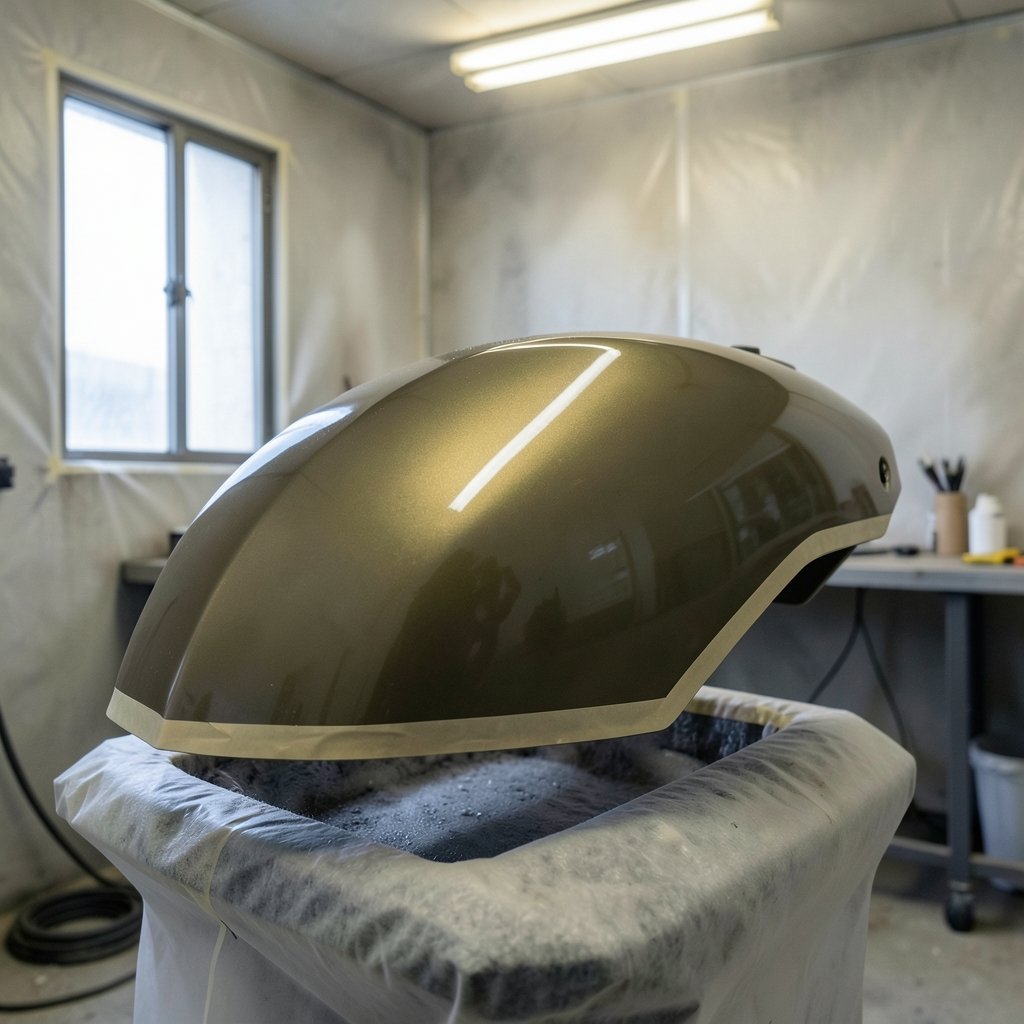
What separates a paint job that still looks wet and glossy five years later from one that turns chalky and dull after two summers? In most cases, the answer sits in the top 50 microns of the finish: the clear coat. And among clear coats, the two-component product known as 2K clear coat is the benchmark that everything else gets measured against. (Cloud storage really means clear definition 2026)
It is also the one that sends people to the hospital when they get careless. That combination of outstanding durability and genuine hazard is what makes 2K worth understanding properly, whether you are spraying a motorcycle tank in a garage or simply deciding what to ask for at a body shop.
What “2K” Actually Means
2K stands for two-component or two-pack. The product arrives as two separate containers: a resin base (the clear itself) and a hardener, which is almost always an isocyanate-based activator. You mix them in a stated ratio shortly before spraying, and from that moment a chemical reaction begins.
That reaction is the whole point. A 1K clear coat cures by solvent evaporation and oxidation; the film hardens because the carrier leaves and the resin slowly reacts with air. A 2K clear cures by crosslinking. The hardener molecules bond the resin chains into a dense polymer network, and the film converts from a liquid into something closer to a thermoset plastic. You cannot re-dissolve a fully cured 2K film back to liquid the way you can with a lacquer.
The practical consequences show up in a table:
| Property | 1K clear coat | 2K clear coat |
|---|---|---|
| Mixing required | No | Yes, base plus hardener |
| Cure mechanism | Solvent evaporation and oxidation | Chemical crosslinking |
| Typical durability | Moderate, product-dependent | Generally higher |
| Chemical and solvent resistance | Limited | Generally strong |
| Sanding and polishing after cure | Possible but risky | Routine and reliable |
| Health hazard during spraying | Lower | Serious, isocyanate-driven |
| Pot life after mixing | Not applicable | Hours, product-specific |
That last row matters more than most hobbyists realise. Once mixed, a 2K clear has a pot life, often measured in hours and always stated by the manufacturer. Use it past that window and you are spraying partially reacted material that may never flow out, may lose gloss, or may fail to adhere. The recoat window works the same way: spray too late without sanding and the next layer will not bite.
Why 2K Clear Dominates Automotive Refinishing

Walk through any professional refinishing shop and the topcoat over the basecoat will almost certainly be a 2K product. The reasons are cumulative rather than dramatic.
UV resistance. Pigmented basecoats are vulnerable to sunlight, and the clear coat is what absorbs that damage. A properly formulated 2K clear is built to hold up under years of exposure, protecting both the colour underneath and its own gloss.
Chemical resistance. Bird droppings, insect remains, tree sap, fuel spills, and road salt all attack paint films. A crosslinked 2K film resists them far better than a softer single-component layer.
Repairability. This is the underrated one. A cured 2K clear can be wet-sanded with fine grit and machine-polished to remove dust nibs, orange peel, and small defects. That means a less-than-perfect spray day is often recoverable rather than a repaint. Anyone who has tried to polish a soft 1K clear and burned straight through it knows the difference.
Film build and gloss retention. 2K clears can be applied at a decent film thickness without solvent popping, and they hold gloss because the crosslinked surface resists the micro-abrasion that dulls softer films.
None of this makes 2K invincible. It is a coating, not armour. But the performance gap over consumer-grade clears is real and consistent.
The Isocyanate Problem Nobody Should Skip
Here is where the tone has to change. The hardener in most 2K clears contains polyisocyanates, and isocyanate exposure is a recognised cause of occupational asthma. Public health and safety bodies treat it as a serious respiratory and skin sensitiser. Sensitisation is not something you build tolerance to; once it happens, even tiny future exposures can trigger a reaction.
The mistake people make, over and over, is assuming a good dust mask is enough. It is not. A standard particulate respirator does not stop isocyanate vapour. Proper protection means a supplied-air respirator or an air-fed full-face hood, used in a ventilated space, with skin covered. Gloves matter too, because isocyanates sensitise through skin contact as well as inhalation.
The second common mistake is spraying in a home garage with the door cracked open and a box fan running. That does not constitute ventilation in any meaningful sense. It moves the vapour around and pushes it into the rest of the building.
A third mistake is mixing more product than you can spray within the pot life “to save time.” It does not save time. It wastes material and produces a worse finish.
If you take one thing from this article, take this: 2K clear is a professional product with a professional hazard profile. The durability is not free.
Surface Prep Decides the Outcome
Almost every 2K clear failure traced back through a repair ends at the same place: the surface underneath. Crosslinking does not compensate for contamination.
Practical steps that actually work:
- Clean, then clean again. Wax, silicone, and polishing residue are the classic culprits. A dedicated prep wipe, changed frequently, beats a single pass with a rag.
- Respect the recoat window of the basecoat. Spraying clear onto a basecoat that has sat far past its window, without scuffing, invites delamination.
- Tack off between coats. Dust nibs are far easier to prevent than to sand out of a fully cured film.
- Control the environment. Temperature and humidity shift flash times and flow-out. Cold product on a cold panel sags; hot product flashes too fast and traps solvent.
- Measure the mix ratio precisely. Eyeballing hardener is the single fastest route to a film that never fully cures. Use graduated cups.
That last point deserves emphasis. An under-hardened 2K clear can feel dry to the touch and still be soft underneath for weeks. It will sand like cheese and never hold gloss. There is no fix except stripping it.
Common Mistakes and What They Cost
A short list of failures that show up again and again, and the reason behind each:
- Spraying too dry. The film looks matte and textured because the droplets partially dried in the air. It needs a wetter pass, closer to the recommended distance, with proper thinner.
- Spraying too wet. Solvent gets trapped, and you get solvent pops, runs, or a film that shrinks back weeks later.
- Ignoring pot life. Material thickens, atomises poorly, and lays down with orange peel that will not flow out.
- Skipping the flash time between coats. Trapped solvent again, this time with a glossy skin on top of a soft layer.
- Polishing too early. A 2K clear that has not fully cured will smear under a rotary polisher rather than gloss up. Waiting longer than feels necessary is almost always correct.
- Assuming “2K in a can” equals a professional 2K. Aerosol products with a breakable hardener cartridge are a clever format, but whether they deliver the durability of a mixed-and-sprayed system is disputed and product-dependent. Treat the claim with caution rather than as equivalence.
There is a broader lesson buried in this list, and it applies well beyond paint. When people search for a fix to a technical problem, they often land on confident-sounding explanations that skip the underlying mechanism. The same pattern shows up in the odd online interest around sportssurge clear look at name behind search, where a search term generates far more speculation than substance. Clear coats at least have chemistry on their side: the mechanism is knowable, and the failures are predictable. (Security camera infrared reflection fix stop glare get clear)
2K Clear in Consumer and Aerosol Form
The consumer market has expanded fast. Two-part clears now come in aerosol cans with an internal hardener vial you break and shake, in small two-part kits with measured mixing cups, and in pre-thinned professional lines sold to anyone with a card.
The aerosol format solves a real problem: you get a chemically curing film without buying a spray gun or measuring anything. For small parts, touch-ups, and one-off jobs, that is genuinely useful. The honest caveats are that the mix ratio is fixed by the can rather than the job, the pot life starts the moment you activate it whether or not you are ready, and the spray pattern is coarser than a gun.
For anything larger than a panel or two, a conventional two-part kit sprayed through a gun gives more control over film build, flash time, and finish quality. It also gives you far more exposure to isocyanate, which loops straight back to the respiratory protection question.
One more consumer-side note: solvent-borne 2K clears fall under volatile organic compound limits in many jurisdictions, and those rules vary. If you are buying in quantity for a project, it is worth knowing what your local supplier is allowed to sell you and why the formulation may differ from what you read about online.
Storage, Shelf Life, and Leftovers
Mixed 2K clear has a short life and cannot be saved. Once the hardener is in, the clock runs. Unmixed components, however, keep well if the containers are sealed properly and stored away from heat and moisture. The hardener is the more sensitive of the two; a hardener that has absorbed moisture from a loosely closed can may cure cloudy or fail outright.
The practical habit: buy the smallest kit that covers the job, decant what you need, and keep the original containers clean and closed. Do not pour unused mixed clear back into the base can. Ever.
Conclusion
2K clear coat earns its reputation the hard way. The two-part chemistry that makes it resistant to UV, solvents, and time is the same chemistry that makes its hardener a serious respiratory hazard, and the same chemistry that punishes sloppy mixing, ignored pot life, and contaminated panels. It is not a product that rewards improvisation.
The good news is that the rules are not secret. Mix precisely, respect the pot life and recoat window, prepare the surface properly, and protect your lungs with supplied air rather than a dust mask. Do those things and a 2K clear will outlast almost any single-component alternative. Skip them and you will get an expensive lesson in polymer chemistry, delivered one sanding block at a time.
Frequently Asked Questions
Is 2K clear coat safe to spray at home?
Not without proper equipment. The hardener contains isocyanates, which are respiratory and skin sensitisers linked to occupational asthma. A dust mask does not stop isocyanate vapour. Safe use requires a supplied-air respirator or air-fed hood, skin coverage, and genuine ventilation. Many experienced people simply leave 2K spraying to a shop for this reason.
How long does 2K clear coat take to cure?
It varies by product, but the pattern is consistent: the film is dust-dry within a short time, handleable sooner than you would expect, and fully crosslinked over a much longer period measured in days. Sanding and polishing should wait until the film has genuinely hardened, not merely until it stops being tacky. Always follow the manufacturer’s data sheet rather than a rule of thumb.
What happens if I get the mix ratio wrong?
If you use too little hardener, the film may feel dry on the surface but stay soft underneath for a long time. It will sand poorly, polish badly, and lose gloss. If you use too much, the film can become brittle or cure with surface defects. There is no reliable fix for an under-hardened film other than stripping it back and starting again, which is why graduated mixing cups are worth the small cost.
Can I put 2K clear over any basecoat?
Usually, but the basecoat has to be compatible and within its recoat window. Spraying clear onto a basecoat that has cured well past its window without scuffing can lead to delamination. Unknown or poorly prepped surfaces, including some factory finishes and cheap rattle-can layers, are a common source of adhesion failure.
What is the difference between 1K and 2K clear coat?
A 1K clear is pre-mixed and cures mainly by solvent evaporation and oxidation. A 2K clear requires mixing a resin with a hardener and cures by chemical crosslinking. The 2K film is generally more durable, more chemical resistant, and more reliably polishable, but it carries a far higher handling hazard and a pot life that limits how long you can work with it.
Is “2K clear in a can” as good as a sprayed two-part system?
It depends on the product, and the claim is genuinely disputed. Aerosol two-part clears do deliver a chemically curing film, which is a real advantage over ordinary rattle-can clear, but the fixed mix ratio, coarse spray pattern, and short activated life make them best suited to small parts and touch-ups. For full panels and durability-critical work, a gun-sprayed kit gives more control.



