
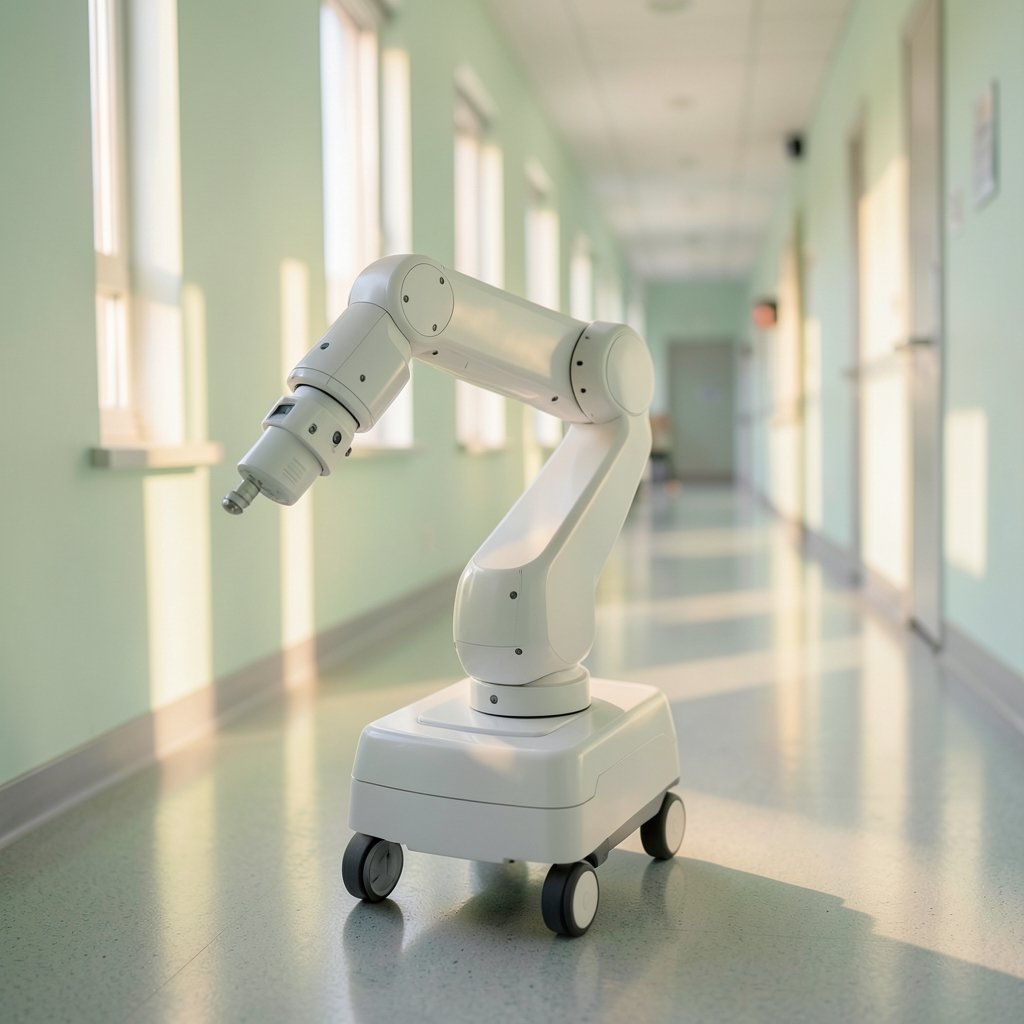
NVIDIA’s CEO Jensen Huang has called physical AI the next wave after generative AI, and the company has staked a large part of its future on the idea. But the phrase hides a real shift: AI that stops typing and starts moving.
Quick Answer: What is physical ai explained?
Physical AI is artificial intelligence built to perceive, reason, and act in the real world, usually inside robots, vehicles, or machines rather than on a screen. In practice, it combines AI models with sensors, simulation training, and hardware so a machine can handle physical tasks without being programmed for each one.
It overlaps with “embodied AI” and “robotics foundation models,” but the terms are not identical. Physical AI emphasizes learning from simulated and real-world data so behavior transfers across tasks, while classic industrial robotics relies on fixed, hand-coded routines.
Before you judge any product or claim in this space, check what the system actually senses, how it was trained (simulation, teleoperation, or real data), how it handles unfamiliar situations, what safety limits exist, and who is accountable when it fails.
The term has spread fast. It shows up in earnings calls, startup pitch decks, and university labs. Yet there is no standards-body definition, so the label can mean anything from a warehouse arm that sorts parcels to a humanoid robot learning to fold laundry. That flexibility is part of its appeal and part of the confusion. This guide separates the substance from the marketing.
Where the Term Comes From and Why It Matters
“Physical AI” gained traction around 2024 as a way to describe AI systems that perceive, reason, and act in the physical world. The framing is attributed to Jensen Huang and NVIDIA, which positioned robotics as the flagship application of a “next wave” after generative AI. Treat the exact first-use date as unverified; the term spread through keynotes and developer materials rather than a formal publication.
The distinction matters because digital AI and physical AI face different constraints. A chatbot that produces a wrong answer wastes a few seconds. A robot that misjudges a staircase or a human hand can cause injury or damage. Physical systems also face latency, battery, wear, and messy sensor data that no language model has to handle.
That is why the field leans so heavily on simulation. Training a robot in the real world is slow, expensive, and sometimes dangerous. Training it in a virtual environment lets engineers run thousands of variations overnight. The hard part is sim-to-real transfer — making sure skills learned in a simulator survive contact with real gravity, friction, and lighting.
How Physical AI Actually Works
Most physical AI systems stack four layers. Understanding them helps you evaluate vendor claims, because weaknesses usually hide in one of them.
| Layer | What it does | Common weak point |
|---|---|---|
| Perception | Cameras, lidar, touch sensors, microphones turn the world into data | Poor performance in glare, dust, or unusual lighting |
| Reasoning | A foundation model interprets the scene and plans actions | Struggles with situations unlike its training data |
| Action | Motors and controllers execute the plan | Precision and safety limits under load |
| Learning loop | Simulation, synthetic data, and real-world feedback improve the model | Sim-to-real gap and scarce real-world data |
The reasoning layer is where recent progress has been dramatic. Vision-language-action (VLA) models take an image, a text instruction, and produce motor commands. Instead of programming a robot for one task, engineers train a model that can generalize. Google DeepMind’s RT-2 work is a well-known example of this approach, and it is documented in published research on vision-language-action models.
Simulation platforms do the heavy lifting on training. NVIDIA’s Isaac Sim and Omniverse tools let developers build digital twins of factories and warehouses, then stress-test robots inside them. The same logic appears in adjacent fields: massive compute and simulation are reshaping biology too, as seen in the Zuckerberg Chan CZI Biohub AI biomedical shift, where AI models accelerate experiments that would take years by hand.
Cloud infrastructure underpins all of it. Training and running these models requires enormous compute, which is why hyperscaler deals matter. The Apple private cloud compute Google cloud arrangement illustrates how even privacy-focused firms now depend on large-scale cloud capacity for AI workloads.
Physical AI vs. Related Terms: What’s the Difference?
The vocabulary is genuinely messy. Vendors use overlapping labels, and no standards body has settled the definitions. Here is a practical way to separate them.
Embodied AI is the academic term for intelligence that arises from a body interacting with an environment. It is broader and older than physical AI.
Robotics foundation models describe the model architecture — large models trained on diverse robot data that can be adapted to new bodies and tasks.
Physical AI is the industry framing that bundles all of this with hardware, simulation, and deployment. It is a marketing-friendly umbrella, not a precise technical category.
Classic industrial robotics relies on fixed programming and structured environments. A welding arm repeating the same motion is not physical AI, even if it is impressive engineering.
The practical test: does the system generalize? If it can handle a task it was not explicitly programmed for, it probably belongs in the physical AI conversation. If every motion is hand-coded, it does not.
Real-World Applications and Honest Limits
Where is this actually being used? The honest answer is narrower than the hype suggests.
Warehouses and logistics are the clearest success story. Picking, sorting, and palletizing robots operate in semi-structured environments where errors are costly but rarely dangerous. This is where commercial deployment is furthest along.
Manufacturing uses physical AI for inspection and adaptive assembly. Vision models catch defects that rule-based systems miss, and robots adjust to slightly varied parts.
Autonomous vehicles are the most mature physical AI category by investment, though full autonomy remains limited to specific regions and conditions.
Humanoid robots attract the most attention and the least deployment. Demonstrations of walking, lifting, and folding are real technical achievements, but general-purpose humanoids in unstructured settings remain early. Claims about mass deployment timelines are often vendor-sourced and should be checked against primary documents.
Healthcare and agriculture are promising but regulated. Surgical assistants and crop-weeding robots face certification and liability questions that slow adoption.
A pattern emerges: physical AI works best where the environment is controlled and the cost of failure is bounded. It struggles where the world is chaotic and mistakes are dangerous. That gap is closing, but slowly.
Practical Tips and Common Mistakes
If you are evaluating physical AI for a business, or just trying to read the news critically, a few habits help.
Ask what data trained the model. Simulation-only training sounds efficient but often fails on real-world edge cases. The best systems blend simulated, teleoperated, and real-world data.
Beware the demo-to-deployment gap. A robot that folds a towel on video may fail on a different towel. Ask how many attempts it took and what the failure rate was.
Check the safety layer. Physical systems need hard limits — force caps, emergency stops, geofencing — that operate independently of the AI model. A model that can override its own safety limits is a red flag.
Watch the total cost. Hardware is only part of it. Integration, maintenance, retraining, and downtime usually cost more than the robot itself.
Distinguish autonomy levels. Remote operation with AI assistance is common and useful, but it is not the same as full autonomy. Vendors sometimes blur this line.
The most common mistake is treating physical AI as a drop-in replacement for existing automation. In practice, it works best as an addition to workflows designed around human variability, not as a swap for a fixed machine. The second most common mistake is underestimating integration time. Pilots that look promising in a lab often take a year or more to reach stable production.
The Economics and the Road Ahead
The investment case is straightforward: labor shortages in logistics, manufacturing, and elder care create demand, and AI models are finally good enough to handle varied tasks. The compute requirements are enormous, which is why chipmakers and cloud providers are positioning themselves early. (Artificial Intelligence)
Capital is flowing in ways that echo other tech cycles. Corporate maneuvering around AI and robotics has become intense, similar to the speculation around the Tesla SpaceX merger and December 6 AGM chatter, where robotics ambitions sit at the center of valuation debates.
For smaller operators, the practical question is not whether to bet on physical AI but where. Start with a narrow, repetitive, low-risk task. Measure failure rates honestly. Scale only after the system proves it handles variation. And keep a human in the loop longer than feels necessary.
Patience is underrated in this field. The technology is real and improving, but the timeline from demo to dependable product is measured in years, not quarters. Anyone promising otherwise is selling something.
Conclusion
Physical AI is best understood as AI that has to deal with gravity. It combines foundation models, simulation, sensors, and hardware so machines can handle physical tasks with some flexibility. The term is industry shorthand rather than a settled technical definition, and that ambiguity invites inflated claims.
The substance is genuine. Warehouses, factories, and vehicles already use these systems, and the underlying models improve every year. The limits are equally real: chaotic environments, safety, cost, and integration time all slow adoption.
If you take one thing away, make it this: judge physical AI by what it does in messy, real conditions, not by what it does in a polished video. That single habit will keep you grounded as the field grows.
Frequently Asked Questions
Is physical AI the same as robotics?
No. Robotics is the hardware and engineering discipline. Physical AI is the intelligence layer — the models that let a robot perceive, reason, and adapt. A robot can exist without physical AI, and physical AI concepts can apply to vehicles or machines that are not robots in the traditional sense. (Artificial intelligence)
Do I need special hardware to use physical AI?
For research and development, yes — sensors, compute modules, and robot platforms are required. For businesses, the practical route is buying integrated systems from vendors rather than building from scratch. Cloud simulation tools let teams prototype before committing to hardware.
Is physical AI safe?
It can be, but safety depends on engineering, not on the AI model alone. Reliable systems use independent safety layers such as force limits, emergency stops, and geofencing. Regulators are still catching up, so buyers should demand clear safety documentation and liability terms.
Why is simulation so important in physical AI?
Training in the real world is slow, costly, and sometimes dangerous. Simulation lets engineers run thousands of scenarios quickly and generate synthetic data. The challenge is sim-to-real transfer — making sure skills learned virtually still work when friction, lighting, and gravity are real.
Will physical AI replace warehouse and factory jobs?
It will change them more than erase them. Repetitive, physically demanding tasks are the most likely to be automated first. Meanwhile, demand grows for technicians who maintain, train, and supervise these systems. The transition will vary widely by region and industry.
How can I tell if a physical AI claim is credible?
Look for specifics: failure rates, number of attempts, training data sources, and independent testing. Vague demos and edited videos prove little. Ask whether the system operates autonomously or with remote human help, and check whether the vendor will share performance data under real conditions.



