Walk into any home-improvement store or scroll through an online marketplace, and you will see a wall of little plastic boxes with glowing screens promising to tell you how “healthy” your air is. Two of the most common types look almost identical, cost about the same, and both light up with numbers. So why do some people swear by a CO2 monitor while others insist an air quality monitor is the smarter buy?
The answer comes down to a simple truth: these two devices measure completely different things, and confusing them is one of the most common mistakes buyers make. A CO2 monitor tracks carbon dioxide as a proxy for ventilation and occupancy. A general air quality monitor usually tracks particulate matter, and sometimes volatile organic compounds, temperature, and humidity. Pick the wrong one and you will spend money on data that does not answer the question you actually have. This guide breaks down the differences, the science, and the practical buying logic so you can match the device to your real situation.
What each device actually measures
Before comparing performance, it helps to be precise about the measurement targets, because the two categories are not defined by any single standard. The term air quality monitor is not a regulated label, and manufacturers use it loosely. That inconsistency is a genuine problem for shoppers, since two devices with the same name on the box can sense entirely different pollutants.
CO2 monitors
A dedicated CO2 monitor measures carbon dioxide concentration in parts per million, almost always using a non-dispersive infrared (NDIR) sensor. These sensors work by shining infrared light through a sample chamber and measuring how much is absorbed by CO2 molecules, which absorb strongly at a specific wavelength. NDIR is a mature, well-understood technique, and a good unit gives you a reliable, meaningful number.
The key point is what that number represents. Indoor CO2 is best understood as a ventilation and occupancy indicator, not a direct measure of toxicity at typical indoor levels. When a room fills with people and fresh air stops flowing, CO2 climbs. When you open a window or crank up mechanical ventilation, it falls. That makes CO2 a wonderfully practical proxy for “is this room getting enough fresh air?” (Introduction to Indoor Air Quality)
Air quality monitors
A general air quality monitor typically measures particulate matter (PM2.5 and often PM10), and many models add volatile organic compounds (VOCs), nitrogen dioxide, temperature, and humidity. The health-relevant star of the show is PM2.5, fine particles small enough to penetrate deep into the lungs and linked to cardiovascular and respiratory effects. According to the World Health Organization, fine particulate matter is among the most consequential air pollutants for human health, which is why so much regulatory attention focuses on it.
Many devices now combine both CO2 and PM sensing in one unit. That sounds like the best of both worlds, and sometimes it is. But as a general rule, combined devices spread their sensor budget across more components, and the quality of each individual sensor can suffer compared with a dedicated unit.
A side-by-side comparison
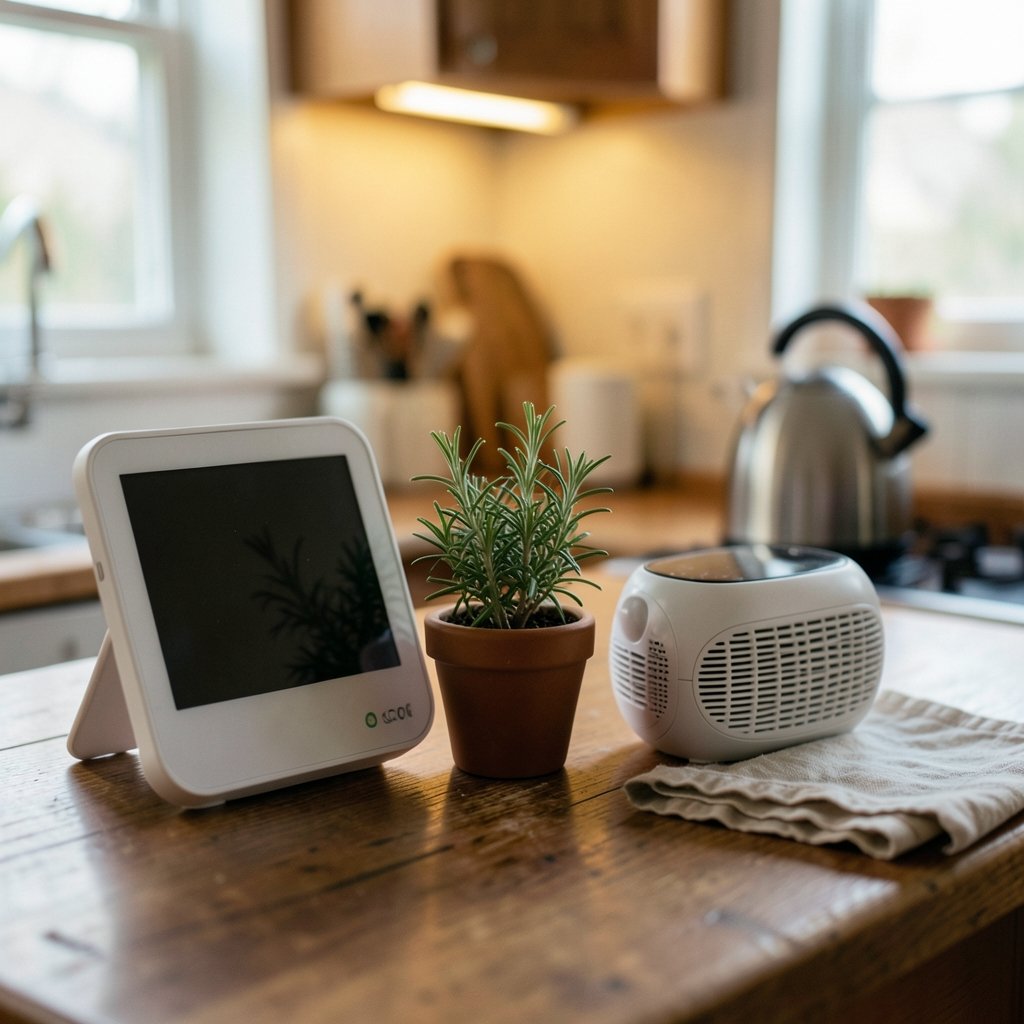
Here is how the two categories stack up on the factors that matter most.
| Feature | CO2 monitor | Air quality monitor |
|---|---|---|
| Primary metric | CO2 in ppm (ventilation proxy) | PM2.5/PM10, often VOCs |
| Typical sensor | NDIR (infrared absorption) | Optical particle counter, MOS gas sensors |
| Best for | Classrooms, offices, bedrooms, meeting rooms | Cooking areas, traffic-facing rooms, wildfire smoke, allergy concerns |
| Main limitation | Does not detect particles or chemicals | PM sensors are sensitive to humidity and particle type |
| Calibration need | Periodic baseline recalibration | Cleaning and occasional recalibration |
| Price range | Moderate | Wide, from budget to premium |
| Answers the question | “Is this room getting fresh air?” | “Is there pollution in this air?” |
The table makes the core distinction obvious. One device answers a ventilation question, the other answers a pollution question. Neither is “better” in the abstract.
Why CO2 is such a useful proxy for ventilation
There is a reason CO2 monitoring has become a staple in schools, offices, and public buildings. Human breath is the dominant indoor CO2 source in occupied rooms, so the concentration rises in near-direct proportion to how many people are present and how little fresh air is being supplied. Outdoor air sits at a global baseline in the low 400s ppm, which gives you a natural reference point.
The practical value is that CO2 tells you something about the building itself. A bedroom that hits 2,000 ppm overnight is not necessarily dangerous, but it is a clear signal that the room is under-ventilated and that stale air, along with whatever else is in it, is accumulating. Fixing ventilation is often the single most effective indoor air improvement a household can make, and a CO2 monitor is the cheapest way to see whether your ventilation is actually working.
Building standards bodies have long treated ventilation as a design requirement rather than an afterthought. The ASHRAE organization maintains widely referenced ventilation standards, and CO2-based demand-controlled ventilation, which uses CO2 readings to modulate fresh-air intake, is a well-established concept in commercial HVAC design. For a homeowner, the takeaway is simpler: CO2 is the metric that tells you whether your space is breathing.
Where air quality monitors earn their keep
If CO2 is the ventilation metric, particulate matter is the pollution metric, and for many households it is the one that matters most for health. An air quality monitor shines in specific scenarios:
- Cooking. Frying, roasting, and especially gas cooking can spike PM2.5 dramatically. A monitor shows you exactly how high and how long it takes to clear.
- Traffic and urban locations. Rooms facing busy roads accumulate fine particles, and a monitor helps you decide when to keep windows shut.
- Wildfire smoke season. When smoke rolls in, a PM monitor tells you whether your indoor air is genuinely protected or whether your air purifier is losing the battle.
- Allergy and sensitivity concerns. Seeing real numbers helps separate a genuine air quality problem from a vague feeling.
The catch is sensor quality. Low-cost optical particle sensors, the kind found in most consumer monitors, are sensitive to humidity and to the composition of the particles themselves. A humid bathroom or a steam-filled kitchen can inflate readings, and different particle types scatter light differently. That does not make the devices useless, but it does mean you should treat the numbers as directional rather than laboratory-grade. The U.S. Environmental Protection Agency maintains extensive indoor air quality guidance that is worth reading before you interpret any single reading as gospel.
The combined-device question
Should you just buy a unit that does everything? Sometimes, yes. A combined monitor is genuinely convenient, and for casual users who want a rough sense of both ventilation and pollution, one device on the shelf beats two devices in a drawer.
But there is a real trade-off, and it is worth stating plainly. Sensor quality varies enormously between models, and a device crammed with five cheap sensors may underperform a device with one excellent sensor. If your primary concern is ventilation in a classroom or home office, a dedicated CO2 monitor with a solid NDIR sensor will usually give you more trustworthy data than a jack-of-all-trades unit at the same price. If your concern is smoke or cooking fumes, prioritize a device with a well-reviewed particle sensor.
The same logic applies to the wider world of displays and monitoring gear: specialization tends to beat generalization at a given price point. That is why people who care about a specific job, whether it is picking the best monitor for PS5 or choosing among the best UHD monitors, tend to research the one spec that matters most rather than trusting a spec sheet stuffed with features. Air monitors reward the same discipline.
Practical tips and common mistakes
A few habits separate people who get real value from their monitor from those who glance at it once and forget it exists.
- Place it at breathing height, away from windows and doors. A monitor sitting right next to an open window will read outdoor air, not your room. A monitor tucked in a corner reads a microclimate. Chest height, central, and away from direct airflow is the sweet spot.
- Give CO2 sensors time to calibrate. Many NDIR sensors use automatic baseline calibration, which assumes the room regularly drops to outdoor levels. If a room is never ventilated, that assumption breaks and readings drift. Follow the manufacturer’s calibration instructions.
- Clean particle sensors. Optical particle counters accumulate dust on their internal optics, and a dirty sensor reads high. A can of compressed air and a few minutes every few months keeps readings honest.
- Watch trends, not single numbers. One reading tells you almost nothing. A rising CO2 curve through the night or a PM2.5 spike when the frying pan comes out tells a story.
- Do not chase perfect numbers. The goal is not a screen full of green lights. The goal is understanding your space well enough to make one or two good changes, like cracking a window or running a hood fan.
The biggest mistake, though, is buying the wrong category entirely. Someone worried about a stuffy, sleepy home office who buys a particle monitor will see reassuringly low PM2.5 numbers and conclude nothing is wrong, while the actual problem, poor ventilation, goes unmeasured. Conversely, someone worried about wildfire smoke who buys a CO2 monitor will learn plenty about ventilation and nothing about the particles filling the air.
Matching the device to your situation
Here is a simple decision framework that cuts through the marketing.
| Your main concern | Better first purchase |
|---|---|
| Room feels stuffy, sleepy, or crowded | CO2 monitor |
| Classroom, meeting room, or shared office | CO2 monitor |
| Cooking fumes, smoke, traffic pollution | Air quality monitor (PM2.5) |
| Allergies or sensitivity to particles | Air quality monitor (PM2.5) |
| General curiosity, tight budget | Combined unit, but check sensor specs |
| Diagnosing a ventilation problem | CO2 monitor |
If you want to go further, think about the broader setup. A monitor is only useful if you act on it, and the actions, opening windows, running exhaust fans, adding a purifier, are what actually change your air. Remote workers who spend all day in one room often pair a CO2 monitor with a comfortable, well-positioned workspace; the same attention to detail that leads people to compare the best portable monitors for remote work applies to the air they breathe for eight hours a day.
The bottom line
A CO2 monitor and an air quality monitor are not rivals so much as different tools for different jobs. CO2 monitoring answers the ventilation question with a reliable, well-understood sensor and is the smarter first buy for anyone dealing with stuffiness, drowsiness, or crowded rooms. Air quality monitoring answers the pollution question and is the better choice when smoke, cooking fumes, traffic, or allergies are the concern. If you can only buy one, start with the question you most need answered, not the device with the longest feature list. If you can buy both, or a well-reviewed combined unit, you get the fullest picture of what is actually floating around your home and whether your space is breathing the way it should.
Frequently Asked Questions
Is a CO2 monitor the same as an air quality monitor?
No. A CO2 monitor measures carbon dioxide concentration, usually with an NDIR sensor, and serves mainly as a ventilation and occupancy indicator. An air quality monitor typically measures particulate matter like PM2.5 and sometimes VOCs, temperature, and humidity. Some devices combine both, but they are measuring different things.
Can a CO2 monitor detect smoke or pollution?
Not directly. CO2 monitors only track carbon dioxide, so they will not tell you whether wildfire smoke, cooking fumes, or traffic particles are present. For those concerns you need a monitor with a particle sensor that reports PM2.5.
What CO2 level should I worry about indoors?
Outdoor air sits in the low 400s ppm. Indoor readings that climb well above that suggest the room is under-ventilated relative to occupancy. Rather than fixating on a single threshold, watch the trend: a steadily rising number in an occupied room means fresh air is not keeping up, and opening a window or improving ventilation is the fix.
Are cheap air quality monitors accurate?
It depends heavily on the model. Low-cost optical particle sensors are sensitive to humidity and particle type, so readings can be inflated or skewed. They are useful for spotting trends and catching spikes, but treat the exact numbers as directional rather than laboratory-grade. Checking independent reviews before buying helps.
Do I need to calibrate these devices?
Usually yes, at least occasionally. Many CO2 sensors rely on automatic baseline calibration and need periodic recalibration per the manufacturer’s instructions. Particle sensors need their optics cleaned, since dust buildup causes high readings. Skipping maintenance is one of the most common reasons people lose trust in a monitor.
Which one should I buy first?
Start with the problem you actually notice. If rooms feel stuffy, sleepy, or crowded, buy a CO2 monitor to assess ventilation. If you are worried about smoke, cooking fumes, traffic, or allergies, buy a particle-focused air quality monitor. If your budget allows and you want the full picture, a well-reviewed combined unit covers both bases.