
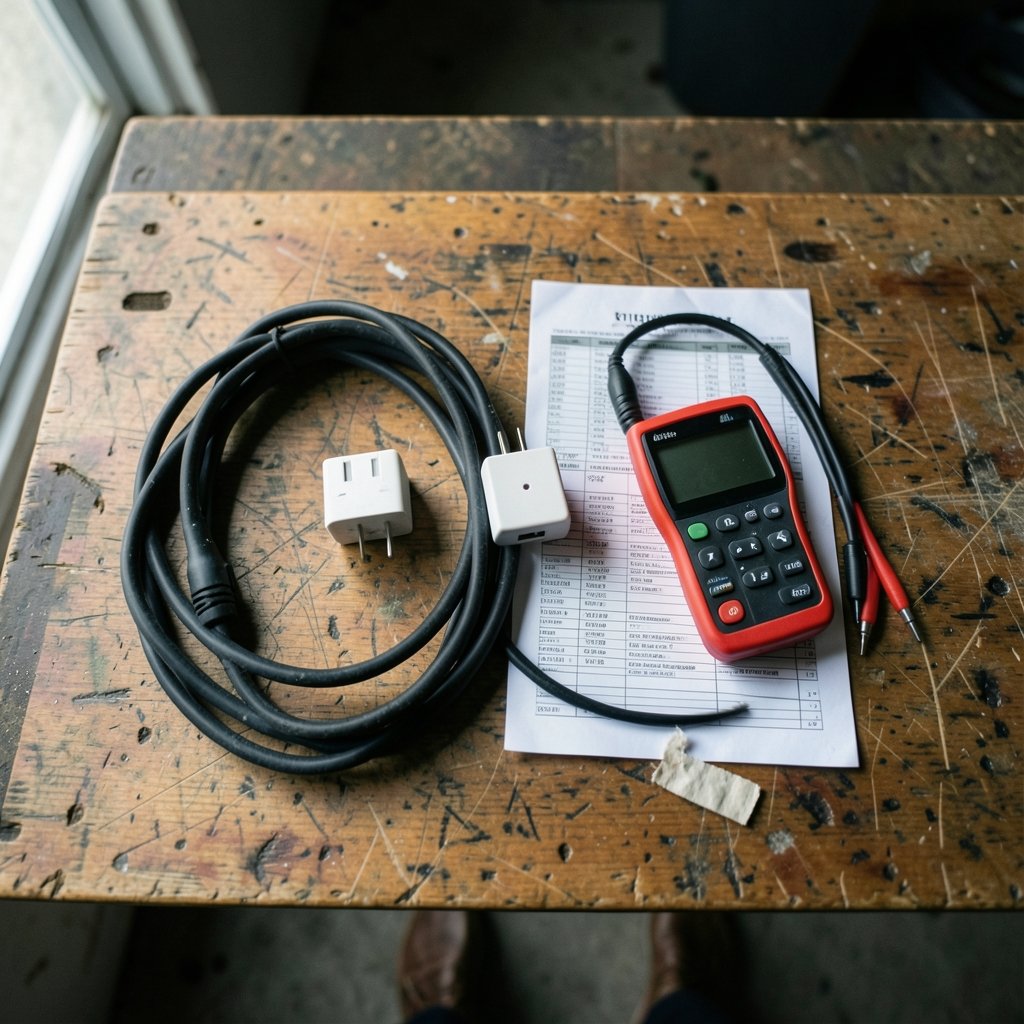
Can a small plug-sized gadget really tell you when the laundry is done, how much each load costs, and whether your washer is secretly guzzling power overnight? Yes, it can, but only if the plug you pick matches the machine you own. A washing machine is not a lamp. It is a motor load with a heating element, sharp current spikes, and long idle stretches. Treat that difference lightly and you end up with a plug that trips, drifts, or quietly dies within a year.
This guide covers what actually matters: load ratings, metering accuracy, the “cycle finished” signal, regional wiring quirks, safety listings, and the mistakes people make most often when they first put a smart plug on a washer.
Why a washing machine is a demanding load for a smart plug
Most smart plugs are built for lamps, chargers, and TVs, which draw a steady few dozen watts. A washer is a different animal. The heating element alone can pull 2,000 watts or more during a hot wash, and the motor adds repeated inrush spikes every time the drum reverses. A common consumer plug rated at 10 to 16 amps may look generous on paper but sit uncomfortably close to the limit once heating and spinning overlap.
The practical rule: check the washer’s rating plate, find the maximum wattage, then buy a plug with real headroom above it, not a plug that merely matches it. Some manufacturers explicitly warn against motor-driven appliances and high-inrush loads, and that warning is worth reading before purchase rather than after a failure.
Voltage matters too. In North America, 120-volt circuits mean a 15-amp plug tops out around 1,800 watts, which can be tight for a hot wash. In the UK and Europe, 230-volt circuits and fused plugs commonly rated at 13 amps give more room, but the plug form factor and fuse arrangement are completely different. Buy the version built for your country, not a gray-market import with the wrong pin layout.
What power monitoring actually tells you

Once a suitable plug is in place, the data it produces is genuinely useful. Three numbers do most of the work:
- Real-time watts show what the machine is doing right now: heating, tumbling, spinning, or sitting idle.
- Cumulative energy in kilowatt-hours shows what a load, a week, or a month has actually cost.
- Power factor or apparent versus true power reveals how trustworthy the readings are, especially at low draw.
That first number is the one people fall in love with. Watching the wattage spike when the heater kicks in and collapse to a few watts at the end of a cycle is oddly satisfying, and it turns a dumb appliance into one you can automate around. The second number is the one that changes behavior, because a family that runs four hot washes a week can often cut their laundry energy bill noticeably just by switching to warm or cold cycles and seeing the difference in the app.
The “cycle finished” signal, and why it is trickier than it looks
The standard automation recipe is simple: when power drops below a threshold for a set number of minutes, send a notification or trigger a routine. In practice, two things break it.
First, standby draw. A modern washer does not drop to zero when it finishes. It keeps a display, a door sensor, and a network module alive, drawing a small but nonzero amount. If you set the threshold at zero watts, the automation never fires. You have to measure the actual standby figure and set the threshold above it.
Second, metering accuracy at low loads. Budget plugs often report apparent power rather than true power, and their accuracy drifts at the bottom of their range. A plug that reads 3 watts when the truth is 1 watt can make your “finished” trigger misfire or miss entirely. Better plugs specify their accuracy, and better automations use a sustained low-power window of several minutes rather than a single instantaneous reading. (AC power plugs and sockets)
A sensible approach is to run one calibration load. Let a full cycle run while logging the wattage, note the peak, the standby floor, and how long the machine sits at the floor before going quiet. Then build the automation around those real numbers instead of guessed ones.
Choosing a plug that survives laundry duty
| Feature | Why it matters for a washer | What to look for |
|---|---|---|
| Load rating | Heating plus motor can approach circuit limits | Clear wattage and amperage rating with headroom |
| Metering type | Distinguishes true power from apparent power | Spec sheet stating watts and accuracy |
| Overload protection | Motor inrush and heater surges stress components | Built-in thermal or current cutoff |
| Safety listing | Insurance and fire safety | Recognized listing mark for your region |
| Connectivity | Automations need a reliable local or cloud link | Stable protocol, offline fallback |
| Physical size | Washers often sit in tight outlets | Compact body, side-facing socket |
The listing mark deserves emphasis. In the United States, look for a recognized testing laboratory mark and check recall databases before buying an unfamiliar brand. In Europe, CE marking and compliance with the low-voltage rules are the baseline. A plug that costs a few dollars less but carries no listing is a false economy on an appliance that runs unattended with water nearby.
If you are already building out a connected home, it helps to standardize on one ecosystem. The same reasoning applies when you are picking best smart speakers for home automation to announce that the wash is done, or when you are comparing something like a washing machine with dryer best brand and want monitoring to carry over to the dryer as well.
Practical setup: a step-by-step that avoids the common traps
- Read the washer’s rating plate. Note maximum watts and confirm the circuit’s breaker size. If the washer is hardwired or on a dedicated 240-volt circuit, a plug-in monitor is not an option at all.
- Check the outlet location. Washers often sit in recessed boxes behind the machine. Measure the clearance before ordering anything bulky.
- Install the plug with the washer switched off, then plug the washer into the plug, not the other way around.
- Run one full cycle while logging data. Record peak watts, standby watts, and cycle length.
- Set your automation threshold above the standby floor, with a sustained window of at least three to five minutes.
- Review weekly energy totals for the first month and compare against your old bills to sanity-check the readings.
- Check the plug’s temperature by touch after the first few hot washes. Warm is normal; hot is a warning sign.
That last step sounds crude, but it catches undersized plugs faster than any app metric. If the plug body is noticeably hot after a hot wash, stop using it for that appliance.
Common mistakes people make
The most frequent error is buying on price and ignoring the load rating. The second is assuming every plug meters accurately; many do not, particularly at the low end. The third is setting the “finished” automation at zero watts and then wondering why the notification never arrives.
Less obvious but equally common: putting the plug on a washer that shares a circuit with other heavy appliances, so the plug’s own overload protection trips during a spin cycle. Another is ignoring regional wiring rules, such as using a plug without the correct fuse in a UK socket. And a surprising number of people forget that some washers lose their cycle memory when power is cut remotely, so switching the plug off mid-cycle does not pause the wash, it cancels it. (Clothes Washers)
It is also worth being honest about what monitoring can and cannot do. It cannot fix a machine that is failing, and it will not save energy on its own. It gives you data, and the savings come from acting on it. The same principle applies across the connected home: a smart device is only as useful as the habit it supports, whether that is a plug on the washer, a best espresso machine for home on a timer, or a best home espresso machine scheduled for the morning. If you are weighing other upgrades, guides like the best nespresso machine and the best home generators follow the same logic: match the device to the real load and the real routine.
Safety, standards, and the fine print worth reading
Mains-powered devices that switch inductive loads sit in a regulated category, not a hobby one. In the United States, the Consumer Product Safety Commission maintains a public recall database that is worth a two-minute check before buying any unfamiliar brand. In Europe, the CE marking regime and the low-voltage rules set the compliance baseline for anything that plugs into a wall socket.
Metering standards matter too. Electricity metering accuracy is covered by international standards, and a plug that claims metering accuracy without referencing any standard is usually guessing. That does not mean you need a laboratory-grade device for a laundry room, but it does mean the spec sheet should say something concrete about how the numbers are produced.
One more piece of fine print: many smart plugs are rated for resistive loads only. A washer is not resistive. If the manual says “do not use with motors or high-inrush appliances,” believe it, even if the wattage looks fine on paper.
When a smart plug is the wrong tool
A plug-in monitor is not suitable for every laundry setup. Hardwired machines, units on dedicated high-voltage circuits, and appliances in commercial or shared laundry rooms are all poor candidates. In those cases, a clamp-on energy monitor at the breaker panel or the machine’s own connectivity features are better routes. It is also worth checking whether the washer already reports cycle status through its own app, which makes a plug redundant.
For the majority of households with a standard plug-in washer on a normal circuit, though, a properly rated smart plug is one of the cheapest useful upgrades in the house. It turns a mute appliance into one that reports its own behavior, and it makes the cost of a hot wash visible in a way that a monthly bill never does.
Conclusion
A smart plug for washing machine power monitoring works well, provided it is chosen for the load rather than the price tag. The winning combination is straightforward: a plug with genuine headroom above the washer’s peak draw, a recognized safety listing, metering that distinguishes true power from apparent power, and an automation threshold set above the machine’s real standby floor. Get those four things right and the payoff is immediate: accurate cycle notifications, a clear picture of what each load costs, and the data to make smarter choices about temperature and timing. Get them wrong and the plug becomes a nuisance at best and a hazard at worst. Read the rating plate, run one calibration cycle, and let the numbers guide the rest.
Frequently asked questions
Can any smart plug handle a washing machine?
No. Many plugs are rated for resistive loads like lamps and chargers and explicitly warn against motors or high-inrush appliances. Check the washer’s maximum wattage against the plug’s rating, and leave real headroom for heating plus spin.
How do I get a notification when the wash finishes?
Set an automation that triggers when power stays below a threshold for several minutes. Measure the machine’s actual standby draw first, then set the threshold above it. A zero-watt trigger almost never fires because washers keep drawing a small amount when idle.
Are cheap smart plugs accurate enough for energy tracking?
Sometimes, but often not. Budget models frequently report apparent power rather than true power and drift at low loads. For cost tracking and reliable cycle detection, look for a spec sheet that states metering accuracy.
Does using a smart plug on a washer save money?
Not by itself. The savings come from what you do with the data, such as switching hot washes to warm or cold, running full loads, and avoiding unnecessary rewashes. The plug makes those choices visible and measurable.
What about 240-volt or hardwired washing machines?
A plug-in monitor is not suitable. Hardwired machines and dedicated high-voltage circuits need a clamp-on monitor at the panel or the appliance’s own reporting features instead.
Is it safe to leave a smart plug on a washer unattended?
With a properly rated, listed plug on a suitable circuit, yes, that is normal use. Check the plug body for excessive heat after the first few hot washes, and stop using it if it runs hot or shows any discoloration.



