
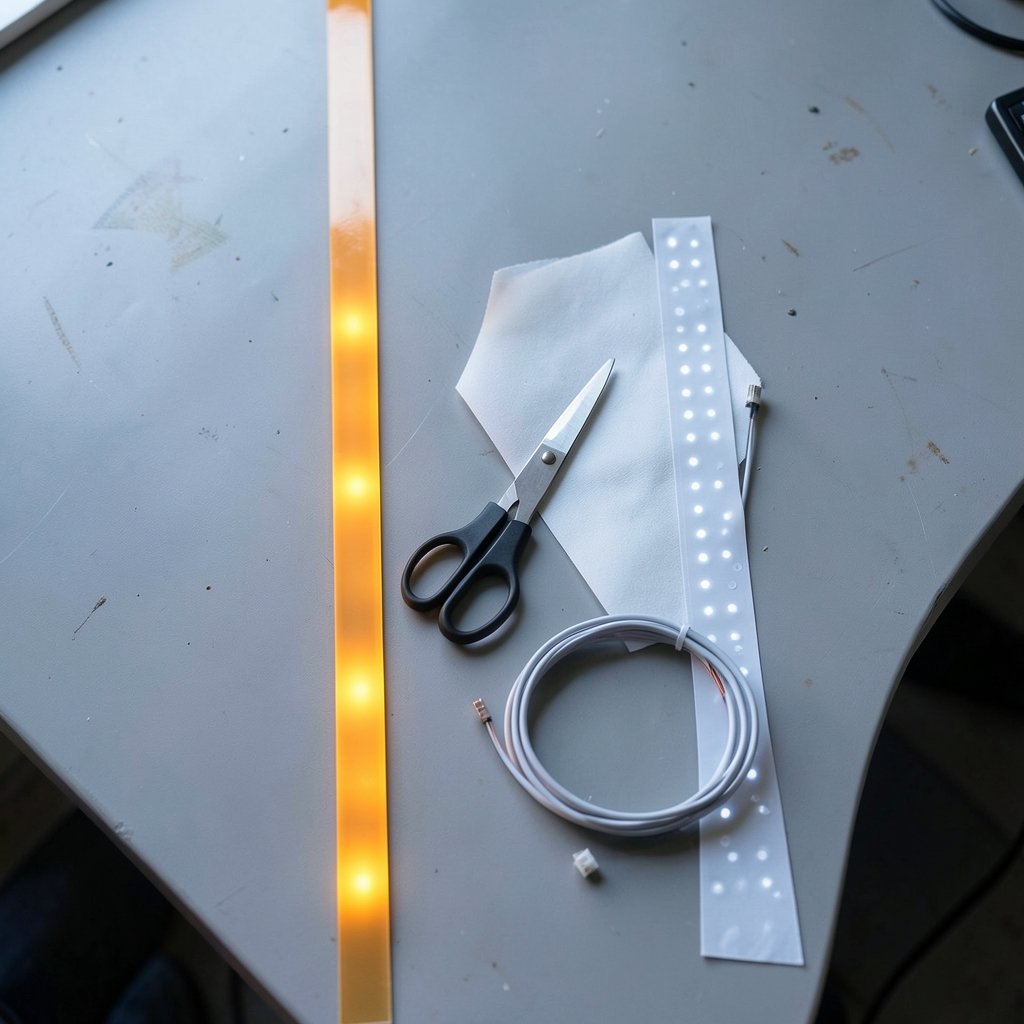
Ever peeled the backing off a cheap LED strip, stuck it under a kitchen cabinet, and then noticed a string of bright dots instead of a smooth glow? That moment of disappointment is exactly where the COB versus SMD debate begins. Both types of strip light are everywhere now, from under-cabinet lighting to gaming setups and campervan builds, and both are sold with confident marketing claims that rarely explain the real differences.
The short version: SMD strips use individual packaged LEDs soldered at intervals, while COB strips mount many tiny LED dies directly on the board under a continuous phosphor layer. That single design difference shapes everything else, including how the light looks, how much you can bend the strip, where you can cut it, and what it costs. This guide breaks down the practical trade-offs so you can pick the right strip the first time instead of the third.
What SMD LED strips actually are
SMD stands for surface-mount device. An SMD strip has discrete LED packages soldered onto a flexible circuit board at regular intervals. The numbers you see in product listings, like 3528, 5050, 2835, and 2216, refer to the physical package size in millimeters. A 5050 LED, for example, measures roughly 5.0 by 5.0 mm.
Because each LED is a separate component, the strip emits light from distinct points. At high densities, say 120 LEDs per meter, those points blur together and look fairly smooth. At lower densities, or when the strip sits close to a reflective surface like a countertop or a glossy floor, you get the classic dotting effect: visible bright spots separated by dimmer gaps.
SMD strips have been the standard format for well over a decade. That maturity shows up in practical ways. Color options are enormous, including single-color, tunable white, RGB, and RGBW variants. Cut points are clearly marked and usually spaced at regular intervals. Connectors, clips, and profiles are widely available because the format is so well established.
What COB LED strips actually are

COB stands for chip-on-board. Instead of packaged LEDs, a COB strip mounts many small LED dies directly onto the board and covers them with a continuous layer of phosphor. The result is a strip that looks like a solid, unbroken line of light. There is little or no visible dotting, even when the strip is mounted just centimeters from a reflective surface.
COB strips pack a very high LED density per meter, which is why the light looks so even. The trade-off is that the format is newer and less standardized. Definitions vary between sellers, and some products labeled COB are simply high-density strips with looser terminology. That inconsistency matters when you are comparing specs across listings.
One practical advantage people notice quickly: COB strips often have shorter or more flexible cut zones, and some can be cut almost anywhere along a marked line. For tight installations, like inside a small display case or around an awkward corner, that flexibility can save a project.
COB vs SMD LED strips: side-by-side comparison
| Feature | COB strips | SMD strips |
|---|---|---|
| Light appearance | Continuous, smooth line | May show visible dots at low density |
| LED density | Very high per meter | Varies widely by product |
| Color options | Growing, but narrower | Very broad, including RGB and RGBW |
| Cut points | Often short or flexible | Fixed, clearly marked intervals |
| Cost per meter | Generally higher | Generally lower at similar output |
| Connector availability | Less standardized | Mature and widely available |
| Heat and efficiency | Depends on the specific product | Depends on the specific product |
A word of caution on that last row. Claims that one format is inherently more efficient or longer-lasting are not reliably supported. Heat output and efficiency depend on the LED bin, drive current, PCB copper thickness, and backing, not on the COB or SMD label itself. Lifetime figures published by manufacturers are per-product, not per-format, so a well-built SMD strip can easily outlast a poorly built COB one.
How the light actually looks in a room
This is where most buying decisions should start. If the strip will be visible, either directly or as a reflection, the smooth output of COB has a real advantage. Think about a strip tucked under a glass shelf, along a stair nosing, or behind a bathroom mirror. SMD dotting is most obvious in these spots because the light bounces off a nearby surface.
If the strip sits inside an aluminum channel with a diffuser, the gap narrows considerably. A decent frosted diffuser over a high-density SMD strip can look nearly as smooth as COB. The catch is that diffusers reduce output, so you may need a brighter strip to compensate. In practice, many installers pair mid-density SMD strips with deep diffusers and get results that satisfy most residential needs.
For accent lighting where the strip itself is the design feature, such as a backlit panel or a cove that washes a wall, COB tends to win on appearance alone. The continuous line reads as intentional rather than as a row of components.
Dimming, flicker, and low-light behavior
Both formats are commonly dimmed using PWM (pulse-width modulation), which switches the LEDs on and off very fast to simulate lower brightness. On SMD strips, low dimming levels can make individual LEDs flicker or drop out unevenly, and the dotting becomes more pronounced as brightness falls.
COB strips often handle low dimming more gracefully because the continuous phosphor layer blends the output. That said, this is product-dependent. A cheap COB strip with a poor driver can flicker just as badly as a cheap SMD one. The driver and dimmer matter at least as much as the strip format, and pairing a quality dimmer with a compatible power supply solves more flicker complaints than switching formats ever will.
Cutting, connecting, and installation realities
Installation is where the two formats diverge in ways that rarely show up in marketing photos.
- Check the cut intervals before you buy. SMD strips have fixed, clearly marked cut lines. COB strips often allow shorter cuts, but the exact spacing varies by manufacturer, so read the datasheet rather than assuming.
- Plan your connectors early. SMD strips have a large selection of clips, corner connectors, and solderless joints. COB strips have fewer connector choices, and some connectors designed for SMD will not grip a COB board properly.
- Match the power supply to the real load. Add up watts per meter times the length, then add a safety margin of around 20 percent. Undersized supplies cause flicker, heat, and early failure regardless of strip type.
- Test the strip before mounting. Unroll it, power it up, and check for even output and consistent color along the full length. Returns are far easier before the adhesive backing is peeled.
- Use aluminum channels for anything permanent. They spread heat, protect the strip, and improve appearance. This applies equally to both formats.
A common mistake is buying a strip based on the cheapest price per meter and then discovering the cut points do not line up with the installation. Measure first, then shop.
Where each format makes the most sense
Choose COB when: the strip will be visible or reflected, you need a seamless line of light, the installation has tight corners or short runs, or you want smooth dimming down to very low levels.
Choose SMD when: you need RGB or tunable color options, you want the widest choice of connectors and profiles, budget is the priority, or the strip will sit behind a good diffuser where dotting disappears anyway.
For travel and outdoor projects, portability and power flexibility often matter more than light quality. A campervan build, for instance, may favor a low-draw SMD strip that runs easily off a 12V system, while a fixed cabin installation might justify COB for the finish. If you are planning a longer journey and want to think through the logistics, these ideas for the best road trip routes in europe are a useful starting point for mapping out where the van will actually go. Closer to home, a weekend build might only need a short trip, so browsing best day trips from london can help you plan a test run before committing to a full fit-out.
What the standards and test data can and cannot tell you
There is no single authoritative body that publishes a COB-versus-SMD comparison. Buyers who want hard numbers have to rely on manufacturer datasheets and standards-based test methods rather than a definitive head-to-head study. Photometric and color measurement standards exist, and LED product test methods cover things like lumen maintenance, but those results apply to specific products, not to a whole format category.
That means two things for shoppers. First, treat format-level claims about lifespan or efficiency with skepticism. Second, ask for per-product data: lumen output, color rendering index, drive current, and thermal specifications. A seller who can provide those numbers is usually a safer bet than one who leads with slogans.
The U.S. Department of Energy’s solid-state lighting program publishes general background on LED technology and efficacy that helps put marketing claims in context, and standards bodies maintain the test methods behind the numbers on datasheets. Neither will tell you which strip to buy, but both help you read a spec sheet without being misled.
Common mistakes that cost money
Buying on price alone and ignoring cut points tops the list. The second most common mistake is skipping the diffuser on a visible installation and then being unhappy with the dotting. Third is underestimating the power supply, which leads to flicker and premature failure. Fourth is mixing strips from different production batches on one run, which can produce visible color shifts between sections.
Finally, many buyers assume COB is automatically better because it is newer. It is not automatically better; it is different. For a hidden installation behind a diffuser, a good SMD strip can deliver the same visual result for less money. For a visible, design-forward installation, COB earns its premium.
Conclusion
The COB versus SMD question does not have one right answer, and anyone who tells you otherwise is probably selling something. COB strips win on smooth, continuous light and flexible cut points, which makes them ideal for visible installations and tight spaces. SMD strips win on color variety, connector availability, and cost, and they perform beautifully when paired with a decent diffuser.
Start with where the strip will live and whether anyone will see it directly. Then check the cut intervals, budget for a properly sized power supply, and insist on real per-product specifications rather than format-level marketing claims. Get those basics right, and either format will do the job well.
FAQ
Is COB LED strip better than SMD?
Neither is universally better. COB produces a smoother, dot-free line of light and often allows shorter cut points, which suits visible installations. SMD provides more color choices, more connector choices, and lower cost. The right choice depends on whether the strip will be seen and what your budget allows.
Why do SMD LED strips show dots?
Each SMD LED is a separate package soldered at intervals, so light comes from distinct points. At low densities, or when the strip sits close to a reflective surface, those points remain visible as bright spots. Higher-density strips and frosted diffusers reduce or eliminate the effect.
Are COB LED strips more energy efficient?
Not inherently. Efficiency depends on the specific LED bin, drive current, circuit board design, and backing, not on whether the strip is COB or SMD. Compare lumen output per watt on individual product datasheets rather than assuming one format is more efficient.
Can I cut COB LED strips anywhere?
Often the cut zones are shorter than on SMD strips, but the exact spacing varies by manufacturer. Some COB strips can be cut at almost any marked point, while others have fixed intervals. Always check the product datasheet or the markings on the strip itself before cutting.
Do COB strips need a diffuser?
They benefit from one for protection and heat spreading, but they do not need a diffuser to look smooth. That is one of their main advantages. SMD strips, by contrast, often rely on a frosted diffuser to hide dotting in visible installations.
Which strip type is better for a campervan or off-grid setup?
It depends on your power budget and how visible the strip will be. SMD strips are widely available in 12V versions with low power draw and a huge range of connectors, which suits mobile builds. COB strips work well where you want a clean line of light along a ceiling or cabinet edge and can spare the slightly higher cost.



