
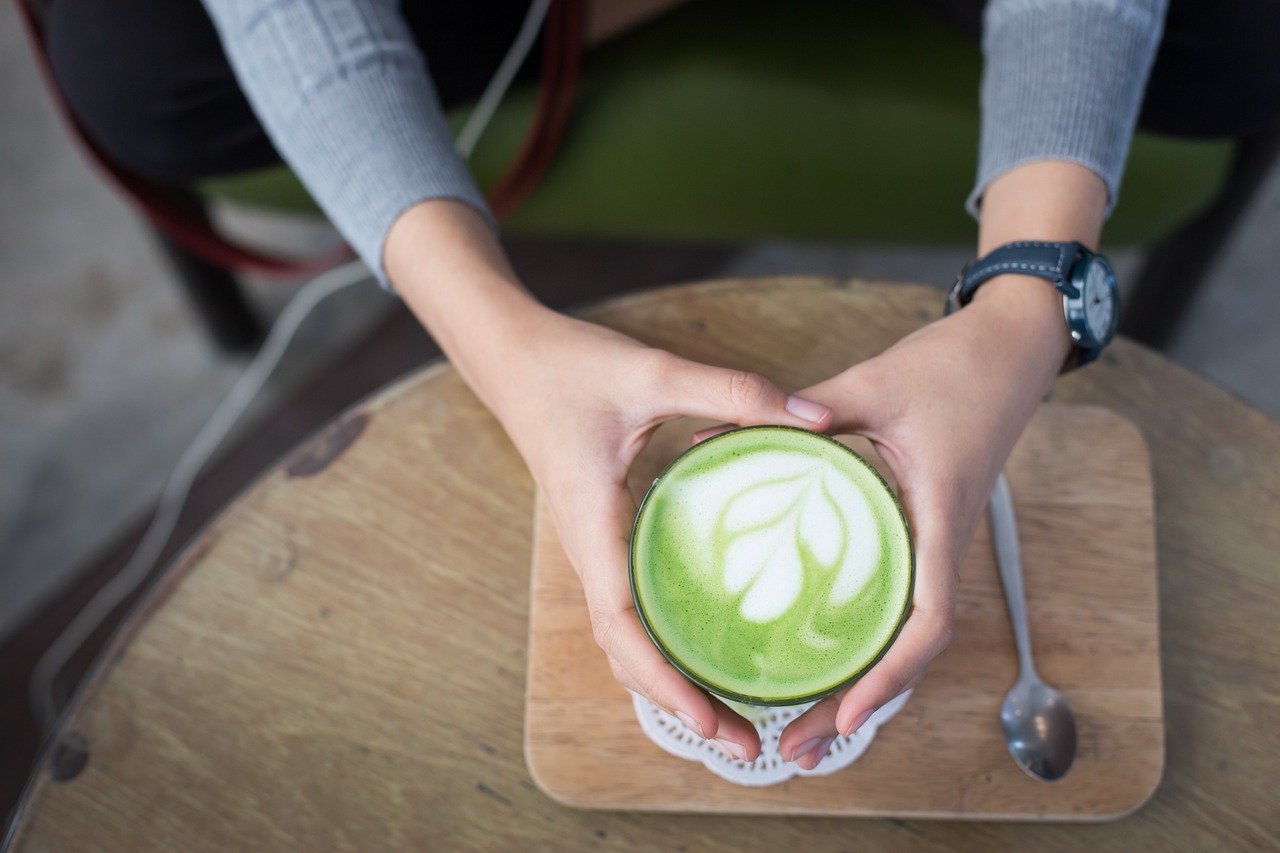
What if the difference between a grassy, bitter cup and a silky, sweet one came down to two numbers: water temperature and matcha-to-liquid ratio? That is basically the whole game. Most people who try a homemade matcha latte once and never again made one of two mistakes. They poured boiling water straight onto the powder, or they used so little matcha that the drink tasted like warm milk with a green tint. (Matcha)
The good news is that a proper matcha latte is genuinely easy once the mechanics are clear. It needs no espresso machine, no special milk steamer, and no barista course. It needs a bowl, a whisk, a kitchen scale, and about five minutes. This guide walks through the equipment that actually matters, the ratios that work, the temperature rule, and the fixes for the problems people hit most often. It also covers iced versions, dairy versus plant milk, and how to make the whole thing a daily habit rather than a one-off experiment.
What Is a Matcha Latte, Exactly?
A matcha latte is powdered green tea whisked into hot water and then combined with milk, usually with a sweetener. That is it. The powder itself is made from shade-grown tea leaves that are steamed, dried, and stone-ground into a fine dust. Because the whole leaf is consumed rather than steeped and discarded, the flavor is more concentrated and more vegetal than a standard green tea.
The drink splits into two parts that behave very differently. The matcha base, sometimes called usucha (thin tea), is a small volume of whisked tea. The milk is the bulk of the cup. Most disappointing homemade lattes fail at the base stage, and no amount of good milk rescues a badly whisked base.
One clarification worth making early: a matcha latte is not the same as traditional Japanese tea ceremony preparation. Ceremonial preparation uses only water, and the thick version, koicha, uses a far higher concentration of powder with no milk at all. The latte is a modern café invention that borrowed the whisking technique and then added dairy. Treating it as a casual drink rather than a ritual is fine, and it removes a lot of the intimidation.
The Equipment That Actually Matters

Matcha has a reputation for requiring fancy gear. Most of it is optional. Here is an honest breakdown of what earns its place on the counter and what does not.
| Item | Needed? | What it does | Practical note |
|---|---|---|---|
| Fine-mesh sieve | Yes | Breaks up clumps | The single biggest upgrade for beginners |
| Small bowl | Yes | Holds the base for whisking | A cereal bowl works; wide and shallow beats tall and narrow |
| Kitchen scale | Yes | Measures powder by weight | Volume scoops vary wildly between brands |
| Bamboo whisk (chasen) | Recommended | Creates foam and dissolves powder | A milk frother works; a fork does not |
| Whisk holder (naoshi) | Optional | Keeps the tines straight | A small cup does the same job |
| Milk frother | Optional | Adds texture to the milk | A jar with a lid and 20 seconds of shaking is a fine substitute |
| Sifter or strainer | Yes | Same job as the sieve | A tea strainer with fine mesh is enough |
Two of these are non-negotiable in practice: the sieve and the scale. Skipping the sieve leaves small dry pockets of powder that no amount of whisking fully dissolves, and they surface as bitter specks at the bottom of the cup. Skipping the scale means guessing, and guessing is why one batch tastes perfect and the next tastes like a lawn.
If the kitchen-gadget side of this appeals, the same match-the-tool-to-the-job logic applies to other home upgrades, like choosing between a purifier and a dehumidifier for dust or damp. The principle is identical: buy for the problem you actually have.
The Ratios That Work
Matcha is expensive enough that wasting it stings, and weak enough that under-dosing ruins the drink. A reliable starting point for a standard 8-ounce (240 ml) latte is:
- Matcha powder: 1.5 to 2 grams, roughly 1 level teaspoon
- Hot water for the base: 60 to 75 ml (about 2 to 2.5 ounces)
- Milk: 150 to 180 ml, depending on how strong you like it
- Sweetener: 1 to 2 teaspoons of honey, maple syrup, or simple syrup, to taste
That base concentration matters more than people expect. The water is not there to dilute the drink; it is there to dissolve the powder into a concentrate that then gets softened by milk. Too much water in the base and the matcha flavor goes flat. Too little and the powder never fully hydrates.
A quick way to remember the structure: a small strong base, a large gentle pour. Once the base is right, the milk quantity becomes a personal preference rather than a correctness issue.
Adjusting for Strength
| Preference | Matcha | Water | Milk |
|---|---|---|---|
| Light and milky | 1.5 g | 60 ml | 200 ml |
| Balanced (default) | 2 g | 70 ml | 160 ml |
| Strong, café-style | 2.5 g | 75 ml | 140 ml |
| Extra strong, low milk | 3 g | 80 ml | 100 ml |
Weigh the powder once at each setting and note how it tastes. After two or three tries, most people settle on a fixed number and stop measuring the milk at all.
Step by Step: The Hot Matcha Latte
- Heat the water to about 80 °C (175 °F). Boiling water is too hot and pushes the drink toward bitterness. If there is no thermometer, boil the kettle and let it sit for two to three minutes, or pour it between two cups once to knock the temperature down.
- Sift the matcha into a dry bowl. Hold the sieve a few centimeters above the bowl and tap it gently. This takes fifteen seconds and prevents the most common failure.
- Add a splash of the hot water first and whisk into a paste. A small amount of water at this stage wets the powder evenly. Whisk in small zigzag motions, not circles, until the paste is smooth and lump-free.
- Add the remaining water and whisk briskly for 15 to 20 seconds. Move the whisk in a tight W or M pattern across the bottom of the bowl. The goal is a fine layer of foam and no powder clinging to the sides.
- Warm and froth the milk. Heat it gently on the stove or in the microwave, then froth it. For a low-tech version, fill a lidded jar one-third full, shake hard for 20 seconds, and microwave the jar for 30 seconds.
- Pour the milk into the base, not the other way around. Pouring milk into the whisked tea preserves the foam layer. Add sweetener and stir once gently.
- Taste before adding more matcha. If the drink tastes weak, the fix is usually more powder in the base next time, not more powder stirred into a full cup, which clumps.
The paste step in step three is the one most recipes skip and the one that separates a smooth cup from a gritty one. It costs ten seconds.
Why Temperature Changes Everything
Bitterness in matcha is mostly an extraction problem. Hotter water pulls more of the compounds responsible for astringency out of the powder faster. Because matcha is a suspension rather than an infusion, there is no way to remove the leaves once they have given up too much, so the bitterness stays in the cup.
The practical rule: keep the water at or below about 80 °C. A kettle boiled and rested for two to three minutes lands close enough. An instant-read thermometer removes all doubt for the first few attempts, and after that most people can judge it by the sound of the kettle and the feel of the cup.
Milk temperature matters too, though less dramatically. Scorched milk tastes cooked and slightly sweet in the wrong way, and it kills foam. Heat milk to steaming but not simmering, and stop before bubbles form around the edge of the pan.
Iced Matcha Lattes and Cold Versions
An iced matcha latte follows the same logic with one change: the base is whisked with a smaller amount of water, because melting ice will dilute the drink anyway.
Use 2 grams of matcha with just 50 ml of water, whisk to a smooth paste, then pour over a glass packed with ice and top with 150 ml of cold milk. Sweetener dissolves better if it goes into the warm base before the ice arrives. A cold-frothed milk, shaken in a jar with no heating, gives a lighter foam that holds up better over ice than warm foam does.
One trap with iced versions: cold water does not dissolve matcha well at all. The powder clumps and sinks. Always build the base with warm water, even when the final drink is served cold.
Dairy, Plant Milk, and Sweeteners
Milk choice changes the drink more than most people expect, because matcha is assertive and the milk needs enough body to meet it.
| Milk | Texture | Flavor effect | Best for |
|---|---|---|---|
| Whole dairy | Rich, thick foam | Rounds off bitterness | Traditional café style |
| Oat (barista) | Creamy, stable foam | Slightly sweet, mild | Best all-round plant option |
| Soy | Medium body | Neutral, faintly beany | Everyday drinking |
| Almond | Thin | Can taste watery | Light, low-calorie versions |
| Coconut | Thin, distinct | Adds its own flavor | Iced drinks with tropical notes |
| Skim dairy | Thin | Highlights bitterness | Not recommended |
Barista-style oat milk is the plant option that behaves most like dairy, mainly because of added fats and stabilizers that help it foam. Regular oat milk works but produces a flatter layer.
On sweetness: honey and matcha pair well because honey’s floral notes sit alongside the tea’s grassiness rather than fighting it. Maple syrup is warmer and heavier. Simple syrup is neutral and dissolves instantly, which makes it the best choice for iced drinks. Start with one teaspoon and add from there; a drink that is too sweet masks the tea entirely, and good matcha is too expensive to hide.
Common Mistakes and How to Fix Them
Clumps at the bottom of the cup. Always the sieve, or always the paste step. Fix both.
A bitter, chalky taste. Water too hot, or too much powder for the volume of liquid. Drop the temperature and check the ratio.
No foam. The whisk was moved in slow circles. Speed and a zigzag motion are what build foam, not pressure.
A weak, grayish drink. Under-dosing. A level teaspoon of matcha is lighter than most people assume, which is why a scale beats a spoon.
Gritty texture even after whisking. Some powders are simply coarser. A finer grind dissolves more readily, and sifting becomes even more important with a coarse one.
A drink that tastes metallic. Usually old powder. Matcha degrades with light, heat, and air, so store it sealed in the fridge and use it within a couple of months of opening.
There is a broader lesson in these fixes that carries over to other everyday tech decisions: matching the tool and setting to the actual job beats buying more equipment. The same reasoning shows up when people work out which Zapier alternatives fit a specific workflow instead of stacking subscriptions, and when beginners compare Notion alternatives that match simpler tools. Fewer, better-matched tools win almost every time.
Making It a Daily Habit
The people who drink matcha every day tend to simplify ruthlessly. They weigh the powder once, keep the sieve next to the bowl, and stop measuring the milk. A few practical shortcuts make the routine stick:
- Pre-sift a week’s worth of matcha into a small airtight jar. It saves the daily sieve step and costs nothing in quality if the jar is sealed and kept cool.
- Batch the sweetener. Keep a small squeeze bottle of simple syrup in the fridge.
- Use a frother for both jobs. A handheld milk frother can whisk the base and froth the milk, which removes the bowl and whisk entirely on busy mornings.
- Keep a second, cheaper powder for experiments. Save the good stuff for the cup you actually drink.
One more habit note: matcha contains caffeine, roughly in the range of a cup of coffee depending on how much powder is used, along with L-theanine, an amino acid that appears to soften the jittery edge of caffeine. That combination is a big part of why people switch from coffee to matcha in the first place. Anyone sensitive to caffeine should treat an evening matcha latte the same way they would treat an evening espresso.
Conclusion
A good matcha latte comes down to a handful of decisions made in the right order. Sift the powder. Weigh it rather than scooping it. Keep the water below boiling. Whisk a small, strong base before the milk ever enters the bowl. Choose a milk with enough body to stand up to the tea, and sweeten with a light hand.
None of this requires special skill, and almost none of it requires special equipment. The sieve and the scale do most of the work, and the temperature rule handles the rest. Start with 2 grams of matcha, 70 ml of water at 80 °C, and 160 ml of milk. Taste it, adjust one variable at a time, and within a week the measuring stops and the drink becomes automatic. That is the real goal: not a perfect café replica, but a cup that is good enough to make again tomorrow without thinking about it.
Frequently Asked Questions
What is the best water temperature for a matcha latte?
Around 80 °C (175 °F) is the sweet spot. Water at a full boil extracts more astringent compounds and makes the drink taste harsh and bitter. If there is no thermometer, boil the kettle and let it rest for two to three minutes before pouring.
How much matcha should go into one latte?
About 1.5 to 2 grams, which is roughly one level teaspoon, for a standard 8-ounce drink. A kitchen scale is worth using because teaspoon scoops vary a lot between brands and between different grinds. For a stronger café-style cup, move up to 2.5 grams and reduce the milk slightly.
Can you make a matcha latte without a bamboo whisk?
Yes. A handheld electric milk frother works well and is faster for most people. A jar with a tight lid and 20 seconds of hard shaking also does a decent job. A fork or a spoon does not, because neither creates enough agitation to break up the powder and build foam.
Why does a homemade matcha latte taste bitter?
Three usual causes: water that is too hot, too much powder for the amount of liquid, or unsifted powder leaving dry clumps that never fully dissolve. Fix the temperature first, then check the ratio, then make sifting a habit.
Is ceremonial grade matcha necessary for a latte?
Not strictly. Ceremonial grade is milder and sweeter, which suits drinking with just water, while culinary grade is stronger and holds up better against milk and sweetener. Many people find a mid-range powder the best value for lattes, since the milk softens the differences that matter most in plain tea.
How do you make an iced matcha latte without clumps?
Whisk the matcha into a small amount of warm water first, using about 50 ml, until it forms a smooth paste. Then pour it over a glass of ice and add cold milk. Cold water alone will not dissolve matcha properly, which is why the base is always built warm even when the drink is served cold.



