Can a few potted plants really clean the air in your home? It is one of the most repeated claims in houseplant culture, and it feels true. Plants take in carbon dioxide and release oxygen. They look fresh and alive. Surely they must do something for the air.
They do, but almost certainly far less than the popular lists suggest. This article walks through what the research actually shows, which plants appear on nearly every “best” list, where those lists came from, and how to think about plants as part of a realistic indoor air strategy rather than a replacement for one.
Where the “plants clean your air” idea came from
The story starts with a NASA study from 1989 titled “Interior Landscape Plants for Indoor Air Quality Abatement.” Researchers placed plants in small sealed chambers and measured how much of certain volatile organic compounds, or VOCs, disappeared. Compounds like benzene and trichloroethylene did decline. The results were real.
The problem is the setup. Those chambers were tiny, the exposure times were long, and the conditions did not resemble a bedroom or a living room with doors, windows, draughts and normal air exchange. A sealed glass box is about as far from a real room as a laboratory gets. Yet the headline “NASA says plants clean your air” traveled around the world and never really stopped.
The 2019 review that changed the conversation
Three decades later, two researchers decided to check whether the numbers added up at building scale. Their review, published in the Journal of Exposure Science & Environmental Epidemiology, analyzed reported VOC removal efficiencies from potted plants and compared them with how quickly air normally moves through a building.
The finding was blunt: typical VOC removal by potted plants is orders of magnitude slower than normal air exchange. In plain terms, the air in your room replaces itself far faster than a plant can clean it. The authors concluded that potted plants are not an effective way to improve indoor air quality. You can read the full analysis of why potted plants do not meaningfully clean indoor air in the published review.
There is a second, more practical way to see the problem. To match the air-cleaning effect of ordinary ventilation, you would need somewhere between hundreds and thousands of plants per square meter of floor space. Not per room. Per square meter. No apartment has ever been that lush.
Why leaf area is not the whole story
Here is a detail most plant lists skip. Much of the VOC removal measured in lab studies is attributed not to the leaves but to microorganisms in the potting soil and root zone. The soil is doing a lot of the work.
That matters for two reasons. First, it means “buy the plant with the biggest leaves” is not a sound strategy. Second, it means the soil is also where moisture sits, and wet soil in a warm room is exactly the condition mold likes. More on that below.
The plants that appear on every list
None of this means the usual suspects are bad plants. They are popular because they are tough, forgiving and widely available. Here is how the most-cited “air quality” plants actually compare as houseplants, setting the air-cleaning claims aside.
| Plant | Light needs | Watering | Realistic difficulty | Notes |
|---|---|---|---|---|
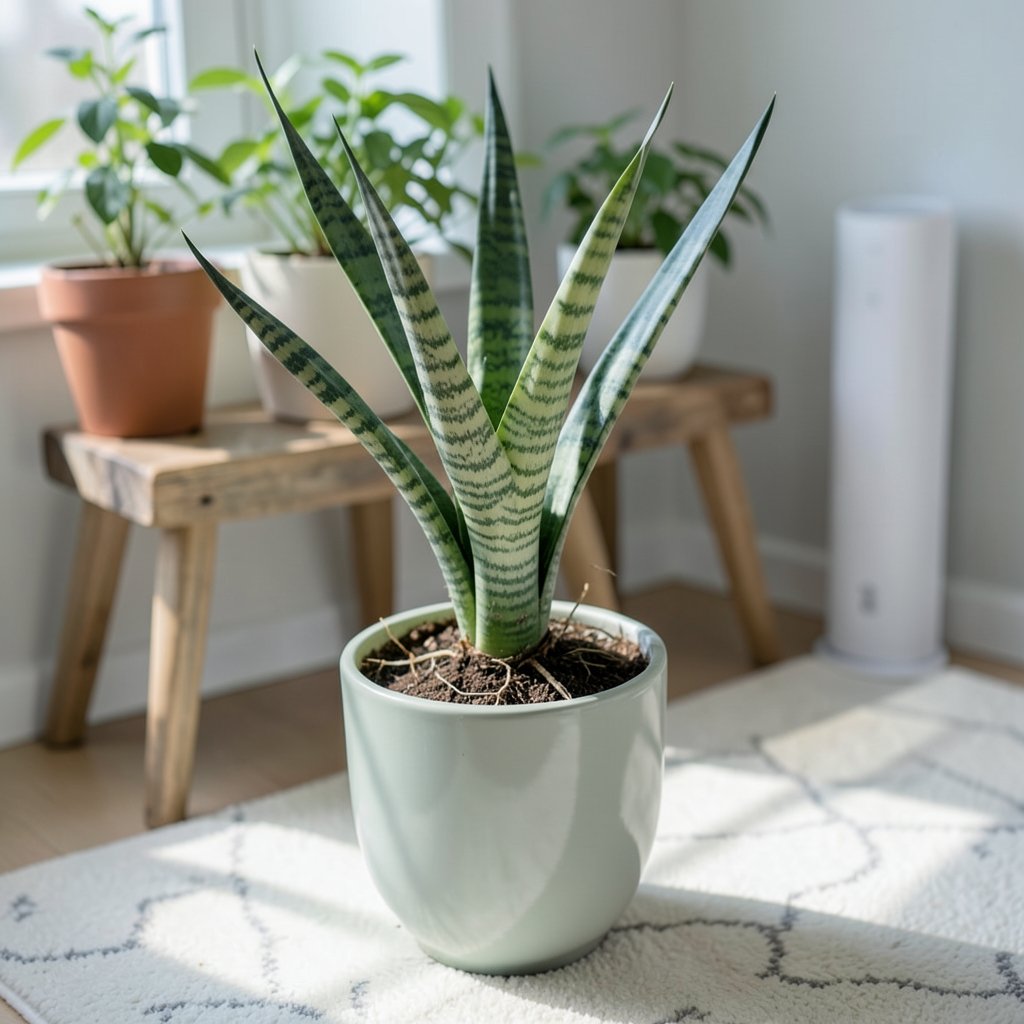
| Snake plant | Low to bright indirect | Very little, let soil dry fully | Very easy | Tolerates neglect and low light; slow grower |
| Peace lily | Medium indirect | Moderate, likes slight moisture | Easy to moderate | Droops visibly when thirsty; toxic if eaten |
| Spider plant | Bright indirect | Moderate | Very easy | Fast grower, produces plantlets freely |
| Pothos | Low to bright indirect | Low to moderate | Very easy | Tolerates almost anything; toxic if eaten |
| English ivy | Bright, cooler spots | Moderate | Moderate | Prone to spider mites indoors |
| Rubber plant | Bright indirect | Moderate | Easy | Large leaves, can outgrow a small room |
| Boston fern | Bright indirect, humid air | High, never let dry out | Harder than it looks | Wants humidity most homes do not have |
If the goal is a plant that survives real life, the snake plant, pothos and spider plant earn their reputation. If the goal is a plant that survives while also looking good in a dim corner, the snake plant is hard to beat.
What plants genuinely do for a room
So if they are not air filters, why keep them? There are honest answers.
Plants add visual softness, give a room a sense of care, and give people something to look after. Many people find tending them calming. That is a real benefit even if it is not a measurable air quality one. Plants also raise humidity slightly through transpiration, which can feel pleasant in dry winter air, though it is a small effect and not always welcome.
What plants do not do is replace ventilation, filtration or source control. Those three are the levers that actually move the needle on indoor air. Official guidance on improving indoor air quality consistently puts source control and ventilation first: open windows, run exhaust fans, use mechanical ventilation where available, and remove or seal the things that are emitting pollutants in the first place.
Formaldehyde: the pollutant people worry about most
Formaldehyde is the indoor pollutant that gets the most attention, and for good reason. It comes from pressed-wood furniture, some fabrics and combustion, and health agencies classify it as a known human carcinogen. The National Cancer Institute’s formaldehyde fact sheet explains the health effects and how the classification was reached.
Plant lists often claim specific species “remove formaldehyde.” Given the scale problem described above, the honest version is that a plant removes a tiny amount, slowly, and the room’s air exchange removes far more, far faster. If formaldehyde is a concern, the useful moves are choosing low-emission furniture, ventilating well and keeping indoor humidity in check. Not buying a second peace lily.
The risks plant lists leave out
Two real downsides rarely make it onto “best air quality plants” articles.
Toxicity. Several common houseplants are toxic if eaten, including dieffenbachia and some lilies, which are dangerous to cats. If there are pets or small children in the house, check before buying. The ASPCA’s toxic and non-toxic plants database lets you search by plant name and see which animals are at risk.
Mold and humidity. A dense collection of plants, especially if overwatered, can push indoor humidity up and encourage mold growth. Mold is itself an indoor air quality problem, so a plant habit that creates damp conditions can work against the goal. The EPA’s mold guidance explains how moisture control prevents mold and why fixing the water source matters more than cleaning the visible patches.
The practical rule: use pots with drainage, empty the saucers, do not overwater, and keep plants out of already-damp rooms like windowless bathrooms.
How to actually improve indoor air
If clean air is the goal, here is what works, roughly in order of impact.
- Control the source. Ventilate new furniture, avoid smoking indoors, and store paints and solvents outside living space.
- Ventilate. Open windows for a few minutes a day when outdoor air is clean, and run bathroom and kitchen exhaust fans.
- Filter. A properly sized air purifier with a HEPA filter helps, especially in a bedroom. If you are choosing one, this guide to picking an air purifier for small bedrooms covers sizing and noise. For smoke events, the advice on an air purifier for wildfire smoke that actually cleans is worth reading before you buy.
- Watch the numbers. A CO2 monitor tells you how well a room is ventilated, which is a different job from what a general air quality monitor does. This comparison of a CO2 monitor versus an air quality monitor explains which one answers which question. Bedrooms are where this matters most, and the case for smart air quality monitors in bedrooms is stronger than most people expect.
- Then add plants. As a finishing touch, not a fix.
If you work with dust or fumes in a garage or workshop, an air purifier sized for workshop dust will do more in an afternoon than a shelf of plants will do in a year. And if you keep birds, read up first: air purifiers and pet birds can interact badly, and some purifier types can harm them.
Common mistakes people make
Buying plants specifically to clean the air, then skipping ventilation, is the big one. It is a bit like buying a sponge to bail out a boat while ignoring the hole.
Other frequent errors: overwatering in the name of care, which invites mold and root rot; placing high-light plants in dark corners and blaming the plant when it fades; and choosing plants by air quality claims instead of by whether they suit the light in the room. A plant that struggles in your conditions will not clean anything.
One more: assuming a bigger plant means proportionally cleaner air. Given the scale involved, the difference between a small pothos and a large rubber plant does not matter at room level.
Conclusion
The best indoor plants for air quality are, honestly, the ones that suit your light, your schedule and your household, kept healthy and not overwatered. Snake plants, pothos, spider plants and peace lilies are all reasonable choices because they are hard to kill, not because they filter air.
The evidence is clear that plants are not an effective air purifier at room scale. Ventilation, source control and filtration are. Keep the plants for the pleasure of them, and let those measures do the actual work. That is a less romantic answer than the headlines promise, but it is the one that leaves you breathing easier.
Frequently asked questions
Do indoor plants really improve air quality?
Only marginally. In sealed chambers, plants can remove small amounts of VOCs, but at room scale the removal is far slower than normal air exchange. Plants are not an effective substitute for ventilation or filtration.
How many plants would I need to clean the air in a room?
Estimates put the figure in the hundreds to thousands of plants per square meter of floor space to match ordinary ventilation. That is not a realistic option in any home.
Which plant is best for removing formaldehyde?
No houseplant removes formaldehyde fast enough to matter in a normal room. If formaldehyde is a concern, focus on low-emission furniture, good ventilation and keeping humidity moderate.
Are air-purifying plants safe for pets?
Some are not. Several popular houseplants, including dieffenbachia and some lilies, are toxic to cats and dogs if eaten. Check each plant against a toxicity database before bringing it home, especially if you have a pet that chews.
Can too many plants make indoor air worse?
Yes, indirectly. Dense plant collections and overwatering can raise humidity and encourage mold, which is itself an air quality problem. Use pots with drainage, empty saucers and avoid overwatering.
What actually works better than plants for cleaner indoor air?
Source control, ventilation and HEPA filtration, in that order. Opening windows, running exhaust fans and using a correctly sized purifier will do far more than any number of houseplants.