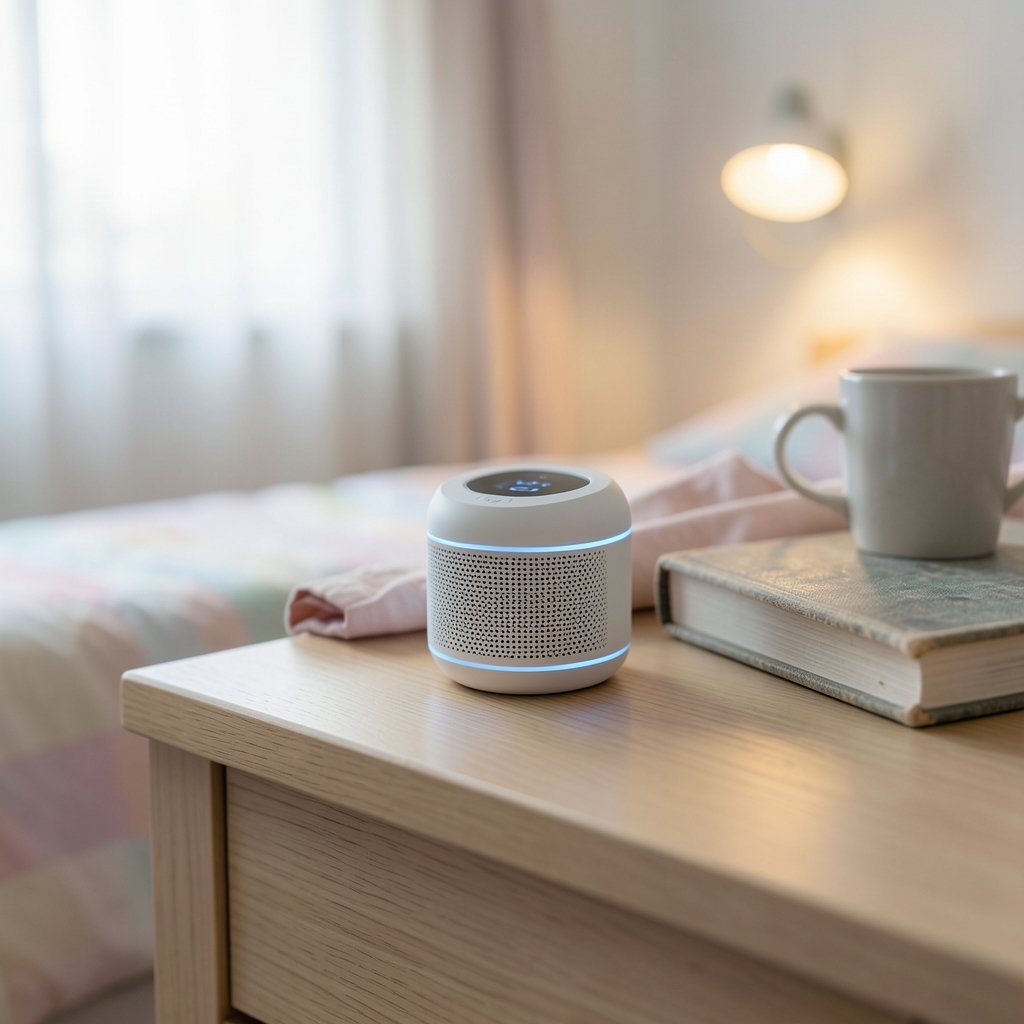
What if the air you breathe for eight hours every night is the most overlooked part of your sleep setup? People spend money on blackout curtains, weighted blankets, and white noise machines, yet rarely think about the invisible stuff floating around the bedroom. A smart air quality monitor changes that. It sits quietly on a nightstand, tracks particles, carbon dioxide, humidity, and volatile organic compounds, and tells you whether the room you sleep in is actually helping you rest or quietly working against you. This guide covers what these devices measure, which readings matter most at night, where cheap sensors fall short, and how to choose one without wasting money on features that never get used. (Air pollution)
Why Bedrooms Are a Uniquely Tricky Room to Monitor
A bedroom is a small, sealed box for roughly a third of your life. Doors stay shut. Windows stay closed in winter. Two adults exhale carbon dioxide all night, and the concentration climbs steadily until morning. Add a mattress, pillows, carpet, and painted furniture off-gassing slowly, plus dust mites doing their thing, and you have a room where air quality can degrade fast and stay bad for hours.
The tricky part is that bedrooms are also where people are least tolerant of gadget annoyances. A bright display at 2 a.m. is a dealbreaker. A fan whirring at 38 decibels is a dealbreaker. A device that pings your phone every time VOC levels twitch is a dealbreaker. So a bedroom monitor has to be accurate and boring at the same time, which is a harder design problem than it sounds.
There is also a measurement problem specific to small rooms. Carbon dioxide builds up quickly in a closed bedroom, and it drops fast when you crack a window. A monitor that samples every five minutes can miss the whole story. Look for devices that log continuously and show you a graph, rather than a single current number.
The Four Readings That Actually Matter While You Sleep
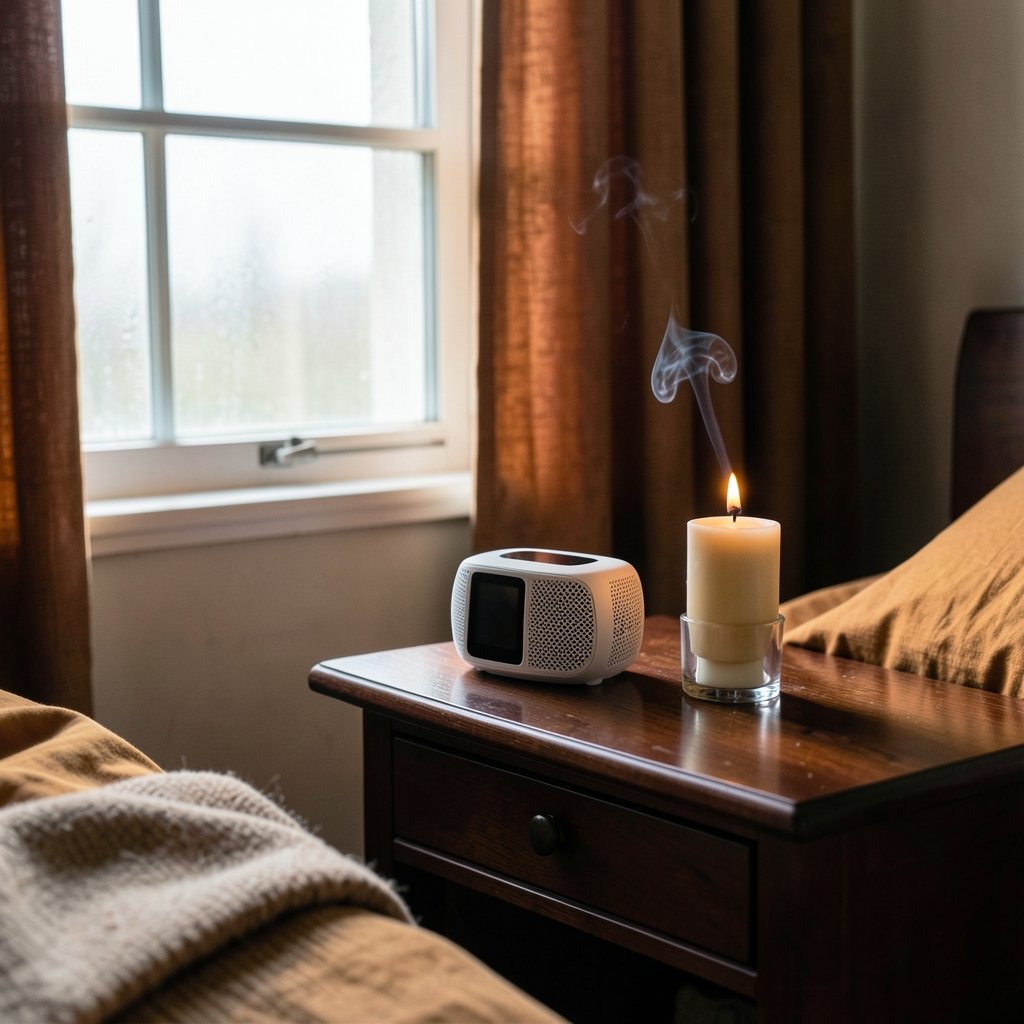
Most monitors display a wall of numbers. In practice, four of them carry the real signal.
PM2.5 is the headline pollutant. These are fine particles small enough to reach deep into the lungs, and they come from candles, cooking smoke drifting down the hall, traffic outside, and wildfire smoke. The World Health Organization’s 2021 global air quality guidelines set an annual PM2.5 guideline of 5 µg/m³ and a 24-hour guideline of 15 µg/m³. Many consumer monitors display readings against older or regional standards, so the same number can look “green” on one device and “yellow” on another. Check which threshold your device uses before you panic or relax.
Carbon dioxide is the ventilation indicator. A closed bedroom with two sleeping adults climbs past 1,000 ppm routinely, and many standards treat roughly 1,000 ppm as a common reference for acceptable ventilation in occupied rooms. CO₂ is not really a health hazard at those levels, but it is a reliable proxy for stale air. If your monitor shows 1,800 ppm at 6 a.m., the room needs a window cracked or a door left open.
Humidity matters more than people expect. Too dry and your throat feels like sandpaper by morning. Too damp and dust mites thrive. Somewhere in the 40 to 60 percent range is the usual comfort zone.
VOCs are the wildcard. Volatile organic compounds come from paint, furniture, cleaning sprays, and cosmetics. Here is the catch: most consumer VOC sensors are largely non-specific. They report a relative index, not a calibrated concentration, and they respond to benign things like alcohol-based hand sanitizer or a scented candle. Treat a VOC spike as “something changed in this room,” not “this room is toxic.”
Where Cheap Sensors Let You Down
This is the part most buying guides skip. Low-cost air quality sensors are genuinely useful, but they are not lab instruments, and academic evaluations published in journals such as Atmospheric Measurement Techniques and Environmental Science & Technology have repeatedly found that low-cost particle sensors deviate from reference monitors, especially at high humidity and in wildfire smoke. Performance is model-specific, so two devices at the same price can behave very differently.
Three practical consequences follow.
First, optical particle counters can over-read in humid air. If your bedroom sits at 65 percent humidity, a cheap PM2.5 sensor may report numbers that are meaningfully too high. Some devices apply proprietary correction algorithms, but those corrections are rarely independently validated.
Second, “eCO₂” is not CO₂. Many budget devices estimate carbon dioxide from a VOC sensor instead of measuring it directly. Real CO₂ measurement uses NDIR (non-dispersive infrared) sensing. If ventilation tracking matters to you, check the spec sheet for NDIR. If the listing says “eCO₂” or “CO₂ equivalent,” you are getting an estimate.
Third, absolute accuracy matters less than trend. A monitor that reads 20 percent high but responds consistently still tells you when to open a window. For bedroom use, that relative signal is often enough. Just do not treat any single reading as gospel.
Matching a Monitor to Your Bedroom Setup
The right device depends on what you are trying to fix. Here is how the common scenarios break down.
| Bedroom situation | Priority reading | What to look for |
|---|---|---|
| Stuffy mornings, headaches, foggy waking | CO₂ | NDIR sensor, continuous logging, history graph |
| Allergy sufferers, dust sensitivity | PM2.5 and humidity | Accurate particle sensor, humidity correction, quiet fan |
| City apartment near traffic | PM2.5 | Fast response time, night mode, app alerts you can silence |
| New furniture or recent repaint | VOCs plus PM2.5 | Understand VOC readings are relative indices, not absolutes |
| Wildfire region | PM2.5 | Verified sensor model, outdoor comparison data |
Notice what is missing from that table: air purifier integration, voice assistant support, and colorful LED rings. Those are nice, but they do not change what the device measures. Buy for the sensor first and the ecosystem second.
Practical Tips That Save People Real Grief
A few habits separate a monitor that earns its place from one that ends up in a drawer.
Place it at breathing height, not on the floor. Particles settle, and CO₂ stratifies. A nightstand at mattress level gives you a far more relevant reading than a shelf near the ceiling or a spot on the carpet.
Keep it away from the air purifier’s exhaust and from windows. Both create local microclimates that misrepresent the room. A meter or two of distance is usually enough.
Turn off every notification except the one you will act on. The single most useful alert for a bedroom is a CO₂ threshold, because it prompts a concrete action: open the window. PM2.5 alerts at night rarely lead to anything except anxiety.
Check the display dimming in person if you can. Specs rarely capture how bright “dim” actually is. If you cannot see it before buying, read reviews that specifically mention night mode.
Run a baseline week before changing anything. Record normal readings for seven nights. Then crack a window for a week and compare. This turns vague worry into a measurable experiment, and it is the fastest way to learn whether your bedroom actually has a problem.
Common Mistakes People Make
The biggest mistake is buying a monitor and expecting it to fix the air. A monitor is a smoke detector for air quality, not a solution. It tells you there is a problem; you still have to open a window, run a purifier, or remove the scented candle.
The second mistake is chasing perfect numbers. Indoor PM2.5 will never read zero, and a device that claims otherwise is either filtering its display or mis calibrated. Aim for consistent improvement, not a green screen.
The third mistake is ignoring the interaction between devices. A monitor that talks to a smart plug can automate a purifier or a bathroom fan, but only if the trigger thresholds are sensible. Many people wire up elaborate automations before they understand their own baseline, then wonder why the fan runs all night. If you are building out a connected bedroom, it helps to start with the fundamentals covered in guides like best smart home devices for beginners before layering on conditional logic. The same logic applies to other connected gear: a smart thermostat that saves energy works best when its schedule matches how the room is actually used, and a smart speaker for home automation is only as useful as the routines you build around it.
One more mistake worth naming: assuming a monitor’s app is an afterthought. In practice, the app is where you will spend most of your time, and a clunky one ruins a good sensor. Check whether the app supports data export, whether history is stored in the cloud or locally, and whether the company has a track record of keeping firmware updated.
Sleep, Noise, and the Radio Question
Bedroom buyers ask two questions that spec sheets handle poorly: how loud is it, and what is it broadcasting?
On noise, most monitors are fanless or use a tiny fan that is inaudible from a meter away. The exception is devices that double as air purifiers, which are much louder. If silence matters, confirm the monitor has no always-on fan, or check whether the fan can be disabled during scheduled sleep hours.
On radio emissions, Wi-Fi and Bluetooth radios in consumer devices operate well below regulatory exposure limits, and there is no established evidence of harm at those levels. Still, some people prefer to disable Wi-Fi at night or choose a device that logs locally and syncs only when asked. That is a personal comfort decision, not a safety requirement, and it is worth being honest about the difference.
How to Read the Data Without Obsessing
The healthiest relationship with a bedroom monitor is a weekly check-in, not a nightly vigil. Look at the morning graph. Did CO₂ climb steadily and plateau? That is a ventilation signal. Did PM2.5 spike at 3 a.m.? Something happened, maybe a neighbor’s wood stove or a draft pulling in outdoor air. Did humidity drift above 60 percent? Time to think about airflow.
Then make one change and watch what happens. This loop, measure, adjust, re-measure, is where the value lives. The device itself is just a sensor. The insight comes from the comparison.
If you are also upgrading other parts of the room, keep the same philosophy: buy for the function you will actually use. A Home Center Lite smart home hub makes sense if you genuinely want local automation, and a smart lock for home security earns its cost through daily convenience, not through the feature list. Bedroom tech should reduce friction, not add a dashboard to manage.
Conclusion
A smart air quality monitor for the bedroom is one of the few gadgets that can change how you feel within a week, provided you buy for the right reasons. Prioritize an NDIR carbon dioxide sensor if ventilation is your concern, a reputable particle sensor if allergies or outdoor smoke are the issue, and a genuinely dim, genuinely quiet design above all else. Accept that low-cost sensors are trend tools rather than lab instruments, place the device at breathing height, and give yourself a baseline week before drawing conclusions. The goal is not a perfect green screen at 3 a.m. It is a room that helps you wake up clear-headed, and a monitor that tells you, quietly and accurately, when it is not.
FAQ
What is the most important reading on a bedroom air quality monitor?
For most bedrooms, carbon dioxide is the most actionable number. It rises predictably overnight in a closed room and drops quickly when you ventilate, which makes it a direct signal for whether to crack a window. PM2.5 matters more if you live near traffic, in a wildfire region, or with allergy sufferers.
Do I need a CO₂ sensor that uses NDIR technology?
If you care about ventilation tracking, yes. NDIR sensors measure carbon dioxide directly. Many budget devices report “eCO₂” derived from a VOC sensor, which is an estimate and can drift when other gases are present. Check the spec sheet before buying.
How accurate are cheap air quality monitors?
They are useful but not precise. Independent evaluations have found low-cost particle sensors deviate from reference instruments, particularly in high humidity and heavy smoke. For bedroom use, trust the trend more than the absolute number, and treat VOC readings as relative indices rather than calibrated concentrations.
Where should I place a monitor in my bedroom?
Put it at breathing height, roughly mattress level, on a nightstand. Keep it at least a meter from air purifier exhaust and away from windows and radiators, since both create local conditions that misrepresent the room. Avoid the floor, where particles settle.
Will a monitor’s display or fan keep me awake?
It depends on the model. Most monitors are fanless or effectively silent, but displays vary widely in how dim “night mode” actually gets. Read reviews that specifically mention brightness at night, and confirm the fan can be disabled during sleep hours if the device has one.
Can a smart monitor automatically improve my air quality?
Not by itself, but it can trigger other devices. With a smart plug or hub, a CO₂ or PM2.5 threshold can switch on a purifier or exhaust fan. Set thresholds from your own baseline data rather than default values, or the automation will run constantly and solve nothing.