
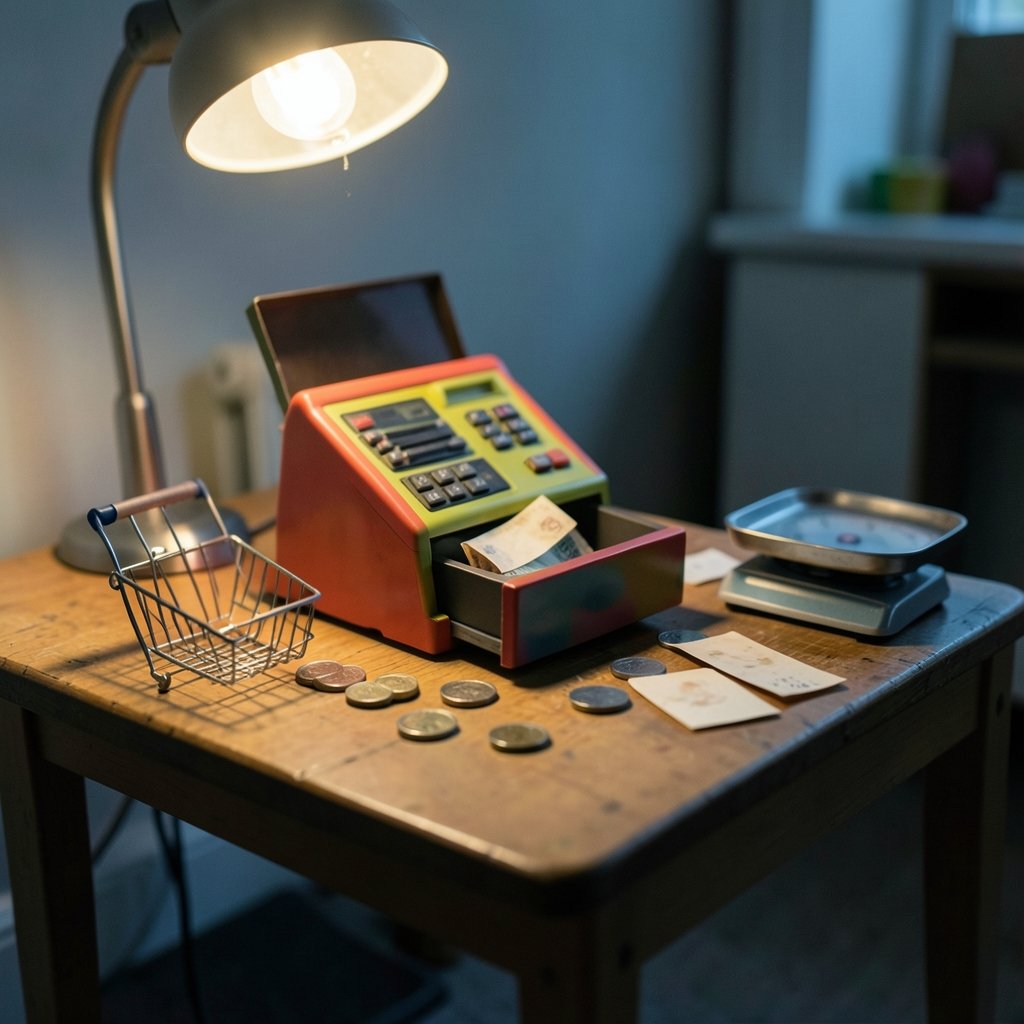
What if the crumpled five-dollar bill in your child’s toy cash register taught them more about money than any lecture ever could? That is the quiet power of play money for kids. It looks like a toy. It costs almost nothing. Yet it gives children a safe, low-stakes way to practice counting, making change, saving, and even spotting a fake note. Parents and teachers who use it well report fewer meltdowns at the shop counter and faster grasp of place value in maths lessons.
This guide covers what play money actually is, how to use it at different ages, which mistakes drain the fun out of it, and how to keep pretend cash from turning into a real-world hazard.
What Counts as Play Money?
Play money is imitation currency used for games, teaching, and pretend play. It is not legal tender, and it is deliberately designed not to pass as the real thing. Most classroom sets are oversized, printed on one side only, or stamped with words like “copy” or “toy money.”
That is not an accident. In the United States, counterfeiting law shapes what toy money may look like. The main statute, 18 U.S.C. § 471 on counterfeiting obligations and securities, makes it a crime to pass off fake notes as genuine. Treasury rules go further and set the conditions under which reproductions are allowed, including one-sided printing and size limits. Good toy money is built around those limits from the design stage.
The upshot for buyers: if a set of notes looks almost exactly like real currency, treat that as a warning sign rather than a mark of quality.
Why Pretend Cash Beats a Worksheet
Worksheets ask a child to circle the correct coin. Play money asks them to hand over change, count it back, and notice they are short. That shift from recognition to action is where learning sticks.
Counting and place value
Handling coins and notes makes abstract numbers physical. A child who trades ten ones for a ten-dollar note has just acted out base ten with their hands. In England, the national curriculum requires pupils to recognise and use the symbols for pounds and pence and to make amounts, typically in key stage 1, ages five to seven. Play money is the obvious tool for that job.
Making change and mental maths
Real shops create time pressure. Pretend shops do not. A child running a toy café can take a twenty, work out the change, and get it wrong without embarrassment. Repeat that twenty times and the mental arithmetic becomes automatic.
Saving, spending, and waiting
A play wallet with a budget turns “I want it” into “can I afford it?” Some families run a weekly pretend payday so children practice allocating money across spending, saving, and giving. The habit transfers surprisingly well when real pocket money starts.
Spotting fakes
Some teachers pair play notes with real ones to teach counterfeit detection, such as checking watermarks and security threads. It is a genuinely useful life skill dressed up as a game.
How Play Money Fits Into Financial Education
Play money is usually the first rung on a long ladder. International assessments treat early money handling as the foundation for later competence. The OECD’s PISA financial literacy assessment, first run in 2012, tests 15-year-olds on money management, planning, and risk, and it assumes students arrive with basic money familiarity rather than learning it from scratch at secondary school. (Money as You Grow)
In the United States, the Jump$tart Coalition’s National Standards for K–12 Personal Finance Education include money-management benchmarks that begin in the early grades, and a growing number of states require personal finance coursework before graduation. The direction of travel is clear: money skills are treated as a school subject, and pretend cash is where most children meet it first.
Choosing Play Money by Age
The right set at four is not the right set at nine. Here is a practical breakdown.
| Age band | Best format | What it teaches | Watch out for |
|---|---|---|---|
| 3–5 | Chunky plastic coins, oversized notes | Coin and note recognition, sorting | Small parts; check choking-hazard labelling |
| 5–7 | Full coin set plus notes to 20 | Counting, making amounts, simple change | Sets that skip the small denominations |
| 7–9 | Notes to 50 or 100, price tags, till | Change from larger sums, budgeting | Sets with no coins, which block change practice |
| 9–12 | Mixed set plus a ledger or savings jar | Planning, saving goals, record keeping | Play money that looks too close to real cash |
| 12+ | Digital budgets and in-game currency talks | Online spending, in-app purchases | Unmonitored purchases on a real account |
Two buying rules cover most of it. First, buy a set with plenty of small denominations, because change-making needs ones and fives far more than hundreds. Second, buy coins that feel different from one another, since tactile differences help younger children sort before they can read the numbers.
Safety Rules Most Parents Miss
Play money aimed at young children is a children’s product, and it is regulated like one. In the United States, the Consumer Product Safety Improvement Act of 2008 set lead and phthalate limits for children’s products, and small parts are regulated for children under three. The U.S. Consumer Product Safety Commission’s toy safety guidance explains those rules in plain terms for anyone checking a purchase.
In the European Union, toys fall under the Toy Safety Directive 2009/48/EC, which sets chemical and mechanical safety requirements. The framework has been under revision, so anyone buying from an EU supplier should check the current status rather than assume the old directive still applies unchanged.
Beyond regulation, three practical checks matter:
- Smell the set. Strong chemical odours on cheap plastic coins are a reason to return them.
- Check the edges. Thin metal-look coins can have sharp rims.
- Skip the realistic option. If a set could be mistaken for real notes in dim light, it is the wrong set for a child’s toy box.
The Mistakes That Kill the Fun
Plenty of well-meaning adults turn play money into homework. A few common missteps are worth avoiding.
Making it a test. Quizzing a five-year-old on coin values mid-game ends the game. Let the shopkeeper role do the teaching.
Skipping the coins. A set of notes alone cannot teach change. Children need the small stuff.
Never letting them be the shopkeeper. Children learn far more when they give change than when they receive it. Swap roles often.
Ignoring the digital version. In-game coins in children’s apps are a newer form of play money, and consumer bodies have raised concerns about in-app purchases and children’s spending. If a child is spending virtual coins, that is a money lesson happening in real time. Talk about it. The same applies to any household debate about which device a child plays on, whether that is a console or a handheld; a comparison like steam deck vs rog ally x which handheld pc fits you play is a reminder that platform choices shape how much parental control you get over spending.
Forgetting the real-world link. The best moment to use play money is right after a real shopping trip, when the memory of handing over cash is fresh.
How to Set Up a Pretend Shop That Actually Teaches
A workable shop takes fifteen minutes to build and can run for years. Here is a sequence that works in classrooms and living rooms alike.
- Pick a theme the child loves: a bakery, a pet shop, a train ticket office.
- Price everything in round numbers first, then move to awkward prices like 3.75 once change-making is solid.
- Give the child a starting float of small denominations and a wallet of spending money.
- Let them run the till for the first few rounds while you shop.
- Introduce a savings jar with a goal, such as a toy they want, priced in pretend money.
- Add a simple receipt book so they write totals as well as count them.
- Swap roles and raise prices gradually.
The step most people skip is the receipt book. Writing the total forces a second pass over the arithmetic, and it gives you a written record of what they got wrong so you can target practice.
Play Money Beyond the Maths Lesson
Pretend cash turns up in unexpected places once you start looking.
Board games popularised paper money in the home long before classrooms adopted it. Monopoly, first published in 1935, put a paper fortune in millions of living rooms and taught generations that rent comes due whether you planned for it or not.
Play money also supports storytelling and negotiation. A child pricing goods in a pretend market is practising persuasion, fairness, and compromise. Those are not maths skills, but they are money skills.
It can even open conversations about how money itself works. Central bank digital currencies are moving real currency toward digital form, and a curious nine-year-old who has just learned that notes are printed tokens is well placed to ask why anyone would want a digital version. A plain-language explainer on cbdc digital currency central bank money going digital can carry that conversation further than most adults expect.
When Pretend Money Meets Real Scams
There is an uncomfortable crossover between play money and fraud. Children who learn to check a watermark grow into adults who check a payment request. That matters, because some of the most damaging scams target exactly the instincts that money education is meant to build.
Gift card scams are a good example. A fraudster asks for payment in gift cards, the victim reads out the code, and the money is gone. Recovery is rare. Understanding how the gift card scam works and why victims rarely get their money back is a genuinely useful lesson to hand a teenager alongside their first debit card. The identity side is similar: knowing where the money goes when an account is taken over makes the warnings concrete rather than abstract, which is why breakdowns of identity threat detection and where the money really goes are worth sharing with older children. (Play money)
None of that requires frightening a seven-year-old. It simply means the money conversation keeps going as the child grows, and play money is where it starts.
Conclusion
Play money for kids works in the toy box because it does something a lecture cannot: it lets children make money decisions, get them wrong, and try again without consequence. Buy a set with plenty of coins, check it against basic toy safety rules, let the child run the till, and resist the urge to turn the game into a quiz. Start with a pretend shop at five, add a savings jar at seven, and by the time they meet in-game coins and real debit cards, the groundwork is already there. The crumpled note in the toy register is a toy, and it is also the first draft of a skill they will use for life.
Frequently Asked Questions
What age should a child start using play money?
Most children can start around age three with chunky coins and oversized notes, mainly for sorting and naming. Real counting and change-making usually clicks between five and seven, which is when many school systems formally introduce coins and amounts. There is no harm in starting earlier as long as the pieces are safe for the age group.
Is play money legal to buy and use?
Yes. Toy and educational money is legal, and it is deliberately made distinguishable from real currency, typically through one-sided printing, larger sizes, or printed markings. The rules exist to prevent counterfeiting, not to ban pretend cash. Sets that look almost identical to real notes are best avoided.
How much play money does a child actually need?
Enough small denominations to make change several times over. A practical set includes at least twenty coins in low values, a handful of mid-value notes, and two or three larger notes for bigger sums. Quantity matters less than variety, since change-making practice depends on having plenty of ones and fives.
Can play money help with real financial literacy?
It is a strong first step rather than a complete education. Handling pretend cash builds counting, change-making, and basic budgeting habits. Later stages need real practice with saving, spending limits, and digital payments. International assessments of teenage financial literacy assume this early foundation is already in place.
What should I check before buying play money for a toddler?
Check the age labelling, the size of the smallest pieces, and the material. Coins small enough to swallow are a choking risk for children under three. Look for sets that state compliance with toy safety rules, and be wary of strong chemical smells or sharp edges on cheap plastic or metal-look coins.
How do I stop play money from becoming boring?
Change the setting rather than the money. Move from a bakery to a ticket office, introduce awkward prices, add a receipt book, or let the child set prices and negotiate. Rotating roles so the child runs the till keeps the arithmetic active. Most children lose interest when the game becomes a test rather than a game.



