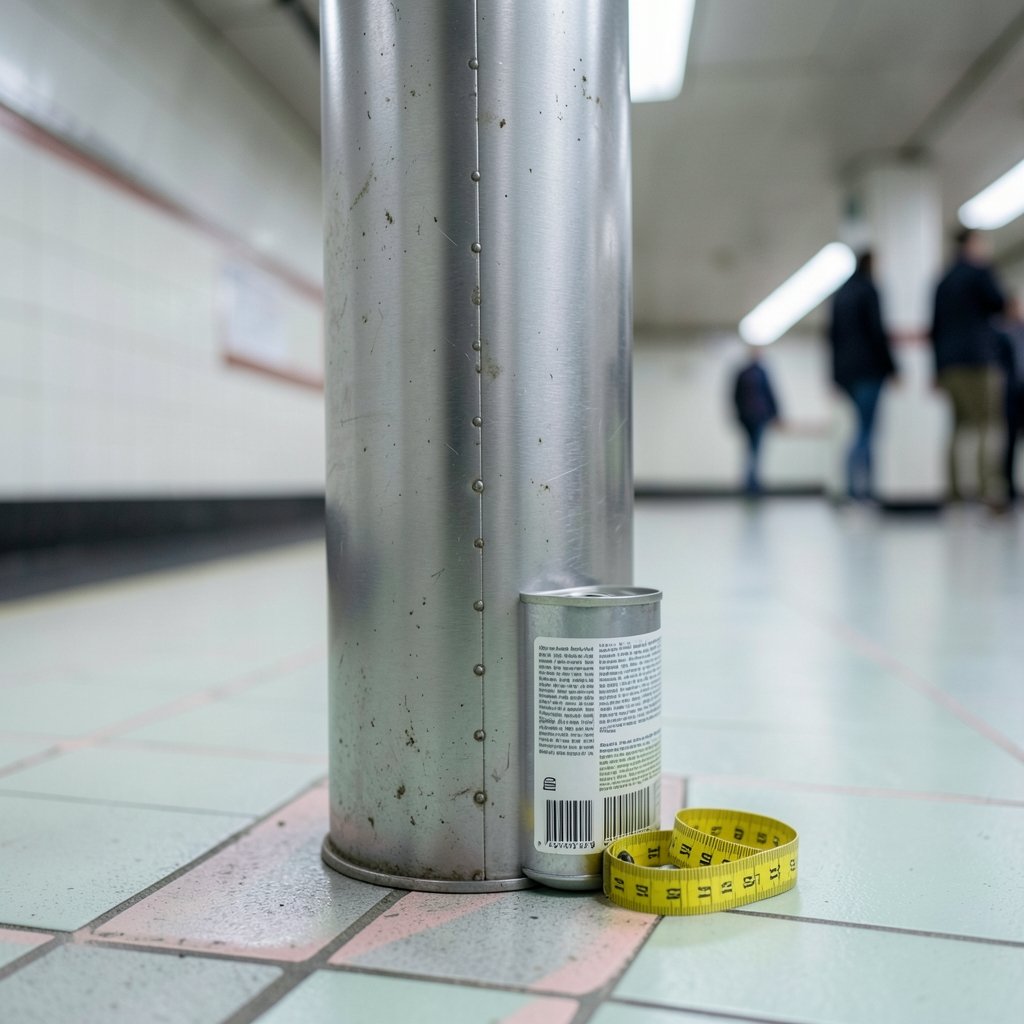
What do a soup can, a water tank, and a concrete pillar all have in common? They are all cylinders, and figuring out how much they hold or how much material they use comes down to one compact formula. If you have ever stood in a hardware store guessing how many bags of concrete to buy, or wondered whether a tall skinny bottle really holds more than a short wide one, the cylinder volume formula is the tool that settles the question.
This guide walks through the formula itself, the variations that trip people up, and the practical habits that keep your numbers accurate.
The Core Formula in One Line
The volume of a circular cylinder is V = πr²h, where r is the radius of the circular base and h is the height. That is it. Everything else in this article is a variation or a caution.
The logic behind it is easy to picture. Any prism or cylinder has volume equal to the area of its base multiplied by its height. For a circle, the base area is πr². Stack that circle up through a height of h and you get πr²h. The same reasoning applies to a box (length times width times height) and to a triangular prism (triangle area times height). The cylinder is just the round member of that family. (Cylinder (geometry))
If you are given the diameter instead of the radius, halve it first. You can also write the formula as V = (π/4)d²h, which skips the halving step. Both forms give identical answers.
A quick example: a can with a radius of 4 cm and a height of 10 cm holds π × 16 × 10 ≈ 502.7 cm³. That is roughly half a liter, which matches the size of a typical large soup can.
Radius, Diameter, and the Mistakes That Follow

The single most common error in cylinder volume problems is plugging the diameter where the radius belongs. It sounds trivial, but it is easy to do when a label reads “10 cm across” and your brain reaches for the number without thinking.
The consequence is not small. Because the radius is squared, using the diameter instead inflates the volume by a factor of four. A tank that actually holds 250 liters would appear to hold 1,000. That kind of error matters when you are ordering materials or sizing equipment.
Practical habits that prevent it:
- Write down what the measurement actually represents before touching the calculator. “Diameter = 10 cm” and “Radius = 5 cm” are two different notes.
- Convert to radius immediately, in the same line, so the rest of the work uses one consistent value.
- Sanity-check the result against something familiar. A cylinder 10 cm across and 20 cm tall should land somewhere near 1.5 liters, not 6.
A second frequent slip is mixing units. If the radius is in centimeters and the height is in meters, the formula will happily produce a meaningless number. Convert both to the same unit first. Volume scales with the cube of length, so a unit conversion error compounds quickly.
Why the Slant Does Not Change the Volume
Here is a question that separates careful thinkers from formula-memorizers: does a leaning cylinder hold less than an upright one?
The answer is no. An oblique cylinder, one whose axis is tilted, has exactly the same volume as a right cylinder with the same base and the same perpendicular height. The key word is perpendicular. You measure the height as the straight-line distance between the two parallel circular faces, not along the slanted side. (Cylinder)
This result follows from Cavalieri’s principle, published by Bonaventura Cavalieri in 1635. The principle states that if two solids have equal cross-sectional areas at every height, they have equal volumes. Slice a leaning cylinder and an upright one at the same level and the slices are identical circles. The lean shifts them sideways but does not shrink them.
The practical takeaway: when you measure a tilted tank or a slanted pipe, drop a perpendicular from the top face to the plane of the bottom face. That distance is your h. Measuring along the sloping wall will overstate the height and, by extension, the volume.
Working With Hollow Cylinders and Pipes
Solid cylinders are the textbook case, but real objects are often tubes. A pipe, a ring, a washer, or a concrete column with a hollow core is a cylindrical shell. Its volume of material is not πr²h for either circle alone. It is the difference between them:
V = π(R² − r²)h, where R is the outer radius and r is the inner radius.
Suppose a pipe has an outer diameter of 12 cm, an inner diameter of 10 cm, and a length of 2 meters. The outer radius is 6 cm, the inner is 5 cm, and the height is 200 cm. Then V = π × (36 − 25) × 200 ≈ 6,912 cm³, or about 6.9 liters of material. That figure tells a fabricator how much plastic or metal the pipe consumes, which is exactly what a materials estimate needs.
Notice the subtraction happens before multiplying by height, and both radii must be squared separately. Writing π(R − r)²h is a different and wrong formula. It computes the volume of a single cylinder with the wall thickness as its radius, which is not the same shape at all.
Units, Precision, and Rounding
Volume is a derived quantity measured in cubic units: cm³, m³, in³, ft³. The unit is always the cube of whatever linear unit you started with. If you feed the formula centimeters, you get cubic centimeters. Feed it feet, get cubic feet. There is no conversion built into the formula itself.
On precision, two pieces of practical advice hold up well. First, do not round π to 3.14 if you can avoid it. Use the π key on a calculator or a longer value like 3.14159. The difference is tiny for small objects but can matter at the scale of a storage tank. Second, round only at the very end. Rounding the radius, then squaring it, then multiplying compounds the error.
For everyday work, three significant figures is usually plenty. A 200-liter drum does not need to be specified to the milliliter unless you are filling it with something expensive.
A Worked Example From Start to Finish
Suppose someone needs to know how much water a cylindrical rain barrel holds. The barrel is 60 cm across and 90 cm tall.
- Convert diameter to radius: 60 ÷ 2 = 30 cm.
- Square the radius: 30² = 900 cm².
- Multiply by height: 900 × 90 = 81,000 cm³.
- Multiply by π: 81,000 × 3.14159 ≈ 254,469 cm³.
- Convert to liters by dividing by 1,000: about 254.5 liters.
That is a realistic barrel capacity, and the sanity check confirms it. If the answer had come out at 1,000 liters, the diameter-versus-radius mistake would be the first thing to check.
This same sequence works for any circular cylinder, whether you are sizing a column, estimating paint for a silo, or working out the displacement of an engine cylinder. The steps do not change; only the numbers do.
Where the Formula Shows Up in Real Work
The cylinder volume formula is not an abstract exercise. It appears constantly in trades and technical fields.
In construction, concrete for round footings and columns is ordered by cubic volume, and getting it wrong means either a short pour or wasted material. In engineering, the displacement of an engine cylinder is πr²h times the number of cylinders, which is why engine sizes are quoted in liters. In food packaging, manufacturers compare a tall narrow can against a short wide one to find which uses less metal for the same capacity. In medicine, syringe barrels and IV bags are calibrated using the same geometry. (How to Do a Plank: Perfect Form & Timing Guide 2026)
The formula also underpins calculus. When you rotate a curve around an axis to make a solid, the volume is built from thin cylindrical slices. That is the same base-area-times-height idea, applied infinitely many times. If you have ever tuned a Docker container’s storage limits on a home server, you have already met the same habit of thinking in volumes and units; the patience required is similar to what goes into fixing NAS Docker volume permissions without breaking your setup.
Common Traps Worth Remembering
A short list of the errors that show up most often:
| Mistake | What Goes Wrong | Fix |
|---|---|---|
| Using diameter as radius | Volume is 4× too large | Halve the diameter first |
| Mixing units | Meaningless result | Convert to one unit before calculating |
| Measuring slant height | Height overstated | Use perpendicular height |
| Rounding too early | Small errors compound | Round only the final answer |
| Using π(R − r)²h for a tube | Wrong shape entirely | Square each radius separately |
| Forgetting to cube the unit | Unit label is wrong | Result is always length³ |
Most of these are caught by a single habit: estimate the answer roughly before calculating precisely. If the rough estimate and the calculator disagree by a factor of four, you know where to look.
The same discipline of checking form before adding load shows up in fitness too, where a few small adjustments make a big difference; the plank form and timing guide covers a comparable idea of getting the basics right before adding difficulty. Geometry rewards the same patience. (Inde Navarrette Movies and TV Shows: Full Career Guide)
Conclusion
The cylinder volume formula is short, but it rewards careful reading. V = πr²h works for any circular cylinder, upright or leaning, as long as you use the radius and the perpendicular height in matching units. Hollow shapes need the subtraction form, and every answer should carry cubic units and pass a rough sanity check.
The people who get reliable numbers are not the ones who memorize more formulas. They are the ones who slow down at the measurement stage, write down what each number means, and verify the result against something real. That habit transfers to every calculation that follows.
What is the cylinder volume formula?
It is V = πr²h, where r is the radius of the circular base and h is the height. Multiply the base area (πr²) by the height to get the volume. If you only know the diameter, use V = (π/4)d²h instead.
Does a tilted cylinder have a different volume?
No. An oblique cylinder has the same volume as an upright one with the same base and perpendicular height. The lean shifts the cross-sections sideways without changing their size, which is exactly what Cavalieri’s principle describes. Just make sure you measure the height perpendicular to the base, not along the slanted side.
How do I find the volume of a hollow pipe?
Subtract the inner circle from the outer circle, then multiply by length: V = π(R² − r²)h. Square each radius separately before subtracting. Do not collapse it into π(R − r)²h, which describes a different shape.
Why did I get a volume four times too big?
You almost certainly used the diameter in place of the radius. Because the radius is squared in the formula, doubling it multiplies the volume by four. Divide the diameter by two before calculating, and the answer will fall back into range.
How precise should I be with π?
For most practical work, use the π key on a calculator or at least 3.14159. Rounding π to 3.14 introduces a small error that rarely matters for household objects but can add up at industrial scale. Whatever you choose, round only the final answer, never the intermediate steps.
What units does the answer come in?
Cubic units of whatever linear unit you used. Centimeters give cubic centimeters, meters give cubic meters, inches give cubic inches. If you need liters, remember that 1,000 cm³ equals one liter, and if you need gallons, convert from cubic inches or cubic meters using a standard conversion factor.