

How many people are locked up right now, and what does that number actually tell us? The answer is bigger than most people guess. Around 11.5 million people are held in penal institutions worldwide, counting people awaiting trial and those in other detention facilities, according to the World Prison Brief’s global prison population data compiled by the Institute for Crime & Justice Policy Research at Birkbeck, University of London. (UNODC: Justice and Prison Reform)
That’s roughly the population of a major city, held behind walls. But raw numbers only scratch the surface. Who these prisoners are, why they’re there, how they’re treated, and what happens after release are the questions that matter most. This article walks through all of it, from global statistics to the standards that govern prison conditions, with practical detail along the way.
The Scale of Incarceration, Country by Country
The United States stands out. At the end of 2022, about 1.23 million people were in state and federal prisons, plus roughly 660,000 in local jails, according to the Bureau of Justice Statistics report on prisoners in 2022. No other country holds as many people behind bars in absolute terms.
The US imprisonment rate was about 355 per 100,000 residents at year-end 2022, down from a peak near 506 per 100,000 around 2007–2008. That decline is real, but the country still ranks among the highest in the world when jails and pre-trial detainees are included. International rankings shift depending on counting methods, with countries such as El Salvador and Rwanda appearing near the top in recent years.
| Measure | US figure | Notes |
|---|---|---|
| State and federal prisoners (end of 2022) | ~1.23 million | Prisons only |
| Local jail population (midyear 2022) | ~660,000 | Mostly pre-trial |
| Imprisonment rate (end of 2022) | ~355 per 100,000 | Prisons only |
| Peak imprisonment rate | ~506 per 100,000 | Around 2007–2008 |
| Black vs. white imprisonment rate | ~1,124 vs. ~218 per 100,000 | About 5 times higher |
That last row deserves attention. Racial disparity isn’t a side note in prison statistics; it’s a central feature. Black residents were imprisoned at roughly five times the rate of white residents at the end of 2022, per the same Bureau of Justice Statistics data.
Who Is Actually Behind Bars?
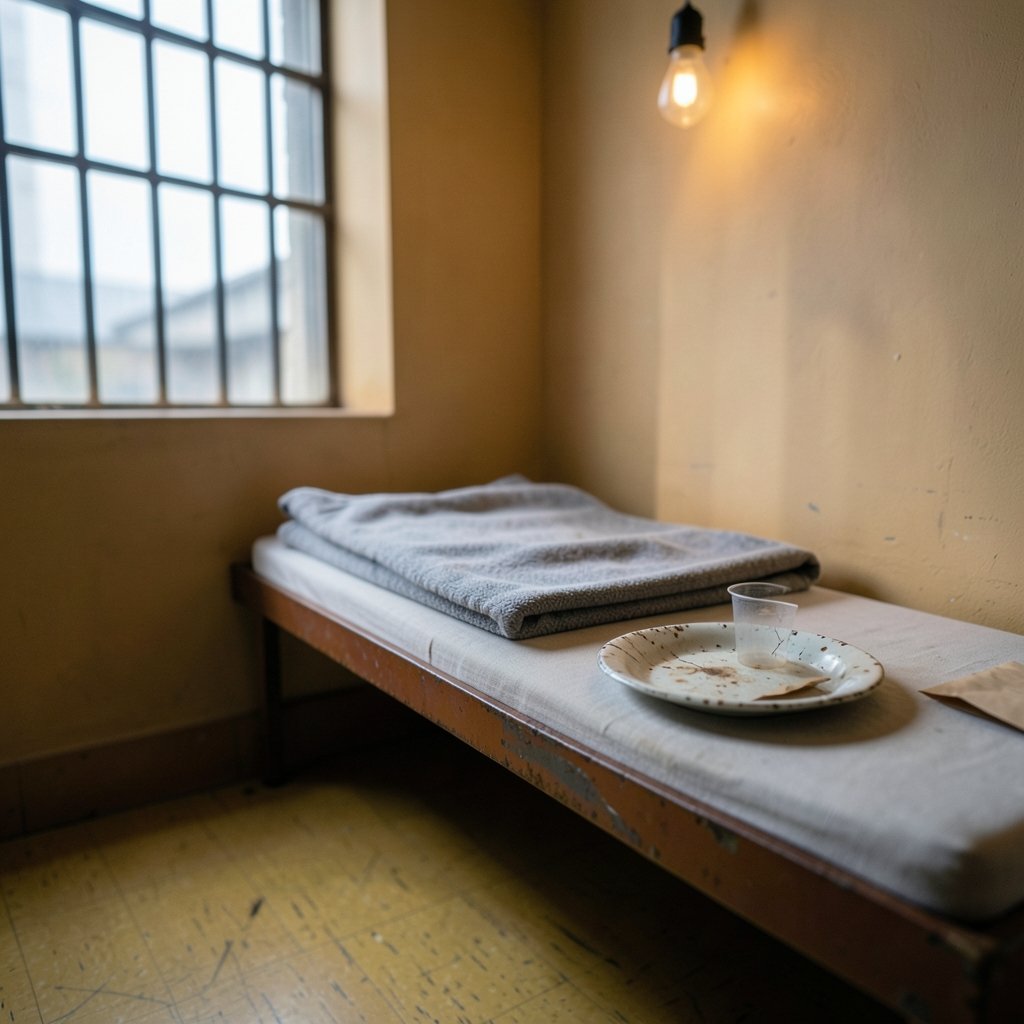
Prisons hold a mix of people, and the mix varies enormously by country.
Sentenced prisoners have been convicted and are serving a sentence. Pre-trial detainees are legally presumed innocent but held while their cases proceed. That second group is often invisible in public debate, yet it’s huge. Roughly one in three prisoners worldwide is unsentenced, according to UNODC’s work on prison reform and alternatives to imprisonment, and the share is far higher in some low- and middle-income countries.
Think about what that means in practice. A person who has not been convicted of anything may spend months or years locked up, sometimes because they can’t afford bail, sometimes because courts are backlogged. Their job may be gone. Their family may lose housing. The damage happens before any verdict.
Other groups within the prison population include:
- People serving short sentences for minor offenses, who make up a large share of jail populations
- People with serious mental illness, who are overrepresented compared with the general population
- Foreign nationals, who often face language barriers and distance from family
- Older prisoners, the fastest-growing age group in many systems
Practical tip for anyone researching this: always check whether a statistic counts prisons only, or prisons plus jails, and whether it includes pre-trial detainees. Two sources can report the same country and produce numbers that look contradictory simply because of counting methods.
The Rules That Govern Prison Life
Prisons are not lawless zones. International standards set minimum conditions for how prisoners must be treated.
The most important is the UN Standard Minimum Rules for the Treatment of Prisoners, revised in 2015 and known as the Nelson Mandela Rules. Adopted by the UN General Assembly in December 2015, they cover accommodation, healthcare, discipline, and solitary confinement. One provision is especially concrete: solitary confinement beyond 15 consecutive days is prohibited.
In Europe, the European Prison Rules, issued by the Council of Europe and revised in 2020, set similar baseline standards for member states on treatment, regime, and oversight.
The main limitation is enforcement. These rules are standards, not enforceable laws in most places. Compliance depends on national legislation, inspection bodies, courts, and public scrutiny. A country can sign up to the Mandela Rules and still run overcrowded, understaffed facilities. Readers who want to understand how standards translate into real conditions should look at inspection reports and court rulings, rather than only the text of the rules themselves.
Health Behind Bars
Prison health is public health, whether or not the public likes to admit it.
The World Health Organization’s status report on prison health in the WHO European Region documents higher rates of infectious disease, mental-health conditions, and substance-use disorders among prisoners than in the general population. That pattern holds broadly across countries.
Why does it matter outside the walls? Because nearly everyone who enters prison eventually leaves. An untreated infection, an unmanaged psychiatric condition, or an untreated addiction doesn’t stay contained. It walks out the gate and into a community, often with no follow-up care arranged.
Common mistakes in prison health systems, according to the research literature, include:
- Treating prison healthcare as separate from the national health system, which leads to gaps at release
- Screening for infectious disease at intake but never again
- Understaffing mental-health services, so only acute crises get attention
- Releasing people with no medication bridge, no appointment, and no address
What actually works, in practice, is continuity: the same records, the same treatment protocols, and a plan made before release day rather than after.
Life After Release and the Recidivism Question
What happens after prisoners are released may be the most consequential part of the whole story.
Recidivism rates vary widely by definition and jurisdiction, which makes comparisons tricky. In the US, about 68% of released state prisoners were rearrested within three years and 83% within nine years, according to the Bureau of Justice Statistics’ nine-year follow-up study of people released in 2005.
Read that carefully. Rearrest is not the same as reconviction, and reconviction is not the same as reincarceration. A person can be arrested and never charged. Studies using different definitions produce very different numbers, so treat any single recidivism figure with caution.
The practical factors that predict success after release are fairly well established:
- Housing. A stable address is the foundation for everything else, including employment and probation compliance.
- Employment. A job that pays enough and doesn’t violate release conditions.
- Identification documents. Many people leave prison without a valid ID, birth certificate, or Social Security card, which blocks housing and work.
- Family contact. Maintaining relationships during incarceration correlates with better outcomes afterward.
- Substance-use treatment. Continued care after release, as well as inside.
A common mistake families make is assuming the prison or parole office will handle these logistics. In most systems, nobody coordinates them. The person leaving, or their family, has to chase documents, appointments, and housing themselves, often in the first 72 hours after release. Starting that paperwork before release day, where the system allows it, is one of the few things that reliably helps.
The Money and Politics of Prisons
Prison policy is shaped by budgets as much as by justice.
Running a prison is expensive. Staffing, healthcare, food, and infrastructure add up to tens of thousands of dollars per prisoner per year in high-income countries. When systems are overcrowded, costs per person may fall, but conditions deteriorate and litigation rises.
Public opinion also shifts. Several countries have reduced prison populations in recent years through sentencing reform, expanded parole, and diversion programs for drug offenses and mental-health crises. Others have moved in the opposite direction, using mass detention as a response to gang violence or political dissent.
For readers trying to follow policy debates, there’s a useful habit: distinguish between the number of prisoners and the rate of imprisonment. A country’s prison population can grow while its rate stays flat, simply because the general population grew. Rate is the fairer comparison across countries and across decades.
Prediction markets have even started pricing political and legal outcomes involving high-profile defendants, which is a strange new frontier for public attention on incarceration. If that kind of forecasting interests you, this analysis of what the Andrew Tate prison 2027 manifold market odds really tell you is a useful example of how to read such numbers skeptically. The same skepticism applies to prison statistics generally: ask what is being counted, by whom, and for what purpose. (Prison)
Conclusion
Prisoners are not an abstraction. They are roughly 11.5 million people worldwide, a third of whom have not been convicted of anything. They are held under standards that exist on paper but depend on inspection and political will to mean anything in practice. They carry higher rates of disease and mental illness than the general population, and most of them will return to their communities, where housing, documents, and treatment determine whether they come back.
The numbers in this article will age. The World Prison Brief updates its rankings regularly, and national statistics offices release new figures each year. What doesn’t change is the value of reading those numbers carefully, asking what they include, and remembering that every statistic represents a person with a release date.
Frequently Asked Questions
How many prisoners are there in the world?
Around 11.5 million people are held in penal institutions worldwide, including pre-trial detainees and people in other detention facilities, according to the World Prison Brief. The exact total shifts each year as national figures are updated, and counting methods differ between sources, so treat the number as a close estimate rather than a precise count.
Which country has the most prisoners?
The United States has the largest absolute prison population of any country, with about 1.23 million people in state and federal prisons at the end of 2022, plus roughly 660,000 in local jails. When measured by rate rather than raw numbers, several countries rank higher depending on whether jails and pre-trial detainees are included in the count.
What are the Nelson Mandela Rules?
They are the UN Standard Minimum Rules for the Treatment of Prisoners, revised in 2015 and named after Nelson Mandela. They set baseline standards on accommodation, healthcare, discipline, and solitary confinement, including a prohibition on solitary confinement beyond 15 consecutive days. They are standards rather than directly enforceable law, so compliance depends on national governments and oversight bodies.
What percentage of prisoners return to prison after release?
It depends heavily on how you define return. In the US, about 68% of released state prisoners were rearrested within three years and 83% within nine years, based on a study tracking people released in 2005. Rearrest rates are higher than reconviction or reincarceration rates, so figures from different studies are often not comparable.
Why is pre-trial detention such a big issue?
About one in three prisoners worldwide has not been convicted of any crime, and the share is much higher in some countries. Pre-trial detainees are legally presumed innocent, yet they can lose jobs, housing, and contact with family while waiting for a court date. In many systems, the length of detention depends more on whether a person can afford bail than on the risk they pose.
Do prisoners have access to healthcare?
International standards require it, and most prison systems provide some level of care. In practice, prisoners tend to have higher rates of infectious disease, mental-health conditions, and substance-use disorders than the general population, and services are often understaffed. The biggest gap usually comes at release, when treatment and medication frequently stop with no plan for continuation in the community.



