
What makes a digital sculpture feel like it could reach out and touch you? That question sits at the heart of 3D artistic work, a field where math, light, and imagination collide. It is not just about making things look round instead of flat. It is about building form, depth, and material truth from scratch inside a computer, then convincing the human eye that the result is real.
The term covers a wide range. It includes digital sculpting, procedural modeling, real-time installations, and 3D-printed objects. It also includes the rendering pipelines behind modern film and games. This guide walks through how the craft works, where it came from, which tools people actually use, and the mistakes that trip up beginners most often.
What Counts as 3D Artistic Work?
3D art generally means art made with three-dimensional form. That includes physical sculpture and installation, but in contemporary usage the digital sense dominates. When someone says “3D artistic,” they usually mean computer-generated 3D graphics: models built in software, lit, textured, and rendered or displayed in real time.
There is no single authoritative definition, and that flexibility matters. A ceramicist working by hand and a digital sculptor working in Blender can share the same vocabulary of form, volume, and silhouette. The difference is the medium. Digital 3D art adds a layer of technical craft: topology, shading, and rendering.
How Digital 3D Art Actually Works
Every 3D artistic project rests on a few building blocks. Understanding them is the fastest way to stop feeling lost in the software.
Modeling: Building the Form
Modeling is the act of creating geometry. Artists work with vertices (points), edges (lines connecting them), and faces (surfaces). Two main approaches dominate:
- Polygon modeling builds shapes by pushing and pulling surfaces. It is precise and common in game art and product visualization.
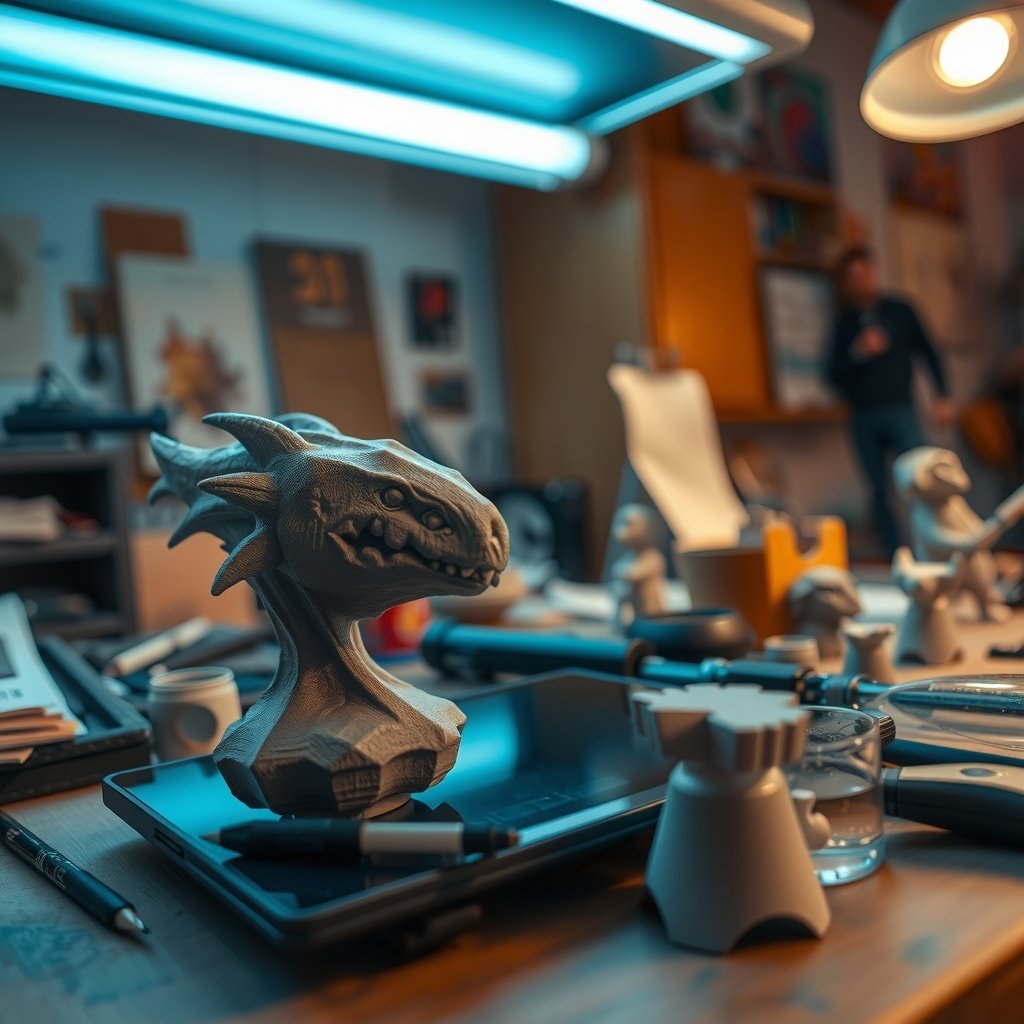
- Digital sculpting works more like clay. Artists push, pull, and smooth a dense mesh. It suits organic forms like characters and creatures.
A related method, procedural modeling, generates geometry through rules and parameters rather than manual placement. Tools like Blender and Houdini support this approach, and it is a common method in generative 3D art.
Texturing and Shading: Giving Surfaces a Story
Geometry alone looks like gray plastic. Texturing adds color and surface detail, while shading defines how a material responds to light. Metal reflects sharply. Skin scatters light softly. Fabric absorbs it. Getting these responses right is often what separates amateur work from professional work.
Lighting and Rendering: Making It Believable
Rendering is the process of turning a scene into a final image or frame. Two families of techniques matter:
| Approach | How It Works | Best For | Trade-off |
|---|---|---|---|
| Rasterization | Projects geometry onto the screen quickly | Games, real-time art, VR | Less physically accurate by default |
| Ray tracing | Follows light paths for realistic reflections and shadows | Film, product shots, stills | Computationally heavy |
Real-time engines increasingly blend both. Game engines such as Unreal Engine and Unity are now used for art installations and virtual production, not just games. Unreal Engine 5 launched in 2022, though version details are worth checking against official release notes before citing them.
A Short History of 3D Artistic Practice
The roots of digital 3D art go back further than most people expect.
Ivan Sutherland’s Sketchpad (1963) is widely credited as the first interactive computer-graphics program and a foundational step toward 3D modeling. It turned the computer into something an artist could draw with, not just calculate on.
Feature film followed. Futureworld (1976) is often cited as the first feature film to include computer-generated 3D imagery, a hand and face produced by Information International Inc. That attribution is debated, and some point to earlier experiments. Treat “first 3D film” claims with caution.
The bigger cultural turning point was Toy Story (Pixar, 1995), the first feature-length film entirely computer-animated in 3D. It proved that digital 3D could carry a full narrative and a mass audience.
Alongside film, open tools reshaped who could participate. Blender was first released in 1994 and became free and open-source in 2002. That shift put professional-grade 3D software in the hands of students, hobbyists, and independent artists worldwide.
The Tools Artists Actually Reach For
Software choice shapes workflow more than beginners expect. Here is how the major categories compare.
| Tool Type | Examples | Strength | Typical User |
|---|---|---|---|
| Open-source suite | Blender | Full pipeline: model, sculpt, animate, render | Beginners, indies, studios on a budget |
| Sculpting-focused | ZBrush | Extremely high-detail organic sculpting | Character and creature artists |
| Procedural | Houdini | Rule-based generation, effects, simulation | VFX artists, generative work |
| Real-time engines | Unreal Engine, Unity | Interactive scenes, installations, virtual production | Installation artists, game developers |
Two formats matter for anyone sharing or printing work. glTF (GL Transmission Format), developed by the Khronos Group, is an open, royalty-free standard for transmitting 3D scenes and models. glTF 2.0 arrived in 2017 and is often called the “JPEG of 3D.” For physical output, STL (stereolithography) is a de facto standard for 3D-printable models, encoding surface geometry as triangles. Its exact origin date is commonly attributed to 3D Systems in the 1980s, but that is worth verifying against primary patents.
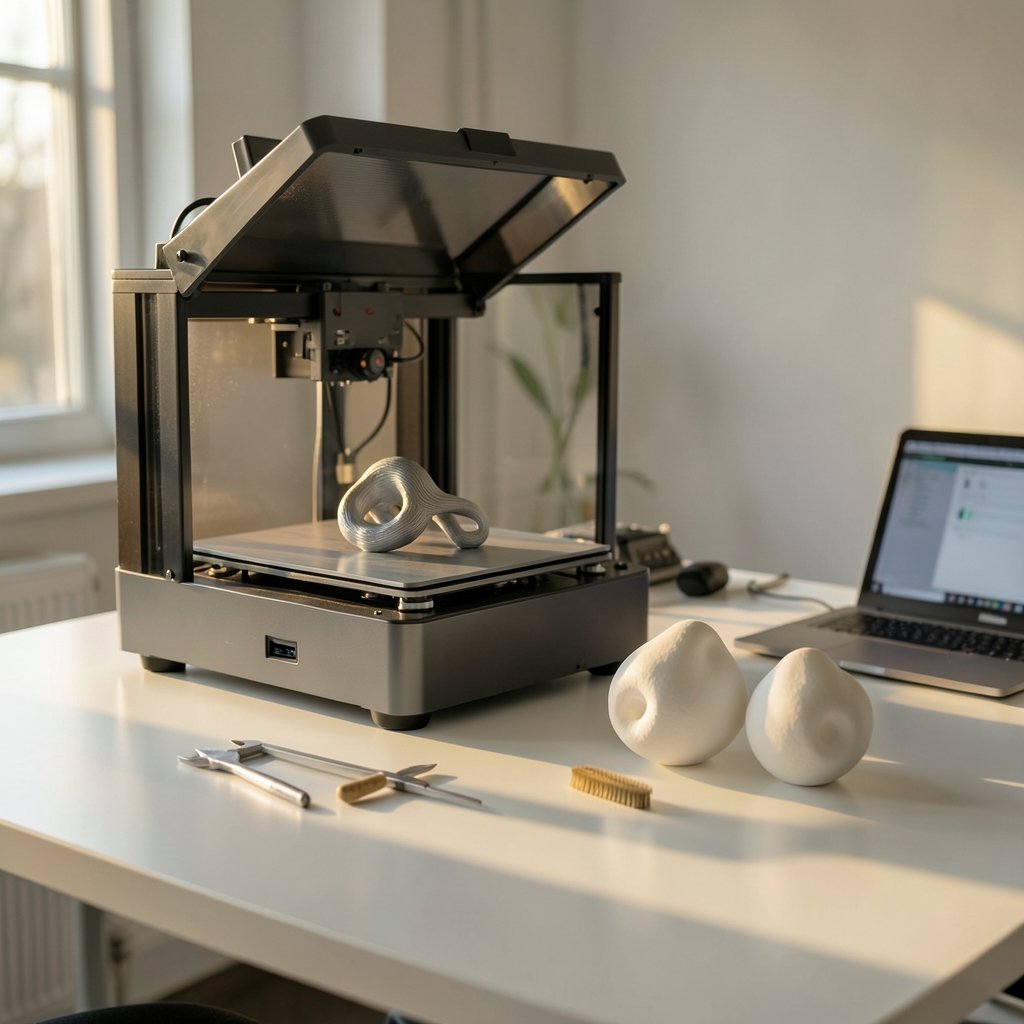
From Screen to Object: 3D Printing as an Art Medium
Fused deposition modeling (FDM) was patented by S. Scott Crump in 1989 and later commercialized by Stratasys. Artists have used FDM and resin printing for sculpture since the 2000s and 2010s. Precise “first artistic use” claims are unreliable, so be skeptical of anyone who names a definitive pioneer.
What actually works in practice is less glamorous than the hype. Printed sculpture lives or dies on model preparation. Walls need thickness. Overhangs need support. Hollow models need drainage holes if they will be resin-printed. A gorgeous digital sculpt with zero wall thickness will fail on the printer every time.
Scanning the Real World Into 3D
Photogrammetry reconstructs 3D models from multiple 2D photographs. It is a standard method in digital 3D art and in cultural-heritage digitization. The method predates digital computing, with roots in 19th-century surveying.
For artists, photogrammetry is a bridge. It lets a sculptor capture a real object, a landscape, or a face, then rework it digitally. The practical rule: shoot more overlapping photos than feels necessary, use even lighting, and avoid glossy or transparent surfaces, which confuse the reconstruction.
What Separates Good 3D Art From Great 3D Art
Technical skill gets you a model. Artistry gets you a reaction. A few principles consistently separate the two.
Silhouette first. If a character reads clearly as a black shape, the design works. If it does not, no amount of texture will save it.
Reference over imagination. Professional artists gather photo reference constantly. Fabric folds, skin pores, and metal scratches are studied, not invented.
Restraint in lighting. Beginners often light everything brightly. Experienced artists use shadow to direct attention. A single strong key light frequently beats five weak ones.
Composition still applies. Rules of framing, negative space, and focal points do not disappear because the medium is digital.
Common Mistakes Beginners Make
Practical experience reveals the same errors again and again. Avoiding them saves months.
- Skipping fundamentals for software tricks. Learning every menu in Blender before understanding form and light produces technically busy, visually weak work.
- Ignoring topology. A model that looks fine in a still image can deform badly once animated. Clean edge flow matters.
- Over-detailing early. Adding fine surface detail before the big shapes work is like decorating a house before the walls are up.
- Neglecting scale. Real-world dimensions matter for printing, rendering, and realism. A chair modeled at the wrong scale looks wrong even if every edge is perfect.
- Rendering once and calling it done. Iteration is the job. Professionals render, critique, adjust, and repeat.
- Chasing trends over craft. Whatever tool is fashionable this year, the underlying skills of form, color, and light transfer everywhere.
What actually works is slower and steadier: finish small projects completely, study real objects, and get feedback from people who will be honest.
Real-Time 3D and Installation Art
One of the most exciting shifts in 3D artistic practice is the move into physical space. Real-time engines let artists build environments that respond to viewers. Projection mapping, interactive installations, and virtual production stages all rely on the same core skills: modeling, lighting, and performance optimization.
The catch is performance. A scene that renders beautifully in a still frame at one frame per second will fail in real time. Artists working in this space learn to balance polygon counts, texture sizes, and lighting complexity against frame rate. It is a different discipline from offline rendering, and it rewards people who plan ahead.
How to Start Learning 3D Art
The path in is more accessible than ever, and the sequence matters.
- Pick one tool and stay with it. Blender is free and covers the whole pipeline, which makes it a strong first choice.
- Learn the big shapes before the small ones. Spend weeks on simple objects: a mug, a chair, a fruit. Get proportions right.
- Study lighting separately. Light is half the image and the most under-practiced skill.
- Finish projects, even small ones. A completed simple scene teaches more than ten abandoned ambitious ones.
- Share work and seek critique. Feedback accelerates growth faster than tutorials alone.
- Learn one export format well. Understanding glTF for sharing and STL for printing removes a lot of frustration later.
For anyone building a portfolio or a studio presence, a clean, well-organized site helps. Artists often showcase process shots alongside final renders, and platforms like can serve as a home base for that kind of presentation.
Conclusion
3D artistic work rewards patience more than raw talent. The field spans six decades, from Sketchpad’s first interactive drawing to real-time installations and printed sculpture. The tools keep changing, but the fundamentals do not: strong form, honest light, and a willingness to iterate.
Whether the goal is a game asset, a gallery installation, or a printed object on a shelf, the same habits carry you forward. Learn the shapes. Study the light. Finish the work. The rest is practice.
Frequently Asked Questions
What does 3D artistic mean?
It refers to art made with three-dimensional form. That includes physical sculpture and installation, but in modern usage it usually means computer-generated 3D graphics: models built in software, then textured, lit, and rendered or displayed in real time. There is no single authoritative definition, so the scope depends on context.
Do I need expensive software to make 3D art?
No. Blender is free, open-source, and covers modeling, sculpting, animation, and rendering in one package. It was first released in 1994 and became free and open-source in 2002. Many professional studios use it alongside paid tools, so cost is not the barrier it once was.
What is the difference between 3D modeling and 3D sculpting?
Modeling builds shapes by manipulating vertices, edges, and faces, which suits hard surfaces and precise forms. Sculpting works more like clay, pushing and pulling a dense mesh, which suits organic shapes like characters. Most artists use both depending on the project.
Can 3D art be printed as a physical object?
Yes. STL is a de facto standard format for 3D-printable models, encoding surface geometry as triangles. Fused deposition modeling, patented by S. Scott Crump in 1989, is one common printing method. Artists have used FDM and resin printing for sculpture since the 2000s and 2010s.
What is glTF and why does it matter?
glTF, the GL Transmission Format, is an open, royalty-free standard for transmitting 3D scenes and models, developed by the Khronos Group. Version 2.0 arrived in 2017. It is often called the “JPEG of 3D” because it makes sharing 3D content between applications far simpler.
How long does it take to get good at 3D art?
It depends on goals and consistency. Learning basic modeling and lighting takes weeks of regular practice. Producing portfolio-quality work usually takes months to a few years. Finishing small projects completely and seeking honest critique speeds up progress more than collecting tutorials.



