
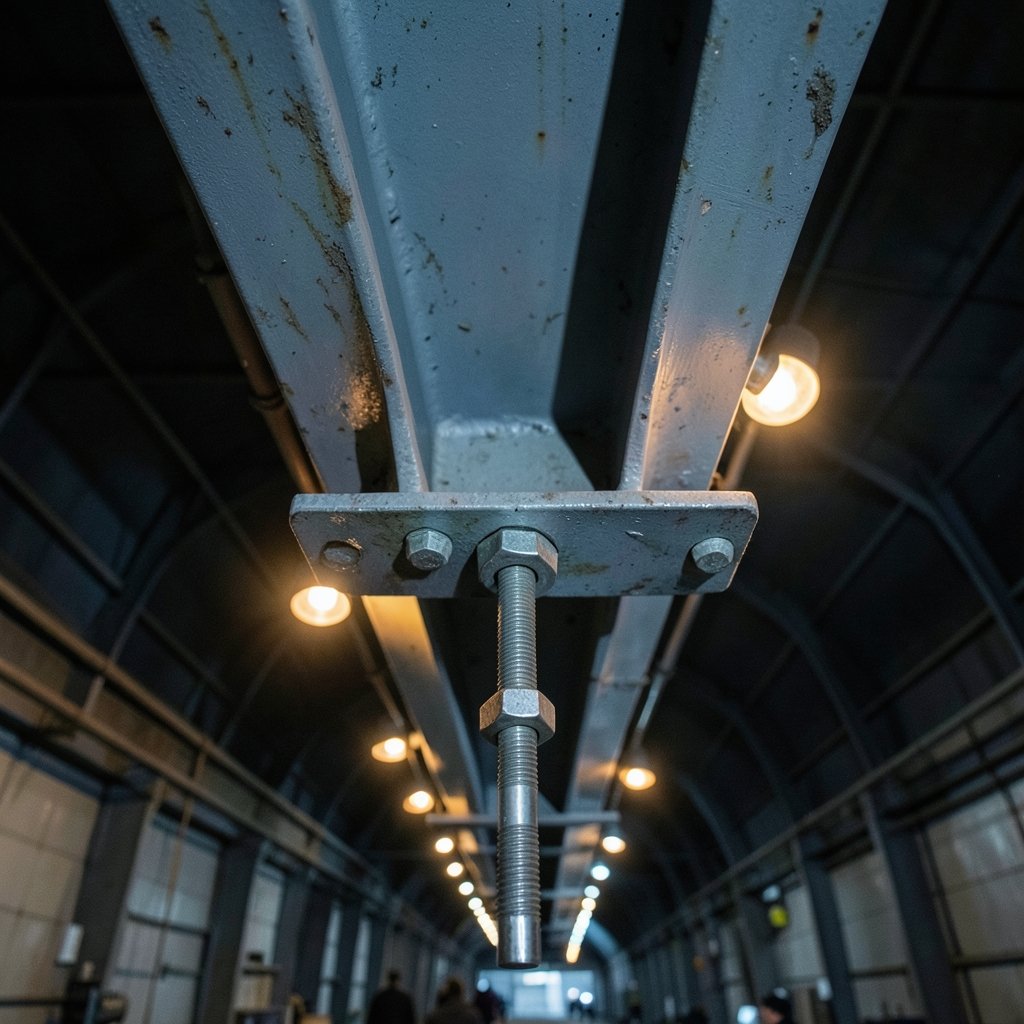
What holds a heavy pipe, a bundle of conduit, or a cable tray to the underside of a steel beam without a single drilled hole or weld? For a huge share of mechanical, electrical, and plumbing work, the answer is a beam clamp — a small, inexpensive fitting that quietly carries a surprising amount of load. Yet plenty of installations go wrong because someone treated a clamp as a generic piece of hardware instead of an engineered part of a support assembly.
This guide walks through what beam clamps actually do, how they are rated, where the standards get murky, and the mistakes that show up again and again on real jobs.
What a beam clamp actually is
A beam clamp is a hardware fitting that attaches a load to the flange or web of a structural steel beam without drilling, welding, or otherwise altering the beam. The load is usually a hanger rod, a pipe, a run of conduit, or a cable support. The clamp grips the steel, and a rod or fastener hangs from the clamp.
That definition matters because the term is ambiguous. In rigging and lifting, “beam clamp” also describes a load-rated device that attaches a hoist or a suspended load to an I-beam. Those are lifting devices governed by different safety rules than everyday MEP supports. This article focuses on the MEP support sense — the clamps you see holding pipe hangers and conduit runs — but the distinction is worth keeping in mind whenever someone hands you a catalog.
Most beam clamps grip the flange (the horizontal plate at the top or bottom of the beam). A smaller family grips the web (the vertical section). Flange clamps are typically rated by flange thickness range and flange width, which means a clamp that fits one beam size may not fit another. That single fact causes more field problems than almost anything else.
Flange clamps vs. web clamps: a quick comparison
| Feature | Flange clamp | Web clamp |
|---|---|---|
| What it grips | Top or bottom flange | Vertical web |
| Typical use | Hanger rods, pipe, conduit below a beam | Loads that must sit closer to the beam center |
| Sizing basis | Flange thickness range and flange width | Web thickness |
| Field flexibility | Can often slide along the flange before tightening | Position is more fixed once installed |
| Common failure mode | Wrong flange thickness, over-tightening | Poor fit on tapered or irregular webs |
The practical takeaway: match the clamp to the beam, not the other way around. Beam dimensions and flange thicknesses are tabulated in the AISC Steel Construction Manual, which is the reference most engineers reach for when they need to know what a given W-shape actually measures.
Load ratings are assembly ratings, not clamp ratings
Here is the point that separates a safe installation from a questionable one. A clamp’s working load limit depends on the clamp, the beam, the rod, and the attachment method together — not on the clamp alone. Manufacturers publish load tables, and there is no universal “beam clamp rating” that applies across brands or configurations.
Three consequences follow:
- Never compare clamps across manufacturers by number alone. A clamp rated for a given load by one maker may carry a different rating from another because the test setup, safety factor, and beam assumptions differ.
- Read the table, not the headline number. The rating often changes with flange thickness, rod diameter, and whether the load is static or vibrating.
- Treat the rod and the attachment as part of the system. A clamp rated well above the load is useless if the rod or the hanger below it is undersized.
If you take one habit from this article, make it this: keep the manufacturer’s load table on site and check it before the first clamp goes up, not after the inspector arrives.
Where the standards get complicated
Ask five people which standard governs beam clamps and you may get five answers. The honest position is that no single standard clearly governs “beam clamp” as a category. Coverage is split across several frameworks:
- Piping. Hardware for supporting piping is often discussed alongside MSS SP-58 (pipe hangers and supports — materials, design, and manufacture) and MSS SP-69 (selection and application). Whether either standard explicitly covers beam clamps is something you should confirm against the standard’s stated scope rather than assume.
- Electrical. Beam clamps are widely used to support conduit and raceways. Support spacing and means of support are addressed in NFPA 70, the National Electrical Code, particularly in the wiring methods articles and the articles covering rigid metal conduit and electrical metallic tubing. Verify the exact article numbers against the edition your jurisdiction enforces.
- Structural. The beam shapes and flange dimensions that clamps must fit come from the AISC Steel Construction Manual.
- Rigging and lifting. Load-rated lifting clamps fall under a different set of rules entirely, including OSHA rigging equipment requirements and the ASME B30 series for cranes and rigging.
The practical implication is that you follow the framework that matches your trade and your jurisdiction, and you let the manufacturer’s published data fill in the gaps. A clamp is a small part, but it sits at the intersection of four industries that do not always talk to each other.
Materials and finishes
Most beam clamps are made from steel with a galvanized or zinc-plated finish. The finish is not cosmetic; it is the corrosion plan. In corrosive environments, stainless steel versions are common. Some conduit supports use non-metallic components.
A few field notes on materials:
- Match the finish to the environment. A zinc-plated clamp in a wash-down area or a coastal plant will not last like a hot-dip galvanized or stainless part.
- Watch for dissimilar metal contact. Mixing finishes in a damp location invites galvanic corrosion at exactly the point you cannot see once the ceiling closes up.
- Do not substitute a lighter-duty clamp for a heavier one just because it fits. Fit and capacity are two different questions.
Installation: what actually works
Good beam clamp work is mostly about discipline. The steps below reflect what experienced installers do consistently.
- Identify the beam first. Measure flange width and flange thickness. Do not eyeball it, and do not assume a beam from a drawing matches what was actually erected.
- Select the clamp from the load table. Confirm the clamp’s flange range covers your measured beam, and confirm the rating covers your load with an appropriate margin for your application.
- Check the rod and the hanger. The clamp is one link in a chain. Verify the rod diameter, the hanger, and the attachment below it.
- Set the clamp position before tightening. Many flange clamps can be slid along the flange to the right spot; once tightened, moving them is a nuisance.
- Torque to the manufacturer’s specification. Set-screw and jaw-type clamps have specified torque values. This is where most damage happens.
- Inspect after the first load is applied. A quick visual check catches a clamp that shifted or a rod that is not hanging plumb.
The most common mistake is over-tightening. A flange clamp cranked down past its specification can deform the flange or damage the clamp itself, and neither problem is obvious until something sags. The second most common mistake is using a clamp outside its flange thickness range because it “seemed to fit.” A clamp that is loose on a thin flange or that cannot close on a thick one is not installed, no matter how tight the bolt feels.
A third mistake is subtler: forgetting that the beam may not be where the drawing says it is. Field measurement beats drawing assumptions every time.
Seismic and vibration considerations
In seismic zones or high-vibration installations, beam clamps are often used as part of a restraint or seismic bracing system rather than as simple gravity supports. That changes the design question. A clamp that holds a pipe’s dead weight is not automatically qualified to resist lateral movement during an event.
If your project has seismic requirements, the clamp becomes one component of a braced assembly, and the bracing design governs. ASCE 7 is the reference most engineers work from for seismic loads. Do not improvise restraint details from a gravity-support catalog page.
Vibration is its own problem. In compressor rooms, near rotating equipment, or on long conduit runs, vibration can work a set screw loose over time. Specifying a clamp with a positive locking feature, or adding a periodic inspection to the maintenance schedule, is cheap insurance.
Beam clamps in electrical work
Electrical contractors use beam clamps constantly, and the workflow has its own rhythm. Conduit and raceway must be supported at intervals set by code, and beam clamps are one of the standard means of support. The practical details that matter:
- Support spacing is code-driven. Check the current edition of NFPA 70 for the wiring method you are installing.
- Conduit fill and weight add up. A large bundle of conduits on a single clamp point deserves a second look at the load table.
- Coordination with other trades matters. A clamp installed before the sprinkler contractor arrives may end up exactly where a pipe needs to go. Layout early.
Teams that manage both mechanical and electrical scopes often find that the same clamp-selection discipline pays off twice. If you are also weighing backend tooling for a game or simulation project, the same logic of matching a component to a documented specification shows up in Unity Gaming Services vs PlayFab vs Beamable: 2027 Guide – occcy, where the lesson is that published limits beat assumptions.
Buying and specifying: a checklist
When you specify or order beam clamps, a short checklist prevents most returns and rework:
| Question | Why it matters |
|---|---|
| What is the measured flange width and thickness? | Determines whether the clamp fits at all |
| What is the total load, including rod and hanger? | Determines the required rating |
| Is the environment corrosive? | Determines finish or material |
| Is there seismic or vibration exposure? | Determines whether a restraint system is needed |
| What does the manufacturer’s load table say for this configuration? | The only rating that counts |
| Is this an MEP support or a lifting device? | Determines which safety framework applies |
That last row is easy to skip and important to answer. A clamp sold for supporting pipe and a clamp sold for lifting a load are different products with different rules, even when they look similar on a shelf.
Workflow differences between platforms and products also reward careful reading of documentation rather than assumptions, a theme that runs through Playfab vs beamable vs accelbyte workflow differences that. The parallel is not exact, but the discipline is: read the spec sheet, then decide.
Common questions from the field
Experienced installers tend to converge on a few practical rules. Keep a torque wrench handy for set-screw clamps. Photograph the installation before the ceiling closes up, because the next trade will not know what is behind the drywall. Label the beam size on your layout drawings so the next person does not have to measure again. And when a clamp does not fit, stop and get the right one rather than forcing it. The few minutes you save are never worth the callback.
Conclusion
A beam clamp is a small, cheap part that carries real responsibility. It connects a load to structural steel without altering the beam, which is exactly why it is so widely used and exactly why it deserves more respect than it usually gets. The rules that matter are not complicated: measure the beam, read the manufacturer’s load table, match the finish to the environment, torque to specification, and know whether you are installing an MEP support or a lifting device.
The standards picture is genuinely fragmented across piping, electrical, structural, and rigging frameworks, and no single authority covers the category cleanly. That is not a reason to guess. It is a reason to lean on published data and to verify the scope of any standard before you cite it. Get those basics right, and the humble beam clamp will do its job for decades without anyone noticing it is there.
Frequently asked questions
What is a beam clamp used for?
A beam clamp attaches a load — a hanger rod, pipe, conduit, or cable support — to the flange or web of a structural steel beam without drilling or welding. It is a standard support method in mechanical, electrical, and plumbing installations.
How much weight can a beam clamp hold?
There is no universal answer. A clamp’s working load limit depends on the clamp, the beam, the rod, and the attachment method together. Manufacturers publish load tables for specific configurations, and ratings are not directly comparable across brands without checking each table.
Can I use a beam clamp on any steel beam?
No. Flange clamps are rated by flange thickness range and flange width, so a clamp that fits one beam may not fit another. Measure the actual beam on site rather than relying on drawings, and confirm the clamp’s range covers your measurement.
Do beam clamps need to be welded or drilled?
No. The whole point of a beam clamp is that it attaches without drilling or welding the beam. That said, set-screw and jaw-type clamps have specified torque values, and over-tightening can deform the flange or damage the clamp.
Are beam clamps covered by a single standard?
Not clearly. Coverage is split across piping standards, the National Electrical Code for conduit support, structural steel references for beam dimensions, and rigging rules for load-rated lifting clamps. Verify the scope of any standard before assuming it applies to your clamp.
What is the difference between an MEP beam clamp and a rigging beam clamp?
An MEP beam clamp supports pipe, conduit, or cable and is selected from a manufacturer’s load table. A rigging beam clamp is a load-rated lifting device that attaches a hoist or suspended load to an I-beam, and it falls under different safety rules, including rigging equipment regulations and crane and rigging standards.



