
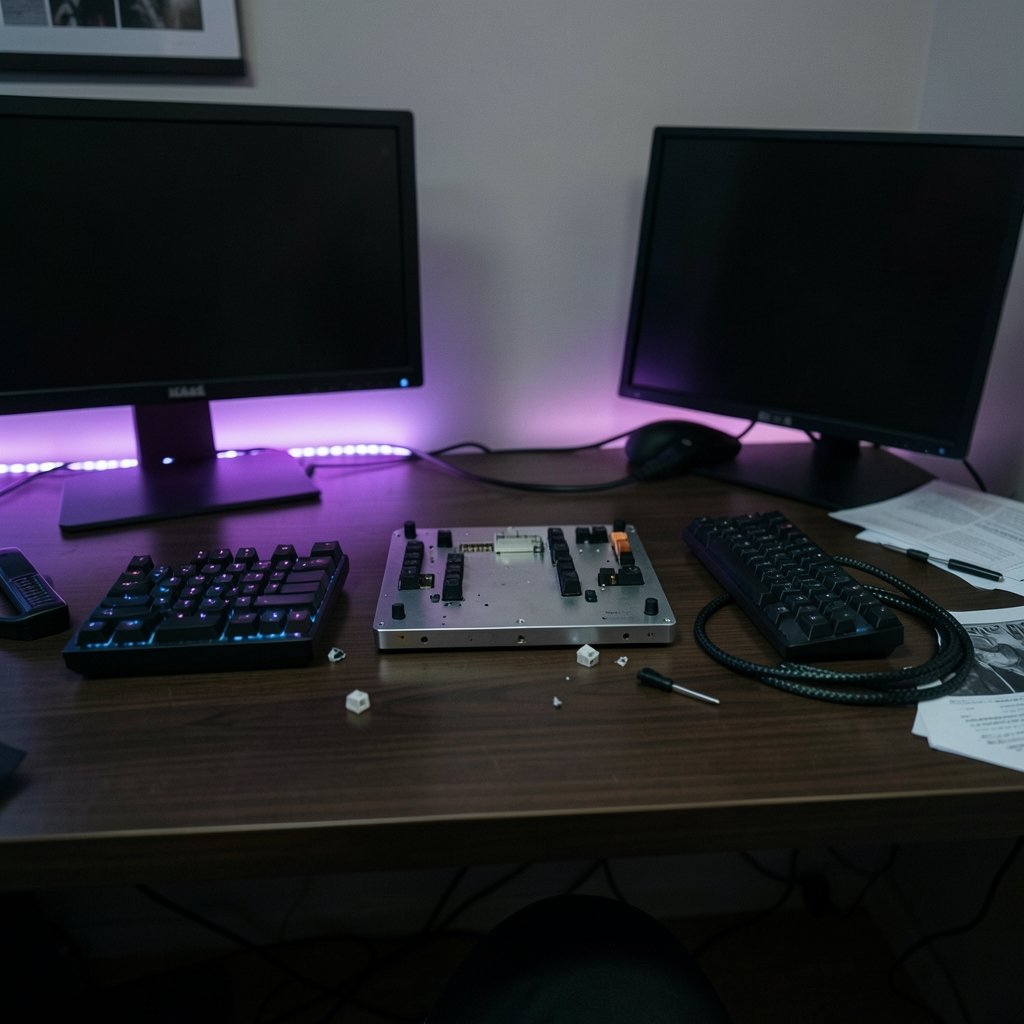
What if the keyboard sitting on your desk is quietly shaping how you work, and you have never noticed? Three names keep surfacing in 2027 keyboard conversations: the Gmmk Eternal, the Kb5, and the V5 Ultra 8k. Each promises a different kind of advantage, and each hides a different kind of friction. The real question is not which one wins a spec sheet. It is which one fits the way you actually type, code, game, and switch between tasks all day.
Here is the honest starting point: these three model names are hard to verify. The GMMK family from Glorious is real and well documented, with hot-swappable boards configured through Glorious Core software. The other two names are ambiguous. “Kb5” could mean a Keychron variant, a bare kit from a parts vendor, or something newer. “V5 Ultra 8k” looks like a Keychron V5 with an 8K polling suffix, but that combination is not confirmed. So this article focuses on the workflow factors that separate these product families, not on invented specs. That approach will serve you better anyway, because the differences that matter in daily use are rarely the ones on the marketing banner.
Why the firmware matters more than the model name
Ask any long-time keyboard tinkerer what they regret, and the answer is usually software, not hardware. A board with great switches but locked-down firmware becomes a chore the moment your workflow changes.
Firmware support is the single biggest divider between these keyboards. Boards built on QMK, VIA, or ZMK let you remap keys, build layers, record macros, and tune tap-hold behavior in a browser or directly in firmware. The configuration lives with the hardware, not with a vendor’s app. Vendor-only software, like Glorious Core or Razer Synapse, ties customization to that specific application and that specific operating system. If the vendor stops updating the app, your custom layout can become a museum piece.
This is not a small distinction. It changes how you troubleshoot, how you migrate to a new machine, and how confident you feel investing hours into a layout. The same logic applies across the whole tooling stack. Teams comparing platforms run into identical tradeoffs, which is why guides like One com vs hostinger workflow differences understand 2027 keep circling back to portability and lock-in rather than raw features.
A practical tip from people who do this daily: before buying, download the configuration tool and try to build your layout in it. If the tool requires an account, an install, or a specific OS version, note that. If it runs in a browser from a config file stored on the keyboard itself, note that too. Ten minutes of testing saves months of annoyance.
What 8K polling actually does for your workday

The “8k” in V5 Ultra 8k refers to polling rate: how many times per second the keyboard reports its state to the computer, up to 8,000 times. It sounds dramatic. It is mostly a gaming feature.
The practical benefit is lower input latency in fast games. For typing, shortcuts, and general office work, the difference between 1,000 Hz and 8,000 Hz is essentially imperceptible to human hands. What you will notice are the costs.
| Factor | 1 kHz board | 8 kHz board |
|---|---|---|
| Typing feel | Unchanged | Unchanged |
| Gaming latency | Good | Slightly better |
| CPU and USB interrupt load | Low | Higher |
| USB port requirements | Any port | Often a dedicated controller or port |
| Wireless battery life | Normal | Often sharply reduced |
| Wired requirement | Optional | Common, or drops to 1 kHz wirelessly |
Many 8K boards are wired-only, or they quietly fall back to 1 kHz over 2.4 GHz and Bluetooth. That fallback is fine, but it means the headline feature disappears exactly when you go wireless. If your workflow is a laptop, a café table, and a bag, an 8K board may deliver nothing but a heavier cable.
The lesson generalizes. Feature comparisons almost always hide a workflow cost, which is why breakdowns like Rabbitmq vs kafka workflow differences understand 2027 spend so much time on operational overhead instead of throughput numbers. The same discipline applies to keyboards.
Hot-swap, layout, and the ergonomics you feel every hour
Here is the uncomfortable truth: layout and switch choice affect your body more than any polling spec. A 75% board, a TKL, and a 65% board put different keys under different fingers. A 5-pin hot-swap socket lets you change switches without soldering, which means you can fix a mistake in feel without buying a new keyboard.
The GMMK line built its reputation on exactly this: hot-swappable sockets, gasket or tray mounting, and per-key RGB, all configured through vendor software. That is a genuinely friendly entry point. The catch is the software dependency described above.
Hall-effect, or magnetic, switches are the other big 2027 story. They allow adjustable actuation and rapid trigger, with actuation points commonly ranging from about 0.1 mm to 4.0 mm depending on the model. For gaming, that matters. For office workflows, it is marginal. Most people type at a comfortable depth and never touch the setting again.
A common mistake: buying an 8K hall-effect board for spreadsheets. The features are real, but they solve a problem the buyer does not have. A better sequence is to pick the layout first, then the switch type, then the firmware, and only then the polling rate.
The software support window is the hidden risk
Vendors drop old models. That is a pattern, not a scandal. When a utility stops receiving updates, older boards can lose configuration access on new operating systems. Open firmware avoids this because the community maintains it and your keymap is portable.
If you plan to keep a keyboard for three to five years, check the support policy before buying. Ask whether the config tool works offline, whether layouts export to a file, and whether the board supports QMK or VIA. Those three answers predict your experience far better than any review score.
The same portability question shows up in development tooling. Editors and AI assistants lock users in or set them free depending on how configs and workflows transfer, a theme explored in Kiro vs cursor workflow differences understand 2027 and again in Cline vs cursor workflow differences understand 2027. Keyboards are no different. The tool that lets you leave is the tool you can trust to stay.
How the three names map to real workflows
Because the exact 2027 SKUs are unconfirmed, the most useful comparison is by workflow profile. Treat these as archetypes, then verify the specific model against official documentation.
| Workflow profile | Likely fit | Watch out for |
|---|---|---|
| Office typing, light gaming | Hot-swap board with solid layout | Proprietary software lock-in |
| Heavy gaming, latency focus | 8K polling, hall-effect switches | Wired-only use, battery drain |
| Multi-OS, multi-machine | QMK or VIA firmware | Vendor apps tied to one OS |
| Tinkerer and customizer | Open firmware, 5-pin hot-swap | Time cost of building layouts |
| Travel and hybrid work | Compact layout, reliable wireless | 8K features vanishing on wireless |
The Gmmk Eternal, if it follows the GMMK lineage, likely leans on hot-swap convenience and vendor software. That suits people who want a good board without learning firmware. The Kb5 and V5 Ultra 8k, if they follow QMK-style kits and Keychron’s V-series conventions, likely lean toward open configuration and, in the Ultra case, high polling. That suits people who enjoy tuning.
Neither path is wrong. They are different relationships with your tools.
Practical setup advice that actually works
First-hand experience from the keyboard community points to a handful of habits that separate happy owners from frustrated ones.
- Write down your five most-used shortcuts before you shop. Then check whether the layout places them comfortably.
- Test the configuration tool before purchase, as described above.
- Buy one set of spare switches. Hot-swap sockets make swapping trivial, and a single failing switch should not sideline the board.
- Keep a backup of your keymap file in cloud storage. If the vendor app dies, you still have your layout.
- If you buy an 8K board, test it wired and wireless. Confirm what polling rate you actually get on each connection.
- Give a new layout two weeks before judging it. Muscle memory lies for the first few days.
Mistakes are predictable. People overpay for polling they cannot feel. They buy a layout that fights their hands. They invest in a custom keymap on software that gets abandoned. They also forget that a keyboard is a long-term relationship, not a one-week novelty.
Where the rest of your stack fits in
A keyboard does not work alone. It sits inside a workflow of editors, databases, and deployment tools, and the same portability logic runs through all of them. Teams that choose open, exportable configurations sleep better, whether the decision is a database engine, covered in Sql vs nosql workflow differences understand 2027, or a language toolchain, covered in Rust vs c workflow differences understand 2027. Even hosted development environments raise the question, as Replit vs cursor workflow differences understand 2027 shows.
The pattern is consistent: the tool that lets you take your configuration with you is the tool that ages well. Apply that lens to the Gmmk Eternal, the Kb5, and the V5 Ultra 8k, and the decision gets simpler.
Conclusion
The Gmmk Eternal, Kb5, and V5 Ultra 8k are less three rivals than three philosophies. One prioritizes convenience and vendor polish. One prioritizes open configuration. One prioritizes raw polling for gamers. In 2027, the winning choice depends on whether you value plug-and-play or portability, and whether 8K polling solves a problem you actually have.
Before you spend money, confirm the specific model exists as described, check its firmware support, and test the configuration tool. Do that, and the keyboard on your desk becomes an asset instead of a compromise. Your fingers will notice the layout long before they notice the polling rate.
FAQ
What does 8K polling actually improve?
It reduces input latency by reporting key states to the computer up to 8,000 times per second instead of 1,000. The benefit is mainly noticeable in fast games. For typing and shortcuts, most people cannot perceive the difference.
Is the Gmmk Eternal a confirmed product?
Not in any reliable documentation available here. The GMMK family from Glorious is well documented across several models, but a specific “Eternal” variant should be verified against official product pages before purchase.
Which matters more, firmware or polling rate?
Firmware, by a wide margin. Open firmware like QMK or VIA lets you remap keys, build layers, and keep your layout portable across machines. Polling rate affects a narrow slice of gaming performance and adds costs.
Are hall-effect switches worth it for office work?
Usually not. Adjustable actuation and rapid trigger help in gaming. For documents and spreadsheets, a comfortable layout and good switches count far more than a tunable actuation point.
Can I change switches without soldering?
Yes, if the board has hot-swap sockets. Five-pin hot-swap sockets are the most flexible, accepting most switch types. Check the socket type before buying switches, since three-pin and five-pin compatibility varies.
How do I protect my custom keymap long term?
Store your layout as an exportable file and prefer boards whose configuration lives in firmware or a portable file. If your setup depends on a vendor app, keep a backup and check that the app still supports your model on current operating systems.



