Can a washing machine that says “Made in USA” still be full of foreign parts? Yes, sometimes. And that gap between the sticker and the reality is exactly why shopping for an American-made washer and dryer takes more than reading a patriotic slogan on the control panel. (Old money vs new money inherited self made wealth really)
The laundry aisle is crowded with brands that talk up American jobs, American factories, and American steel. Some of those claims hold up under scrutiny. Others stretch the truth through assembly lines that bolt together imported components. This guide cuts through the noise. It explains the legal standard behind the label, names the brands that actually build laundry machines on U.S. soil, and shows you how to verify a claim before you spend a thousand dollars or more.
What “Made in USA” Legally Requires
The phrase is not free speech for marketers. The Federal Trade Commission enforces a Made in USA Labeling Rule that took effect in August 2021, and it sets a strict bar: “all or virtually all” of a product’s significant inputs and processing must be domestic.
In practice, that means the machine’s major components and the labor that turns them into a washer should come from the United States. A company that imports drums, motors, and circuit boards and merely screws them together in a Kentucky warehouse generally cannot use an unqualified “Made in USA” claim. It can say “Assembled in USA” or “Made in USA with imported parts,” which are honest descriptions but not the same thing.
Here is where buyers get tripped up. A flag decal, a red-white-and-blue box, or a tagline like “American values” is not a legal origin claim. Companies use those cues because they work emotionally, but they carry no enforcement weight. The only phrase with teeth is the qualified or unqualified Made in USA statement, and even that depends on the company being truthful. The FTC acts on complaints, so enforcement is reactive rather than automatic.
Practical tip: When a product page is vague, look for a specific sentence about domestic content. “Proudly built in America” is marketing. “Made in USA” with a substantiated origin statement is a claim you can hold a company to.
Which Brands Actually Build Laundry Machines in the U.S.
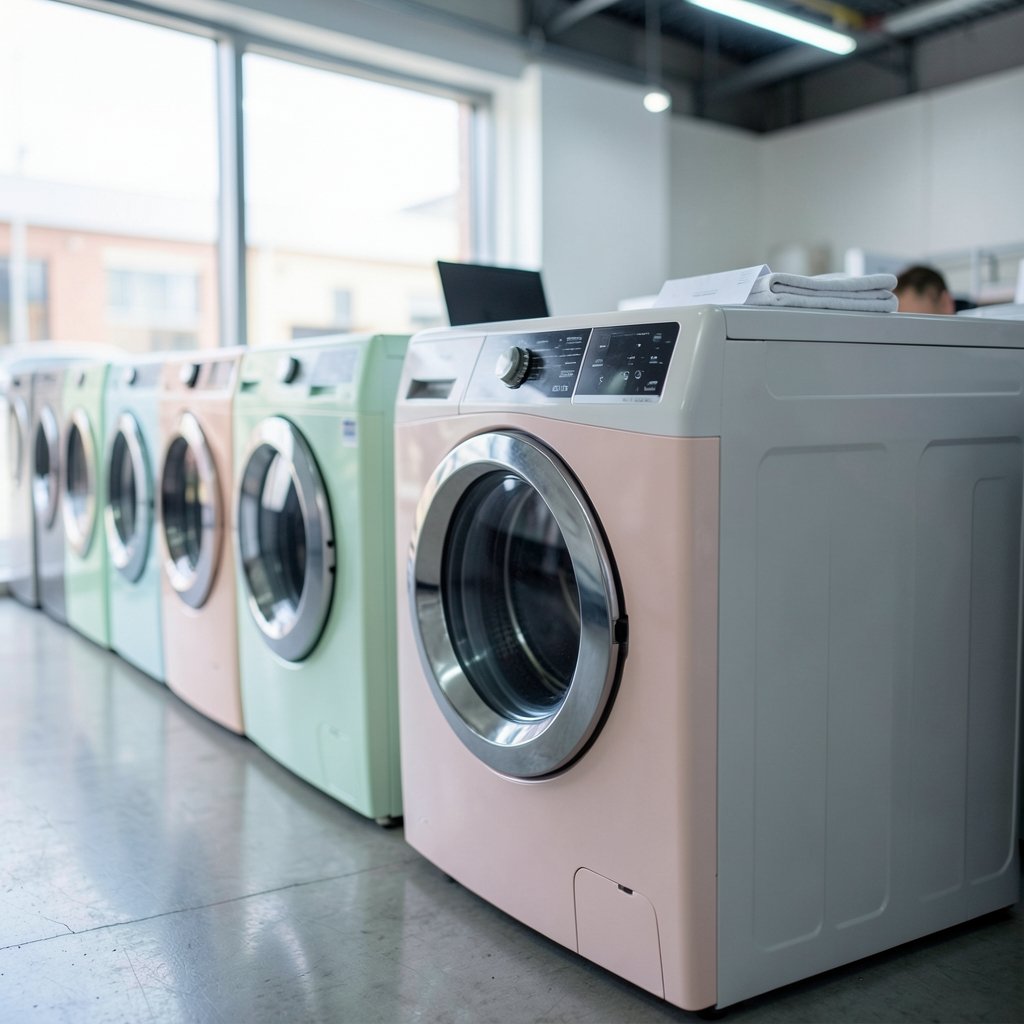
The American laundry market is highly consolidated. A handful of companies control most of the shelf space, and their manufacturing footprints vary widely. Here is how the major players stack up.
| Brand | U.S. Laundry Manufacturing | Ownership | Notes |
|---|---|---|---|
| Whirlpool | Washers in Clyde, Ohio; dryers in Marion, Ohio | U.S.-owned | Largest U.S. appliance maker; Clyde is its biggest washer plant |
| Maytag | Shares Whirlpool’s Ohio production network | U.S.-owned (Whirlpool) | Positioned as a premium Whirlpool brand |
| GE Appliances | Washers and dryers in Louisville, Kentucky | Owned by China’s Haier since 2016 | U.S. factories, foreign parent company |
| Speed Queen | Washers and dryers in Ripon, Wisconsin | U.S.-owned (Alliance Laundry Systems) | Commercial-grade build; strongest “American-made” story |
| Electrolux | Closed its St. Cloud, Minnesota washer plant around 2019 | Foreign-owned | Shifted some U.S. laundry production elsewhere |
| Samsung and LG | Mostly imported; some U.S. assembly expansion | Foreign-owned | LG in Clarksville, Tennessee; Samsung in Newberry, South Carolina |
Whirlpool stands out as the anchor of American laundry manufacturing. Its Clyde, Ohio plant has been described by the company as its largest U.S. washing-machine factory, and the Marion, Ohio dryer plant sits in the same manufacturing corridor. The company also announced in 2024 that it would sell a majority stake in its European appliance business to Arçelik, a move that narrows its focus toward North America. That is corporate strategy, not a manufacturing claim, but it signals where the company sees its future.
GE Appliances presents a more complicated picture. The machines roll off lines in Louisville, Kentucky, and the company has invested in that U.S. laundry production. But Haier, a Chinese company, has owned GE Appliances since 2016. So the factory is American, the workers are American, and the profits flow to a foreign parent. Whether that counts as “American-made” depends on what you care about: jobs on U.S. soil or ownership of the company.
Speed Queen, made by Alliance Laundry Systems, offers the cleanest story for shoppers who want both domestic factories and domestic ownership. The machines are built in Ripon, Wisconsin, and the company is U.S.-owned. If commercial-grade durability matters to you, that combination is hard to beat, and it is worth understanding what you actually get from that build quality.
Why the Label Gets Murky: Tariffs, Ownership, and Assembly
The economics of appliance manufacturing have shifted repeatedly over the past decade, and those shifts explain much of the confusion shoppers feel.
In January 2018, the U.S. imposed Section 201 safeguard tariffs on large residential washers. The tariffs raised the cost of imported machines and were cited by manufacturers as a reason to add or keep U.S. capacity. Some production did move onshore in response. Others simply raised prices. The tariff status has been revisited since, so current rates are worth checking if cost is your main concern.
Ownership adds another layer. A machine built in South Carolina by a Korean company is American-made in the literal sense of factory location, but the brand is not American. A machine built in Ohio by an American company is American through and through. Neither is inherently better, but the distinction matters if your goal is supporting U.S. ownership rather than just U.S. assembly. (Which presidents american money)
Then there is the parts question. Even brands with U.S. factories source some components globally, because the supply chain for motors, electronics, and specialty steel is international. The legal test is whether “all or virtually all” of the significant inputs are domestic, and companies interpret that phrase with varying degrees of strictness.
Common mistake: Assuming a high price tag guarantees American production. Premium pricing often reflects features, brand positioning, or import duties, not domestic content. A $1,400 machine can be assembled abroad while a $900 one comes off an Ohio line.
How to Verify a Claim Before You Buy
You do not need a law degree to check whether a washer is genuinely American-made. A few habits will separate substance from spin.
- Read the origin statement, not the slogan. Look for a specific sentence about where the machine is made. Vague patriotism is a red flag.
- Check the brand’s ownership. A quick search reveals the parent company. This tells you whether profits stay domestic.
- Look up the factory. Reputable brands name their plants. If a company will not say where a model is built, that silence is information.
- Compare model-level sourcing. A brand can build some models domestically and import others. The origin can vary by SKU, so check the specific model you plan to buy.
- Check efficiency separately. Federal efficiency standards and the ENERGY STAR label apply no matter where a machine is built. American-made does not automatically mean efficient, and efficient does not automatically mean American-made.
That last point deserves emphasis. Energy and water standards shape how a washer performs, not where it comes from. A machine can be built in Wisconsin and still be a water hog, or built overseas and be the most efficient unit on the floor. If efficiency is your priority, the efficiency label is the source of truth, not the origin claim.
For shoppers who want to understand how the physical object in their laundry room connects to the broader story of American money and manufacturing, the journey from raw material to finished product is worth a look at how currency and goods actually get made. (Inside money factory u s currency actually gets made)
The Real Trade-Offs of Buying American Laundry Appliances
Choosing a domestically built washer and dryer is not a pure win. It is a set of trade-offs, and honest shopping means understanding them.
The case for American-made: You support U.S. manufacturing jobs, you often get easier access to parts and service, and you may get a machine built to commercial-grade standards. Speed Queen’s reputation rests on exactly this: simpler designs, fewer electronics, and a build meant to last decades rather than a decade. For buyers who hate planned obsolescence, that matters more than a touchscreen.
The case against blind loyalty: Foreign-owned brands often lead on features, efficiency, and price. Samsung and LG have pushed large-capacity drums, smart diagnostics, and heat-pump dryers that rival anything built domestically. If your priority is the lowest energy bill or the most advanced features, an imported machine may serve you better.
There is also a durability question that cuts both ways. A commercial-grade American washer may cost more upfront and last far longer, which changes the math on total cost of ownership. A feature-rich imported machine may cost less and need replacement sooner. Neither path is wrong; they simply optimize for different things.
What actually works in practice: Decide which value matters most before you walk into the store. If it is domestic jobs and repairability, focus on U.S.-owned brands with named factories. If it is efficiency and features, compare efficiency labels and warranty terms across all brands, domestic or not. Trying to maximize every value at once leads to paralysis, and the machine you never buy does not clean any clothes.
What to Look For on the Showroom Floor
The showroom is designed to sell, not to inform. A few concrete checks will keep you oriented.
Look at the model’s origin statement on the spec sheet, not the display card. Ask the salesperson where the specific model is built and watch whether the answer is specific or evasive. Check the warranty length and what it covers, because a long warranty on a domestic machine is a meaningful signal about expected durability. Compare the energy guide numbers side by side rather than trusting the yellow sticker in isolation.
One more practical note: service networks vary by brand. A domestic machine from a company with a deep U.S. service footprint may be easier and cheaper to repair years down the line. That is a real cost, and it rarely appears on the price tag. The same logic applies to any major purchase where repairability matters, from appliances to the vehicles in your driveway.
Conclusion
American-made washers and dryers are real, but the label is not self-enforcing. The FTC’s “all or virtually all” standard gives the phrase legal meaning, yet companies interpret and advertise it with wide latitude. Whirlpool anchors domestic laundry manufacturing in Ohio. Speed Queen offers the cleanest combination of U.S. factories and U.S. ownership. GE Appliances builds in Kentucky under a Chinese parent. Electrolux pulled back from Minnesota. The map is more complicated than any single slogan suggests.
The smart approach is simple. Read the origin statement, check the ownership, name the factory, and separate efficiency from origin. Then decide which trade-off you can live with. A machine that supports American jobs and lasts twenty years is a different purchase than one that saves energy and offers every feature. Both can be right. The mistake is letting a flag decal make the decision for you.
FAQ
Is a “Made in USA” label on a washer legally enforced?
Yes, but enforcement is reactive. The FTC’s Made in USA Labeling Rule, effective August 2021, requires that “all or virtually all” significant inputs and processing be domestic. The agency acts on complaints rather than inspecting every product, so the label is only as reliable as the company behind it. Look for specific origin statements rather than slogans.
Which washer and dryer brands are actually made in America?
Whirlpool builds washers in Clyde, Ohio and dryers in Marion, Ohio. Speed Queen, owned by Alliance Laundry Systems, builds in Ripon, Wisconsin. GE Appliances builds in Louisville, Kentucky, though it is owned by China’s Haier. Samsung and LG mostly import, with some U.S. assembly expansion. Origin can vary by model, so check the specific unit.
Does American-made mean more energy efficient?
No. Efficiency is governed by federal standards and the voluntary ENERGY STAR label, which apply regardless of where a machine is built. An American-made washer can be a water hog, and an imported one can be the most efficient model on the floor. Check the energy guide, not the origin claim.
Why did Electrolux stop making washers in Minnesota?
Electrolux closed its St. Cloud, Minnesota washer plant around 2019 and shifted some U.S. laundry production elsewhere. The closure illustrates that American appliance capacity has shrunk as well as grown over the past decade, driven by consolidation and global supply chain decisions rather than any single cause.
Do tariffs affect whether a washer is American-made?
Tariffs affect cost and sourcing decisions, not the legal definition of American-made. Section 201 safeguard tariffs on large residential washers, imposed in January 2018, raised import costs and were cited as a reason to add or keep U.S. capacity. But a tariff does not make a machine domestic, and its absence does not make one foreign.
How can I tell if a specific model is built in the U.S.?
Check the model’s spec sheet for an origin statement, confirm the parent company’s ownership, and see whether the brand names its factory. If a company will not say where a model is built, treat that as a warning sign. Origin can differ within a brand, so verify the exact model rather than the brand as a whole.