
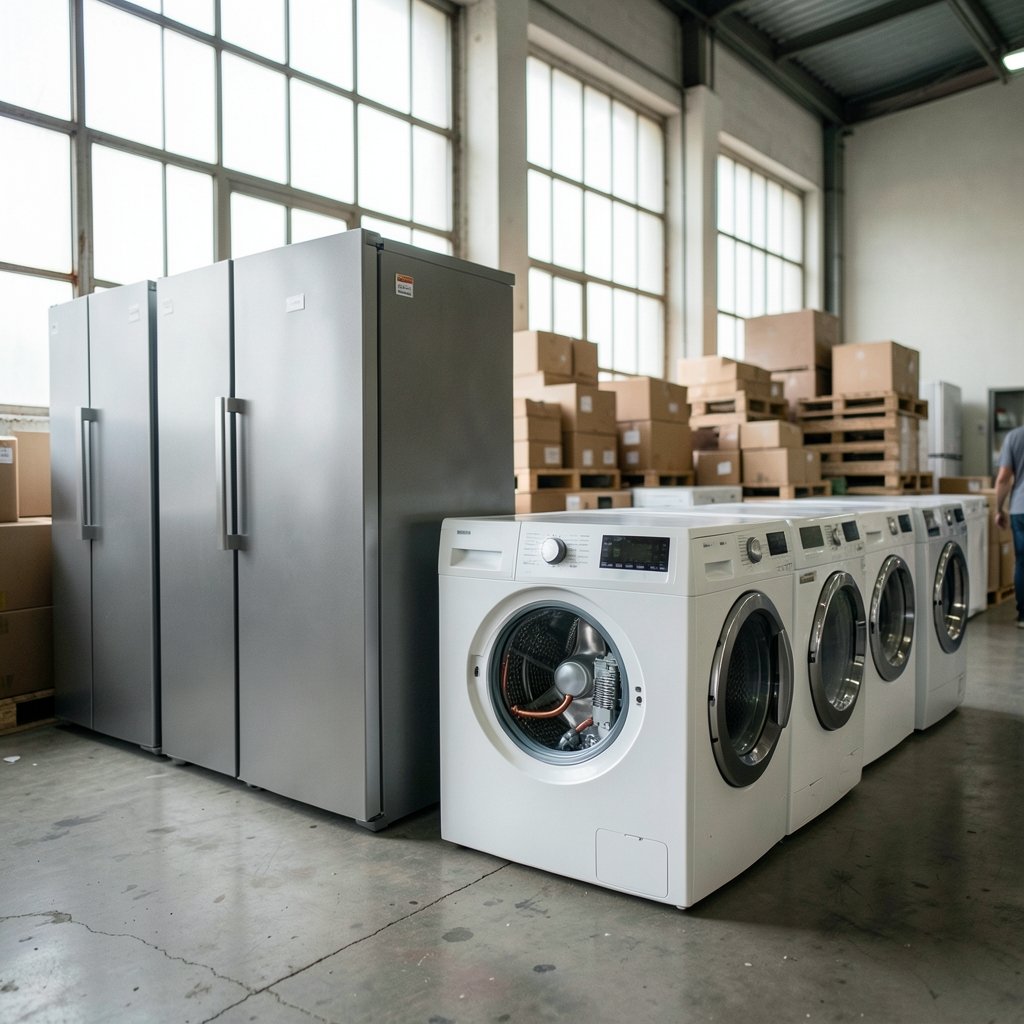
Ever stared at the logo on your washing machine and wondered who actually built it? Here is the surprising truth: the brand on the door and the company behind it are often two very different names. A fridge sold under a familiar American badge may roll out of a factory owned by a Chinese group. A dishwasher with a German logo might come from a Turkish conglomerate. The home appliances industry is a maze of acquisitions, licensing deals, and shared supply chains, and understanding it changes how you shop, compare, and repair.
This guide maps the major home appliance companies, explains how the industry consolidated, and shows what that structure means for buyers. It also covers the regulations shaping the machines, from energy labels to right-to-repair rules, and the practical mistakes people make when they assume a brand name tells the whole story. (Best web accessibility auditing companies startups practical)
The big groups that dominate home appliances
The global major appliances market, sometimes called white goods, is concentrated in a handful of corporate groups. Names that come up again and again include Haier, Whirlpool, Bosch and Siemens through BSH, Electrolux, LG, Samsung, Midea, Panasonic, and Hisense. Market share numbers swing wildly depending on the source, the year, and whether small appliances count, so treat any single percentage with suspicion.
What matters more than a share figure is the ownership map. A few parent companies control dozens of consumer brands, and those brands often compete with each other on the same store shelf. That is not a conspiracy; it is simply how the industry grew through mergers.
| Parent group | Well-known consumer brands | Home base |
|---|---|---|
| Haier | Haier, GE Appliances, Candy, Hoover (Europe) | China |
| Whirlpool | Whirlpool, Maytag, KitchenAid, Amana | United States |
| BSH | Bosch, Siemens, Neff, Gaggenau | Germany |
| Electrolux | Electrolux, Frigidaire, AEG | Sweden |
| LG | LG appliances | South Korea |
| Samsung | Samsung appliances | South Korea |
| Midea | Midea, plus components for other brands | China |
| Hisense | Hisense, plus acquired brands | China |
Whirlpool’s footprint shifted in a big way when it agreed in 2023 to sell its European major-domestic-appliance business to Arçelik, the Turkish manufacturer. The combined entity was later branded Beko Europe, and the deal closed in 2024. That single transaction moved a large chunk of the European market under a new corporate roof, even though shoppers still saw familiar badges on the boxes.
How consolidation reshaped the industry
The past decade has been defined by cross-border deals. The most cited example is Haier’s acquisition of GE’s appliances business for roughly US$5.6 billion, completed in June 2016. Overnight, a Chinese group became the owner of a brand that many American households associate with domestic manufacturing.
Midea took a different route to scale. It is among the world’s largest appliance makers by revenue, but it also supplies components such as compressors to other brands. That means a machine sold by a rival may contain Midea parts inside. Component supply is the quiet backbone of the industry, and it is why two competing brands can share reliability characteristics.
Electrolux, one of the largest makers by units sold, has faced pressure in recent years. Weak consumer demand in Europe and North America led to profit warnings across 2023 and 2024. The lesson for observers is that appliance makers are cyclical businesses tied closely to housing markets, interest rates, and household confidence. When people stop moving house, they stop buying fridges. (How to stop snoring at night home remedies)
LG and Samsung compete fiercely on features, from inverter compressors to smart-home integration. Their appliance divisions report segment results quarterly, and the numbers move around a lot, so anyone quoting revenue should cite the latest earnings release rather than an old headline.
What the corporate structure means for buyers
Here is where the industry map becomes genuinely useful. A buyer who understands ownership can make smarter choices about price, parts availability, and service.
Shared platforms save you money. When one group owns several brands, lower-tier brands often use the same internal components as premium ones. You may pay extra for finishes, electronics, and warranty terms rather than fundamentally different engineering.
Brand loyalty is not company loyalty. Recommending “the brand that lasted 20 years” works only if the same company still owns that brand and still builds it the same way. Ownership changes reset the clock.
Service networks follow the parent. A brand’s repair network is usually managed at group level. Before buying, check who handles warranty claims in your country and how long spare parts stay available.
For households building a connected home, the parent company also matters because smart features depend on software ecosystems. Compatibility, privacy, and cost vary widely between platforms, and a comparison of Homekit vs google home vs alexa compatibility privacy cost is worth reading before committing to one brand’s app for every appliance.
Practical tip: photograph the model and serial plate inside the door before you need it. When a repair is needed, the model number, not the brand name, is what gets the right part shipped.
The regulations steering appliance design
Appliance companies do not design in a vacuum. Two regulatory shifts are reshaping what gets built and sold.
The first is energy labelling. Since 1 March 2021, the EU’s rescaled energy label applies to dishwashers, washing machines, washer-dryers, refrigerators, and TVs. The scale runs A to G with no A+ or A++ classes, which removed the top-heavy grades that had made almost everything look efficient. Manufacturers had to re-engineer products to earn a good grade again, and that is why a new machine may look less efficient on paper than the old label suggested.
The second is repair rights. EU rules adopted in 2024, under Directive (EU) 2024/1799, require repairs at reasonable prices and extend producer obligations for certain goods, including some appliances. The direction of travel is clear: products must be repairable for longer, and makers must supply parts and information.
In the United States, minimum energy-conservation standards are set under the Energy Policy and Conservation Act of 1975, with updates arriving through rulemaking. The pace of those updates has shifted with administrations, which creates planning headaches for manufacturers and uncertainty for buyers comparing labels across years.
These rules matter to shoppers because they change the trade-offs. A cheaper machine with a poor energy grade can cost more over its life. A machine with a strong repair obligation may be worth fixing instead of replacing.
Where the value sits: major versus small appliances
One reason market-size claims confuse people is definition. “Home appliances” can mean major white goods, small kitchen appliances, or everything including consumer electronics. Always ask which definition a figure uses.
Major appliances are heavy, installation-heavy, and long-lived. They are sold through retailers, builders, and property managers, and they are sensitive to housing cycles. Small appliances are lighter, cheaper, and more trend-driven, which is why the two categories behave like different industries.
For anyone tracking the business side, the practical advice is to separate the categories in any analysis. Startups and analysts often blur them, and the result is misleading. If you are building a product or service around this sector, the same discipline applies as in other technical fields, where choosing the right partners early pays off, much like startups should choose data analytics consulting companies with domain knowledge before scaling.
There is also a consumer-side angle. A household replacing a kitchen often discovers that premium small appliances, such as a quality espresso machine, deliver more daily satisfaction per dollar than an upgraded major appliance. Reviews of the best espresso machine for home show how much the small-appliance segment has matured.
Smart features and the platform question
Connectivity has become the main battleground. Every major group now ships appliances with apps, voice control, and remote diagnostics. The hardware is often similar; the difference is the ecosystem.
Buyers should ask three questions before paying for smart features. First, does the appliance work fully without the app? Second, does the manufacturer promise software support for a defined number of years? Third, can the device talk to the platforms you already use?
The answers vary by brand and region. A machine that integrates smoothly with one voice assistant may need workarounds with another. Reading a comparison of Homekit vs google home vs alexa compatibility privacy cost helps set expectations before purchase rather than after.
Another practical consideration is privacy. Connected appliances collect usage data, and policies differ. A buyer who cares about this should read the privacy terms the same way they read the warranty.
Common mistakes when choosing an appliance company
A few errors show up again and again in practice.
- Buying on brand alone. Check the parent company, the model’s repair record, and local parts availability instead of trusting a logo.
- Ignoring the energy label’s new scale. The rescaled A to G label is not comparable to the old A+++ system. Compare like with like.
- Skipping the service question. A great price means little if the nearest authorized repairer is three hours away.
- Assuming smart features will last. Software support windows are shorter than appliance lifespans. Plan for the app to disappear before the machine does.
- Overlooking installation costs. Delivery, plumbing, and old-unit removal can add a meaningful amount to the sticker price.
- Forgetting about repairability. Under the new EU rules, repairable products hold value longer. Check whether parts and manuals are available.
What actually works is boring but effective: measure the space, confirm the model’s dimensions, check the warranty terms in your country, and read the repair obligations that apply to you.
Conclusion
The home appliances industry is less a collection of familiar brand names and more a small club of global groups running dozens of labels. Haier owns GE Appliances. Whirlpool’s European business moved to Beko Europe. BSH runs Bosch and Siemens. Midea builds machines and the parts inside rivals’ machines. Understanding that structure helps shoppers see past the badge, compare what is actually inside, and weigh energy grades, repair rights, and software support with clear eyes.
The next time a salesperson promises that a particular logo means quality, ask a better question: who owns it, who fixes it, and how long will it last? That is where the real answer lives.
FAQ
Who owns the biggest home appliance brands?
Ownership is concentrated in a few groups. Haier owns GE Appliances, Whirlpool owns Maytag and KitchenAid, BSH owns Bosch and Siemens, and Electrolux owns Frigidaire and AEG. LG, Samsung, Midea, Panasonic, and Hisense are also major players. Because brands change hands, always check current ownership before relying on a reputation.
Did Haier really buy GE Appliances?
Yes. Haier Group completed its acquisition of GE’s appliances business for about US$5.6 billion in June 2016. The deal made a Chinese group the owner of a brand long associated with American homes. It is one of the clearest examples of how global the appliance business has become.
What changed with the new EU energy label?
Since 1 March 2021, the rescaled A to G label applies to dishwashers, washing machines, washer-dryers, refrigerators, and TVs. The old A+ and A++ classes were removed, so a product that looked top-rated under the old system may sit lower on the new scale. The change was designed to push manufacturers to improve efficiency again.
Do right-to-repair rules cover appliances?
The EU’s right-to-repair directive, adopted in 2024 as Directive (EU) 2024/1799, requires repairs at reasonable prices and extends producer obligations for certain goods, including some appliances. Member states must transpose it into national law, so the practical details vary by country. The overall effect is longer repairability and better access to parts.
Why do market-size figures for appliances differ so much?
Because “home appliances” is defined differently across sources. Some count only major white goods, others include small kitchen appliances, and some fold in consumer electronics. Any market-size claim should state its definition and year. Without that context, two credible reports can appear to contradict each other.
Are smart appliances worth the extra cost?
Only if the smart features solve a real problem for you and the manufacturer commits to software support for years. Check whether the appliance works fully without the app, whether it fits your existing platform, and what the privacy terms say. If those answers are unclear, the basic model is usually the safer buy.



