Quick Answer: What to get men for xmas?
The safest answer is to buy something he would replace anyway but never upgrades himself: a better version of a daily-use item, a consumable he genuinely enjoys, or an experience he would not book on his own. Start with his routine, then his hobbies, then his wish list, and only then look at novelty. Practical and personalised gifts dominate most “gifts for men” lists for a reason, though that is an editorial convention rather than a researched finding. Consumables and experience vouchers differ from physical goods in one key way: they are used up, so there is no clutter risk if you choose well. Before buying, check the return window, sizing and compatibility, electrical safety markings, delivery cut-off dates, and whether the item duplicates something he already owns.
Why so many gifts for men fail

Walk into any January charity shop and you will see the graveyard: novelty socks still in the packet, a gadget that needed three batteries nobody owned, a grooming set with a scent he would never wear. The problem is rarely money. It is that the gift was chosen for the giver’s imagination of the man rather than the man’s actual week.
Men are not a monolith, obviously. A 24-year-old cyclist and a 58-year-old who has not bought himself a shirt since 2019 need completely different things. But there is a useful pattern. Most men buy functional items at the last possible moment, at the lowest acceptable quality, and then use them for years. That gap between what he owns and what he could own is where good Christmas gifts live.
The second pattern is that men tend to under-invest in comfort. He will spend £200 on a bike part and £12 on a wallet that has split at the seam. Christmas is the one moment when someone else can close that gap without it feeling like a criticism.
Start with what he already uses every day
The highest hit rate comes from upgrading something already in his hand. This is not glamorous, but it works, and it avoids the clutter problem entirely.
Look at his morning. Does he shave with a disposable razor that drags? Does he drink coffee from a chipped mug? Is his wallet held together with a hairband? These are signals, not insults.
Good upgrade categories include:
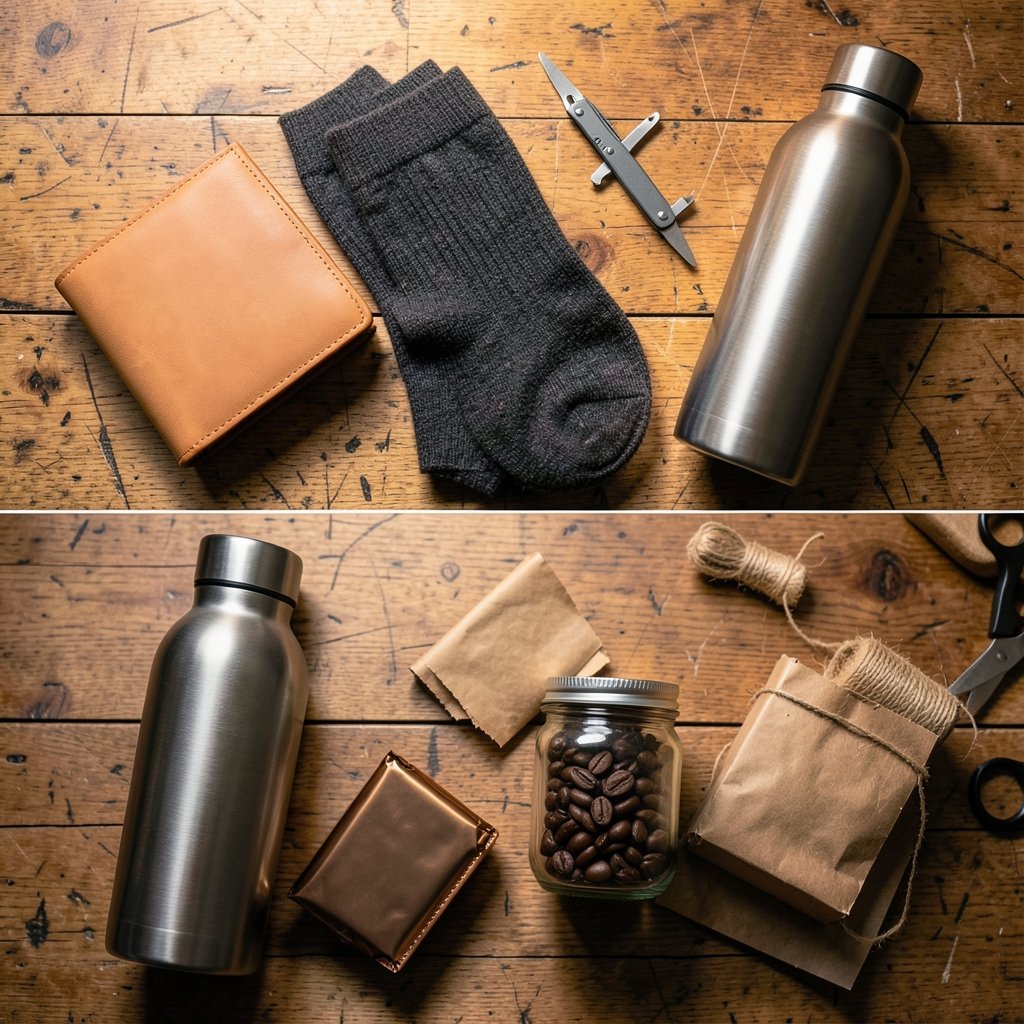
- A better version of a cheap item. A solid safety razor or a quality cartridge system, a proper leather wallet, a decent water bottle, a genuinely sharp kitchen knife if he cooks.
- Something he uses but has never chosen for himself. Bedside lamp, dopp kit, belt, umbrella, gloves. Men often own these by default rather than by decision.
- Replacement, not addition. If he has three hoodies, a fourth is not a gift. If he has one falling apart, a good one is.
The practical tip here is to check the current item before buying. Photograph the label, note the size, check whether the worn-out thing is actually a favourite he wants replicated. A surprising number of gifts fail because the giver bought the “better” version of something the recipient specifically liked the cheap version of.
If you want a framework for buying clothes he will actually keep, the thinking behind old money outfits men building look that lasts applies well to gifting: fewer, better, and chosen to fit the life he actually lives rather than an imagined one.
Gifts for the man who says he wants nothing
This is the hardest category, and the answer is almost never to take him at his word. “Nothing” usually means “I have not thought about it” or “I do not want you to spend money.”
The workaround is to move away from objects. Consumables and experiences solve the problem because they do not need storage space and they do not require him to pretend enthusiasm for a thing.
Consumable options that tend to land:
- Coffee beans from a roaster he would not find himself, or a tea he cannot buy locally.
- Good olive oil, hot sauce, or a spice set, if he cooks.
- A bottle from a category he likes but rarely buys at that level.
- A workshop, course, or ticket to something he has mentioned in passing.
Experiential and consumable gifts are a documented trend, with hospitality and experience-voucher sectors reporting Christmas as a peak trading period. The advantage is real: an afternoon doing something beats an object that sits in a cupboard. The disadvantage is also real, because an experience requires scheduling, and a voucher with a short expiry date is just a deadline in an envelope. Check the validity period before you buy.
Hobby gifts: the highest-reward, highest-risk option
Buying into a man’s hobby can produce the best reaction of the morning, or the most polite one. The difference is research.
The rule is simple: buy consumables or accessories within the hobby, not equipment that requires expertise. A cyclist will have strong opinions about tyres. He will not have strong opinions about a good pair of cycling socks or a proper chain-cleaning kit. A home cook will not want you choosing his knives, but he will use a heavy-duty apron or a decent instant-read thermometer every week.
| Hobby | Safe gift | Risky gift |
|---|---|---|
| Cycling | Socks, gloves, cleaning kit, snack subscription | Tyres, saddle, groupset parts |
| Cooking | Thermometer, apron, good oil, knife sharpening | Chef’s knife, pans |
| Gaming | Store credit, controller grip, headset stand | Games, peripherals |
| DIY | Quality bits, head torch, organiser | Power tools |
| Music | Strings, cables, picks, stands | Instruments, pedals |
The pattern is that the safe column consists of things that get used up or wear out, and the risky column consists of things that require a preference. When in doubt, buy the thing he will need to replace anyway.
Tech and electrical gifts: check the boring details first
Electronics are the most-requested and most-returned gift category. Three checks prevent most problems.
First, compatibility. Check the connector, the voltage, the model number, and whether it works with what he already owns. A gift that needs an adapter he does not have is a gift that sits in a drawer.
Second, safety markings. Electrical gifts sold in the UK should carry UKCA or CE marking, and the rules around this have been extended repeatedly, so it is worth checking the current government guidance rather than relying on what you read last year. Cheap unbranded imports from marketplace sellers are the usual source of problems.
Third, battery safety. Small button batteries in gadgets, torches, keyrings, and toys are a serious ingestion hazard for children, and safety guidance recommends secured compartments and caution with unbranded imports. If there are young children in the house, this matters more than any feature.
Personalised and practical: the reliable middle ground
Personalisation has a bad reputation because it is often done badly, with a name printed in a font that will look dated in two years. Done well, it turns a generic object into something he will keep.
The rule is to personalise the object, not decorate it. A leather wash bag with initials embossed small and discreet is a different proposition from a mug with a joke on it. Good candidates are items with a long lifespan: wallets, belts, luggage tags, notebooks, tools, hip flasks, and chopping boards.
Practical gifts deserve a defence too. They are frequently dismissed as boring, but the test is whether the item removes a small friction from his week. A good desk lamp, a cable organiser, a proper laundry bin, a decent pillow. These are unglamorous and they get used every single day, which is more than can be said for most novelty gifts.
Second-hand and made-to-last gifting
Resale has grown substantially at Christmas, with platforms and charities reporting rising second-hand gifting. The appeal is obvious: limited editions, discontinued items, vintage tools, and out-of-print books are often only available used, and the price-to-quality ratio is better.
The practical considerations are different from buying new. Check the condition carefully, confirm the seller’s returns policy, and be aware that the 14-day right to cancel most online purchases under the Consumer Contracts Regulations 2013 applies to distance purchases from traders, not to private sales between individuals. If you are buying second-hand from a business, the standard protections apply.
For faulty goods, the Consumer Rights Act 2015 requires items to be as described, of satisfactory quality, and fit for purpose, and the remedy runs against the retailer. That holds regardless of who bought the gift, which is worth knowing if he opens something in December and finds it broken in January.
The practical checklist before you click buy
Most Christmas gift disasters are logistics, not taste. Run through this before checkout:
- Delivery cut-off. Postal and courier Christmas deadlines are published annually and typically fall in mid-December for standard services. Check the current year’s dates, not last year’s.
- Return window. Confirm the policy, especially for sale items and personalised goods, which are often excluded from cancellation rights.
- Sizing. If it is clothing, find the actual size from something he wears rather than guessing.
- Duplication. Check he does not already own it. This is the single most common mistake.
- Batteries and chargers. Confirm what is included and what is not.
- Assembly and setup. If it needs building, know that before Christmas morning.
What actually works, in practice
The gifts that land tend to share three qualities: they fit something he already does, they are better than what he would buy himself, and they do not create work for him. A voucher with a two-week expiry creates work. A gadget needing three uncommon batteries creates work. A pair of gloves that fit perfectly creates nothing but warmth.
The most common mistakes are buying for the imagined version of the man, buying novelty over function, ignoring the return window, and leaving delivery too late. The fix is unglamorous: watch what he uses, note what is worn out, and buy the better version of it. If you cannot think of anything, buy something consumable or an experience he has mentioned, and check the expiry date.
There is also a quieter point worth making. The best gifts for men are rarely the ones that generate the biggest reaction on the day. They are the ones still in use in March. That is the only test that really matters, and it is a much easier target to hit than surprise.
Conclusion
Buying for men at Christmas gets easier the moment you stop looking for a clever idea and start looking at his actual routine. The worn wallet, the dragging razor, the hobby he talks about, the coffee he drinks every morning. Upgrade one of those, choose something consumable if he claims to want nothing, and check the boring details like sizing, safety markings, and delivery dates before you order. A gift that gets used in February is worth ten that impress for five minutes in December.
FAQs
Is it better to buy one expensive gift or several cheaper ones?
It depends on what he needs. One well-chosen item that replaces something worn out usually beats a pile of small things, because it gets used and remembered. Several cheaper gifts work better when they are consumables or hobby accessories that will be used up. Avoid spreading a budget across many novelty items, which is how most unwanted gifts end up in a drawer.
How much should you spend on a Christmas gift for a man?
There is no official figure. Gift spending is not separately measured in official retail statistics, so any “average spend” number comes from commercial surveys with different methods and should be treated as indicative only. A more useful approach is to set a budget based on your relationship and stick to it, then spend it on one thing he will genuinely use rather than several things that fill space.
What should you buy for a man who already has everything?
Move from objects to consumables and experiences. Good coffee, a bottle from a category he likes, a cooking class, tickets to something he has mentioned. These take up no storage and do not duplicate what he owns. If you want something physical, upgrade a small everyday item he has never bothered to replace, such as a wallet, belt, or wash bag.
Are experience vouchers a good Christmas gift?
They can be, provided you check the details. Confirm the validity period, whether dates are restricted, whether it can be exchanged, and whether it covers the full cost of the activity. A voucher with a short expiry or heavy restrictions becomes a chore rather than a gift. Pairing it with a specific date you have already checked is the safest option.
What are the rules if a Christmas gift turns out to be faulty?
Under the Consumer Rights Act 2015, goods must be as described, of satisfactory quality, and fit for purpose, and the remedy runs against the retailer. This applies regardless of who bought the gift, so the recipient can usually deal with the shop directly. Keep the receipt or order confirmation, as proof of purchase will be requested.
Can you return a Christmas gift bought online?
Usually yes. The Consumer Contracts Regulations 2013 give a 14-day right to cancel most distance purchases, starting from the day the goods are received. There are exceptions, including personalised items and sealed goods that have been opened. Check the retailer’s policy before buying, and note that private second-hand sales between individuals are not covered in the same way.